Developing a successful newsletter marketing strategy: Tips for long-term success
Careful planning is one of the most important prerequisites for successful email marketing. After all, a smart email marketing strategy is essential if you want to get the very best from your newsletter sends. There is plenty to consider, from choosing a newsletter tool to analyzing the campaign afterwards. Our comprehensive step-by-step guide shows you how to develop your own newsletter strategy.
Step 1: Choose the right newsletter tool
Start without a plan? Absolutely not. To make sure the work you put into creating and sending your newsletter pays off, you should develop a sound strategy in advance. When you create a comprehensive plan for your email sends, you can make full use of your potential and create compelling newsletter campaigns.
The first important foundation for successful email marketing is an email marketing tool that meets your exact needs and supports you in planning and implementing your strategy. A suitable newsletter tool offers you the following benefits:
- 💰 Low costs and little time required: With just a few clicks, you can contact customers or promote your products and services without a large financial outlay.
- 🏆 Measurable success: Automatically generated metrics show you how successful your newsletter was and help you identify potential improvements.
- 🏁 Deliverability: Professional newsletter tools have a strong sending reputation, so delivery rates are excellent. Additional spam tests, available from some providers, make it highly unlikely that your campaigns will still end up in recipients’ spam folders. These tests let you put newsletter deliverability through its paces before sending.
- ⏱️ Stress-free send planning: You can use newsletter software to schedule your campaigns in advance and have them sent automatically at your chosen time.
- 🔒 GDPR compliance: An automatically GDPR-compliant email marketing tool gives you peace of mind and helps keep you out of legal trouble.
- 🎨 Intuitive features make it easier to create attractive newsletters tailored to your target group because you do not have to be a newsletter professional to create professional newsletters. With the right software, you can create excellent newsletters without any prior knowledge or specialist expertise. Email marketing features that help you implement your email marketing strategy with rapidmail include a practical drag-and-drop editor, attractive design templates, segmentation and personalization options, A/B tests and a personal support team that offers senders free help and advice.
💡 rapidtip
Which email marketing tool is right for you depends on many factors and your individual needs. Our newsletter tool comparison helps you find the right software for sending your newsletters.
Step 2: Set your newsletter marketing goals
Before you get started, take a look at your current situation:
- Where are you now? Which inbound marketing activities are you already carrying out?
- What goals do you want to achieve through newsletter marketing?
- How can a well-thought-out email marketing plan help you achieve your business goals?
It makes sense not only to define general goals, but also to attach specific figures to them:
| General email marketing goals | Examples of specific goals |
|---|---|
| Win customers | Win 100 new customers per month |
| Increase revenue | Increase revenue by 5% |
| Strengthen customer loyalty | Reduce the newsletter unsubscribe rate by 1% |
| Increase sales | Increase the conversion rate by 2% |
| Share information | Achieve a newsletter open rate of 25% |
| Generate website traffic | Achieve a newsletter click rate of 3% |
These detailed goals do more than show you the direction you want to take with your email strategy. They also indicate which actions are now needed to achieve them. Do you want to reduce your newsletter unsubscribe rate, for example? Then reconsider your sending frequency and focus on varied, engaging content and an appealing newsletter design.
Defining specific goals also provides the perfect foundation for subsequently evaluating your newsletter campaign. You can then easily compare the target values with the results achieved.
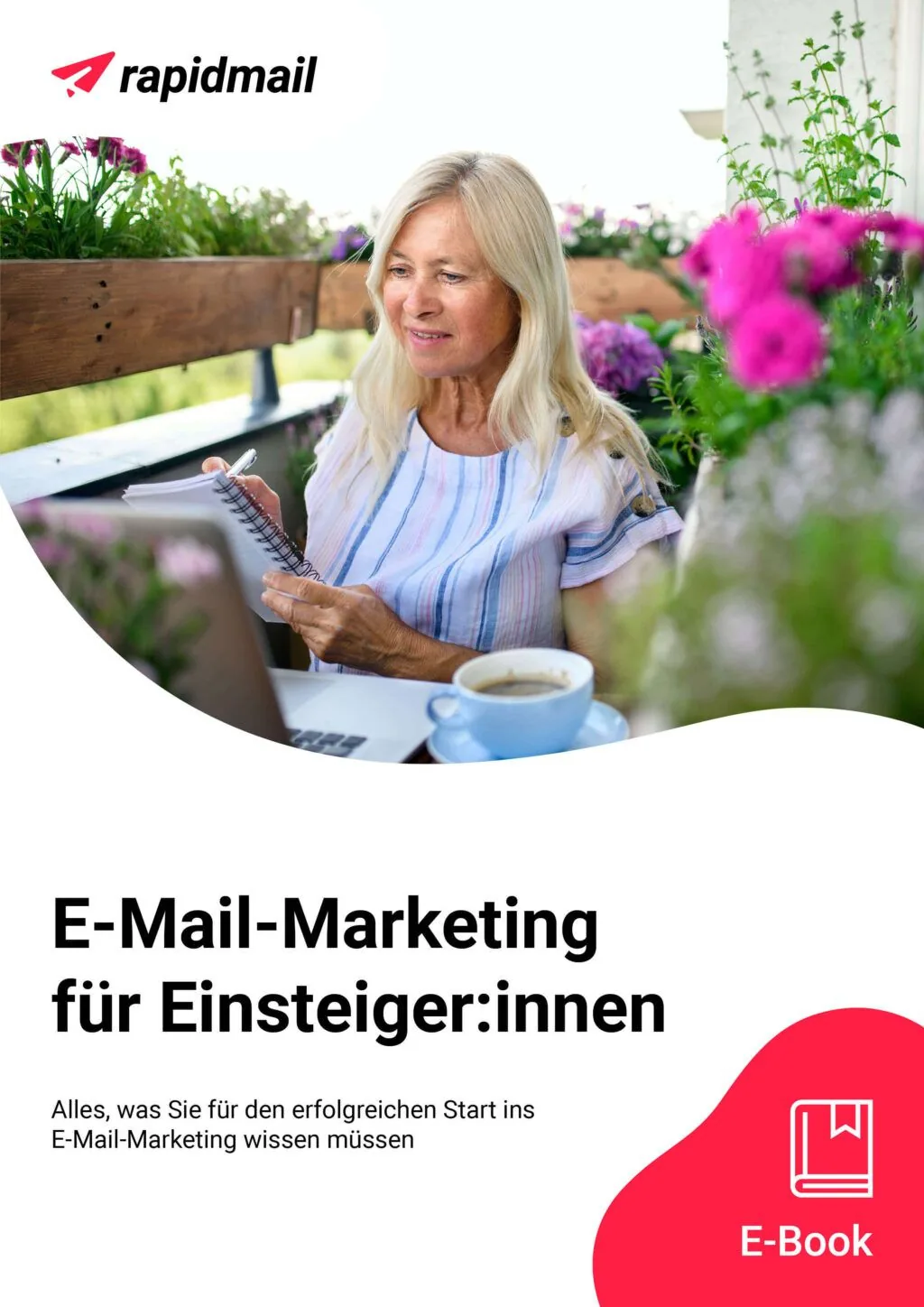
Are you still new to newsletters? No problem! Our free ebook “Email marketing for beginners” explains everything you need to know about newsletters when you are starting out.
In the ebook, you will learn more about topics including:
- Essential definitions: What exactly is email marketing?
- The benefits of marketing emails
- The most important information about newsletter marketing for different types and sizes of business
- Different types of marketing emails
- How to choose the right email marketing software
Download the free ebook on email marketing for beginners (PDF in German)
Step 3: Define your target group
Next, it is time to define your target group. To send relevant campaigns later and move closer to your newsletter marketing goals, you need to know who you are dealing with. Ask yourself: What does your company stand for and which customers is your offering relevant to? Who do you want to reach through your email marketing? Which characteristics, interests, circumstances, economic traits and needs define your target group?
💡 rapidtip: Develop personas
Personas are part of an effective online marketing strategy. They are fictional users from your target group who, like real people, have specific characteristics, needs and expectations. When you picture specific representatives of your target group instead of a large group of anonymous people, you can put yourself in their shoes much more easily. This helps make your newsletter marketing particularly user-friendly and focused on your target group.
One crucial characteristic of successful newsletters is that the campaign’s content appeals to its recipients. If users find the newsletter uninteresting, however, it could quickly land in the trash or, worse still, in the spam folder, completely missing its purpose. In short, a strong target-group focus is essential for successful email marketing.
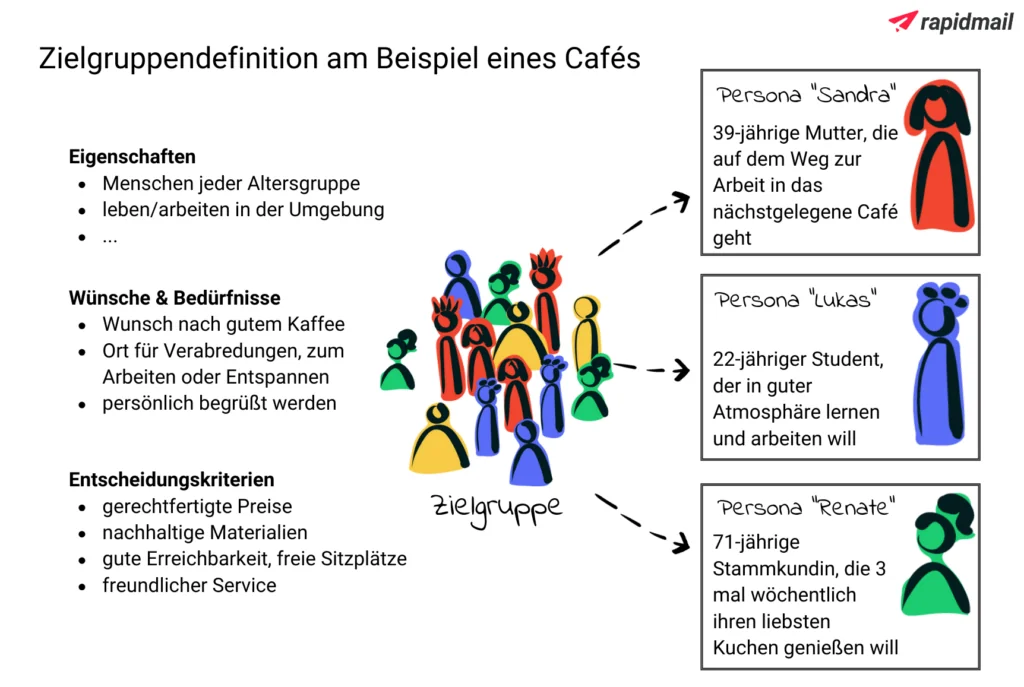
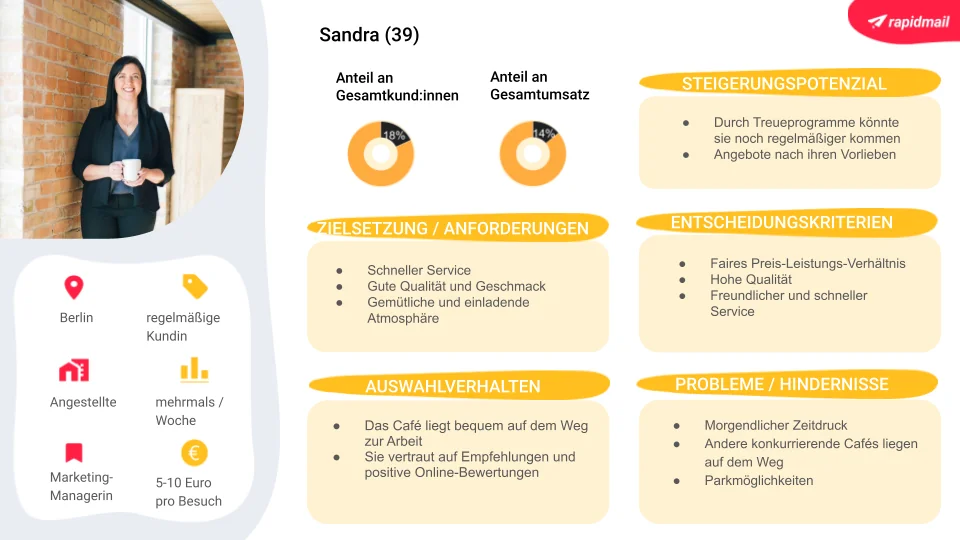
Once you have considered some basic points about your ideal customers, you can tailor your entire newsletter plan and strategy to their needs and expectations. Returning to our example, you should now consider how best to reach and engage the personas Sandra, Lukas and Renate with a newsletter campaign.
Step 4: Manage your recipient list
Next, please! After choosing the right newsletter tool, planning your marketing goals and defining your target group, you can now turn your attention to your contacts. The next step toward a smart newsletter marketing strategy is a well-managed recipient list:
- 1️⃣ Create recipient lists: First, of course, you need a list of contacts to whom you can send your newsletter. With rapidmail, you can create multiple recipient lists, import existing recipient lists or customer contacts and select one or more of these lists when sending your newsletter. Be sure to remember that the handling of recipients’ personal data is closely regulated by law. Always obtain your contacts’ express consent to receive your newsletters, ideally through the double opt-in process, and never buy email addresses.
👀 Have you seen this? How to build your email list
Would you like to learn more about building a recipient list for your email marketing? In the following video, our Content Manager Wiebke explains how to do it step by step:
Open video transcript
Chapter 1: Introduction
Especially when you are just starting with email marketing, you may wonder how you can quickly build a large email list. But even if you have been sending newsletters for some time, you will certainly want to keep growing your email list. Today, I will show you how to do this easily and, above all, legally.
You have made the smart decision to get started with email marketing. Buuuut wait, stop: Where will you get subscribers from in the first place?
Hi, I am Wiebke, and I will show you how to build an email list full of contacts who are keen to receive your newsletters.
Chapter 2: The key principles for building your list
Please do not buy email lists! Sending to purchased addresses is not only illegal, but in most cases it also makes no sense. The contacts are unlikely to have much interest in your offers.
Instead, build your own email list of contacts who have a genuine, voluntary interest in your messages. The best thing is that your email list belongs to you. You can communicate directly with your subscribers and are not dependent on platforms and their algorithms, as you are on social media.
But what do you need to build your own email list step by step?
Chapter 3: What you need to build an email list
A reliable email marketing tool is an essential building block for successfully creating an email list. It allows you to collect and manage contacts as well as design and send emails. You can use the software to create sign-up forms and embed them on your website. There are numerous tools on the market, including rapidmail. If you would like to consider other providers, our newsletter tool comparison can help you find the right solution. When choosing a tool, consider which features matter to you, whether you need complex functionality, value free support or depend on software that is 100% GDPR-compliant.
Another important consideration is where to place the sign-up form. It should be embedded at strategically useful points on your website. You can choose whether the form appears as an eye-catching pop-up or is positioned more discreetly in the footer. Take care not to overwhelm your visitors with too many pop-ups. rapidmail makes it particularly easy to design an attractive sign-up form. All you have to do is enter your URL, and rapidmail automatically creates a customized form featuring your logo and company colors. You can, of course, customize the form and then embed it on your website. As soon as interested visitors find the form, enter their email address and confirm the double opt-in process, they are automatically added to your email list.
Offer incentives to encourage more people to sign up. Visitors will not simply leave you their email address without compelling benefits. Attractive offers such as discounts, free delivery, contests or exclusive content, for example ebooks or checklists, significantly increase the likelihood of a sign-up.
These basic steps give you the foundation for building your email list. But there are a few more tips to help you get the most out of your sign-up process.
Chapter 4: Tips for the ideal sign-up process
A successful sign-up process ensures that interested people receive precisely the content relevant to them. You can offer different newsletter topics by allowing people to use keywords to select the content they want to subscribe to. A travel agency, for example, could offer categories such as weekend breaks, cruises or round trips. Contacts can then decide which travel offers they want to receive by email, while you can use the relevant keywords to target your sends.
To encourage as many people as possible to sign up, make the process as simple as possible. Too many mandatory fields can be off-putting. As a rule, asking for an email address is enough. You can optionally add fields for first and last name so that you can address your contacts personally later.
A compelling call to action can make signing up even more appealing. Instead of a dull “Sign up” button, a creatively worded prompt such as “Sign up now and save 10%!” is much more effective.
Legal compliance also plays a major role. Use the double opt-in process to ensure that the sign-up is voluntary and your contacts have confirmed their consent. Entry to a contest must not depend on signing up for the newsletter, and contacts must be able to unsubscribe at any time.
To welcome new contacts right from the start, send a welcome email immediately after they sign up. First impressions count, and a friendly greeting can instantly strengthen their connection with your company.
You should also use other channels to promote your newsletter. Social media, advertisements or QR codes can help you win new subscribers. You can collect contacts offline too, for example through sign-ups by text message or printed QR codes.
Chapter 5: Tips for a low unsubscribe rate
To prevent your email list from immediately shrinking again, choose the right sending frequency. There is no universal rule for the ideal frequency because it depends on your industry, your company and your target group. One rule of thumb, however, is to send emails only when you have valuable content to offer. If you are unsure, you can ask subscribers about their preferred frequency directly in the sign-up form.
Segmenting your recipient list is another important point. Not all subscribers have the same interests. Use personas and segments to provide tailored content. Customers in Hamburg, for example, might receive different offers from recipients over the age of 50.
Variety is also crucial. Nobody wants to read the same content repeatedly. Vary your topics and surprise your subscribers with new formats to keep your open rate high.
If your subscribers also follow you on social media, take care not to share the same content everywhere. The newsletter should offer clear added value, for example through exclusive discounts or content available only to subscribers.
An appealing design is another essential factor. Use high-quality images, a harmonious color scheme and a clear structure with plenty of white space to delight your readers visually.
Finally, do not send too much advertising. If readers feel they are constantly being pressured to buy, it could be counterproductive. Instead, focus on providing valuable information and helpful tips, with promotional content only occasionally included.
Chapter 6: Conclusion: How to build your email list
If you follow these principles, your email list will grow step by step. But remember: Rome was not built in a day. Give the process time and appreciate every genuinely interested contact.
I hope you enjoy building your email list and wish you every success! If you have any questions or comments, I look forward to your feedback in the comments.
Thanks for watching, and see you next time!
- 2️⃣ Segment the recipient list: To send targeted content based on people’s interests, it is worth creating different segments, for example according to your subscribers’ location, industry, gender, age or area of interest. You can easily request this information, which is important for newsletter marketing, in the sign-up form. This reduces the likelihood of sending marketing newsletters to people for whom your message is irrelevant. Segmenting the recipient list also pays off in our café example. If the café has several locations, for example, the town/ZIP code segment can be used to contact precisely those recipients for whom a particular offer is relevant. Especially useful is the keyword feature, which lets you record customers’ favorite drink, for example, and send them personalized offers by newsletter.
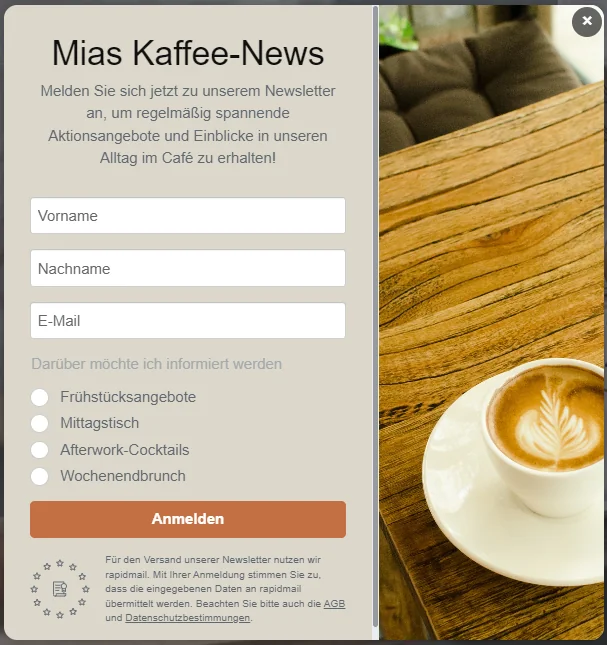
- 3️⃣ Win new newsletter subscribers: Recipient list created and segmented, so you are finished? Yes, to begin with. In the long term, however, we recommend continually expanding your recipient lists. After all, some contacts will unsubscribe from your newsletter. Because a larger recipient list lets you reach more potential buyers, your newsletter strategy should also consider how to build your newsletter list. In addition to appealing sign-up forms, you can create further incentives to attract as many interested readers as possible. How about clever pop-ups, call-to-action buttons or QR codes that lead to the newsletter sign-up? Contests, discount codes and free downloads are also popular ways to win new newsletter subscribers.
💡rapidtip: Take our newsletter crash course

Would you like to learn even more about newsletters, preferably in short weekly lessons? Then our newsletter crash course is exactly what you need! You will hear from us twice a week and learn everything beginners need to know about newsletters in a total of 10 lessons.
And the best part: The course is completely free for you! So what are you waiting for?
Sign up for the newsletter crash course now
Your data protection is important to us. By entering and submitting your details, you agree that we may contact you personally by newsletter, in which we regularly share important information and news from the world of newsletter marketing. You can unsubscribe from the newsletter at any time. We do not pass your data on to third parties. You can find more information in our privacy policy.
Step 5: Plan and prepare relevant content
Now it is time to get down to the details: creating appealing content and visuals for your newsletter. Remember three important questions:
- What expectations does my target group have of the newsletter?
- What goal do I want to achieve by sending the newsletter?
- What action do I want recipients to take as a result of the newsletter campaign?
The answers to these questions provide important guidance on the content relevant to your newsletter. It is also a good idea to collect valuable feedback from your readers with newsletter surveys. Strategically effective and popular newsletter content includes:
- 📢 Presenting what’s new: Introducing new products, features, collections, …
- 🌱 Offering added value: Useful information about how to use a product, tips in the form of guides, video tutorials, …
- 🫂 Strengthening customer loyalty: Invitations to exciting events and webinars
- 📰 Keeping readers up to date: News from day-to-day office life and the team, important internal updates
- 💸 Creating incentives to buy: Attractive offers and bargains, discounts, loyalty gifts, free delivery, …
💡 rapidtip: Give your newsletter a name
Baker’s Best, Letters from a Trendsetter or The Daily Press: An original name gives your newsletter a distinctive identity and ensures that recipients remember it. Giving it its own recurring name creates distinctive branding and helps you implement your email marketing strategy effectively.
The newsletter design should also suit the topic and the overall concept. This makes the newsletter feel coherent and much more appealing. Fortunately, the rapidmail 1-click design automatically creates professional newsletter templates in your own corporate design, without any headaches, a design team or high costs. As an alternative to our 1-click design, you can choose one of our many attractive pre-designed newsletter templates and get started right away.
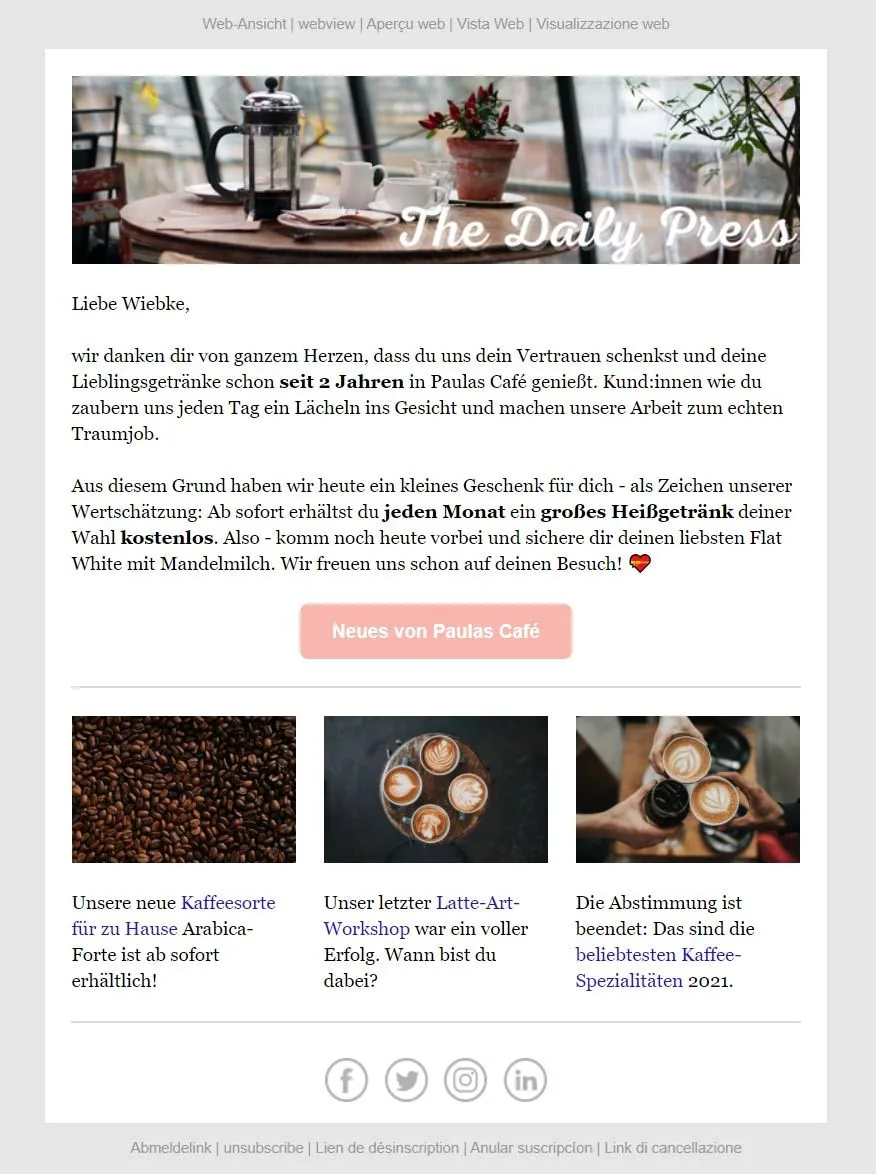
Personalization is just as important as an attractive design. Personalized newsletters build a trusting customer relationship and can be tailored much more closely to your readers’ interests. Another benefit is higher open rates because customers are more likely to read a campaign when their name appears in the newsletter subject line. And when customers feel personally addressed, they are also more likely to buy something, resulting in higher transaction rates for you. This brings you closer to your newsletter marketing goals.
The rapidmail newsletter
Tips, ideas and news about email marketing, straight to your inbox.
Step 6: Set suitable send times
Your goal, target group, recipient list, content and design are all in place. Now it is time to plan the send. Here too, begin by thinking about your recipients and asking when, how and where you can best reach them.
- ⏰ Send time: Where should your subscribers be when they receive your campaigns? Should they be at work, at home, on their way to the office or enjoying their free time? If your newsletter reaches recipients’ inboxes at the wrong time, it may be overlooked and left unopened. However, the ideal time and perfect day of the week to send your newsletter depend heavily on the particular target group and how work, family, living situation, purchasing power and other factors shape their daily routine. Your website visit times also provide a useful guide because they can show you when your subscribers are more active and likely to open your newsletter. For the café newsletter, for example, the times before and after work and typical break times would be ideal for sending.
- 🔁 Sending frequency: How often do you want to send your newsletter? Finding the balance between sending newsletters too often and not often enough is not easy and varies somewhat from industry to industry. To be on the safe side, you can ask customers about their preferred newsletter frequency directly in the sign-up form.
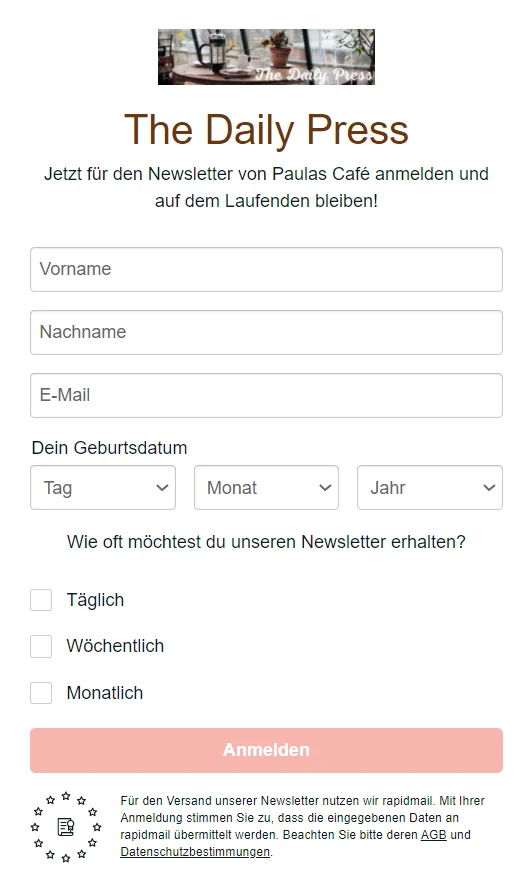
Once you have finished your newsletter, you can use the scheduling feature in the rapidmail Newsletter Editor to specify the day and time at which it should be sent. It then happens automatically, without you having to log in to your account.
💡 rapidtip: Support for a smart newsletter marketing strategy
Explore our service partners, who can help you achieve your goals through a well-thought-out marketing strategy. You are also sure to find some smart tips in our customers’ strategies.
Although a newsletter does not always need a specific occasion, some opportunities are particularly well suited to contacting your contacts. There is no shortage of seasonal occasions, and you can incorporate them skillfully into your newsletter depending on your industry. Still looking for an inspired idea beyond Christmas, the summer vacation and Halloween? Our newsletter send plan has plenty of creative ideas and occasions for you.
Recipient-related occasions are also an important part of a successful newsletter campaign. To give new recipients a warm welcome, prepare a welcome email because first impressions count in email marketing too. A birthday email with a small gift is also sure to be well received by people on your recipient list celebrating their birthday. In this way, your newsletter strategy strengthens customer loyalty and brings you closer to your marketing goals.
💡 rapidtip: Send test emails
Always allow enough time in your newsletter marketing strategy for a test send. This lets you check every feature and aspect of your newsletter at your leisure, ideally with a few colleagues, and make sure that every step of your strategy has been implemented effectively.
Step 7: Evaluate the success of your newsletter marketing strategy
Once one newsletter has been sent, it is time to prepare for the next. As we all know, practice makes perfect, so there will certainly still be room for improvement after your first campaigns. By regularly analyzing your newsletter performance, you can see whether your topics and content are genuinely relevant to your target group and are therefore bringing you closer to your goals. To achieve your email marketing goals step by step, keep asking yourself: How can I improve my marketing newsletters and continue developing my strategy?
The best part is that the essential newsletter metrics, or KPIs (key performance indicators), reveal what you can do even better on your next send:
- Delivery rate: This shows the percentage of subscribers whose inboxes the email actually reached. You can take some simple steps to optimize your newsletter deliverability.
- Bounce rate: The counterpart to the delivery rate, this indicates the proportion of undeliverable emails out of the total number of newsletters sent. To keep the number of bounces as low as possible, make sure, among other things, that you keep your recipient list clean.
- Open rate: Your newsletter’s open rate tells you how many recipients opened your newsletter after it was successfully delivered.
👀 Did you know?
There are numerous ways to increase your newsletter open rate. Trustworthy sender names, compelling subject lines that capture recipients’ interest, varied content, personalization and the right send times all have a particularly positive effect on newsletter open rates.
- Click rate: This tells you how many recipients clicked at least one of the links or call-to-action buttons you included in your newsletter. If a link did not receive any clicks at all, this may indicate, for example, that your subscribers were not interested in the linked topic.
- Conversion rate: The conversion rate measures the percentage of recipients who completed the desired action, such as registering, making a purchase or downloading something, out of the total number of recipients who clicked in the newsletter. You can track newsletter conversions with Google Analytics 4, for example.
- Unsubscribe rate: Time to say goodbye. The unsubscribe rate indicates the number of newsletter unsubscribes as a proportion of all delivered campaigns. Unsubscribes can also highlight important optimization steps to reduce the newsletter unsubscribe rate.
Not so difficult, is it? You now know how to develop your own effective newsletter strategy, what you need to consider and how to get the best from your newsletter sends. So what are you waiting for? Ready, set, newsletter!