10 ways to find relevant newsletter content

Delight your contacts with interesting newsletter content! That is the advice senders receive on most email marketing websites. It sounds sensible, but it is not necessarily helpful. After all, what counts as interesting content for your newsletter? What content, products and events are your subscribers actually interested in? We show you 10 approaches and tips that will help you discover which newsletter content wins over your readers!
1. Ask about interests during newsletter sign-up
The newsletter sign-up form is the first point of contact with your new subscribers. Use this opportunity to learn more about your future recipients than just their email address.
For example, if you are a tour operator with a regular newsletter featuring current travel offers, knowing your subscribers’ ages would help you tailor the newsletter content more effectively. Subscribers under 30 are probably more interested in party trips and backpacking trips than recipients aged 60 and over, while offers for guided coach tours and cruises are likely to appeal more to older target groups and encourage bookings, although there are always exceptions to the rule ;-).
In this case, it would make sense to ask subscribers for their age in the newsletter sign-up form on your website. However, for data protection reasons, providing a date of birth, like all other fields except the email address, must not be mandatory. You can then tailor your travel offers to the age of your contacts and send each target group newsletters with the appropriate offers.
In addition to optional extra fields in the sign-up form, you can also let prospective subscribers choose from different newsletter topics, areas of interest or preferred product groups when they sign up. Your recipients benefit because they only receive newsletters that genuinely interest them, and you benefit as the newsletter sender too: you know which content will appeal to which contacts!
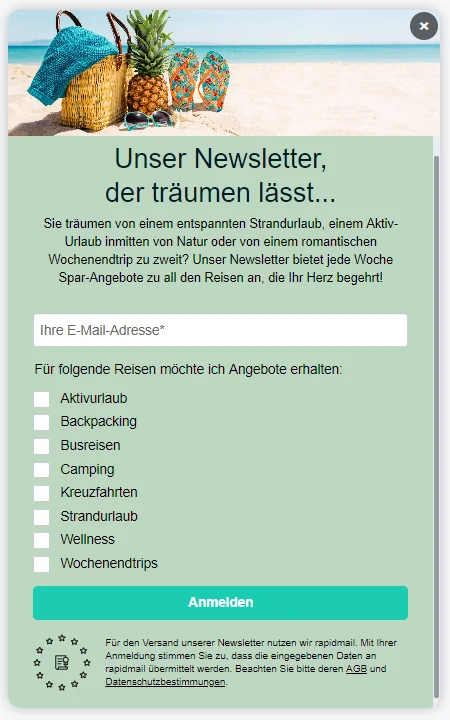
Once website visitors have signed up for the newsletter and specified certain areas of interest, they are automatically added to the recipient list. Their selected topic preferences are included too and assigned to every new contact in the form of keywords, or “tags”. You can then adapt your newsletter content to the different keyword groups and use each newsletter to reach the subscribers who are interested in it!
Everyone changes their mind sometimes, including some of your readers. That is why subscribers can adjust the topic preferences saved in their own recipient profile at any time. If a contact said during sign-up that they were mainly interested in the shoes category of your online shop, for example, they can simply open their recipient profile and add “swimwear” as an interest when they start looking for a new beach outfit. The changes are automatically applied to the recipient list.
This means that when you send your next newsletter featuring swimwear offers to the corresponding keyword group, this contact will receive it too, without you needing to change anything yourself! This ensures your newsletters always feature exactly the products and topics that interest your subscribers most at that moment!
2. Test different newsletter content and analyze newsletter clicks
Regularly analyzing your newsletters is essential for continuously optimizing your email marketing. By analyzing your subscribers’ click behavior, you can determine which newsletter content performs particularly well and which content receives hardly any clicks.
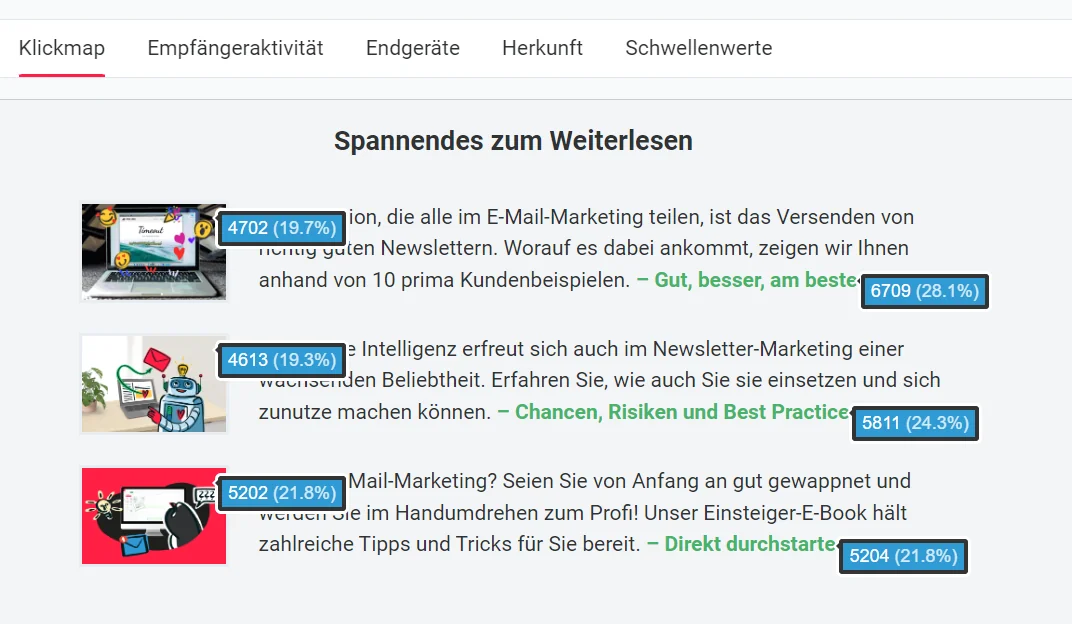
When you send newsletters with rapidmail, a click map is automatically generated for every campaign. It gives you an overview of how many recipients clicked each of the links included, whether they are text links, call-to-action buttons or linked images.
💡 rapidtip
Review click maps for the same recipient group over an extended period. This is the best way to compare whether certain content generated an unusually high number of clicks and whether some content is completely irrelevant to your target audience. You can then draw important conclusions from your analysis for future newsletters and select the content your subscribers respond to best.
The rapidmail newsletter
Tips, ideas and news about email marketing, straight to your inbox.
3. Send a survey newsletter
Offering a selection of different newsletter content in your newsletter sign-up form already allows you to identify the most important differences between your contacts’ interests. However, there is very limited scope at this point to obtain additional, more precise information about your subscribers. After all, prospective subscribers would hardly feel motivated to sign up if they first had to answer several multiple-choice questions in the form.
Asking “What content would you like to receive newsletters about?” is already enormously helpful to you as a sender. But other important questions, such as “What is your current job role?” for a recruitment portal’s newsletter or “How often do you buy new clothes?” for an online fashion retailer’s newsletter, remain unanswered after sign-up.
Testing different content and then analyzing click behavior takes you a little closer to the answer. Even so, bear in mind that recipients only have a limited selection of newsletter content to choose from. As the sender, you have already made a preliminary selection, so you cannot know whether your recipients might have preferred other content. Unfortunately, click analysis cannot answer questions such as “Is this newsletter interesting to you?” or “Which topics would you like to learn more about?” either.
The solution? Send a survey newsletter containing all the questions you have always wanted to ask your subscribers, then use their answers to identify relevant newsletter content, for example:
- What content would you like to see in our newsletter?
- Which features of our product are you still having problems with?
- How satisfied are you with the newsletter so far?
- Which other topics in the industry interest you?
- What is the first question that comes to mind about our product?
The more you learn about your subscribers, the more precisely you can tailor your newsletter content to their interests, preferences and habits.
Make sure the introduction to your survey newsletter excites and engages your readers, rather than presenting the survey in a dry, impersonal way. An incentive can also motivate more subscribers to take part. For example, enter all participants into a prize draw for a voucher for your online shop or a brunch at your café.
You should also ask short, easy-to-understand questions. Avoid double negatives, for example, where respondents first have to work out what the question actually means. We also recommend not asking too many questions in a survey. Otherwise, you risk your subscribers becoming impatient, abandoning the survey and leaving you empty-handed. ☔
How can you integrate a survey into a newsletter?
Unfortunately, it is not currently technically possible to embed a survey directly in the newsletter. However, you can easily create a survey with a survey tool and link to it from a call to action in your newsletter.
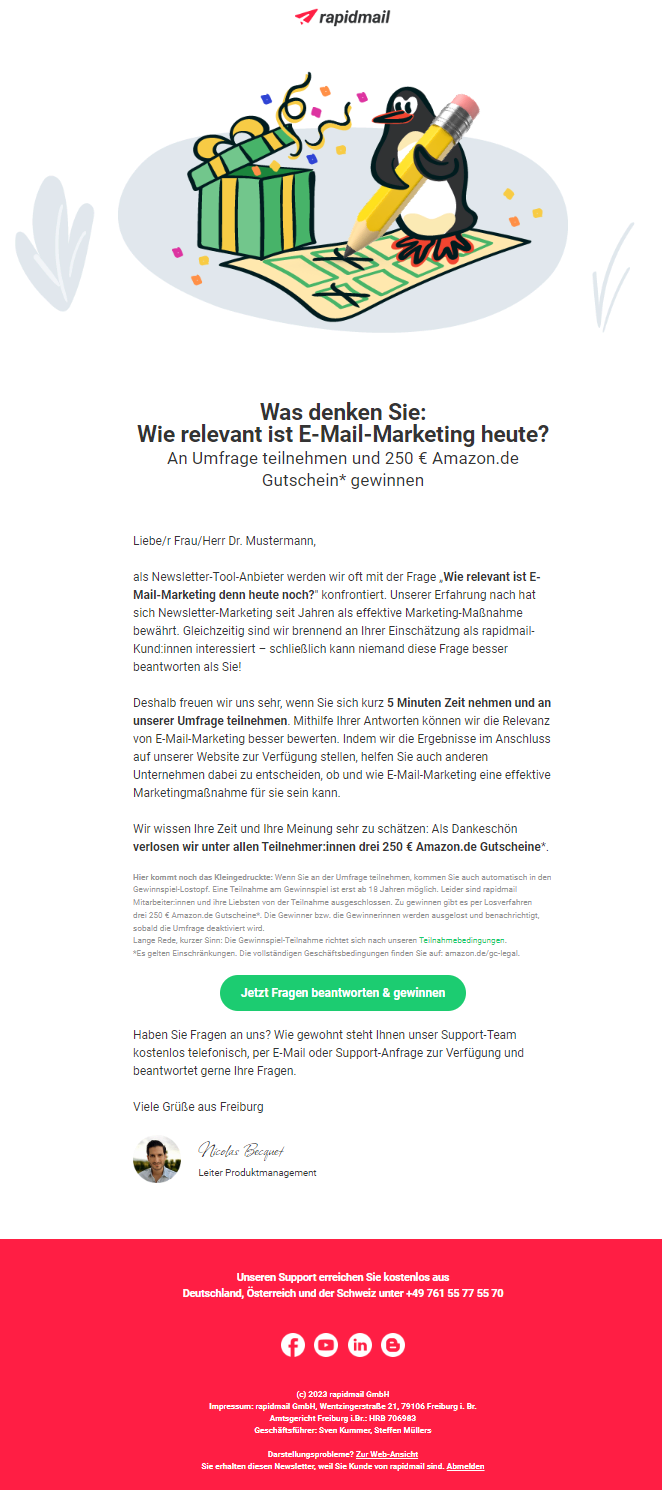
You can use the following tools to create surveys for your newsletter, for example:
- Survey Monkey
- Typeform
- Google Forms
- Crowdsignal
- Survmetrics
4. Ask your team: What might interest your customers?
Your customer support colleagues know your customers best. Ask them which questions come up most often or which product features cause your customers the most problems. You can also ask your support staff for a general assessment of which content might interest or help customers. You can then use this information to create relevant, interesting and useful newsletter content. Your subscribers will thank you!
These topics do not just interest existing customers, who probably receive the newsletter too. They also matter to regular newsletter subscribers who are currently only prospects or potential customers. Helpful newsletter content reinforces your expert status and builds a stronger relationship between your newsletter contacts and your company or brand, as well as your product or service offering. The right newsletter content can motivate your readers to make their first purchase or booking, or get in touch, helping them become actual customers rather than potential ones!
Customer support is not the only good source of interesting newsletter content. Other colleagues can also use their expertise to help you view your target audience from outside the marketing bubble.
5. Subscribe to other newsletters in your industry
When looking for relevant content for your newsletter, it always helps to consider current topics from across your industry. To stay up to date with the content that currently matters to your target audience, simply sign up for other newsletters in your industry and use them as inspiration.
For example, search online for:
- Newsletters from your competitors
- Newsletters from well-known blogs
- Newsletters from relevant forums
- International newsletters from your industry
6. Ask artificial intelligence for help
For several months now, terms such as artificial intelligence and ChatGPT have been on everyone’s lips. Newsletters have not escaped these rapid developments, tools and technologies either: AI in email marketing is actually an excellent way to find relevant newsletter content.
ChatGPT
Why not ask ChatGPT which newsletter content might interest your target audience? ChatGPT is available to everyone online free of charge.
👀 Did you know?
ChatGPT stands for Chatbot Generative Pretrained Transformer. Simply enter some text into the online tool and you can communicate with the chatbot in a human-like way. The chatbot learns from conversations and produces different results each time you enter a new prompt.
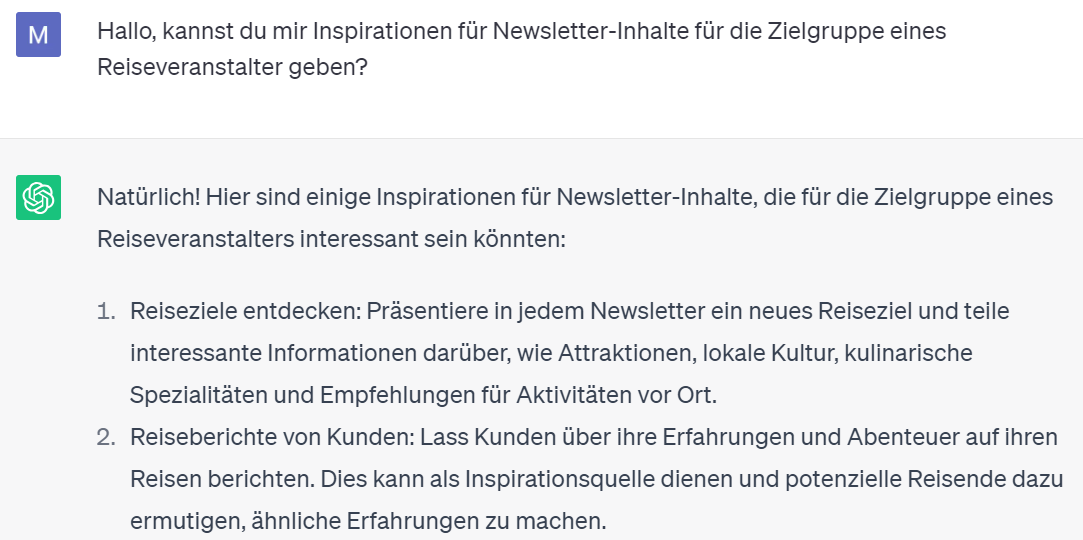
rapidmail’s AI sending planner
Have you discovered rapidmail’s AI sending planner yet? If not, now is the perfect time to try it. You will receive original, personalized newsletter ideas for the entire year, perfectly suited to your company, simply by describing your business in a few keywords. Let the magic begin! ✨
This is how rapidmail’s AI sending planner creates a schedule packed with creative campaign ideas for the whole year, ideally tailored to your company and products.
7. Analyze website visits and identify popular content
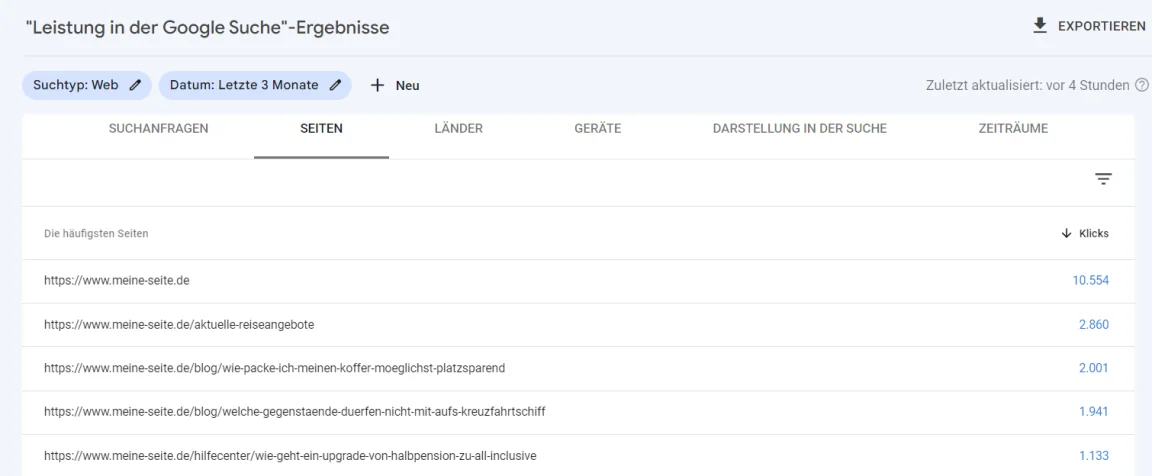
Which posts on your blog or pages on your website have been the most popular recently? Analytics tools such as Google Analytics for all page views or Google Search Console for page views from Google Search allow you to track visits to your website or blog and find out which content is currently attracting the most clicks. You can use this information to feature trending topics in your next newsletter.
8. Use Google to help find relevant newsletter content
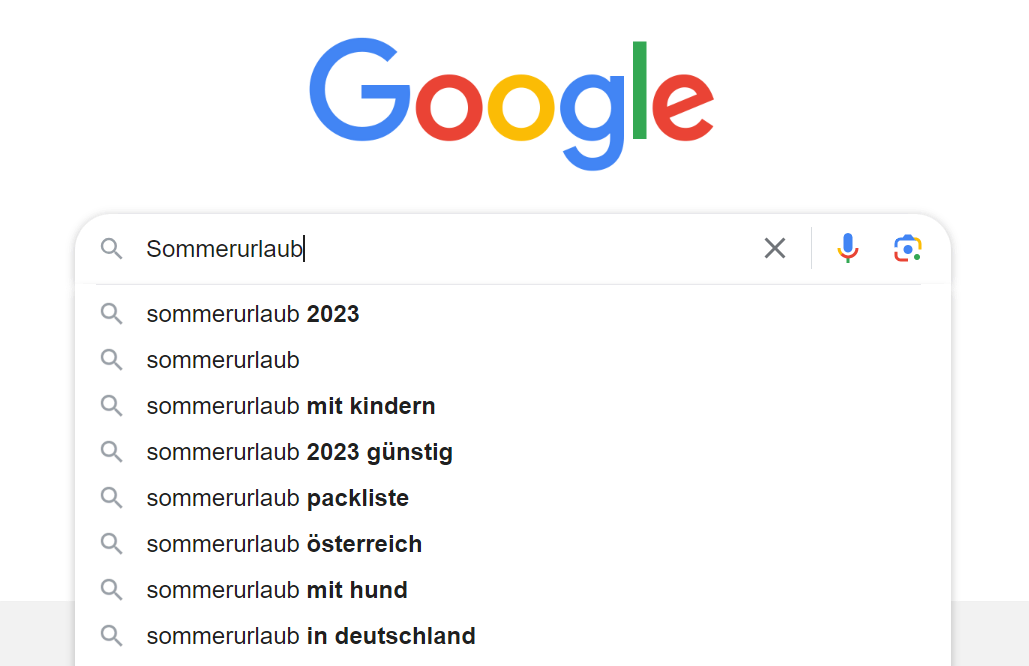
Google Suggest
Have you already made a good start and roughly defined the content for your target audience? Great! Now it is time to make the newsletter content for your contacts more specific. Enter the terms you identified using one of the previous tips into Google Search. Google Suggest is an autocomplete feature that offers further suggestions based on the keyword you enter. It not only helps users search for information, but also makes it easier for you to research suitable content for your newsletter audience that people are currently searching for frequently online.
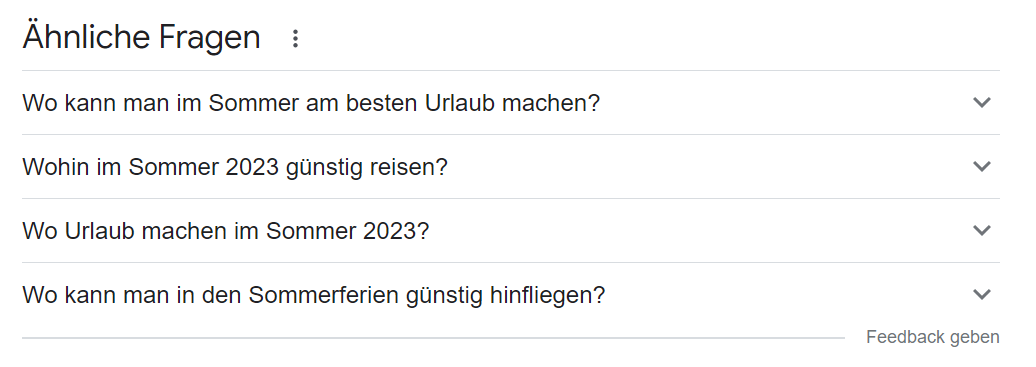
People also ask
The “People also ask” box is a Google feature that answers questions related to a user’s search query. In our case, it is also a great source of inspiration when looking for interesting newsletter ideas.
9. Bring in fresh perspectives from external experts and guest authors
Invite experts from your industry to contribute to your newsletter and share their perspective with your readers. They can discuss current trends, common misconceptions or their assessment of recent developments in the industry. Find suitable experts and arrange a telephone interview or exchange emails, then include their insights in your next newsletter.
Another option is to interview your customers. People who have recently been on a cruise know best what preparations are necessary for this kind of trip, what to pack and what can safely be left off the packing list. Share these tips from your customers in your next newsletter to make future travelers’ next trip easier.
Alongside guest authors and expert opinions for your newsletter content, you can also let members of your target audience have their say directly. You could even turn this into a small “contest”. Ask your readers to submit an article they have written themselves or photos featuring one of your products, then publish the best entry in your next newsletter. Encourage your customers to take part by offering product bundles as prizes.
10. What the online world is talking about: Find relevant newsletter content on social media
Do not overlook social media either. Search for mentions of your company and read the comments under your posts on social networks. What experiences have users had with your products or services? How do they rate your company? What problems might they have encountered? All of this gives you interesting pointers for the content of your next newsletter.
Above all, do not forget the number one rapidtip for your newsletter marketing: put yourself in your subscribers’ shoes and see things from their perspective. Where does your target audience spend time? What do they like? What do they dislike? Keep up to date with the discussions your potential readers are taking part in on social media and incorporate that content into your newsletter.
11. Conclusion: Ongoing research, analysis and segmentation for your newsletter content
Once these ten approaches have shown you which content your subscribers care about, it is still important to check the newsletter statistics after every send. This allows you to quickly identify, for example, when your judgment about a topic was wrong and the newsletter has a comparatively low click rate.
Over time, you will also find that your target audience contains several subgroups with different interests. By creating individual content for each interest group or persona and then sending segmented newsletters, you ensure your newsletter remains consistently interesting for every contact!
The effort involved in newsletters with engaging content is worthwhile. In the long term, well-considered newsletter content has a positive impact on open and click rates. You will also see fewer people unsubscribe from your newsletter. After all, people are far less likely to unsubscribe from newsletters whose content continues to impress them!
💡 rapidtip
Do you still need newsletter inspiration for the rest of the year? Our newsletter plan offers a wide selection of occasions and topics for your newsletter sends from January to December.