Email marketing with AI: opportunities, risks and best practices

The use of AI (artificial intelligence) is clearly no longer confined to the tech sector or futuristic companies. In email marketing today, AI offers countless useful applications for every industry. Whether you want to generate copy for a warm welcome email, create a subject line that suits your company or find newsletter topic ideas for your industry, we use specific examples and tools to show you how you can use AI for your emails. Alongside the many possible applications, we also highlight some risks you should keep in mind. Let’s get started! 🤖
1. Definition: what artificial intelligence (AI) means in email marketing
Artificial intelligence is certainly one of the most widely discussed topics of our time and is fundamentally changing the world of online marketing. But what exactly do we mean by “artificial intelligence” (AI for short) in email marketing? These terms describe a technology with a wide range of applications, concepts and ideas based on the desire to create a “machine” that possesses human cognitive abilities or can even surpass them.
Put simply, AI is an attempt to transfer human thinking skills such as learning, creativity and planning to a computer, thereby giving it intelligence. The more input the computer receives from us, the more connections it understands and learns to apply to other situations. This means new actions do not constantly have to be programmed from scratch, because AI independently finds solutions and answers to questions and problems. In short, artificial intelligence is a complex, self-learning algorithm.
In the context of email marketing, artificial intelligence describes the use of AI technologies such as “machine learning”, “natural language processing” (NLP) or AI-powered personalization to automate email campaigns while making them as intelligent, efficient and targeted as possible. Depending on the tool, AI uses algorithms to analyze large volumes of data, learns from subscribers’ interactions with the emails they receive and, in some cases, optimizes email campaigns in real time.
At first, this all sounds… complicated. 🤯 But don’t worry: as a user, you do not need to understand much about how AI works behind the scenes. In practice, various email marketing tools give you access to AI features that are easy to use, helping you save time and create newsletters that resonate even better with your target audience!
👀 Did you know?

You have probably already used ChatGPT for support in your day-to-day work. The abbreviation ChatGPT stands for “Chatbot Generative Pretrained Transformer”. You can use a text input field to communicate with the chatbot almost as if you were talking to another person. The AI learns from these conversations, which means that every new input can generate a new result. ChatGPT’s chatbot is a prime example of machine learning (ML for short). Machine learning is an important branch of artificial intelligence in which relationships within data are identified and understood independently. The system learns from examples and, after a certain learning period, can apply them to different situations and requests. Today, for example, you can already use ChatGPT to get help writing your newsletters!
2. Our top tips: applications and tools for AI in newsletter marketing
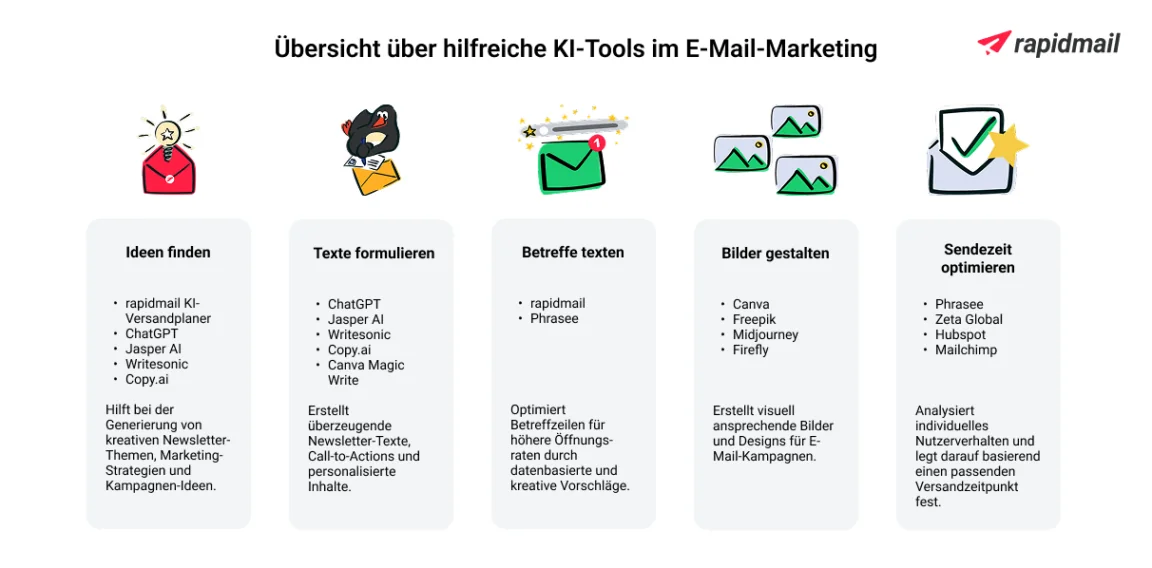
The development of AI has brought about major changes, particularly in the world of work, and will continue to support many jobs and revolutionize processes in the future. Even in email marketing, AI offers countless applications that can make your working day much easier. To give you a clear overview, we have selected what we believe are the most useful applications and AI tools for your email marketing:
Optimizing compelling email subject lines
A good subject line is essential in email marketing: it is the first thing your contacts see when your newsletter reaches their inbox, so it has a major influence on the campaign’s open rate. Unfortunately, it is not always easy to write THE ideal subject line. It needs to be appealing but not sensational, encouraging but not intrusive, while still reflecting your company and the newsletter topic! 😮💨
To write an appealing subject line without spending too much time on it, while also standing out among all the other emails in your contacts’ inboxes, you can use AI in the form of subject line generators. These AI email marketing tools make it easy to write varied newsletter subject lines in no time at all: simply enter a few keywords and you will receive imaginative suggestions for engaging subject lines. ✨
💡 rapidtip: use AI to write compelling newsletter subject lines with rapidmail
All you need to do to receive plenty of creative subject line suggestions for your newsletters with rapidmail is enter the URL of your company website. The AI then takes a close look at your website and notes details such as your company name, the products or services you offer and the style of language you typically use. All this information is then incorporated into the subject line suggestions it generates.
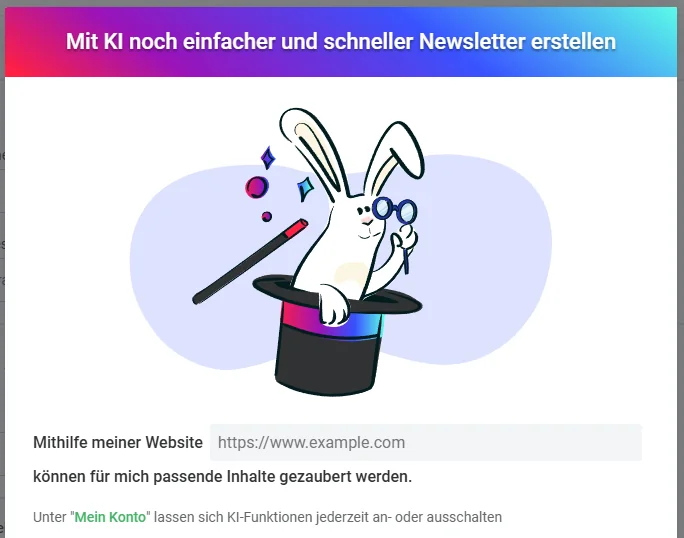
Now it’s your turn: for example, you can enter a keyword describing the topic of the planned campaign in the subject line field, and the AI will immediately generate various subject line suggestions for your email.
More AI email marketing tools for engaging newsletter subject lines:
- 🤖 ChatGPT: creative and adaptable, producing individual subject lines in a specific tone of voice. Example: “Just arrived: your spring must-haves!”
- 🤖 Jasper AI: creates optimized subject lines for high open rates, ideal for marketing, promotional and sales newsletters. Example: “Sun, sand & great deals: your summer vacation awaits!”
- 🤖 Copy.ai: generates different subject line variants, providing quick ideas for different target audiences. Example: “🏋️♂️ The 5 best fitness exercises for fast results!”
Finding topics for relevant newsletter content
Do you find it difficult to keep coming up with new and interesting newsletter content for your target audience? You’re not alone! At rapidmail, we also spent a long time working on a way to make newsletter topic research as easy as possible for us and for you. The result is our wonderful AI newsletter scheduling planner. 🚀
This feature uses artificial intelligence to conjure up a completely individual campaign schedule packed with creative newsletter ideas for your company. Simply enter your company name, a few relevant keywords and a description of your company in the appropriate fields, and you’re ready to go!
The rapidmail AI sending planner then creates a campaign schedule with creative campaign ideas for the entire year, perfectly tailored to your company and products.
Try the AI sending planner for free now
More AI email marketing tools for varied newsletter content:
- 🤖 Neuroflash: creates varied, target-group-specific newsletter copy with creative wording. Example: A sustainable fashion label uses Neuroflash to create newsletter copy with emotional storytelling, for example about fair production or sustainable fashion tips.
- 🤖 Writesonic: automated, emotional and compelling content for different target audiences. Example: Creating a travel newsletter with inspiring descriptions and exclusive discounts.
- 🤖 Canva Magic Write: combines text generation and visual design to create complete newsletter templates. Example: Designing an event newsletter for an online conference, including suitable graphics and engaging copy.
- 🤖 Phrasee: automated A/B testing (comparing different versions of copy to identify the best one) and optimization for large email campaigns. Example: Optimising the copy structure for a tech company’s campaign to turn more subscribers into customers.
Optimizing send times with AI
When is the best time to send a newsletter? You have probably asked yourself about the ideal time to send a newsletter many times. And rightly so, because a campaign’s open rate depends heavily on when the email reaches the recipient’s inbox. Artificial intelligence can help here too, using machine learning to optimize send times even more precisely.
This is how it works: first, the AI analyzes user behavior to determine the optimal send time for every individual newsletter contact. For example, the AI identifies when the recipient typically opens or clicks emails and automatically adjusts the send time accordingly. The aim is to achieve a higher open and click rate through personalized send times.
Optimizing send times with the help of AI is therefore a good way to make your email marketing even more efficient while improving the performance of your campaigns. But even if you decide against using such a feature, there are other ways to identify the ideal send time for your campaigns. One example is regular A/B testing to find out when your target audience is most active and when you can achieve the optimal open rate.
Several tools for AI-powered send-time optimization are already available on the market. HubSpot, for example, uses machine learning to evaluate past user behavior and automatically adjust the send time. The US tool Mailchimp also offers an AI-based solution with its “Send Time Optimization” feature, which uses millions of collected data points to determine the best time to send.
However, the extensive range of features in both tools makes them less intuitive to use and requires a certain level of expertise and time to get started. Our comprehensive newsletter tool comparison makes it easy to find out which software is right for you.
AI email marketing tools for send-time optimization:
- 🤖 Zeta Global: analyses individual user behavior and adjusts send times in real time. Example: An online shop uses Zeta Global to send product newsletters at precisely the time when customers are most likely to click “Buy”.
- 🤖 Phrasee: AI-powered optimization of subject lines and send times for maximum open rates. Example: A fashion retailer uses Phrasee to send seasonal sale newsletters precisely when its target audience is most active.
- 🤖 Mailchimp: calculates the best send time for each target audience based on collected data. Example: An online magazine uses Mailchimp to send its weekly newsletters at the exact time when readers have clicked most often in the past.
- 🤖 HubSpot: automated send-time optimization based on each contact’s individual history of opens and clicks. Example: A B2B company uses HubSpot to send webinar invitations specifically at the times when business customers are most likely to respond to emails.
Using ChatGPT to help write newsletter copy
Engaging newsletter copy is not always easy to write. That is why it is definitely worthwhile getting help from AI email marketing tools to find inspiration for newsletter wording.
But what is the best way to formulate the task, known as a “prompt”, to achieve the best result? Using six prompt examples, we show you how to generate suitable newsletter copy quickly and easily with ChatGPT.
A quick tip before we start: for once, “more is more”. The more information you give ChatGPT, the more accurately the chatbot understands what you want and the better the results it can provide.
6 dos and don’ts for writing prompts in ChatGPT
1. Clear and precise wording: the more specific your prompt, the more helpful the answer.
❌ Poor:“How do I write a good newsletter?”
✅ Good:“I run a bakery and want to write a newsletter informing my customers about new seasonal products in February. Please create an engaging introduction and a short product description of our carnival doughnuts and Valentine’s shortbread hearts in a friendly tone.”
2. Provide context: give background information so that the newsletter is targeted specifically at your audience.
❌ Poor:“Write a newsletter for my business.”
✅ Good:“I run a gym and want to write a newsletter for my customers. The aim is to get them excited about our new online training program. The target audience is working people between the ages of 25 and 45 who have little time for exercise. Please write compelling copy with a clear call to action (CTA).”
3. Specify the format and style: if you expect a particular structure or format, include it in your prompt.
❌ Poor:“I need a newsletter for my bookshop.”
✅ Good:“Create a newsletter for my bookshop in which I introduce a new crime novel. The structure should be as follows:
- Greeting
- Introduction to the book with a short plot summary
- Why this book is perfect for our readers
- Call to action (e.g. link to purchase or pre-order)”
The rapidmail newsletter
Tips, ideas and news about email marketing, straight to your inbox.
4. Mention examples or styles: say if you want a particular tone or style for the newsletter copy. Examples also help ChatGPT better understand the result you want to achieve.
❌ Poor:“Write a newsletter for my café.”
✅ Good:“I need newsletter copy for my café to promote our new winter special. The tone should be warm, inviting and have a touch of humor. Here is an example of the style: ‘It’s cold outside, but our new cinnamon latte is guaranteed to melt your heart! Come and try our winter special, available for a limited time only!’”
5. Use multi-stage prompts (iterative process): if you want a particularly creative or detailed answer, you can provide step-by-step instructions.
1️⃣ First prompt:“Write a newsletter for my online shop for sustainable fashion. It should tell customers about our new collection.”
2️⃣ Follow-up prompt:“Can you make the introduction more emotional and include a personal story?”
3️⃣ Another prompt:“Is there a way to include a humorous call to action (CTA)?”
6. Assign roles or perspectives: if you want to create a newsletter of a particular kind, you can put ChatGPT in a role and have it generate the copy from a specific perspective.
❌ Poor:“Write a newsletter for my marketing agency.”
✅ Good:“You are an experienced marketing expert. Write a newsletter for your marketing agency that tells potential customers why email marketing is still relevant in 2025 . The target audience is small and medium-sized enterprises that have hardly used newsletters before.”
Bonus: example of an optimal prompt
❌ Poor:“Write a newsletter for my bakery.”
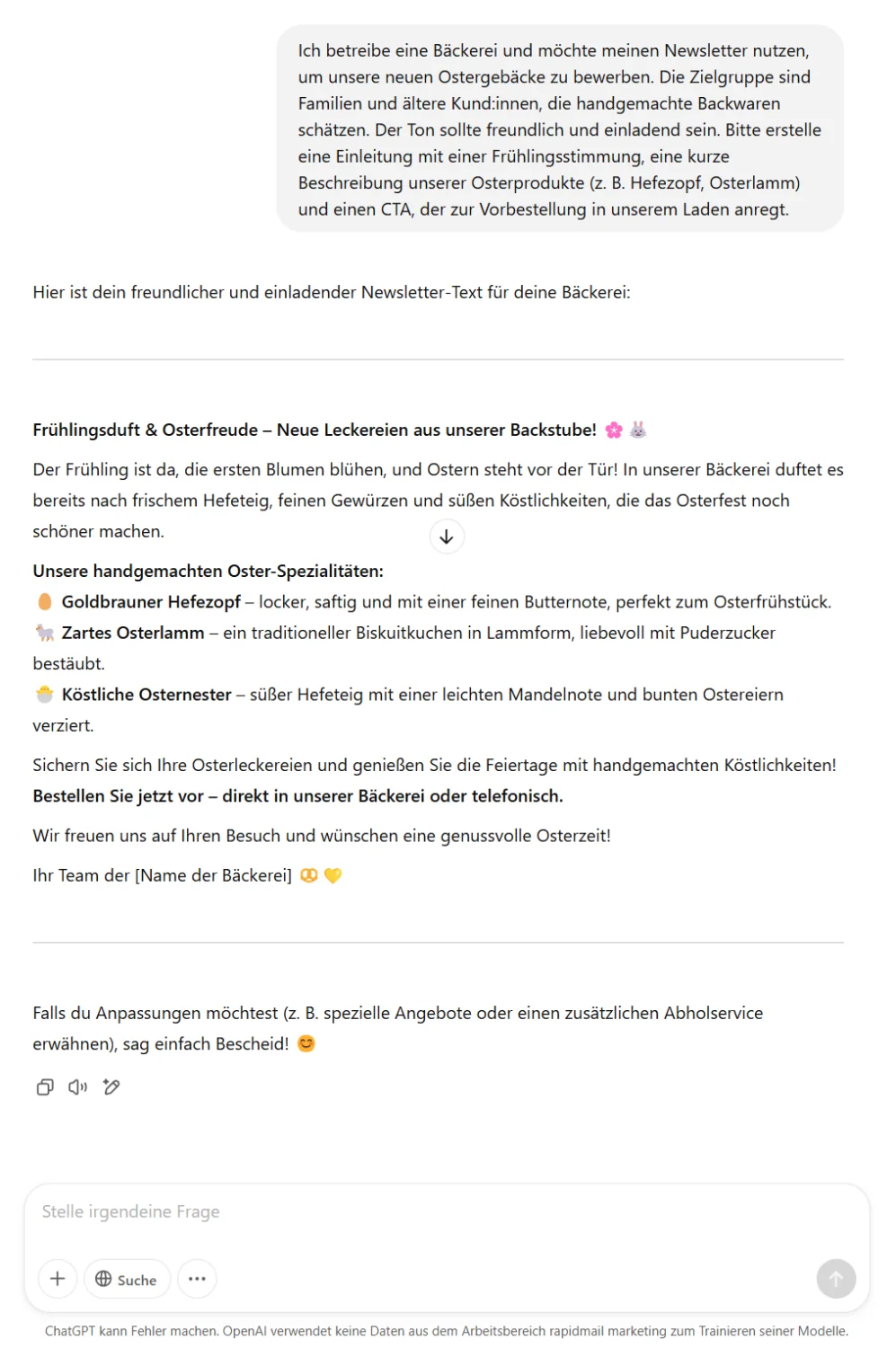
✅ Good:“I run a bakery and want to use my newsletter to promote our new Easter baked goods. The target audience is families and older customers who appreciate handmade baked goods. The tone should be friendly and inviting. Please create an introduction with a springtime feel, a short description of our Easter products (e.g. braided yeast bread and Easter lamb cake) and a CTA encouraging customers to pre-order from our shop.”
3. Limitations and risks of email marketing with AI
Are you already imagining artificial intelligence handling the entire newsletter creation process while you only have to write a few brief instructions here and there? Unfortunately, we need to temper those expectations a little. Even if the opportunities currently seem endless, the use of AI in email marketing also has its limitations. Remember that this technology is still quite new and therefore prone to errors. You should keep the following risks in mind when using AI tools for your email marketing:
Everyone is writing with AI: a lack of originality?
As you now know, AI learns and does not give the same answers repeatedly. That sounds like individual results, doesn’t it? Yes and no. AI still has to obtain the information it is asked for. This means the content it provides must already exist somewhere. We can therefore conclude that its suggestions have limited originality and will eventually repeat themselves in some form. This creates a risk that copy in your newsletter or blog may also appear in the same or a similar form among your competitors if they too use artificial intelligence.
💡 rapidtip
Feel free to use AI to find inspiration for topics and copy, but always review your copy carefully afterwards. How can you rewrite the suggested copy so that it better matches your company’s tone of voice? What factual errors might the AI tool have made that you still need to correct, and what important information is missing? You should therefore continue to invest some of your own time and energy in your email marketing to achieve your goals. The good news is that you too learn from every new piece of copy and will keep getting better and faster. 😉
Treat AI knowledge with caution
As you already know, artificial intelligence can only provide information that it has previously learned or absorbed from existing data sources. It is therefore unable to generate genuinely new information that goes beyond its training material. This means that all content supplied by AI must already exist in some form, whether in public databases, books, scientific articles or entirely different sources that were incorporated into the training process, including, in the worst case, sources that lack credibility.
For this reason, it is very important not to rely blindly on information provided by AI in your email marketing. Review the information critically yourself, ideally by conducting your own research, to verify that it is actually correct. This is particularly important when it concerns recent developments, complex issues or sensitive topics. For example, AI may provide outdated data if it was trained using information that is no longer current.
The reliability of statements made by AI is particularly problematic for topics that can change regularly and quickly, such as:
- 🤖 Technological innovations
- 🩺 Medical findings
- 🧑🏻⚖️ Political developments
- ⚖️ Legal changes
- 💸 Financial advice and developments
- 🗞️ Current news and events
Another risk is that AI may exhibit bias depending on its training data. Certain perspectives or relevant information may be missing or presented in a one-sided way. This is another reason why you should always compare AI-generated content with other reliable sources before using it in your email marketing. Do not blindly trust the AI’s answer. Carry out your own research and, for complex topics, seek advice from experts.
4. Conclusion: why we recommend AI for sending newsletters
The possible applications of AI in newsletter marketing seem endless. Of course, you should still always remember that it is only a tool. While it can make your work easier, it can also make mistakes. You should also remain aware that nobody, including AI, knows your company, your product and your target audience as well as you do.
Despite the many risks, artificial intelligence is a valuable, time-saving source of support and inspiration in everyday work. It can provide plenty of creative ideas, help you formulate copy and save time when finding suitable images.
In summary, our conclusion on email marketing with AI is:
- 🕑 AI saves time and provides creative inspiration for newsletters, whether for potential content, copy or images
- 📝 It helps with the optimization and personalization of content
- 🙋🏻 The human element remains the most important factor for your brand to achieve maximum authenticity and long-term customer loyalty
- 🔧 AI should be used as support, not as a complete replacement for content creation in email marketing
It will be exciting to see how AI and email marketing develop in the future. But one thing is certain: people are, and will remain, irreplaceable in this relationship. At rapidmail, we are certainly very excited to see where this journey leads and already offer you several AI applications in our newsletter tool! 🚀