How to win and retain customers with direct marketing
Companies that use direct marketing address customers and prospects very specifically through channels such as telemarketing or email marketing. Unlike television or radio advertising, direct marketing allows advertising content to be far more personal and tailored to the individual interests of different target groups. Our direct marketing guide explains what the term means. Alongside a definition and clear, practical examples of direct marketing, we show you how to achieve your objectives quickly and easily with email marketing, among other methods.
1. Definition: what exactly is direct marketing?
Direct marketing includes all advertising activities that address or contact customers and prospects individually. The objective of direct marketing campaigns is to use individual advertising content to motivate recipients to take a specific action. This might be registering on a website, making a purchase from an online shop or signing up for an event. It is not only about winning new customers. Another objective is to retain existing customers and strengthen their relationship with your company or brand, encouraging them to make another purchase, for example.
Direct marketing is therefore the opposite of mass advertising, which communicates advertising messages to the general public through media such as radio or television. Thanks in particular to the many possibilities offered by digital direct marketing, content can instead be tailored very precisely to consumers’ interests and habits. When sending newsletters, for example, various personalization features make it easy to address contacts individually by their first or last name, motivate them to make a purchase with personalized coupon codes or surprise them with birthday emails that include a special discount.
The different areas of direct marketing
Direct advertising
Direct advertising describes the “simplest” type of direct marketing. Unlike general mass advertising, such as a TV commercial, direct advertising consists of targeted emails or letters with or without a personalized salutation, delivered directly to subscribers’ inboxes or letterboxes. This increases the likelihood that the advertising messages will actually reach the right target group.
Examples:

- Product newsletters sent to all contacts to introduce the new winter collection
- Product catalogs sent by post
- Information brochures from insurance companies or banks
Dialogue marketing
Dialogue marketing focuses on interaction between the company and the prospects or customers who receive the advertising message. Interaction can be encouraged by inviting them to an event or offering a discount, which recipients can respond to by clicking the call-to-action button in the campaign, for example. For a dialogue marketing activity to generate as many responses as possible, the target group should be clearly defined in advance and narrowed down appropriately using personal data where necessary.
Examples:
- Personal conversations in a pedestrian zone
- A campaign with an invitation to an online event
- A newsletter with a coupon code
- A campaign featuring prize draws or contests
- Customer communication via WhatsApp
Database marketing
In database marketing, companies use all available customer information to offer them tailored advertising content and thereby generate more revenue. Products purchased or pages visited, for example, can provide insights into customers’ individual interests and purchasing behavior. These insights are then used to suggest precisely the products and services that are most likely to interest each buyer group. In marketing, this approach is also known as the “next best offer”.
In email marketing, this type of direct marketing involves dividing newsletter recipients into different segments or assigning them to different tag groups so that they are offered only relevant and interesting content and products. It also helps avoid unnecessary costs because you can narrow down your target group effectively.
Examples:
- Creating different newsletter content based on recipients’ interests (such as men’s or women’s fashion, luxury vacations or camping vacations, etc.)
- Phone calls offering suitable alternative mobile phone tariffs based on individual needs
The different forms of direct marketing
Passive direct marketing
Passive direct marketing does not involve entering into a direct dialogue with prospects. Instead, advertising content passively draws recipients’ attention to the company and its range of services or products. They have no way to respond directly to the advertising message or contact the company.
Examples:
- Product newsletters sent to all contacts (without a call to action)
- Advertising brochures sent by post
Response-oriented direct marketing
With this type of direct marketing, response elements in the advertising message encourage prospective or existing customers to respond. This initiates two-way contact and helps build a long-term connection between recipients and the company or brand.
Examples:
- A newsletter with a coupon code
- A product catalog with an order form
- An advertising letter featuring a prize draw
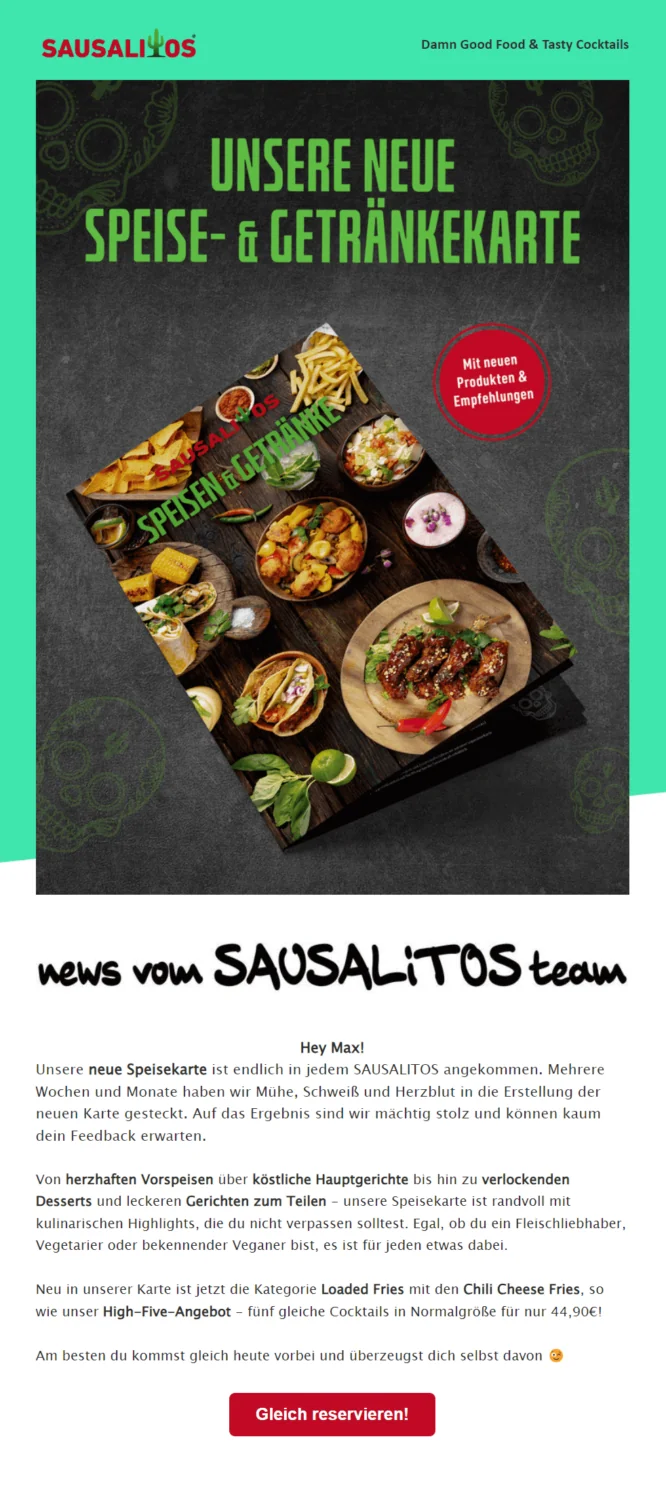
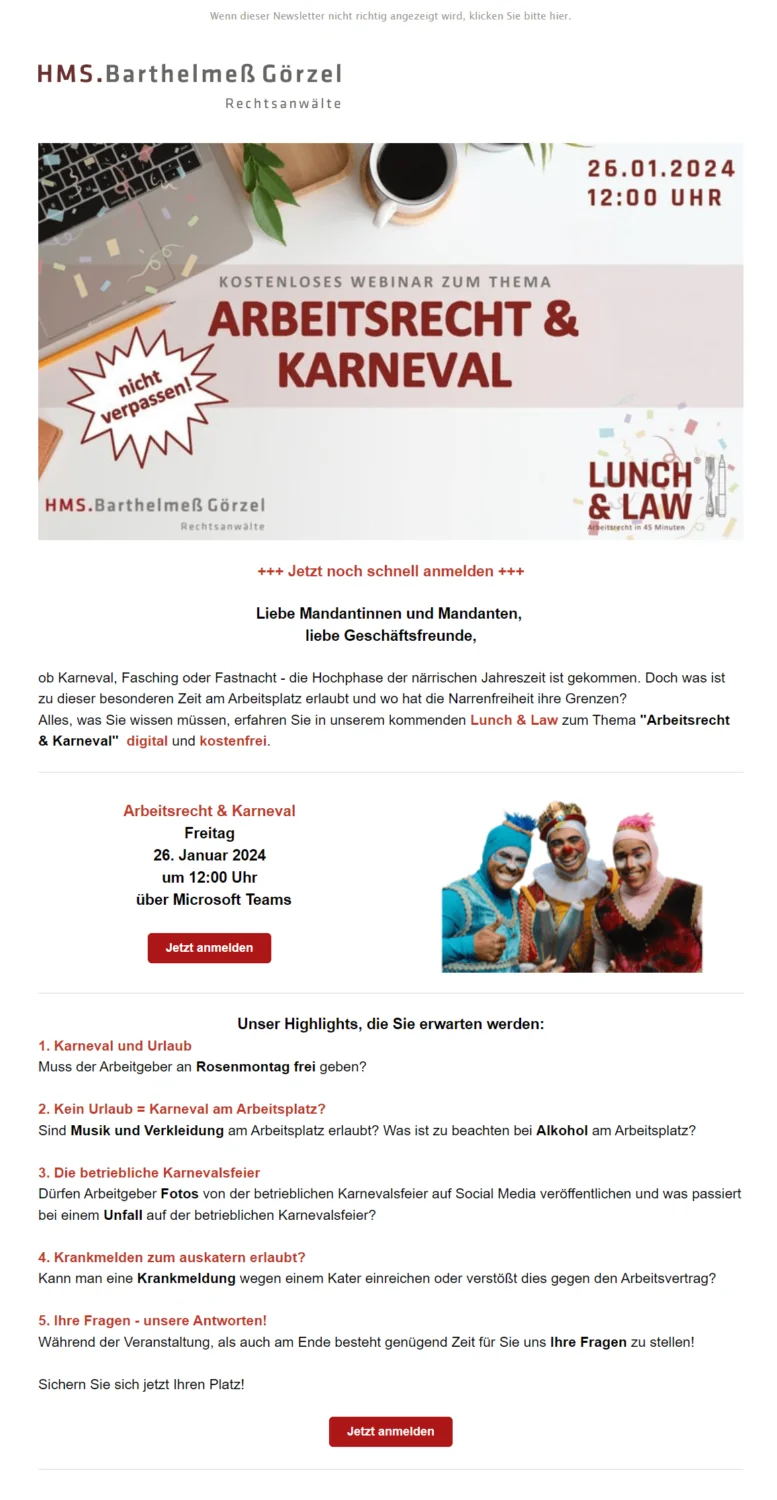
A successful practical example of response-oriented direct marketing: in jewelry studio Modern Eves’ customer newsletter, a coupon encourages contacts to click the CTA button, browse the website and redeem the offer (excerpt from the newsletter, created with rapidmail).
Interaction-oriented direct marketing
Interaction-oriented direct marketing involves a two-way exchange between the company and prospects.
Examples:
- A bank appointment to present further investment options
- A phone call with customer support
- A webinar followed by a feedback session
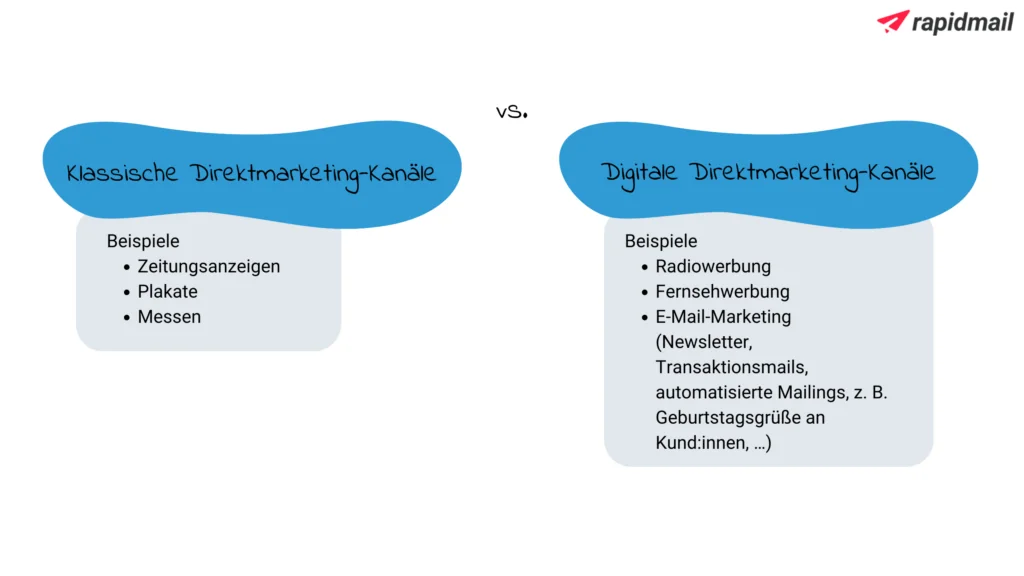
Traditional vs digital: the different direct marketing channels
💡 rapidtip
A varied direct marketing mix covering all areas, forms and channels opens up an incredible range of opportunities to contact customers and prospects directly and draw their attention to your products or services. Digital direct marketing channels such as online marketing give you a particularly valuable opportunity to raise awareness of your company and boost revenue. This increases the likelihood that you will achieve your marketing objective (such as winning and retaining customers) as quickly as possible!
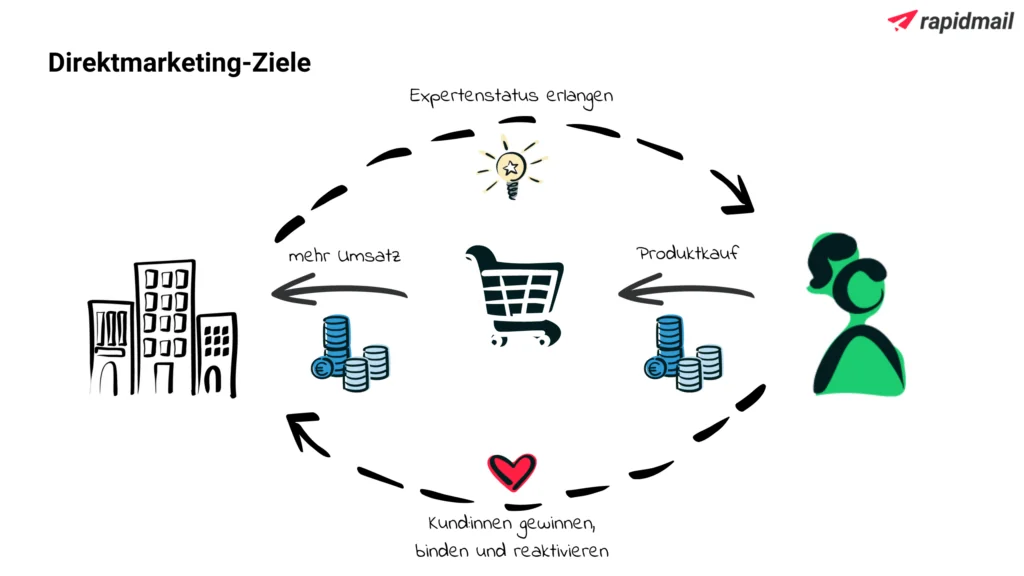
2. The most important direct marketing objectives
Depending on its industry and target group, a company can pursue different objectives with direct marketing. In B2B online marketing, for example, the method is used to reach business customers effectively and build long-term relationships. Direct marketing is also used in ecommerce marketing to attract more customers to an online shop.
The most common and important direct marketing objectives are:
- 🛒 Selling products or services to increase revenue: Using different direct marketing channels and formats can raise awareness of your company and product range, helping boost sales.
- 🤓 Strengthening the company’s expert status: Consistent direct marketing shows your target group that your company is an expert in its field, which supports their long-term decision to purchase your products or services.
- 🧲 Winning new customers: Regular direct contact with your company gradually brings prospects closer to your product range and strengthens their connection with your brand, increasing the likelihood of a purchase.
- 🫂 Retaining existing customers: Staying visible to existing customers through regular direct marketing strengthens their connection with your company and helps you build lasting customer relationships.
- 🤝 Reactivating former customers: Consistent direct marketing and targeted offers, such as automated reactivation emails, can rekindle former customers’ interest and motivate them to make another purchase.
3. Advantages and disadvantages of direct marketing
Direct marketing requires a fair amount of effort, especially when it comes to complying with legal requirements. But if you take the time to get to grips with the subject, you will be rewarded with the many advantages that effective direct marketing offers. 🚀
Let’s compare the advantages and disadvantages of direct marketing:
| Advantages | Disadvantages |
|---|---|
|
|
4. Let’s get started: how to plan a direct marketing campaign
Exactly how you plan your direct marketing campaign naturally depends both on whether you want to reach B2B or B2C customers and on the objective you have set. Beyond that, there are specific direct marketing activities and important planning steps that are relevant to every company, as well as questions you should always ask when planning the campaign:
🐾 Step 1: establish your starting point
- Competitor comparison: where does your company stand?
- What do your customers expect from your company?
- To what extent can you meet these expectations?
- Under what circumstances can your product or service help customers?
- How much budget do you have available for the marketing campaign?
🐾 Step 2: decide what you want your direct marketing campaign to achieve
- Which target group do you want to address?
- What information would you like to share with prospects?
- What action do you want the campaign to trigger? (such as a purchase, registration or event attendance)
🐾 Step 3: plan how the campaign will run
- Over what period do you want to address prospects?
- Should your target group be contacted once or in several stages?
- Which channel do you want to use to reach your target group? (such as email or phone)
🐾 Step 4: prepare for implementation
- For direct marketing by email, prepare the campaign (newsletter design, structure, content, newsletter copy, etc.), create the recipient list and so on.
- For direct marketing by post, commission the printing of the advertising brochure, find a leaflet distributor, select the recipients and so on.
🐾 Step 5: implement the campaign
- For email marketing, send the newsletter on the planned date
- For telemarketing, call the selected contacts, for example
The rapidmail newsletter
Tips, ideas and news about email marketing, straight to your inbox.
5. Email marketing example: an efficient direct marketing channel
One of the most efficient marketing channels is direct marketing by email. Because you can create and send newsletters online, it generally takes only a few steps to move from your defined advertising objective to a successfully implemented direct marketing campaign.
👀 Have you seen this?
Are you a beginner who wants to start email marketing but does not yet know how? On our YouTube channel, our Content Manager Wiebke introduces you to the most important email marketing basics and tips. This will help you get off to a successful start with one of the most effective direct marketing channels! 💌
Open video transcript
Chapter 1: Introduction
Isn’t email marketing completely outdated? It is a fair question, given that email has been around for more than 50 years. Today, I want to show you that email marketing is by no means dead. On the contrary, it is one of the most effective and popular marketing activities. But what exactly is email marketing? And how do you get started? There are plenty of questions, and I am going to answer them today. Hi, my name is Wiebke and I would like to accompany you on your email marketing journey.
In this video, you will learn the essential email marketing basics you need for a successful start. Together, we will look at exactly what email marketing is, what advantages it offers and what you need to begin email marketing as a beginner.
I will also explain how to find the right email marketing tool and how to build your newsletter list.
Ready to get started with email marketing? Let’s go!
Chapter 2: Definition: what exactly is email marketing?
Email marketing is one of the best-known and most popular forms of online marketing.
Emails, such as newsletters, are used to build a relationship with your target group and send them different advertising messages. This has many positive effects:
Email marketing can help you win new customers.
Once you have sparked prospective customers’ interest and persuaded them to subscribe to your newsletter, for example, email allows you to stay in touch and continually increase their interest with suitable content until they
ultimately become paying customers.
Newsletter marketing also helps strengthen your customers’ connection with your company.
Marketing emails create a direct link with your contacts and regularly remind them of your company. If your content appeals to your contacts, they will associate your emails, and in the long term your brand, with a positive feeling.
Emails sent in your company’s name act as a mouthpiece. This gives you an excellent opportunity to share the information that matters to you. You can therefore take active steps to ensure your company makes a positive impression. Recurring emails that include your company name, products or other brand assets increase your visibility and, over time, your brand recognition.
And all of this is naturally reflected in your revenue:
Marketing emails offer many ways to motivate your target group to make a purchase, such as sending discount codes or promoting special offers.
But be careful: one of the most important basic rules in email marketing is that you may only contact people who have expressly consented to receiving your emails in advance.
Instead of sending unwanted spam messages to thousands of people, you contact only interested contacts, addressing them individually and with their target group in mind. There is therefore a world of difference between unlawful spam emails and GDPR-compliant, interest-based emails.
That takes care of the first misconception, namely that newsletters are just spam. Let’s move straight on to the next question: is email marketing still worthwhile today?
Chapter 3: Is email marketing still worthwhile today? (display and highlight chapter heading)
TikTok, Pinterest, Instagram… Of course, email marketing is not the newest form of advertising. However, it is every bit as effective as advertising formats such as social media marketing or search engine advertising. In fact, email marketing is the ideal complement. It is always advisable to combine different communication channels to reach as many people as possible.
A study by the German Retail Federation found that emails and newsletters remain the second most popular channel for communication between consumers and companies. Only face-to-face contact is more popular.
That is why more and more companies are discovering email marketing. We conducted a survey on this very subject and found that over 90% of the nearly 800 companies surveyed use email for marketing purposes. Most respondents said that email marketing had become more relevant in their view, and many expect its relevance to grow even further.
If you would like to read our study at your leisure, follow the link in the video description.
Chapter 4: Advantages of email marketing
But why exactly is email marketing so popular? Let’s take a look at the advantages of this marketing channel.
Compared with other marketing channels, email marketing offers affordable and transparent pricing. With rapidmail’s email marketing tool, for example, you can get started for just €15 a month. And the money you invest pays off:
The email marketing ROI (return on investment) is particularly good. In concrete terms, every euro spent on email marketing generates an average of €42. This makes email marketing the advertising channel with the best cost-benefit ratio!
If you are now thinking that you do not have enough staff, time or prior knowledge to start email marketing yourself, let me put your mind at ease. A professional email marketing tool allows you to create and design your emails quickly and, above all, easily, before sending them to any number of contacts at the same time.
The right email marketing tool gives you access to practical features that minimize the time required for email marketing, such as a drag-and-drop editor, stylish design templates that automatically adapt to your corporate design, and the option to edit images directly in the tool.
Emails have enormous reach. Almost everyone has at least one email address.
At the same time, you can reach your contacts by email virtually anytime and anywhere. After all, emails are now read not only on computers but also on smartphones and tablets while people are out and about.
Your recipients do not even have to actively check their inboxes because push notifications automatically alert them to new emails.
This means you can plan precisely when and under what circumstances you want to reach your target group. Would you prefer to contact them in the morning on their way to work, during working hours or while they are relaxing after work?
You already know that GDPR-compliant email marketing allows you to contact only people who want to hear from you. At first glance, this might sound like an inconvenient restriction, but it certainly is not.
Consent means that only contacts who are genuinely interested in your brand and advertising join your list. This presents your company as trustworthy and credible and prevents extensive wasted coverage, because you are not throwing away your advertising budget on people who have no interest in your products and offers anyway.
Email marketing also lets you address prospects by name using a salutation that is automatically populated with recipient data, creating a personal, trusted basis for communication.
It is very easy to use customer data such as name, place of residence, gender, purchasing behavior and interests to tailor your emails to each individual contact.
Would it be even better not only to tailor the content of your emails to your contacts, but also to deliver your messages to their inboxes at exactly the right time? Email automation makes this possible.
Automated emails are either triggered by a specific action taken by a contact, such as subscribing to your newsletter, or sent at a set time, such as on November 30 or at intervals of five days.
An online shop for babies and children could send its customers a campaign about balance bikes one year after they order a pushchair, responding perfectly to those contacts’ current circumstances.
But emails are not simply sent out blindly. Immediately after sending them, you can monitor and measure how successful they are.
Email marketing continuously tracks important metrics that show whether, and how well, your emails are received by your target group.
For example, you can check how many contacts received the emails, how many opened them and how many clicked a link in the email. With an additional tracking tool such as Google Analytics, you can also find out how much revenue an email generated. If your figures still leave room for improvement, you can optimize your marketing emails with a few simple adjustments.
Have all these advantages persuaded you to get started with email marketing too? Then I will now explain how to begin.
Chapter 5: Requirements: how can I start email marketing as a beginner?
You need just three simple things: an email marketing tool that lets you create and send emails, a website where you can place a sign-up form, and website visitors or contacts you can write to in the future.
But why do you need a dedicated email marketing tool? In principle, you could send marketing emails using an email provider such as Outlook, but this is not advisable. These programs lack the right sending infrastructure for a large recipient group and other important features such as recipient management, varied design options and email display testing.
To take advantage of all the benefits of email marketing, including easy and fast email creation, personalization and reporting options, you need professional applications designed specifically for this purpose.
Chapter 6: How do I find the tool that suits me best?
Choosing an email marketing tool is not quite so simple, as there are countless providers on the market. To find the right tool for your company, you should first gain an overview of what you expect from your ideal email marketing tool.
I would recommend starting by considering whether you need a very extensive range of features or whether ease of use for the most important basic functions matters more to you.
You should also pay attention to the level of data protection offered by the tools you are considering. In my view, you should not compromise on support either, because receiving fast, expert help when you get stuck is incredibly valuable.
The video description contains a link to our tool comparison. We took a close look at several popular tools and compared their features, levels of data protection, prices and other important decision criteria. Perhaps it will make choosing your email marketing tool a little easier.
Chapter 7: How do I build a list for my marketing emails as a beginner?
Once you have chosen an email marketing tool, you can turn your attention to your contacts. But how do you build a newsletter list?
If you are new to email marketing, you probably do not yet have a huge mailing list. But with the right steps, building your own contact list gradually is not that difficult.
Buying a large list of email addresses in one go is not a good idea, by the way. Contacting purchased contacts is unlawful because they have not given you permission to do so. What is more, they are unlikely to be particularly interested in your messages. It is much safer and more sensible to collect contacts who have a genuine interest in your company and its products or services.
You therefore need to encourage people to subscribe voluntarily to your newsletter. The easiest way to do this is with a sign-up form on your website.
You can create this form easily using your email marketing tool. When website visitors enter their details in the form, the data is
automatically transferred to your contact list in the software.
However, it needs to be clear why signing up is worthwhile. Otherwise, why would prospective contacts provide their details in the first place? You should therefore think about which incentives might spark your target group’s interest in your emails.
You could use special offers, such as a discount code or early access to new products. But it may be enough to explain clearly that your newsletter will keep prospects up to date with new collections, new resources, current events, contests and exciting internal news.
If not enough people are finding your sign-up form through your website, you can also promote your newsletter through other channels. You could use social media, for example. Offline, signs and posters can also draw attention to your newsletter. Building your list does require a little patience, however. Your contact list will grow gradually, step by step.
Chapter 8: Conclusion: what happens next?
That covers all the email marketing basics, and you are now essentially ready to create your first newsletter and send it to your contacts. Our tutorial shows you how to do this with rapidmail.
Thank you for watching and see you next time!
The key steps in email marketing
- 👨🏽👩🏼👧👦🏽 Collect email contacts: A high-quality contact list is the foundation of successful direct marketing by email. But you will not achieve this by buying email addresses online. Instead, build your list gradually by collecting high-quality email contacts made up exclusively of interested recipients.
- 🔖 Narrow down the recipient list to the precise target group using segments or tags: Communication tailored to the target group and made as individual as possible is fundamental to sending newsletters. Divide your recipient list into different subgroups using segments or tags and create separate campaigns for each group of buyers or prospects.
- ✍️ Create a newsletter: You can then create a suitable newsletter based on your subscribers’ interests and purchasing behavior. Use a compelling subject line to encourage your contacts to open the campaign. Alongside an appealing newsletter design with the wow factor, it is also important to inspire readers with relevant newsletter topics and prompt them to take action by including a call-to-action button, such as registering on your website or buying one of your products.
- 📨 Send the newsletter: Once your campaign is ready to send, pause briefly rather than sending it immediately. First, think carefully about the best time to send your newsletter. Even if you cannot send the campaign manually at that time, there is a solution: simply schedule your newsletter in advance and set the desired sending time.
- 📊 Analyze your newsletter: Now it gets really interesting. How many recipients opened the campaign, and how many clicked a link? Analyzing your newsletter is essential for finding out what appeals most to your contacts. Key newsletter reporting metrics, such as the open rate and click rate, show you what you can improve in your next campaigns.
Create your own newsletter now
Is email marketing still new territory for you, and would you like to learn more? Then our ebook for beginners is exactly what you need.
Learn more about the basics of email marketing
In this ebook, we answer the most important questions, including what email marketing actually is, what benefits it offers and which forms of email marketing are available.
We also provide helpful tips on choosing suitable email marketing software and building an email list.
This will help you get off to a flying start with email marketing! 🚀
Download the email marketing ebook for beginners free of charge (PDF in German)
Advantages of email marketing
You should never overlook direct marketing by email when implementing your marketing campaign. Email marketing helps you achieve your marketing objective as quickly as possible and offers many other advantages compared with other channels:
- 🎯 Numerous personalization options, such as a personal salutation or individual coupon codes. Asking about interests in the newsletter sign-up form also lets you learn more about new recipients straight away and tailor your content accordingly.
- 🔖 Easy segmentation into different groups of buyers or prospects, so your contacts receive only newsletters about topics that genuinely interest them.
- ❗Fast responses to current events, such as the shutdown during the coronavirus crisis.
- 🗨️ Regular customer contact without major financial expense thanks to fair newsletter sending prices.
- 🛒 Automated purchase processes using transactional emails.
- 🕓 Setting the exact sending time: unlike post, email lets you know exactly when your subscribers receive your advertising message.
- 📈 Precise measurement of marketing campaign success.
- 🗂️ Collection of important customer information, such as your customers’ preferred topics or interests.
Would you like to get started with direct marketing too?
With rapidmail as an intuitive and 100% GDPR-compliant email marketing tool you can implement direct marketing activities with ease. Create newsletters online and send them to your contacts in just a few clicks, helping you sell more! What is more, your first newsletter send to up to 2,000 contacts is free, so you can try everything at your leisure: