B2B online marketing made easy: Win business customers with the right strategy


Digitalization has not passed B2B marketing by: online marketing activities are becoming increasingly important when it comes to reaching business customers effectively and building long-term partnerships. With its many possible channels, methods and tools, B2B internet marketing now offers a wealth of options for targeted, measurable advertising campaigns. Wondering where to start? Don’t worry, we’ve got your back: our tips, best practices and examples will help you devise the right online marketing strategy for your B2B company. Let’s get started!
1. B2B online marketing basics: What does it mean?
B2B online marketing (short for “business-to-business online marketing”) encompasses the strategies and advertising activities that companies use to reach and win other companies as business customers through digital channels.
“B2B internet marketing” and “B2B web marketing” are also frequently used as synonyms for “B2B online marketing”. They all describe the same thing: advertising that focuses not on traditional channels such as telemarketing, but on digital channels such as newsletter campaigns.
These are precisely the channels we will examine more closely in this article. In B2B too, it is important not to fall behind your competitors and to use modern communication channels for online marketing to reach your target audience.
👀 Have you seen this? Email marketing for B2B companies
Do you want to persuade your business customers and boost your B2B company’s revenue? In this video, our Content Manager Wiebke shows you how to create the perfect B2B email marketing plan in just six steps. Roll the film! 🎬
Open video transcript
Chapter 1: Introduction
Do you want to address decision-makers in companies directly? Then B2B email marketing is exactly right for you! This channel lets you reach the right contacts without a great deal of wasted coverage and accompany them throughout the customer lifecycle. Email marketing is also cheaper and less time-consuming than trade fairs or print advertising.
Hello, I’m Wiebke, and today I want to show you how to put together the perfect email marketing strategy for your B2B company. This includes setting clear objectives and defining your target audience, building your mailing list, planning content, choosing the right design and timing, and of course analyzing your results. So, let’s get started!
Chapter 2: What is B2B email marketing?
In email marketing, emails in the form of newsletters, automated emails or transactional emails are sent to contacts who have previously consented to receiving them, in both B2C and B2B. The difference lies in the type of contacts or target audience.
In B2B email marketing, you send commercial emails to business contacts. By contrast, B2C targets individual consumers. While emotional and entertaining content performs well in B2C, rational arguments are the main influence on purchasing decisions in B2B. That does not mean it has to be stiff and dull: people in B2B appreciate a friendly, humorous tone too.
It is important to remember that you are often dealing with trained professionals who have high expectations and fixed budgets. Impulse purchases are rare, and decision-making processes often take a long time. This is precisely where email marketing is useful for building long-term personal relationships. Regular information about features, pricing models and offers helps persuade potential customers.
Chapter 3: Step 1: Define your B2B email marketing objectives
Before you really get started, think about the overarching objectives you want to achieve. This will make it easier to choose the right activities later.
B2B email marketing can help you establish and strengthen personal relationships, win new business customers and retain them over the long term, generate interest in your products and services, generate leads, increase revenue, and keep customers informed and up to date.
Set specific objectives so that you can identify which activities are needed. If a cleaning company wants to win ten new customers a month, for example, its newsletters should present the service attractively and explain why it is particularly relevant. If the company wants to increase revenue from existing customers, its emails should promote additional offers and consultations.
Chapter 4: Step 2: Define the target audience
Defining the target audience is particularly important in B2B because the audience is usually smaller than in B2C. Persuading trained professionals with strict requirements and fixed budgets can be challenging, but a thorough analysis makes it achievable.
Ask yourself the following questions:
Who is our product or service aimed at? Which industries is our offer relevant to? How large are the companies for which our offer is suitable? Who makes decisions in these companies? What characteristics do these decision-makers share? What challenges do they face in their working day?
It can be helpful to speak to your sales or customer service team. Personas are fictional representatives of your target audience with typical characteristics. They help you understand potential customers’ needs and decision-making processes more clearly.
Chapter 5: Step 3: Generate leads and maintain your recipient list
Because the B2B audience is smaller, collecting high-quality contacts is especially important. They should be involved in decision-making processes or participate in the flow of information within the company.
The foundation is an inviting sign-up form on your website. You can offer incentives to make signing up more attractive, such as discounts, free webinars or ebooks. However, do not buy contact lists or add existing customers to the list without their consent.
The double opt-in process ensures that only people who actively sign up receive your emails. Interested parties must verify their registration through a confirmation link in an email before they are added to the list.
Chapter 6: Step 4: Plan relevant content for B2B emails
Appealing content that provides added value can persuade potential business customers over the long term. Consider which content your contacts enjoy consuming so that you can spark their curiosity and build trust.
Possible topics for B2B newsletters include product presentations (introducing new products or services), industry news (sharing current developments and relevant information), use cases (practical examples of how products are used), testimonials (using customer opinions and case studies), special offers (providing individual discounts and promotions), and studies and reports (including relevant statistics and expert opinions).
Create a sending plan so that you can send content regularly and in a structured way.
Chapter 7: Step 5: Find the right timing for B2B email marketing
Base your sending times on your contacts’ working day. Emails are generally read between 8 am and 5 pm, so test which time works best. Sending frequency is also crucial. Only send emails when you have relevant content. Monthly or occasion-based campaigns are often a good choice.
Good planning prevents you from overwhelming recipients with emails sent too frequently. Use automation tools to manage campaigns efficiently.
Chapter 8: Step 6: Evaluate and optimize success
To optimize your B2B email marketing, keep an eye on important metrics:
The delivery rate, meaning how many emails actually arrive.
The open rate, meaning how many recipients open the email.
The click rate, meaning how many recipients click links or calls to action.
And the unsubscribe rate, meaning how many recipients unsubscribe from the newsletter.
These KPIs allow you to continually adjust and improve your strategy.
Chapter 9: Conclusion: Achieve your B2B objectives quickly with email marketing
As you can see, it takes just six simple steps to make a successful start with B2B email marketing. Now it is up to you to plan and test your first campaign. With rapidmail, you can try your first campaign to up to 2,000 contacts free of charge.
Good luck with your B2B email marketing! I look forward to your questions and comments. See you next time!
🔎 Traditional marketing vs online marketing in B2B
Do not misunderstand us: traditional B2B marketing activities can of course continue to work well. You certainly should not immediately stop all traditional methods such as telemarketing or field sales and rely solely on digital advertising from now on.
Instead, we recommend expanding your B2B marketing strategy with digital channels. Today, this is a good way for smaller companies too to stay in touch with their target audience even more efficiently and effectively. It is always worth trying different activities to find out which approach works best for your company.
These traditional and online marketing channels are available in B2B:
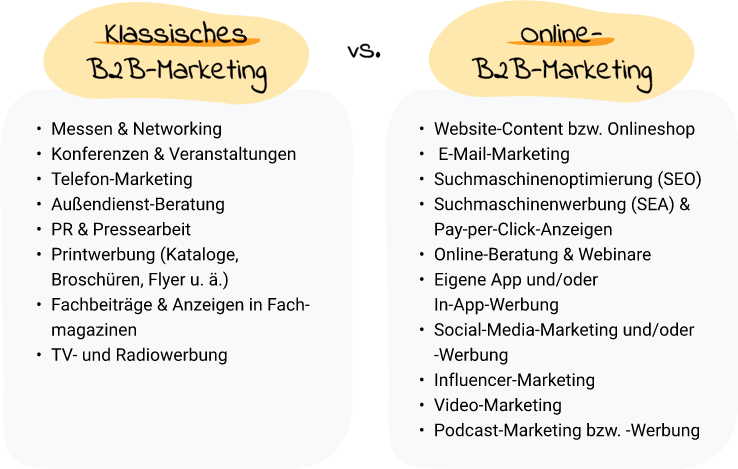
Some digital methods, such as email marketing and search engine advertising, are always worthwhile, regardless of whether a company wants to reach individual consumers (B2C) or business customers (B2B). By contrast, some channels, such as webinars and podcasts, are especially useful in B2B for making direct contact with employees at relevant companies in your target audience.
But why can B2C and B2B marketing not be treated in exactly the same way? Are there really differences?
🔎 B2B online marketing vs B2C online marketing: The difference
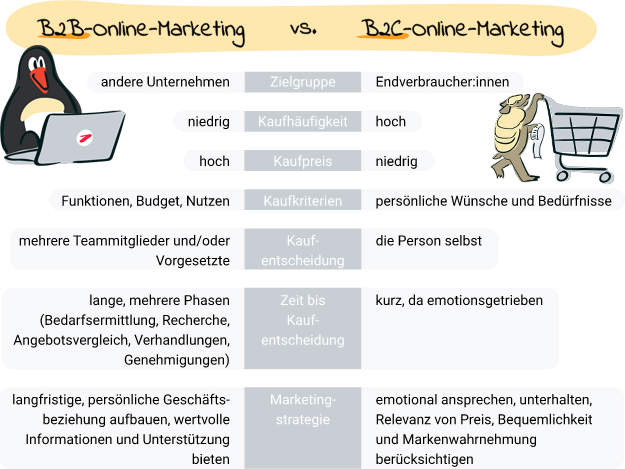
Unlike B2C marketing (short for “business-to-consumer marketing”), whose target audience is individual consumers, B2B marketing aims to encourage long-term business relationships and regular sales between companies. Put simply, B2C marketing seeks to win over individuals, while B2B marketing targets other companies.
Because these different audiences behave differently, have different habits and make purchasing decisions in very different ways, B2C online marketing uses different digital marketing strategies and purchasing processes.
The rapidmail newsletter
Tips, ideas and news about email marketing, straight to your inbox.
2. Opportunities and challenges of web marketing for B2B companies
Depending on their industry, audience and own range of products or services, B2B companies need to use a variety of relevant advertising channels to gradually build long-term, personal and trusting business relationships. Ideally, these lead not only to a one-off purchase, but also to regular purchases and eventually to ongoing subscriptions and partnerships.
To develop a smart online marketing strategy, as a B2B business you should first consider the general challenges involved in winning business customers. Work with your team to find ways to overcome these challenges and include your approaches in your strategic master plan. This will leave you well prepared to take full advantage of the many opportunities that a carefully considered online marketing concept offers B2B companies.
Challenges in B2B online marketing
The challenges a company faces when planning a marketing strategy can vary greatly depending on its precise target audience, industry and product range. We will therefore look only at the challenges that most B2B companies are likely to encounter:
| Challenge | Examples of possible solutions for your B2B online marketing strategy |
|---|---|
| Complex, multi-stage decision-making and purchasing processes, and a long period before the purchase decision | • Offer free features or trial periods on the website so features can be tested thoroughly and decision-makers can be persuaded by initial results• Provide detailed information packs on the website containing everything needed to make a positive decision, such as payment terms, price packages, features, service description and customer service• Publish case studies on the website blog so decision-makers can use feedback from existing customers as a guide• Conduct honest provider comparisons and use comparison pages to show which provider and price packages are right for which requirements; communicate the results, for example in an automated email after registration, through newsletter campaigns and on social media |
| Low purchase frequency | • Ensure continuous touchpoints across different channels, such as social media marketing and email marketing, to stay memorable and retain customersRegularly provide information about new features, different pricing models or additional offers, for example through influencer marketing or newsletter campaigns• Become the go-to source for maximum support in everyday work, for example through a blog or newsletter with expert tips, guides and templates |
| Limited, predefined budgets | • Offer individual price packages that can be configured or selected using a price calculator on the website• Promote discount campaigns through social media channels such as LinkedIn and by newsletter |
| Limited accessibility | • Test different sending times for newsletters and marketing emails• Test channels used in a work context, such as webinars, which people attend during working hours, or podcasts, which they may listen to on their commute |
| In niche markets: low search volume and little active searching for your product range | • Start higher up the funnel when generating leads: use content marketing on broader topics to reach contacts who do not yet have, or cannot yet have, an explicit interest in your product, then guide them gradually toward your range of products or services |
Challenges accepted: you can already see that overcoming these challenges is primarily about using the different available marketing channels in combination, ensuring that all relevant information reaches the right contacts and that your company remains present in your audience’s minds.
Once you and your team have worked out which obstacles in the search, decision-making and purchasing process need to be overcome, you can use the many benefits of the diverse B2B online marketing channels to clear every hurdle and win even more business customers for your company.
Opportunities in B2B online marketing
Compared with traditional advertising methods, online marketing offers clear advantages in terms of the efficiency, reach and effectiveness of marketing activities, especially for small to medium-sized B2B companies with limited budgets:
- 🗺️ High reach and visibility: online marketing makes it easy even for a small B2B company to reach potential business customers around the world, without additional staffing and with limited financial resources.
- 🎯 Targeted advertising: unlike traditional advertising methods, which often involve a great deal of wasted coverage, digital marketing activities and tools let you target specific audiences and potential business customers easily, based for example on demographics, industry, position in the company or behavior. “Tagging” also allows you to tailor your offers precisely to the individual needs and interests of potential business customers.
- 💸 Low costs: print advertising, trade fair stands, talks at events… If you have already tried traditional marketing activities to win other companies as customers, you know how expensive conventional B2B measures are. Digital marketing campaigns, by contrast, are cost-effective and let you adjust your budget flexibly, manage it and measure exactly how much revenue your spending has generated.
- 📈 Continuous, data-driven optimization: online marketing tools help your B2B company monitor its marketing activities precisely and then analyze whether campaigns have achieved the desired effects. The tools’ statistics and metrics, which are often available automatically, give you a sound basis for deciding whether to continue, repeat or stop marketing activities, without needing to be a math genius. You can therefore adjust your online marketing strategy at any time and keep optimizing it step by step.
- 🤝Fast lead generation: compared with traditional advertising methods, planning B2B online campaigns with the many available tools takes less time and can be done more independently. This means you can also establish contact with interested leads more quickly.
- 🏇🏻 A smart competitive advantage: online webinars vs in-person events, email marketing vs advertising flyers and search engine advertising vs adverts in trade magazines: using digital online marketing tools and channels saves you time and money, lets you bring new products to market faster, and will probably put you more than one step ahead of your competitors.
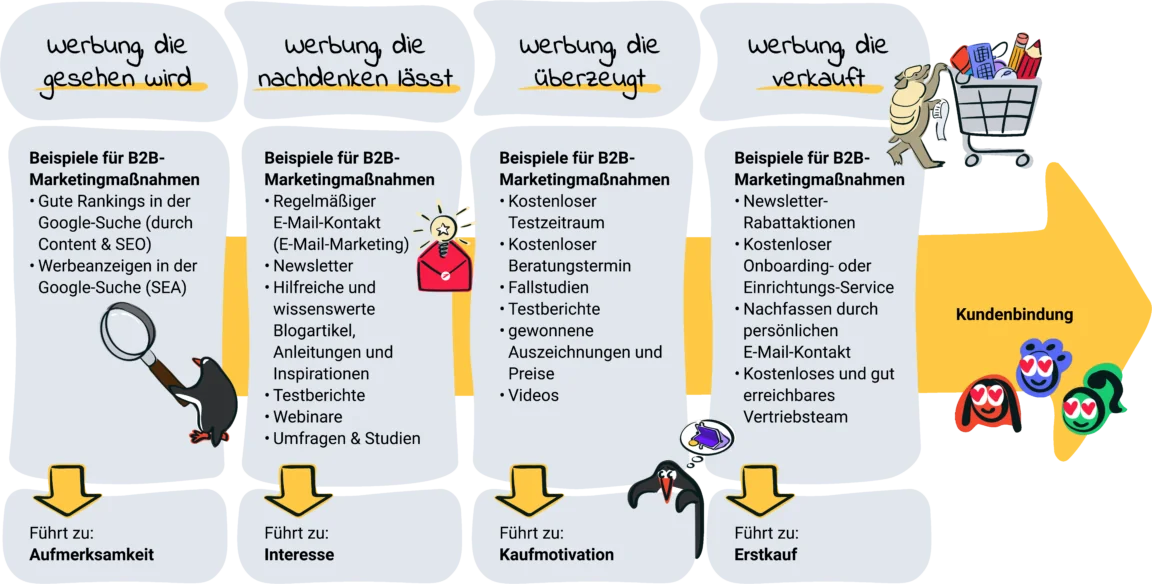
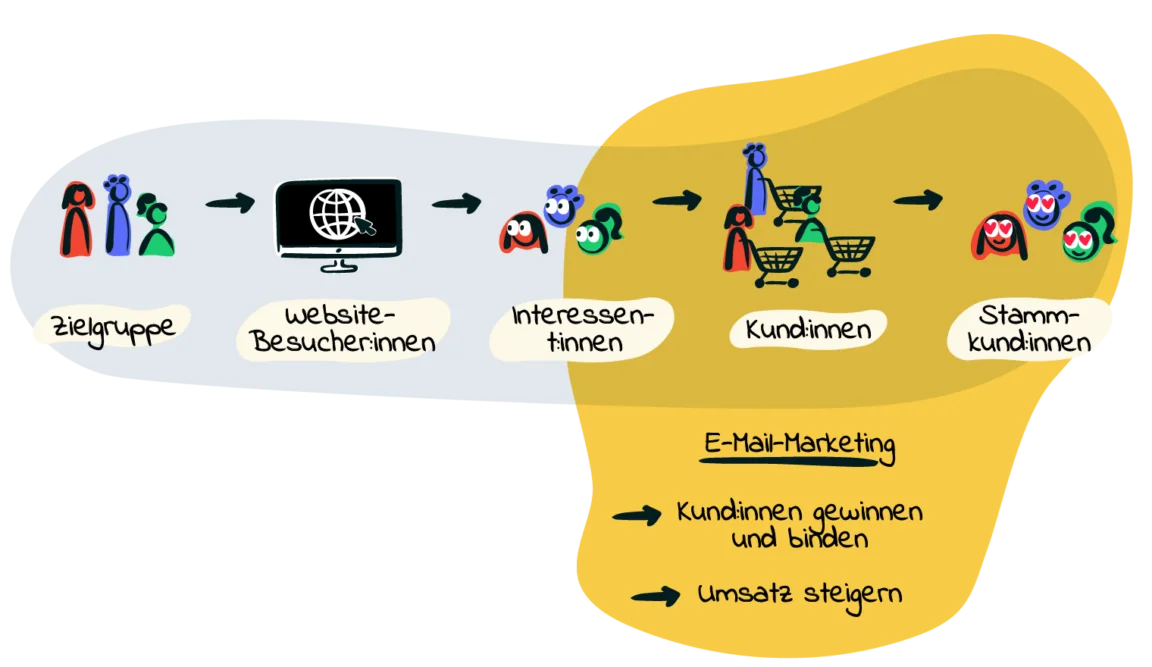
Our infographic on how B2B online marketing works shows how internet marketing helps you build a long-term, trusting business relationship with your customers quickly and from the very first contact:
Discover the newsletter tool for B2B companies
3. Important channels for online marketing in B2B
As you can see, B2B online marketing offers many channels, methods and activities that you could theoretically use to increase your company’s reach among relevant target companies and win over more business customers. But we know that reality often looks different: your diary is full, your objectives are ambitious and your team is at capacity. It is therefore worth taking the time to create a master plan for your B2B online marketing strategy. Consider which communication channels and methods will best reach decision-makers in relevant companies.
Unfortunately, there is no perfect one-size-fits-all solution that you can simply adopt for your marketing strategy. But if you have already considered your audience and their working day, and carefully reviewed the most important possible online marketing activities for B2B companies, you will probably have a good instinct by now for which channels to test first in order to make contact with potential new business customers.
We will introduce the most important marketing channels, which are particularly useful at the outset for small or new B2B companies seeking to build brand awareness quickly and establish their first business contacts:
Content marketing and SEO in B2B
As part of inbound marketing, content marketing plays an important role in increasing awareness of your company and positioning it as an expert in your industry.
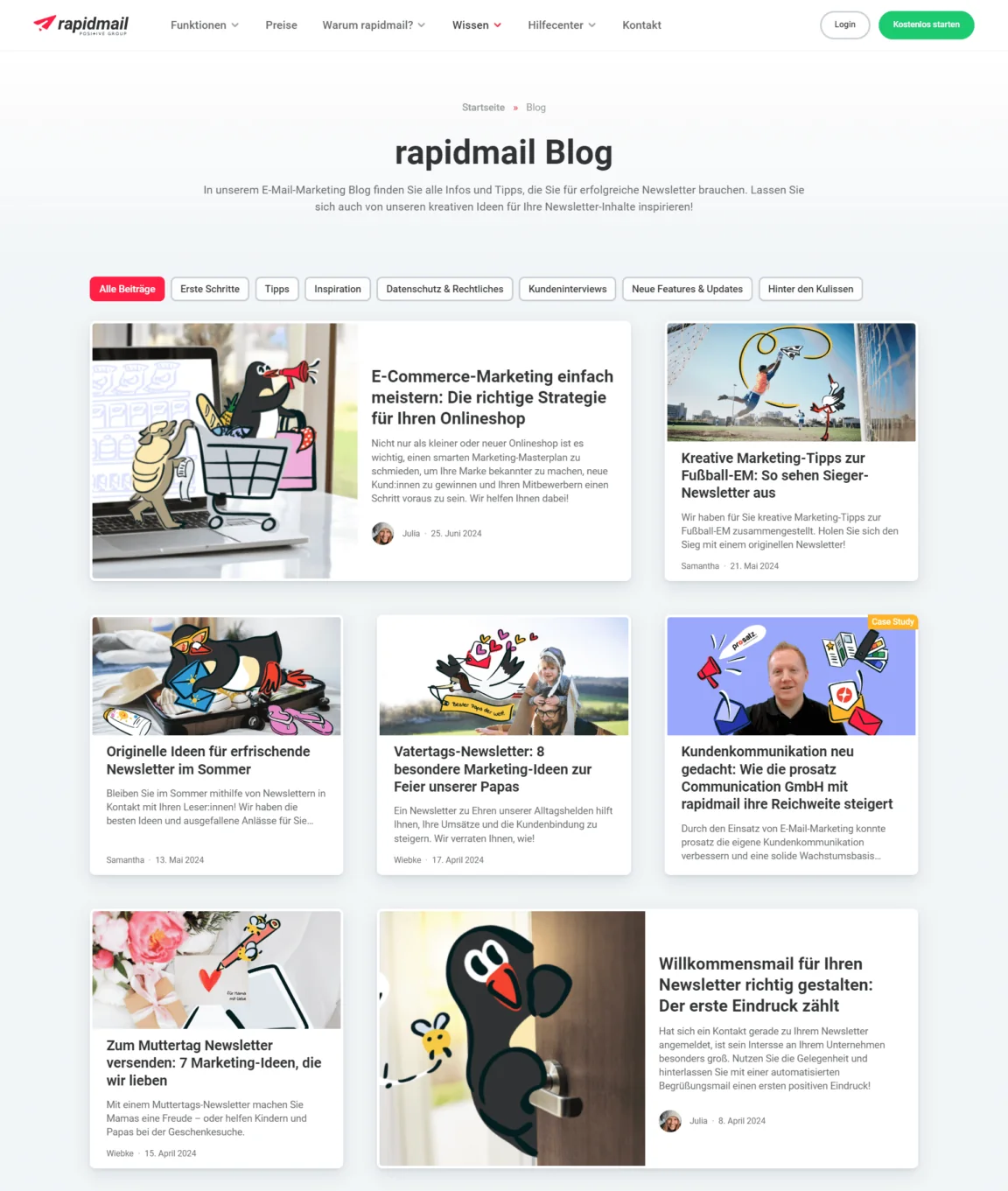
Try to provide helpful, relevant content regularly, for example through blog articles, guides or targeted landing pages on your website. The topics should naturally suit your industry. As an email marketing tool, for example, rapidmail regularly shares useful tips, guides and inspiration about email marketing on our blog, in the hope that our content will help other companies in their day-to-day work and enable us to build a reputation as an industry expert.
Content marketing can position your B2B company as a thought leader and expert in your industry. Particularly useful B2B content formats include in-depth analyses such as studies, surveys and data analyses; opinion pieces such as assessments of current trends, controversial topics or future developments; and expert interviews, such as top tips from your team, podcasts with your management or blog interviews with internal experts. Specialist articles, ebooks, white papers and case studies are also suitable formats for demonstrating your industry expertise and winning other companies as business customers.
Content marketing is often a sensible way to begin B2B marketing because published content lays the foundation for further online marketing activities. The content you publish on your company website is also the basis for search engine optimization (SEO): the more valuable search engines such as Google consider your content to be for users, the better it will rank on search results pages.
In turn, the more care you put into your content to provide potential business customers with detailed service descriptions and useful, unique information, tips, guides or inspiration, the more likely it is that more potential new customers will visit your website. Suppose you hire out venues to companies: it could be worthwhile publishing an article about “corporate event ideas” on your website blog, as an average of 1,000 users a month search online for ideas using precisely this keyword (source: Semrush, 2024).
Alongside useful tips and guides, your service or product pages should contain enough content tailored to a specific set of keywords. After all, your main objective is for users searching online for services or providers with specific terms to arrive on your website and be encouraged to make contact.
Suppose many users search online for “corporate event venue”. As a venue hire company, you should provide a dedicated page for that search term. On further subpages, you can then tailor your descriptions to more detailed search terms according to your offering, such as “outdoor corporate event venue”. The best way to discover which terms users search for on Google and other search engines is with an SEO tool such as Surfer, Sistrix or Semrush. You can learn more about B2B search engine optimization on the Surfer blog.
Also make sure that your product or service pages have a clear, informative design, so that potential and existing customers find everything they need to make contact, including professional product images, precise information about the scope of service, prices and cancellation options, and details of how to get in touch.
👀 Did you know?
By filling not only the product or service pages on your website with content and optimizing them for search engines, but also offering useful knowledge, tips and guides on relevant industry topics through a blog, for example, you strengthen your overall “website authority”. The more valuable content you provide on current, relevant industry topics, the more expertise Google attributes to your website and the more it regards your company as an industry expert. This can also improve the rankings of relevant pages such as your home page or offer pages in Google’s search results, bringing more users to your website.
💡 5 rapidtips for your B2B content marketing
- 💭 Start by planning a sensible website structure: check which search terms users use to find your products or services and use them to decide which categories to include in your website navigation and which keywords should appear on your most important pages. Once the basic structure is in place, you can begin filling your website with content.
- ⏱️ Give your content time: content marketing and SEO are B2B activities that only produce results in the long term. Initially, it takes time for Google to index the first articles and product pages and determine where your company’s expertise lies and which services or products you market. As you add more valuable content over time, rankings improve, which becomes apparent through rising visitor numbers.
- 🔎 Use an SEO tool for relevant keywords: in B2B online marketing, it is worth investing in a good SEO tool. This makes it easy to find out which keywords users employ when searching for your offers and which terms your competitors target with well-ranking landing pages, offer pages or blog articles.
- 👑 Choose quality over quantity: artificial intelligence (AI) can produce copy in no time, right? We recommend using AI tools only to create a solid starting point. Take the time to optimize your website copy so that it fits your brand and audience and contains unique information that users cannot find on 1,000 other pages. Your visitors and Google will be delighted!
- ✒️ Give metadata enough attention: for every page on your company website, you can define individual metadata, for example in your content management system, consisting of a title (meta title) and description (meta description). These are the texts Google then displays for that page in the search results. Make sure that your metadata contains all important keywords and information, respects the maximum character count and, of course, encourages users to click.
Email marketing
Email marketing is an indispensable advertising activity for B2B companies and should certainly form part of an ideal marketing mix of relevant channels. With varied, personalized content such as presentations of new products or services, information about your company and team, or interesting special offers, B2B email marketing can help you win new business customers, build long-term loyalty among existing customers, win back former customers and thereby increase your revenue.
Why email marketing is worthwhile in B2B
- 💸 You accompany your contacts throughout the customer lifecycle: whether potential business partners are looking for suitable solutions, making a purchase decision or have already completed their first transaction, targeted newsletters and offers let you give interested contacts exactly what they need at that moment. Automated transactional emails after a purchase let you keep customers informed about their order and delivery status and send invoices efficiently. Automation emails also let you send targeted messages based on customer behavior, for example directly after registration or on important anniversaries such as a customer’s company anniversary.
- 💌 You contact interested people exclusively: for GDPR-compliant email marketing, you may contact only people who have expressly consented to receiving your marketing emails. Your newsletter list therefore consists exclusively of contacts who have already shown an interest in your company and services. You avoid wasted coverage and can focus on potential business partners who want to learn more about your offers and solutions and are receptive to them.
- 🖱️ Your contacts reach your website with just one click: for B2B companies, product and service newsletters are a smart way to guide interested contacts to further information or direct offers on your website with a simple click on a newsletter link. Whether they are using a laptop or smartphone, if subscribers like an offer in the newsletter, they can learn more on your website or purchase the product immediately.
- 💰 Email marketing does not involve high expenditure: compared with other channels, the return on investment (ROI) of email marketing is particularly high: every euro you invest in email marketing generates an average of €44 (source: EmailToolTester, 2021). Newsletter sending prices vary by tool, but generally start at just €15 per month.
- 📊 You can easily measure and optimize results: if you use a professional newsletter tool for your company’s email marketing, it collects important metrics for every campaign, showing whether and how well contacts respond to your newsletter offers. If you also track newsletter conversions with Google Analytics 4, you can even analyze how much revenue each article placed in the newsletter has generated.
👀 Did you know?
Email marketing is a popular, valuable channel in B2B online marketing: almost 70% of B2B marketers use email marketing to generate leads and retain customers. Only company websites and content marketing through a blog are used more frequently (source: Content Marketing Institute, 2021).
B2B online marketing example: How prosatz uses email marketing
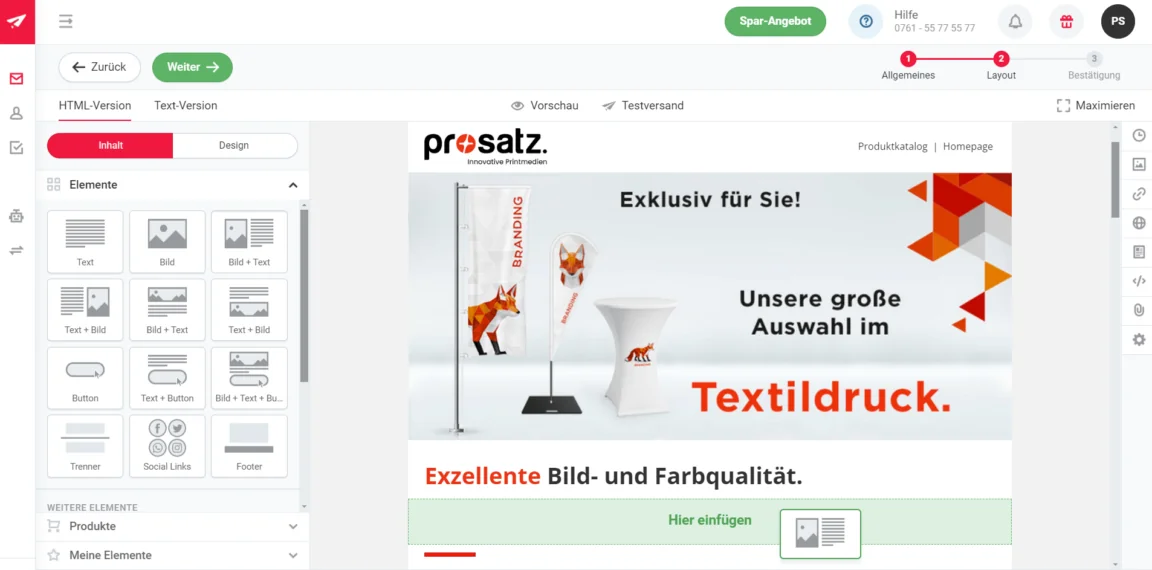
prosatz GmbH uses email marketing as a cost-effective way to inform new and existing customers about current offers, updates and its range in general. In the video, Head of Marketing and Head of Graphics Markus Müller explains the objectives his B2B company achieves through newsletter campaigns, why his team chose rapidmail as its email marketing tool, and shares tips for getting started quickly:
💡 5 rapidtips for B2B email marketing
- ✂️ Segment your business customers into subgroups: divide your audience by industry, company size or specific needs. By discovering your business customers’ interests and purchasing habits and tailoring newsletter content accordingly, you can increase the click rate in your newsletters and traffic to your company website.
- 💡 Do not send product offers exclusively: if your newsletter only advertises products and discounts, your subscribers will eventually get bored. Maintain their interest by sending varied newsletter content, offering behind-the-scenes glimpses of your team and sharing customer success stories or fascinating industry knowledge.
- 🖌️ Design newsletters in your own corporate style: your B2B company’s online marketing strategy should be consistent. This includes a uniform newsletter design that matches your website and other communications, increasing brand recognition. Incidentally, rapidmail’s 1-click design automatically creates newsletter templates in your individual company design! Alternatively, you can start with predesigned newsletter templates and simply add your content.
- 👍🏻 Find out what interests your contacts most: every newsletter provides lessons for the next one. After each campaign, take a moment for newsletter analysis. Which content and topics generated the most interest? Which subject lines work better? As you learn more about your audience, you can tailor newsletter content more closely to them and keep contacts engaged over the long term.
- 📈 Place newsletter sign-up forms on frequently visited pages: to win more newsletter readers, do not hide your sign-up form in the website footer. Position it prominently on popular pages, for example in the sidebar or as a pop-up.
👀 Did you know?
The average open rate for B2B campaigns was 22.8% in 2024, which is 0.9% higher than the previous year (source: Inxmail Email Marketing Benchmark, 2024).
Free download: An effective online marketing strategy, with 33 inspiring real-world newsletter examples
Specific newsletter examples will certainly help you devise your own online marketing strategy. Take a look at our newsletter collection featuring best-practice examples from our customers and give your creativity a fresh boost. 💫
You will receive no fewer than 33 newsletter marketing examples for many occasions and from a wide variety of companies.
Curious? Download the successful newsletter examples now, free of charge. Enjoy exploring!
Download 33 inspiring newsletter examples for free (PDF in German)
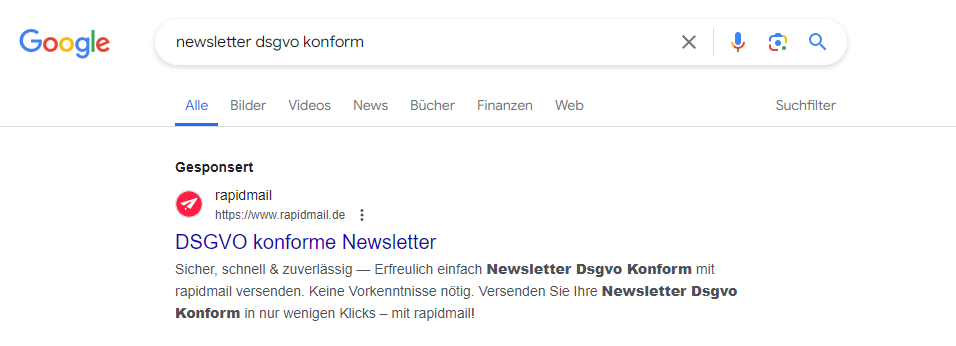
Pay-per-click advertising and SEA
Depending on the level of contest, it can make sense for your B2B online marketing to focus more heavily on search engine advertising (SEA), and particularly pay-per-click advertising (PPC), especially at the outset. Place targeted adverts on results pages for relevant Google searches and on websites frequently visited by corporate decision-makers. This increases the likelihood that potential business customers will notice your brand and services and click the advert to visit your website.
PPC advertising is particularly advantageous for smaller or new B2B companies seeking to use limited marketing budgets efficiently. Publishing the advert itself is free, and you pay only when an interested user clicks it to visit your website. The advantage is that you invest only in users who have already shown an initial interest in your offers.
👀 Did you know?
If you place an advert through Google Ads today, it may generate initial page views and possibly even initial purchases tomorrow. Unlike SEO, SEA takes effect immediately. Google Ads are displayed through an auction: as an advertiser, you bid the amount that a user’s click for a specific keyword is worth to you. Depending on the type of keyword and level of contest, the bid range is between approximately €2 for your own brand name, for example, and €15 for highly competitive keywords.
SEA and PPC campaigns let you increase your online visibility quickly and build awareness of your brand among your audience. The ability to regulate expenditure individually as needed gives you great flexibility and lets you respond quickly to market changes, seasonal trends or special promotional days. This is particularly valuable in B2B, where purchasing decisions are often complex and involve several decision-makers.
💡 5 rapidtips for B2B SEA and PPC advertising
- 🗨️ Address your audience correctly: consider the professional roles, company sizes and industries of your audience when writing adverts. The more closely the copy is tailored to potential business customers and the more precise the call to action at the end, the more likely they are to click your advert.
- 🗝️ Bid on the right keywords: when selecting keywords, focus on niche, industry-specific long-tail keywords. These are keywords concentrating on specific business solutions, services or products that are relevant to your target companies and face as little competition as possible.
- 🖌️ Design appealing adverts: compared with B2C advertising, your B2B adverts should rely less on visual elements and primarily provide extensive information that is relevant to your audience and sparks interest. Make sure your adverts look professional and reputable; among other things, they should contain no errors.
- 🎁 Persuade with suitable incentives: to encourage clicks on your advert, include targeted incentives in the copy. Offers such as free demos, webinars or a no-obligation initial consultation are especially suitable in B2B.
- 🧪 Run A/B tests: by entering several advert variants for the same keyword, you can test different copy, headings and CTAs to determine the most effective combinations. You can then keep optimizing your adverts based on the results.
Social media marketing and influencer marketing
In B2B internet marketing, social media channels such as LinkedIn, YouTube and Twitter are ideal platforms for presenting your company and offers while also building a personal relationship with your audience and contacting decision-makers and specialists. Depending on the channel, you have different options for addressing users in your target audience with suitable content based on demographic characteristics, interests and behavior.
Organic social media marketing
First, it is important today to create profiles for your brand or company on relevant social media platforms and promote them through other communication channels such as your newsletter and website. Regular informative and varied posts let you win new followers and gradually increase your reach.
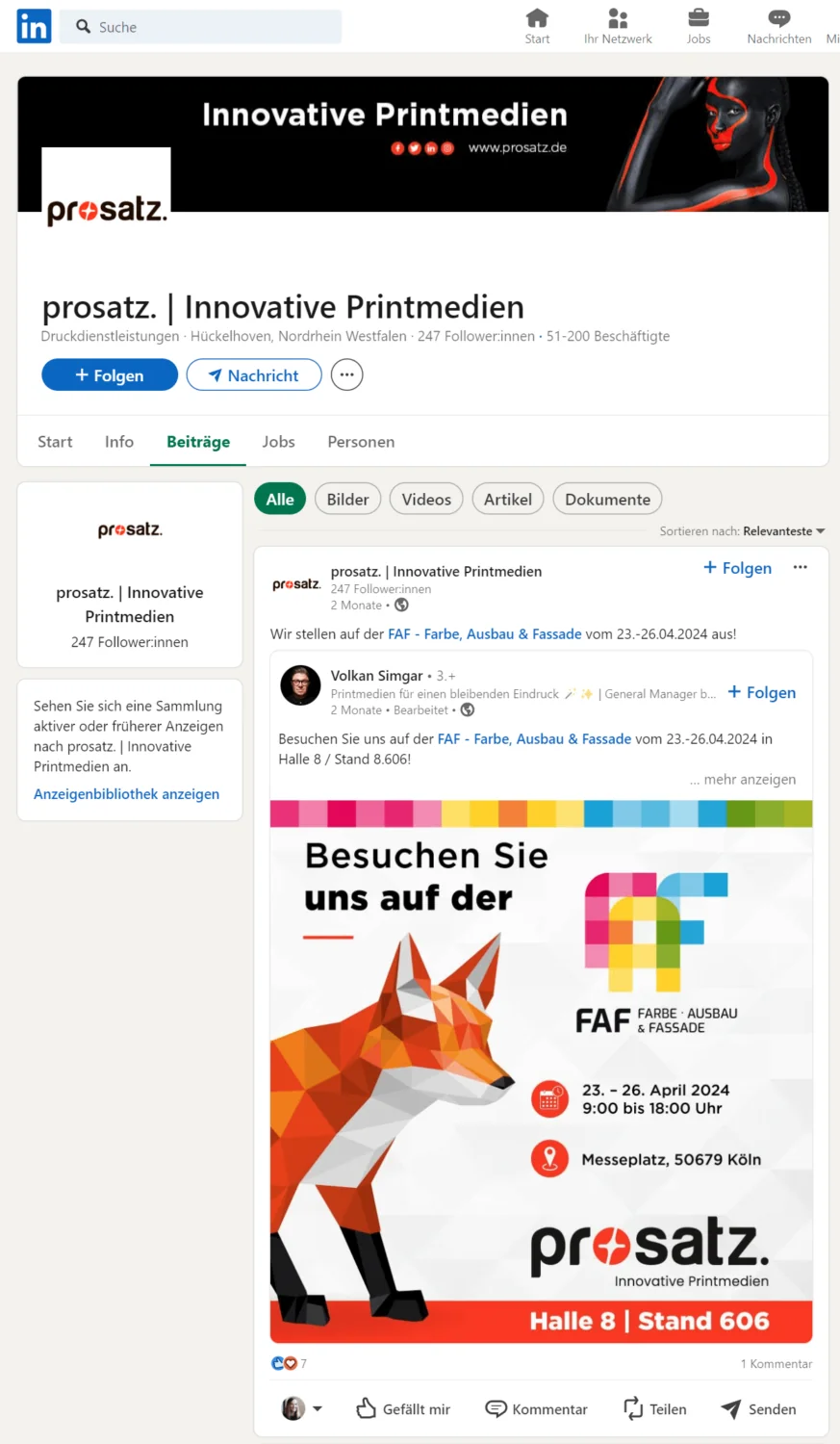
Be patient: begin by testing which platforms and social content formats, such as slideshows, videos, reels, photos and LinkedIn Ads, are best received by your audience. Especially when you do not yet have many followers, it is perfectly normal for your posts not to go viral or receive many likes or comments. For maximum recognition, make sure your social posts have a design that matches your company website.
Content ideas for your B2B social media marketing
- 💌 Informative LinkedIn newsletters: LinkedIn is probably the most important social media platform for B2B companies seeking to establish business contacts and build awareness. Publishing LinkedIn newsletters, for example about fascinating industry insights or useful tips for your business contacts, can further increase your reach and win new followers.
- 🏆 Case studies and success stories: share interviews with customers who have already bought your products or used your service. Being open and honest about criticism rather than concealing it strengthens trust in your company, and you can learn from mistakes too. Use a good mix of text, images and short videos in social media posts to tell customer success stories. Include interesting information about the challenges your customers can overcome with the help of your offers.
- 🔎 Industry insights and research findings: LinkedIn and Twitter are well suited to positioning your company as a thought leader in its industry. Conduct surveys or studies on current topics and share the findings with your followers. Clear infographics summarizing the most important insights are particularly useful.
- 🖥️ Webinars and live events: hold regular webinars or live streams on platforms such as LinkedIn Live or YouTube. Promote events in advance through other channels such as your newsletter and provide recordings to attendees afterwards. Live events give your brand a face, facilitate personal dialogue with your audience and increase the likelihood that followers will eventually become new or repeat customers.
- 💡 Tips on using your products or services: how do users correctly submit company credit card expense receipts in your accounting software? How should office spaces be left in the evening so that your cleaning team can do a good job for corporate customers? Use your social media channels to lend business contacts a hand and remove any obstacles that might arise when using your offers.
- ❓ Interactive content such as surveys and contests: ask followers for their opinions or invite them to enter a contest. Content that followers can actively respond to strengthens their relationship with your brand, products and content.
- 🤩 Exclusive product previews and discounts: sharing exclusive content such as product previews, invitations to the next launch party or interesting discounts for existing customers shows your appreciation and encourages followers to continue following you attentively on social media.
- 🎥 Team insights and behind-the-scenes glimpses: show the people behind your team and great products. Who answers customer questions on the phone, who organizes team events for business customers, or who prints advertising banners for your next trade fair? Showing the faces of your team and telling personal team stories creates a sense of closeness with your followers.
- 📸 High-quality product photos and videos: use professional product photos and videos in posts to convey precisely the values behind your brand. For example, post photos of breathtaking office roof terraces where customers can enjoy cool refreshments from your delivery service, or make a video of cheerful team events that you organize for business customers.
💡 rapidtip: The more original the content, the better
Social media in particular is a marketing channel driven by creativity and unique content formats. Do not focus too rigidly on simply presenting your offer. Fill your profile with entertaining and exciting content that makes your B2B company more likeable and strengthens people’s connection with your brand. Above all, your followers want to have fun and learn something new when they use social media!
Paid advertising campaigns and influencer marketing
Alongside free organic social media marketing for your company, you can run paid advertising campaigns, either by placing paid adverts in your audience’s feed or by working with influencers who advertise your brand or products.
LinkedIn Ads, for example, offer detailed targeting options for adverts based on job titles, industries, company sizes and professional interests. This is ideal when you want your adverts to reach decision-makers or specialists in a particular industry.
Influencers are well-known social media personalities who generally have large followings and therefore extensive reach. When influencers show their followers how your products help them in everyday life, your brand reaches completely new audiences and becomes better known in the market. The personal experiences influencers share about your products also help build followers’ trust in your brand and offers, increasing the likelihood that they will contact your company.
You pay influencers to advertise your company, depending on their reach and individual contractual agreements, with a specified amount of money, free products or discounts for using your services, for example. Take the opportunity to ask influencers whether they would be interested in working with your company to produce specialist articles, case studies, webinars or videos that present your products or services in a credible context. Influencers also gain attention and, ideally, new followers, making it a win-win situation for both sides!
💡 rapidtip: Find the right influencers for your B2B company
If there are no well-known, recognized people in your industry who suit your offers and audience, you can search the relevant social media channels yourself. Which public profiles with large followings use particularly high numbers of hashtags that fit your offers and industry? Contact these people and simply ask whether they are interested in working together.
Alongside your own research on platforms such as LinkedIn and Twitter, you can use specialist influencer marketing tools to identify experts and thought leaders who regularly share relevant, valuable content. Analyze their engagement rates, content quality and authenticity to make sure they are credible and trustworthy. Ensure that they have a genuine connection with their audience and are prepared to enter into a long-term partnership with your company that goes beyond mere advertising.
Podcasts
Podcasts are digital audio recordings distributed online and published regularly as episodes. Listeners can download or stream podcast episodes on platforms such as Spotify or Apple Podcasts, and they cover an enormous range of topics. From travel reports and financial tips to specialist marketing knowledge, everything is now available in podcast form.
For your B2B company, podcasts offer a good additional platform for sharing in-depth insights, specialist knowledge and industry news. Combined with personal information or opinions from the speakers, podcasts allow your company to build a direct, personal connection with your audience.
Content ideas for your B2B podcast
- 📈 Discuss current industry trends: present current trends and developments in your industry and explain how they affect your business. External market research studies and surveys also provide a good foundation for sharing and discussing interesting or important findings in a podcast.
- 🎙️ Expert and customer interviews: invite important, well-known figures from your industry to discuss current trends, challenges and future prospects. You can naturally also invite internal experts from your team to share their specialist knowledge and provide fascinating insights into their fields.
- 🌟 Present case studies and success stories: nothing inspires more trust than hearing stories from customers who have already used your products or services and achieved significant results. However, the podcast should also address difficulties or challenges so that customer stories remain authentic and genuinely help your listeners.
- 📝 Project reports: offer listeners a glimpse behind the scenes at your company. Talk about completed projects, for example, and explain how you came up with the idea, which points had to be considered during planning, and the added value the project provides for your audience.
- 🤖 Technology updates and innovations: discuss the latest technological developments affecting your industry. Have they prompted innovative projects in your company? What influence do they have on internal or external collaboration?
- 🗨️ Live Q&A sessions: live question-and-answer sessions allow listeners to ask the questions that have long been on their minds. This creates direct contact with your audience and gives you an opportunity to resolve any uncertainties about your offers.
As part of your B2B online marketing strategy, podcasts are a flexible way to explore complex topics in depth and demonstrate your expertise. This strengthens your audience’s trust in your company and your status as an industry expert. It is important to publish new episodes regularly to build a loyal, growing audience and keep your company in listeners’ minds.
To promote your podcast, use different marketing channels for maximum reach. You should of course publish your podcasts on popular podcast platforms such as Apple Podcasts, Spotify and Google Podcasts. You can also attract listeners by promoting your podcast through additional channels such as your website, social media and newsletter.
💡 rapidtip: Strengthen listener engagement through interactive dialogue
Collect feedback from your listeners, for example, or ask them to suggest topics for upcoming podcast episodes. By discussing these suggestions at the start of the next episode, you give your audience the feeling that they can actively participate in the podcast. This increases the likelihood that they will become loyal listeners.
4. Let’s get started: How to develop the right B2B internet marketing strategy
As you can see, there are many different options and channels from which you can assemble your individual B2B online marketing strategy. And so far, we have concentrated only on the online marketing activities that we consider particularly useful at the outset for increasing awareness of new or small companies as quickly and effectively as possible.
It is now up to you to develop a carefully considered marketing concept for your B2B company from all these possibilities. There is naturally no single correct model strategy: every company must determine where and how it can best reach its audience. Nevertheless, we can give you the most important steps for developing your successful B2B online marketing strategy for 2024:
Step 1: Define your audience
To develop relevant content and distribute it through the right communication channels, you first need to find out exactly who your audience is. The following questions can help you define the audience for your B2B marketing strategy:
- ❓ Which companies are your ideal customers?
- ❓ Which customers generate the most revenue?
- ❓ Which companies or industries need my products or services?
- ❓ Who makes the decisions in these companies?
- ❓ What challenges and needs do the decision-makers have?
- ❓ How and where do these decision-makers find out about solutions?
- ❓ How does my audience differ from my competitors’ audiences?
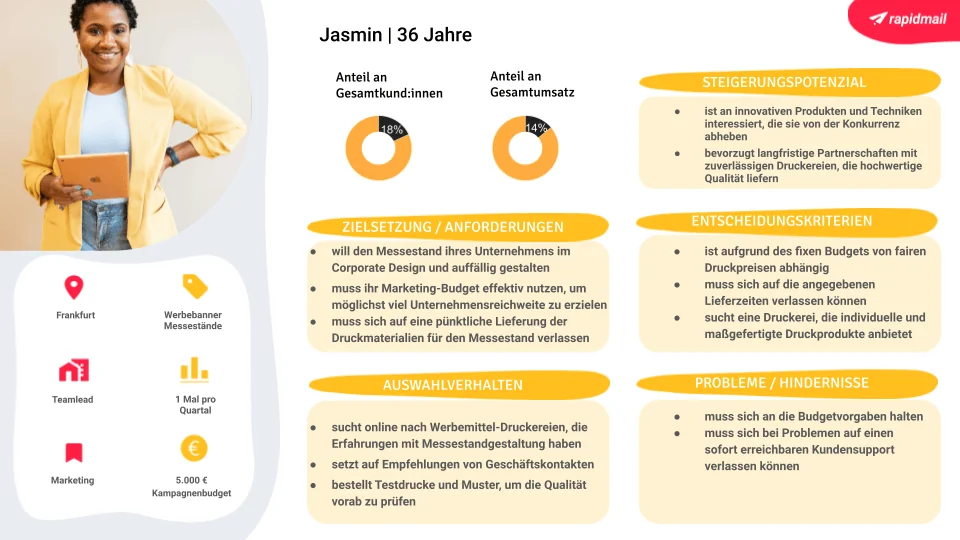
Although companies within your audience will certainly have things in common, do not underestimate the individuality of potential business customers. Instead of imagining a homogeneous group of customers, it makes a great deal of sense to develop different personas that you can use as a guide.
Personas are fictional users from your audience who have specific characteristics, needs and expectations just like real people. In B2B online marketing, personas therefore help you produce helpful, relevant content tailored precisely to the interests and problems of decision-makers within your target companies.
Step 2: Check which channels your competitors use
Look around the market to see which marketing channels your strongest competitors use and assess whether they work. This can already give you an initial impression of the channels and methods you should focus on first.
Nevertheless, it is important not to copy every advertising campaign from your competitors exactly. Do it even better! Successful B2B online marketing requires you to take risks occasionally, experiment extensively and explore completely new avenues. Use this opportunity to gain a competitive advantage as a new or small company.
Step 3: Consider the story your brand should tell
Once upon a time… All good stories begin in a similar way. Your company’s marketing strategy also needs a common thread running through all your advertising activities. To write your story, ask yourself the following questions in advance and consider how you can use the answers to develop a vision and mission for your business that are reflected in every advertising activity:
- ❓ What values does your company represent?
- ❓ How do your offers help your business customers?
- ❓ What objective was your company founded to achieve?
- ❓ If employees had to describe your company in three words, which would they choose?
Whether your focus is on environmental friendliness, fair pricing, team spirit, fast delivery, simplicity, customer service or local involvement, your advertising should convey precisely the values that your team lives by every working day. Do not tell fairy tales: authentic content is generally the content that inspires people most.
Step 4: Select suitable marketing channels
One thing at a time: start by choosing the channel that you think will reach your audience most effectively. Focus initially on developing and using this channel until it successfully wins new business customers.
At the same time, you can begin approaching more channels, learning about them, and determining which internal and external capacities and resources are needed to use additional marketing channels successfully for your B2B company and make many potential business customers aware of your brand.
Once you have built a solid, satisfied customer base, customer loyalty programs and referral programs, for example, are an effective way to retain business customers over the long term and almost magically win new customers through your satisfied contacts. Press relations or PR (public relations), as well as affiliate marketing, are also important high-potential marketing channels that you can incorporate at a later stage, once you have successfully established the most important channels for your company.
💡 rapidtip: Persuade potential and existing customers with email marketing
Sending newsletters offers the major advantage that recipients actively sign up for your advertising messages and have therefore already shown considerable interest in your company and offers. Segmentation and tagging features also let you divide your list using criteria such as industry, job title or company size, allowing you to send particularly relevant, interest-based newsletters to your contacts. Promotional newsletters for seasonal occasions such as Black Friday with special offers and discounts are also an excellent way to encourage product sales, win new customers and build long-term loyalty to your brand.
👀 Did you know?
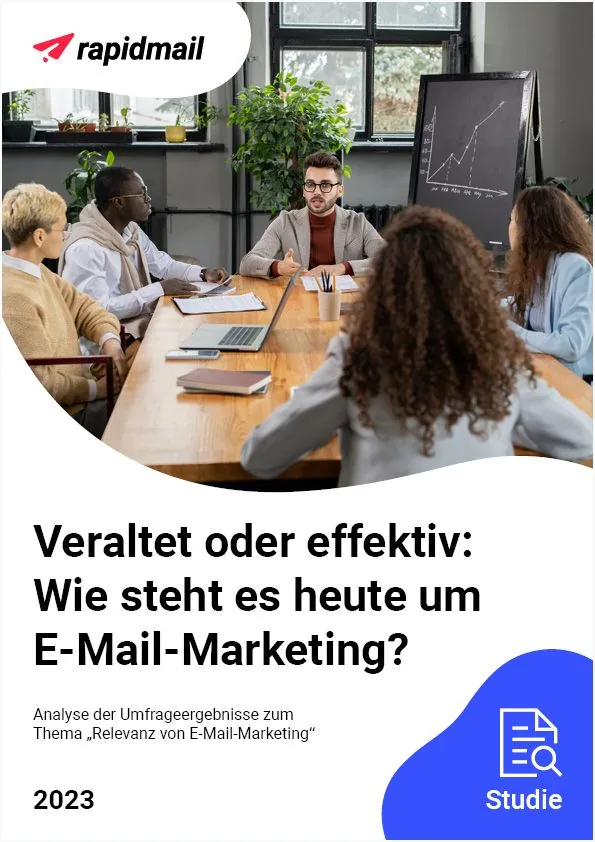
Our study on the relevance of email marketing found that sending marketing emails and newsletters had a positive effect on revenue (57.1%), new customer acquisition (40.8%) and event attendance (54.7%) among the nearly 800 companies surveyed.
Survey findings on the relevance of email marketing
Get…
- … the most important insights and survey findings on the use and current relevance of email marketing
- … an insight into the industries and company sizes that use email marketing with rapidmail as an advertising channel
- … an overview of the objectives, effects and possible challenges of newsletter marketing for companies in Germany
- … tips for finding interesting newsletter content for your own audience
- … an outlook on the future of email marketing
Download all survey findings for free (PDF in German)
Step 5: Let marketing tools support you
Editing product photos easily, publishing social media content on several platforms at once, finding important SEO keywords for product pages, or designing newsletters quickly and easily with drag and drop: today there are smart marketing tools for every task and channel that reduce your workload and save time. Research online in advance, using software comparison sites such as OMR Reviews, to find out which software offers which features and pricing models and which will best help you implement your B2B online marketing strategy effortlessly and successfully.
👀 Did you know?
With rapidmail, you can send your first newsletter to up to 2,000 contacts free of charge, allowing you to test whether our email marketing tool offers all the features you need for your B2B marketing. What are you waiting for? Take a leisurely look around:
Open video transcript
Chapter 1: Introduction
No time for lengthy training and complex features? rapidmail lets you create and send simply excellent newsletters!
Email marketing with rapidmail gets you to your goal in no time, whether you want to win new customers, attract more attendees to an event or boost sales in your online shop.
Hi, my name is Wiebke, and today I will show you that with rapidmail, you need neither prior knowledge nor a great deal of time to design excellent newsletters and move closer to your company objectives. So let’s not beat about the bush: let’s simply get started!
Chapter 2: Navigation and first steps
You can reach everything from the dashboard. For example, you can create a new campaign directly. To make your newsletter a hit with contacts, you can address them individually with our personalization fields, add emojis to the subject line and consult the automatic subject line checker. It shows you how effective your subject line is and what you could improve.
Our 1-Click-Design makes newsletter design child’s play. Simply enter your website URL and, hey presto, rapidmail creates a design template featuring your logo, company colors and fonts. You can make further adjustments here if you wish, then save it.
Now choose one of more than 250 free templates, and your newsletter’s basic structure is ready! You can now replace and fill all the content as you wish.
Chapter 3: Design and customization
The integrated image editor and our free image library, containing more than 1.5 million high-quality, royalty-free images, are particularly useful. They save you extra steps and additional tools!
If you have an online shop, our free plugins make it easy to connect it to rapidmail and synchronize your customer and product data automatically. Then use our one-click product import to drag products directly from your online shop into the newsletter.
It is now time to examine the draft closely with the preview feature. Does personalization work? Does the newsletter look good on different devices? You can then send test emails to up to 10 email addresses, free of charge of course!
Before the newsletter goes out, put deliverability through its paces and make any final corrections. This ensures your campaign does not end up in spam. Thanks to our top deliverability, rapidmail gets your newsletter to its destination particularly reliably.
Everything looking good? Your newsletter can now set off, either immediately or automatically at a specified time. Your first campaign to up to 2,000 contacts is on us, so you can test rapidmail at your leisure.
Chapter 4: AI sending planner
If you ever lack inspiration for newsletter content, our AI sending planner uses artificial intelligence to create an individual newsletter sending plan for your company. Simply enter the company name, a few keywords and a short description and, hey presto, there is your individual sending plan with newsletter ideas for the entire year!
Chapter 5: Contact acquisition
rapidmail also supports you in winning new contacts. Just as with 1-Click-Design, you can create newsletter sign-up forms that perfectly match your website design in only a few clicks.
You can upload existing contacts to rapidmail easily from CSV, Excel or text files using copy and paste. You can also assign as many tags as you like to contacts to ensure that they receive only the campaigns that genuinely interest them.
Chapter 6: Data protection and segmentation
Data protection is our highest priority! At rapidmail, every process is 100% GDPR-compliant. Your contact data is stored exclusively on servers in Germany, so you do not need to worry.
To address contacts particularly precisely, you can divide them into segments, for example by age group, gender or place of residence, and then select these segments when sending so that your newsletter reaches only specific subgroups.
Incidentally, we are very approachable! If you have questions or difficulties, our support team will be happy to help, free of charge by telephone or through the ticketing system directly in the tool.
Chapter 7: Reporting and analysis
After sending your newsletter, you can track its success in real time. Thanks to the automatically generated newsletter statistics, rapidmail gives you an overview of all important email marketing KPIs.
Our campaign statistics help you understand your audience’s interests and wishes ever more clearly and send more successful newsletters.
Want to know every detail? In the activity history for individual contacts, you can see exactly which campaigns a recipient has received, opened and clicked. These reporting options allow you to learn more about your contacts and tailor newsletter campaigns even more precisely.
Chapter 8: Email automation
If you want to tailor your email marketing even more closely to your contacts, you should certainly try our email automation. You need no prior knowledge and can create individual email sequences in just a few clicks, for example for welcome and birthday greetings or multi-part courses. We provide practical workflow templates that make getting started even easier!
Chapter 9: Prices
Finally, a few words about our prices. If you want complete flexibility and to pay only when needed, our pay-per-send plan is ideal for you. If you want to send newsletters regularly, our monthly subscription packages “Starter” and “Premium” are perfect. You can get started from just €15 per month and send an unlimited number of emails. Our price calculator on the website helps you find the right package. You can of course switch, pause or cancel your package at any time.
Sound good? Try rapidmail for free and see for yourself that rapidmail lets you send professional newsletters without being a newsletter professional!
Step 6: Measure results and optimize your marketing strategy
To find out whether your sophisticated marketing strategy works and brings your company more business customers and higher revenue, you should evaluate important metrics regularly and analyze what is working and what is not. Only by taking the time to observe the different marketing channels closely and compare the results can you determine which adjustments are needed to optimize your strategy further.
Your marketing tools will generally help you evaluate advertising activities easily using automatically generated statistics. One more reason to rely on professional tools instead of reaching for a calculator and wrestling with complex Excel spreadsheets! 🧮😶🌫️
💡 rapidtip: The 5 most important metrics (KPIs) for your B2B online marketing strategy
- 🏎️ Website traffic: broken down by traffic source (SEO, SEA, direct visits, newsletters and so on), this helps you discover which channels are most relevant to your company
- ➕ Number and quality of leads generated through online marketing activities: this helps you identify the marketing activities on which you should focus
- 🔄 Conversion rate: the percentage of website users who perform a desired action, such as completing your contact form, signing up for your newsletter or purchasing a price package; among other things, this helps you identify your audience’s most important needs and the most persuasive arguments
- 💸 Average revenue per account (ARPA): this helps you discover which customer group generates the most revenue for your company and should therefore receive your focus
- 💰 Return on investment (ROI): calculated using the revenue generated and marketing costs, this measures how profitable your online marketing activities are
5. Outlook: Follow current B2B digital marketing trends
Although offline marketing activities can continue to work for B2B companies, it is important to keep up with the times and place greater emphasis on digital marketing trends and channels today.
For a successful B2B online marketing strategy, multichannel marketing is now your best option. It uses offline and online channels in parallel to reach as many potential business customers as possible and increase your company’s visibility through different routes.
Using artificial intelligence (AI) and email automation tools already reduces your workload and makes it possible for even a small team to cover several marketing channels. Automating processes or supporting them with AI, through an AI newsletter sending planner in email marketing for example, allows your company to work more efficiently and make more targeted decisions.
The many intuitive marketing tools available today also reduce the time needed to create a newsletter or design a social media post, for example. Useful features also help you send your audience personalized advertising and product recommendations and inspire them with tailored content. This can reduce your newsletter unsubscribe rate and the likelihood that contacts will stop following your company on social media.
But do not make false promises: remain authentic and credible in your communications as a company and team and make sure you comply with important legal requirements, such as the GDPR, competition law and copyright law, so that other companies can place their trust in you without hesitation.
By embracing digital trends and incorporating online marketing channels into your B2B company’s strategy, you can not only reach even more business customers but also secure a sustainable, successful market position.
So, put your creative heads together and devise an individual B2B online marketing strategy that will inspire many new business customers! If email marketing is a channel you would like to try, you can test our email marketing tool for free and send your first campaign to up to 2,000 contacts at no charge.