Inbound marketing made easy: your guide to the perfect strategy
What is inbound marketing? Inbound marketing is a more modern and efficient advertising method than impersonal mass emails or random television commercials, which most recipients barely notice any more. With engaging and useful content, inbound marketing can make new contacts aware of your brand, then targeted email marketing can turn them into leads and customers. Our guide helps you develop your own effective inbound marketing strategy, step by step. Let’s get started!
1. Inbound marketing definition: what exactly is it?
Inbound marketing consists of useful information and content that a business publishes about a specific topic. It attracts prospects who then take the initiative and approach the business themselves. In this way, potential customers make the first, non-promotional contact.
If prospects like the content the business has published and it precisely addresses their questions and needs, they are more likely to visit the website again, subscribe to the newsletter and even become customers. This allows you to generate high-quality leads, meaning qualified contacts who are interested in your products and offers, and therefore familiarize potential customers with your brand. That is also the main goal of inbound marketing: to connect with more people in your target audience who do not yet know you, and gradually persuade them of the value of your brand and offers.
Inbound marketing can prevent unwanted scenarios, such as uninterested recipients quickly changing the channel during television adverts, throwing away direct mail or moving mass emails to their spam folder.
Instead, you can position yourself as a knowledgeable and trustworthy source of information and inspiration for your target audience and build lasting relationships with your customers.
👀 Is there such a thing as offline inbound marketing?
Inbound marketing is adapted to modern purchasing behavior and, because of the internet’s enormous reach, primarily uses online methods. Nevertheless, there are also some examples of offline inbound marketing:
- printed checklists
- free printed guides
- guest articles in print magazines
- presentations
However, offline marketing is often more expensive and time-consuming, making online inbound marketing the more efficient option for most businesses.
2. Outbound vs. inbound marketing: the difference
Alongside inbound marketing, there is also outbound marketing, the “traditional” form of advertising. To help you distinguish between the two forms, we have compiled a comparison and the key advantages and disadvantages.
| Outbound marketing | Inbound marketing | |
|---|---|---|
| Definition | Outbound marketing means addressing the target audience with disruptive or interruptive advertising. Businesses therefore actively approach potential customers with an advertising message. | In inbound marketing, businesses produce useful content that provides value and attracts potential customers. Compared with outbound marketing, inbound marketing is permission-based and does not impose itself on potential customers. Here, the target audience takes the initiative and approaches the business. |
| Examples | Cold calling, television advertising, radio advertising, print ads, direct mail, social media ads | Newsletters, e-books/white papers, infographics, blog articles, guest articles on third-party blogs, checklists, social media posts, presentations and webinars, free guides, explainer videos and podcasts, SEO, landing pages |
| Advantages | Outbound marketing activities can be planned and carried out relatively quickly and easily. As agencies are often commissioned for this type of advertising, the businesses running the adverts have relatively little work to do. The media used, such as television, radio and social media, also have a very wide reach. | Providing useful and relevant information can increase trust in the business as well as its credibility and visibility. Because it primarily attracts prospects, businesses obtain better leads than they do through outbound marketing activities. There is very little wasted coverage. Another significant advantage is the low cost of inbound marketing. |
| Disadvantages | Wide reach, agencies and broadcasting advertising all come at a price. Businesses that use outbound marketing therefore need to budget for high costs. Although outbound marketing can reach a very large number of people, it also involves considerable wasted coverage because very few recipients are genuinely interested in the advertising message. | Informative and relevant content is not created overnight. Effective inbound marketing requires you to invest a great deal of time and effort in producing information. Strictly speaking, an inbound marketing project never ends and should be continually developed and optimized to achieve the best possible results. To conserve resources, it is therefore advisable to use a marketing tool that helps you achieve your goals. |
In short, the two forms of marketing can also be distinguished using the English words push and pull. In outbound marketing, an advertising message is pushed toward the target audience (“push”). By definition, inbound marketing attracts the target audience with valuable content (“pull”).
👀 Is inbound marketing the right strategy for your business?
Are you wondering whether an inbound marketing strategy is the right choice for your business too? In most cases, the answer is a clear “Yes!” Every industry has engaging topics that you can cover in newsletters, blog articles, social media posts and more.
Young businesses in particular, as well as businesses incorporating this form of direct marketing into a smart e-commerce marketing strategy, have an opportunity to make themselves heard and increase brand awareness.
Best of all, you do not have to choose between outbound and inbound marketing. For the best possible results, the two forms of advertising can easily be combined.
Nevertheless, you should consider a number of fundamental factors, including budget, target audience and available time, when planning and implementing your marketing strategy.
3. How inbound marketing works: the four phases
So far, so good. Now it is time to delve deeper into inbound marketing and understand how a campaign is structured. The way inbound marketing works can be described using a four-phase model:
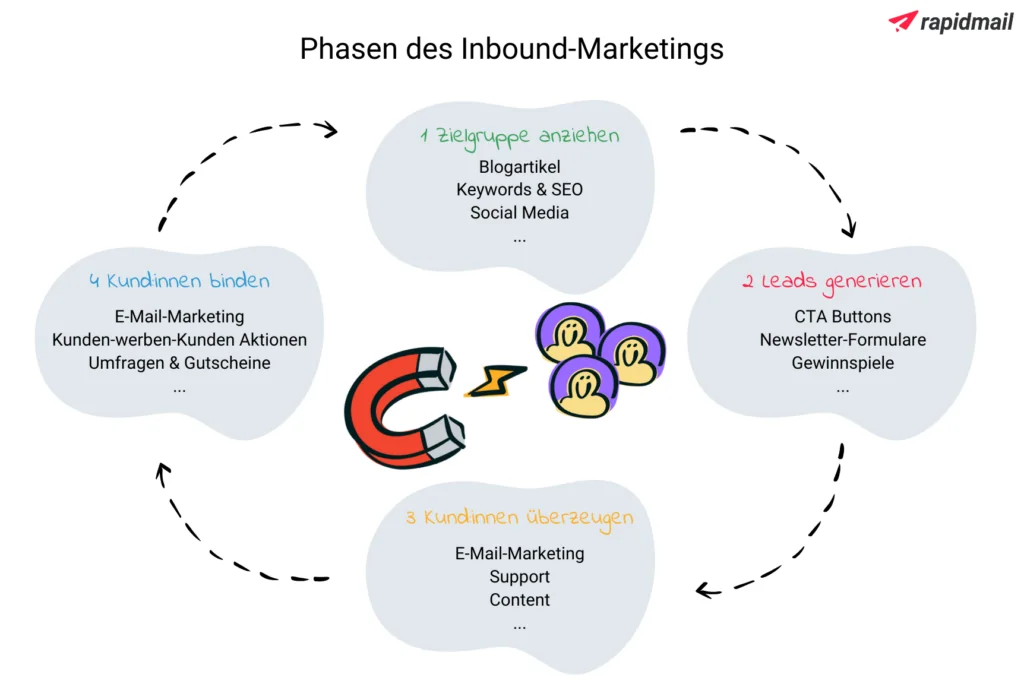
Phase 1: attract your target audience
The first step is to attract potential customers. You can do this by producing relevant and useful content and specifically sharing the information prospects are looking for. Blog articles with important keywords, search engine optimization (SEO) and engaging social media posts are ideal for this phase.
Phase 2: generate leads
Once prospects have made initial contact, your business should continually provide value while encouraging ongoing interaction. This process is known as “lead management” or “lead nurturing”. Features that prompt such interactions are also known as “lead magnets” and can include call-to-action buttons, newsletter signup forms or download forms for e-books, templates and similar resources. After a successful interaction and receipt of an email address, you should use follow-up emails containing more relevant content to try to turn contacts into valuable leads with purchasing potential. To acquire valuable new leads as successfully as possible, you should consider a few points:
- Define a lead management concept: Define the goal of your strategy, align everything with it and be as specific as possible: Which lead magnets do you want to use on which pages, and which target audience do you want to reach? What additional content should the contacts then receive to move them closer to making a purchase?
- Data protection compliance: Find out about all the legal requirements governing the collection of personal information in advance. What personal data are you allowed to request in the download form? Do you need explicit consent to process it, for example through double opt-in?
- Lead scoring, the evaluation process: This is about determining how ready your leads are for specific purchase offers. How much interaction is there between the contact and your business, how willing are they to buy and how close is the customer to the goal you are pursuing with the campaign?
Phase 3: turn prospects into customers
You can now interact with potential customers and actively approach them. Sending newsletters is especially useful during this phase to keep prospects up to date. If they are not yet convinced, you can use additional informative blog articles, video tutorials, podcasts or social media posts to show them how to get the most out of your products and demonstrate that these products precisely meet their needs.
Email marketing automations are particularly effective during these phases. Provide prospects with the necessary, relevant information at the right point in the process so they can ultimately decide in your favor. Final marketing emails containing targeted, personalized purchase offers allow you to turn your leads into customers.
During this important phase, you must provide your leads with all relevant information and offer assistance where necessary. Pass the leads on to your sales or support team too, so they can take good care of your carefully selected contacts.
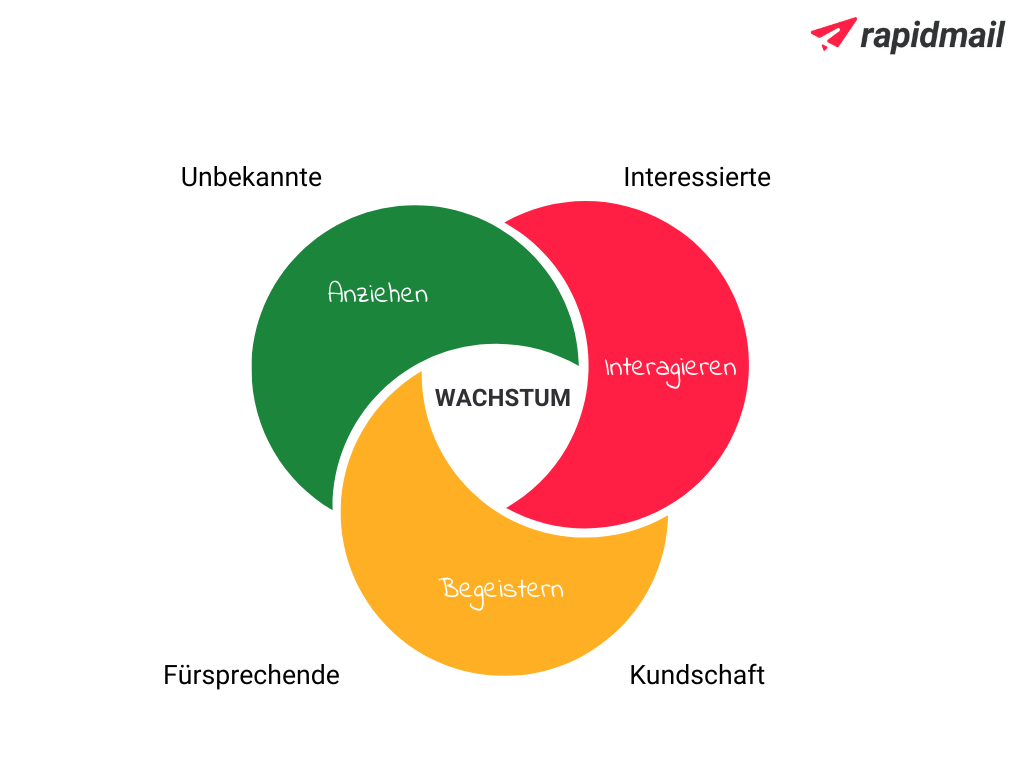
Phase 4: delight customers over the long term
To make sure that your newly acquired customers do not stop after a one-off purchase, it makes sense to maintain their interest and, in the final step, turn them into loyal customers. If this strategy works, your delighted customers will tell other prospects about their positive experiences with your business. Like promoters, they influence and support your inbound marketing. This also makes it clear that, strictly speaking, an inbound marketing campaign does not end. It is a cycle whose phases drive one another.
💡 rapidtip: put customers first from the outset with the right strategy
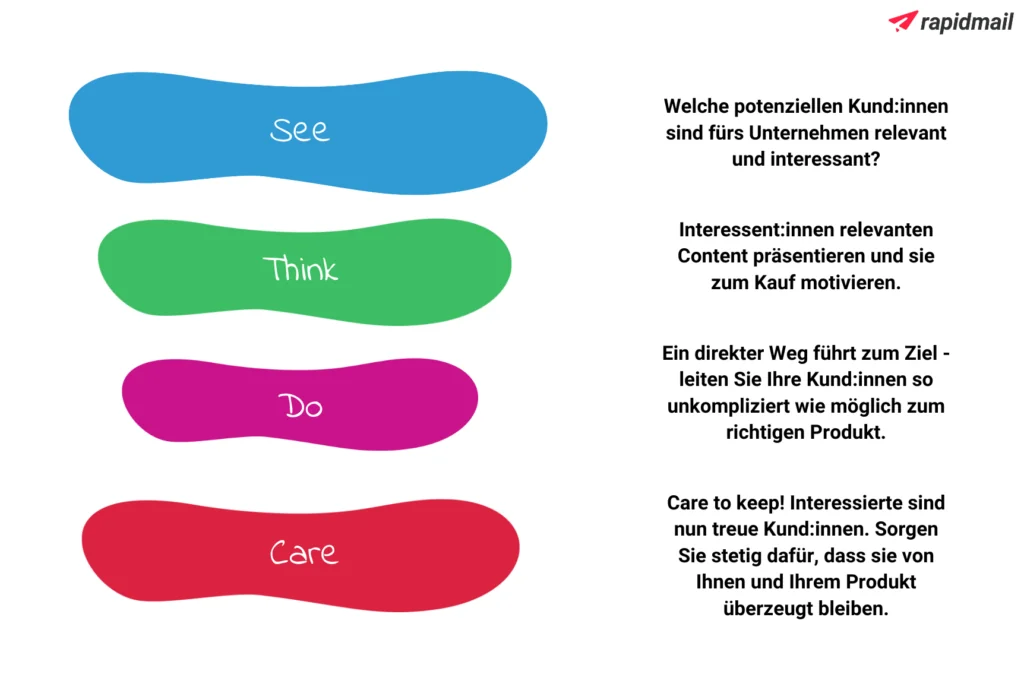
The STDC model helps you optimize your customers’ customer journey and ideally retain them over the long term. The inbound marketing phases can therefore also be interpreted as a funnel that guides customers toward the product, step by step.
4. How to create an effective inbound marketing strategy
Do you want to get started with inbound marketing right away? First, you should devise a smart strategy to unlock the full potential of this marketing method.
Step 1: define the target audience
To produce relevant content and share it through the right communication channels, you first need a clear picture of your target audience. The following questions can help you define the target audience for your inbound marketing strategy:
- Who are your ideal customers?
- Which demographic and socioeconomic characteristics define your ideal customers? Consider potential customers’ gender and age, as well as where they live, their marital status, occupation and level of education. If your offering is aimed at businesses (B2B), you should also consider economic characteristics such as legal form, company size and industry.
- Which routes and channels can you use to reach your existing and potential customers?
- What interests, preferences and attitudes do your customers have? Are they facing particular challenges and problems?
- Which needs of this target audience can you meet with your products or services, and how?
Although individual members of your target audience are bound to have some things in common, you should not underestimate the individuality of potential customers. Instead of imagining a homogeneous group of customers, it therefore makes good sense to develop different personas. Personas are fictional users from your target audience who, like real people, have specific characteristics, needs and expectations. The following example shows what this can look like:
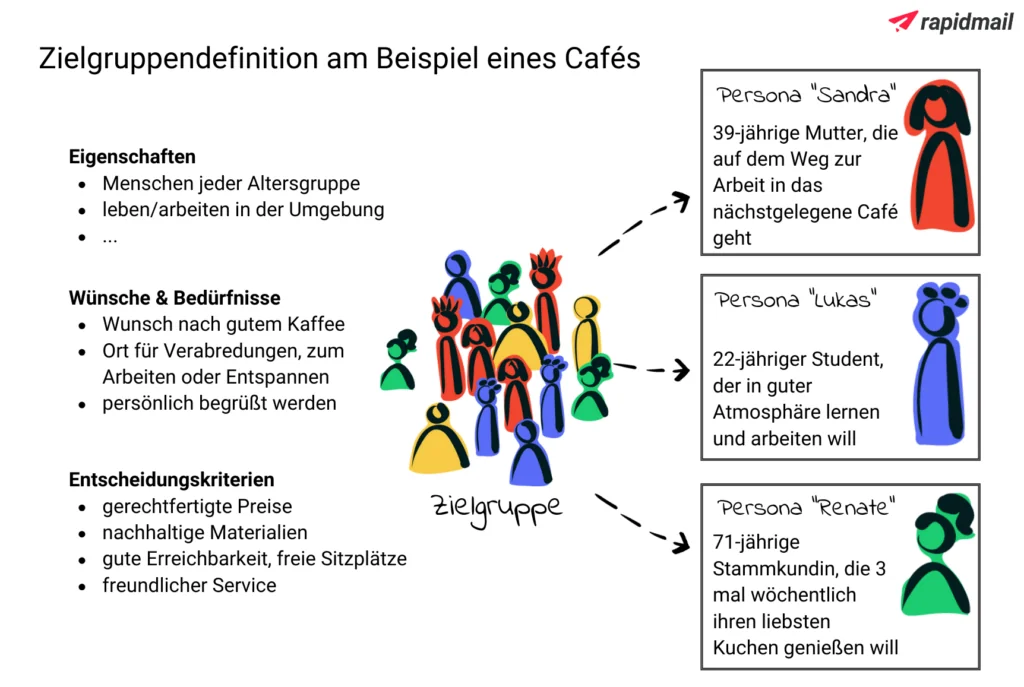
In inbound marketing, personas therefore help you produce useful and relevant content that is tailored precisely to your target audience’s interests and problems.
Step 2: reach the target audience and turn them into prospects
The next step is to create useful content. If you run out of ideas, you can use SEO tools (such as Sistrix or SemRush) to search for relevant keywords or ask your support team which topics generate the most customer inquiries. Useful tips, guides and the latest developments in your industry are always popular too.
Now there are no limits to your creativity: Choose between landing pages, informative blog articles, infographics, explainer videos and social media posts to find the formats that best suit your target audience and business. A varied marketing mix of social media marketing and a well-managed company blog is particularly advantageous here. This distributes your content with a particularly wide reach, making it highly likely that you will reach many interested readers.
💡 rapidtip: think about the right customer communication
When planning your content, do not forget to consider how you want to communicate with your customers. A good communication strategy not only prevents customer dissatisfaction, but above all helps to establish and deepen interpersonal relationships to maintain long-term customer loyalty. After all, that is exactly what you want to achieve with inbound marketing.
A good website is one of the most important foundations for ensuring that your content makes a particularly good impression. It should not only have an appealing, user-friendly design, but also be optimized for SEO so you can welcome as many visitors as possible to your website.
Our café example also offers plenty of opportunities to produce engaging content:
- Based on your target audience definition and the various personas, as a café owner you could use landing pages with important keywords to show that your local café is exactly the right place for all the coffee lovers in the neighborhood.
- Guides to the perfect latte macchiato or popular baking recipes on your website are sure to delight your target audience too. And sharing your secrets does not have to be limited to the internet: workshops can also convince prospects of your expertise and your café.
- Social media are particularly well suited to sharing an impression of your café’s relaxed atmosphere. How about some appealing photos of your drinks and food to make your followers’ mouths water as well?
- You can also use blog articles to explore topics and values that are particularly important to your business and target audience. For example, show how your café supports sustainability and fair coffee production.
Step 3: generate leads
Website visitors who gain value from your content are good; turning them into qualified leads is even better! You should therefore consider how to collect contact details so that you can continue interacting with them and contact them proactively. For example, content offers such as e-books or white papers allow you to provide particularly detailed information to download in exchange for prospects’ email addresses.
The rapidmail newsletter
Tips, ideas and news about email marketing, straight to your inbox.
You can also generate more contacts through call-to-action buttons, contests and newsletter signup forms.
By the way: These subscribers are much more valuable to you than purchased addresses or addresses found online because they are already interested in your brand and are therefore much more likely to become customers of your business.
💡 rapidtip: reach existing and potential customers with smart email marketing
Sending newsletters offers the major advantage of reaching contacts directly on their own desktop or smartphone at times you choose. The segmentation feature also lets you divide your contact list according to criteria such as place of residence, age, occupation or gender, enabling you to send your subscribers particularly relevant newsletters tailored to their interests. Promotional newsletters for seasonal occasions such as Black Friday with special offers and discounts are also an excellent way to promote sales of your products, acquire new customers and then keep them up to date.
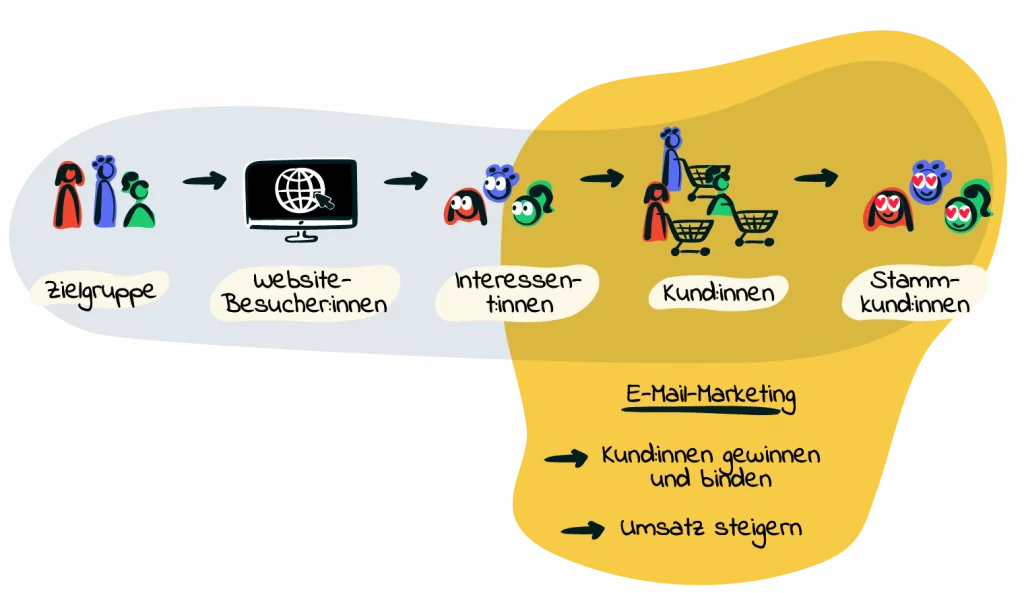
Step 4: use newsletters and marketing emails to convince prospects and guide them toward a purchase
From now on, the aim is to stay on the ball and maintain customer contact. Continue to publish and send solution-oriented content regularly. To finally win prospects over and encourage them to buy, you should communicate which problem your product solves for your contacts and illustrate this through blog articles, tutorials or social media posts, for example. This useful information can also be combined very effectively with various purchase incentives, such as contests or advance offers. However, always make sure that you do not make subscribing to your newsletter a mandatory condition for entering a contest or downloading an e-book or white paper, as this link is generally prohibited by the GDPR ban on coupling.
For our café example, this could work as follows: A newsletter regularly announces news such as the new lunch menu, encouraging recipients to visit the café. You can create further purchase incentives by sending targeted marketing emails featuring promotions such as “Drink of the month”, “Bring a friend: get two speciality coffees for the price of one for you and your companion”, or discounts on your customers’ favorite products. Newsletters and targeted marketing emails are perfect for drawing attention to these special offers.
Editorial newsletters and marketing emails: establish yourself as an expert in your field with current, high-quality and relevant content
As you can see from our café example, both editorial newsletters and marketing emails containing targeted promotions are part of a successful inbound marketing campaign. For a better understanding, let us examine the differences between these two campaign formats more closely so you can better judge which emails to send and when:
| Editorial newsletters | Marketing emails | |
|---|---|---|
| Definition | An editorial newsletter regularly sends news by email, for example about new collections, useful content and articles on the website, or seasonal occasions. Its main purpose is to strengthen customer loyalty and keep the brand in contacts’ minds. | Marketing emails are a useful addition to traditional newsletter delivery and, as an important email marketing channel, are also part of a sound inbound marketing strategy. Marketing emails send targeted offers, discounts and suitable product suggestions to individuals or groups of people on your contact list. |
| Characteristics | In theory, businesses can send their newsletter to all contacts. However, it makes more sense to send different newsletter content based on the interests of different target groups. This increases the likelihood that your newsletter will be read. | Before sending marketing emails, it is worth carefully considering which offers to send to which group of contacts. A contact who has mainly viewed the “Menswear” category of an online shop should naturally receive offers and discounts primarily for products in this category. |
| Differences | Primarily serves customer retention. The main aim is not to sell, but to maintain contact. | Sending targeted marketing emails is primarily about customer activation, in other words triggering a purchase decision. |
In summary, the right combination of regular newsletters and targeted marketing emails is important for a successful inbound marketing strategy. At this stage of your inbound marketing strategy, a good support team is also a major advantage because it can examine potential customers’ difficulties in detail, answer important questions and draw significant conclusions about the success of the marketing strategy. Alternatively, you can obtain this valuable feedback through newsletter surveys.
Step 5: win over convinced, loyal customers
New customers have made their first purchase, so have you achieved your goal? Yes and no. As we have already established, this is where the cycle starts all over again. Your agenda now includes not only acquiring more new customers, but also working on close, long-term customer relationships. After all, it would be a great shame to miss out on delighted, loyal customers who attract more prospects by sharing their positive experiences with your business. So-called “word-of-mouth advertising” plays an important role in customer acquisition for most businesses.
We have gathered a few ideas for strengthening customer loyalty and satisfaction:
- Thank your customers for their loyalty with a small surprise. Coupon codes and freebies are a great way to give them a little treat.
- Use loyalty programs and “refer a friend” promotions.
- One way to use inbound marketing as part of an effective B2B online marketing strategy is to develop case studies together with existing customers and present them on your website. This not only shows how other businesses use your product to solve a specific problem, but also helps ensure that these customers remain loyal to your product.
- Use surveys to obtain valuable customer feedback.
- Send personalized newsletters.
- Analyze the success of your marketing campaign using important metrics.
5. Download the guide to a successful inbound marketing strategy
To make it even easier for you to build your ideal inbound marketing strategy, we have created an interactive guide for you.
Simply download our guide for free and develop your own master plan, step by step, to ensure that you achieve your newsletter marketing goals. 🚀
We hope you enjoy reading it and wish you every success with your new, effective inbound marketing strategy!