Optimize your newsletter marketing with segmentation

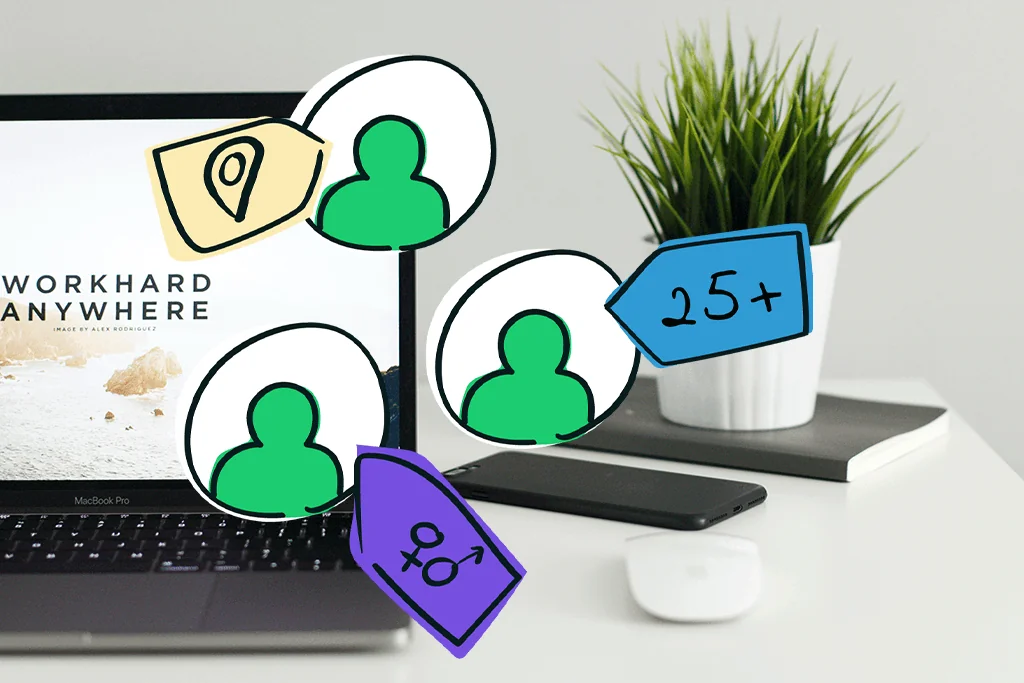
Some wasted coverage is usually unavoidable when distributing advertising messages. In email marketing, however, the number of recipients who do not belong to your marketing campaign’s target group is relatively small. One reason is that recipients must first expressly consent to being contacted through double opt-in. Another is that you can segment newsletter readers very effectively with simple criteria, such as location, age, employment status or gender.
1. What is segmentation in email marketing?
Segmentation means dividing your newsletter recipient lists into different categories and groups so that, unlike mass email, you can give readers much more targeted information. A common problem in email marketing is an excessive number of newsletter unsubscribes, caused by unsuitable or irrelevant email content, for example. Segmentation allows you to organize your newsletter contacts, by age or industry for example, helping to prevent excessive unsubscribes.
2. Benefits of segmentation
First consider whether it makes sense to divide your customers and prospects into segments:
- Will segmentation give subscribers personalized information that is irrelevant to other recipient groups?
- Can you create groups in which the people share the same interests?
If both of these basic requirements are met, it is worth segmenting your newsletter contacts.
The more precisely you can define your different target groups, the better. This reduces the likelihood of contacting people for whom your advertising message is irrelevant. In turn, this offers many benefits for newsletter marketing, including more customer responses in the form of:
- 💌 more email opens
- 👉 more newsletter clicks on links leading to your website
- 🛒 more purchases in your online shop
Segmentation also reduces your advertising costs. You need to distribute your message to fewer people to achieve the same response rate as with untargeted communication. The fewer people you contact, the lower the costs.
The rapidmail newsletter
Tips, ideas and news about email marketing, straight to your inbox.
3. Examples of segmentation criteria
Depending on your industry, product characteristics and target audience, subscribers can be divided into different segments, or smaller groups, using a variety of criteria. Generally speaking, they can be filtered and sorted by previous activity, such as opens, as well as characteristics, interests and requirements.
To make your work a little easier from the outset, you can start segmenting new customers before you send your first newsletter. Add a field to your newsletter sign-up form that lets them select their interests from a list of tags, for example, or provide their current location.
Alternatively, divide prospects into segments based on their activity and data. Create one segment for all recipients in a specific age group and another for everyone who has not opened a newsletter in recent months, for example. The more precisely you divide your customers into subcategories, the more specifically you can address their needs.
Further examples of segmentation categories include:
- 📌 Location: Does your company have several locations offering different products or services? You could use location-based segmentation to offer recipients events taking place near them, for example. This makes the content relevant to readers who could actually attend.
- 🏢 Industry: If you market different events, for example, you can also divide readers using the tagging feature. Readers are assigned different areas of interest, such as sporting events, music concerts and art exhibitions.
- 👫 Gender: In the cosmetics sector in particular, many companies distinguish between men’s, women’s and gender-neutral products, such as perfumes or hair-care products. Avoid suggesting products in which your customers have no interest.
- 🔢 Age: Another option is to ask subscribers for their age in the sign-up form. You can then segment recipients into different age groups later.
- 🗨️ Language: Do many of your subscribers speak a different language or live in another country? Adapting the newsletter to their language not only improves the open rate by removing potential language barriers, but above all strengthens customer loyalty: readers feel that you are responding to their individual needs.
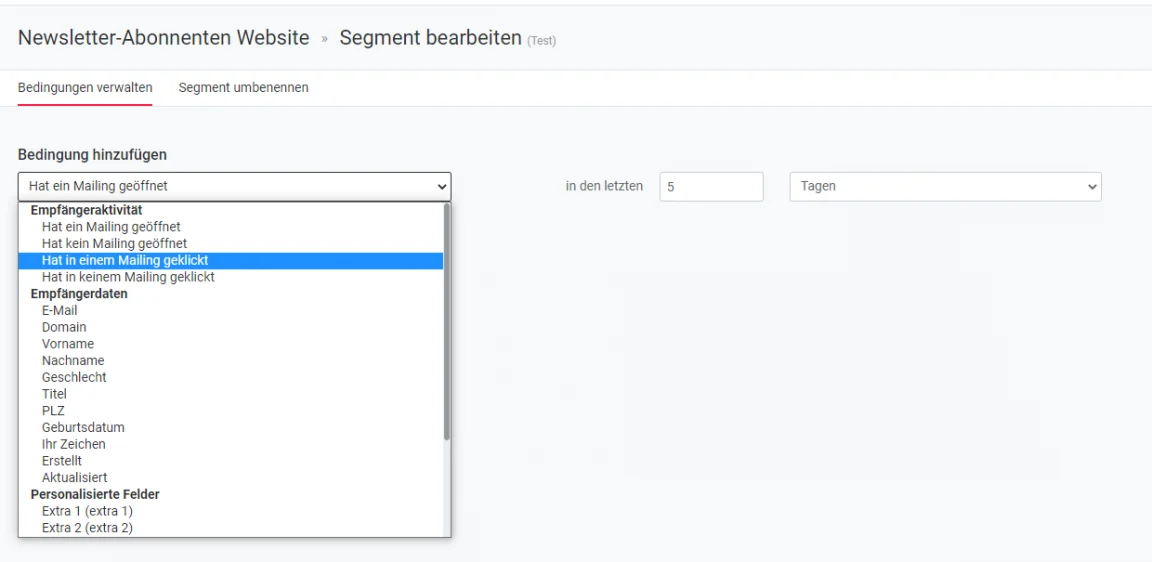
After all these examples, you are probably wondering how segmentation works in practice. rapidmail lets you segment your recipient lists. In just a few simple steps, you can create a structured list. Our help article shows you step by step how to create a recipient segment with rapidmail.
Start sending segmented newsletters
💡 rapidtip
In general, we recommend creating neither too many nor too few groups. In either case, it is difficult to make customers a suitable offer. With too many segments, you may lose track and might not even be able to provide that many different offers. On the other hand, if you have only two groups that barely differ, segmentation involves extra work and may not produce the desired result. Examine the customer data you have collected carefully and decide which division makes the most sense and is the best fit.
4. Differences between B2B and B2C
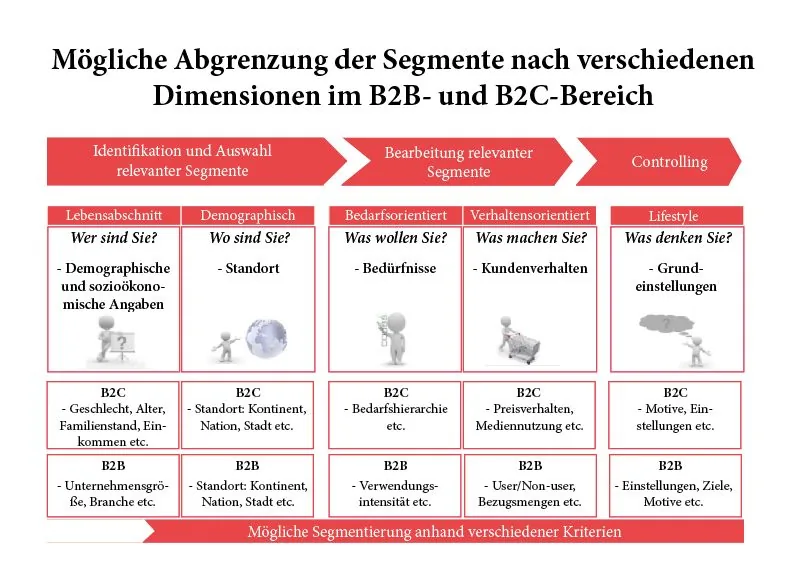
In the B2C sector, the most common segmentation criteria are gender, age and interests. Other useful criteria often include place of residence, activities, occupation and marital status, as well as distinguishing between buyers and non-buyers or frequent and occasional buyers.
👀 Have you seen this? Email marketing for B2B companies
Do you want to win over business customers with targeted messages and boost your B2B company’s revenue? In this video, our content manager Wiebke shows you how to create the perfect plan for your B2B email marketing in just six steps. Roll the film! 🎬
Open video transcript
Chapter 1: Introduction
Do you want to address decision-makers in companies directly? Then B2B email marketing is exactly what you need! This channel lets you reach the right contacts without large amounts of wasted coverage and accompany them throughout the entire customer lifecycle. Email marketing is also more cost-effective and time-efficient than trade fairs or print advertising.
Hello, I’m Wiebke, and today I want to show you how to put together the perfect email marketing strategy for your B2B company. This includes setting clear objectives and defining your target audience, building your mailing list, planning content, choosing the right design and timing, and of course analyzing your results. So, let’s get started!
Chapter 2: What is B2B email marketing?
In email marketing, emails in the form of newsletters, automated emails or transactional emails are sent to contacts who have previously consented to receiving them, in both B2C and B2B. The difference lies in the type of contacts or target group.
In B2B email marketing, you send commercial emails to business contacts. By contrast, B2C communications target private consumers. While emotional and entertaining content performs well in B2C, rational arguments have the greatest influence on purchasing decisions in B2B. This does not mean the content has to be stiff and boring: people in the B2B sector also appreciate a personable, humorous tone.
It is important to bear in mind that you are often dealing with trained professionals who have high expectations and fixed budgets. Impulse purchases are rare and decision-making processes often take a long time. This is precisely where email marketing can help you build long-term personal relationships. Regular information about features, pricing models and offers helps to convince potential customers.
Chapter 3: Step 1: Define objectives for your B2B email marketing
Before you get started, think about the overarching objectives you want to achieve. This will make it easier to select the right measures later.
B2B email marketing can help you establish and deepen relationships, acquire new business customers and retain them over the long term, generate interest in your products and services, generate leads, increase revenue, and inform customers and keep them up to date.
Set specific objectives to identify the measures you need. If a cleaning company wants to acquire ten new customers every month, for example, its newsletters should present the service attractively and explain why it is particularly relevant. If the company wants to increase revenue from existing customers, its emails should promote additional offers and consultations.
Chapter 4: Step 2: Define the target audience
Defining the target audience is particularly important in B2B because it is usually smaller than in B2C. Convincing trained professionals with strict requirements and fixed budgets can be challenging, but a thorough analysis makes it possible.
Ask yourself the following questions:
Who is our product or service aimed at? Which industries is our offer relevant to? How large are the companies that could use our offer? Which people make decisions in these companies? What characteristics define these decision-makers? What challenges do they face in their day-to-day work?
It can be helpful to speak to your sales team or customer service team. Personas are fictional representatives of the target group with typical characteristics. They help you understand the needs and decision-making processes of potential customers more clearly.
Chapter 5: Step 3: Generate leads and maintain the recipient list
Because the B2B target audience is smaller, collecting high-quality contacts is particularly important. They should be involved in decision-making processes or participate in the flow of information within the company.
The foundation for this is an inviting sign-up form on your website. You can offer incentives to make registration more appealing, such as discounts, free webinars or e-books. However, do not buy contact lists or add existing customers to the mailing list without their consent.
The double opt-in process ensures that only people who actively sign up receive your emails. Interested users must verify their registration through a confirmation link in an email before they are added to the mailing list.
Chapter 6: Step 4: Plan relevant content for B2B emails
Appealing content that offers added value can convince potential business customers over the long term. Consider what content your contacts enjoy consuming to spark their curiosity and build trust.
Possible topics for B2B newsletters include product presentations (introducing new products or services), industry news (sharing current developments and relevant information), use cases (practical examples of how products are used), testimonials (using customer opinions and case studies), special offers (providing individual discounts and promotions), and studies and reports (including relevant statistics and expert opinions).
Create a sending schedule so that you can send content regularly and in a structured way.
Chapter 7: Step 5: Find the right timing for B2B email marketing
Base your sending times on your contacts’ working day. Emails are generally read between 8 am and 5 pm, so test which time works best. Sending frequency is also crucial. Only send emails when you have relevant content. Monthly or occasion-based distribution is often a good choice.
Good planning prevents you from overwhelming recipients with emails that arrive too frequently. Use automation tools to manage sending efficiently.
Chapter 8: Step 6: Evaluate and optimize success
To optimize your B2B email marketing, keep an eye on important metrics:
The delivery rate, meaning how many emails actually arrive.
The open rate, meaning how many recipients open the email.
The click rate, meaning how many recipients click links or calls to action.
And the unsubscribe rate, meaning how many recipients unsubscribe from the newsletter.
These KPIs allow you to continually adapt and improve your strategy.
Chapter 9: Conclusion: Achieve B2B email marketing objectives in no time
As you can see, it takes just six simple steps to make a successful start in B2B email marketing. It is now up to you to plan and test your first campaign. With rapidmail, you can try your first send to as many as 2,000 contacts free of charge.
Good luck with your B2B email marketing! I look forward to your questions and comments. See you next time!
In the B2B sector, suitable segmentation criteria include industry, company size, the type and organization of the company, and revenue, divided into A, B and C customers.
👀 Did you know? Segmentation using ABC analysis
When dividing customers using ABC analysis, you place them in three groups according to relevance. A = very important, B = important and C = less important. At first, this may sound as though group C should be ignored. In fact, the aim is to examine the three groups more closely from different perspectives, such as their willingness to buy or share of revenue. You can then send personalized newsletters based on this analysis. Group A might be offered more expensive products than group B, for example.
5. How to segment recipients
Once you have defined your target audience as precisely as possible, you can divide it into individual segments. The segments should differ from one another as much as possible, while the people or companies within each segment should be as similar as possible.
Here are a few examples:
- 👕 You run a clothing store selling women’s and men’s fashion. It makes sense to divide the entire target audience into women’s fashion and men’s fashion segments, then contact each segment with different advertising content.
- ✈️ You are a tour operator and ask in the newsletter sign-up form whether users are more interested in a city break or a beach vacation. This information lets you segment users and offer relevant content directly.
- 🔨 A DIY store that has not yet segmented its customers sends general newsletters. Take a closer look at readers’ clicking behavior using the click rate: does one group click more often on information about new flowers, while another clicks on new bathroom tiles? These patterns can also create useful segments, such as garden lovers and bathroom enthusiasts.
Take a look at the information you already have about your target audience and the information you can gather with little effort. Then decide whether segmentation based on this information would support your marketing objectives.
The more information you have about your target audience, the better you can segment it and the more targeted and effective your subsequent marketing measures will be.
Our step-by-step help article explains how to divide your recipients into different segments before sending a newsletter.
Conclusion
In conclusion, segmentation offers numerous ways to narrow down target groups and send even more relevant newsletter content. Over the long term, this produces greater email marketing success. Whether you should segment by behavioral criteria, such as click rate, demographic information, such as gender, or customer relevance, such as ABC customers, depends on your industry, company and interests.