Sending newsletters without double opt-in: a GDPR breach?


Double opt-in is a well-known process in newsletter marketing: it ensures that the owners of the email addresses entered really do want to sign up for an email newsletter. Since the GDPR came into force, this sign-up process has become common practice for most newsletters. But what if, as a newsletter sender, you are not currently using a double opt-in process when new subscribers sign up? Does that mean you are breaching the General Data Protection Regulation? In this article, we explain everything you need to know about newsletter double opt-in. Let’s get started! 🚀
Send newsletters with double opt-in now
1. What exactly is double opt-in in newsletter marketing?
Double opt-in (DOI) is a process used in email marketing to ensure that a new contact has genuinely consented to receiving newsletters or other marketing emails.
The double opt-in process consists of two steps:
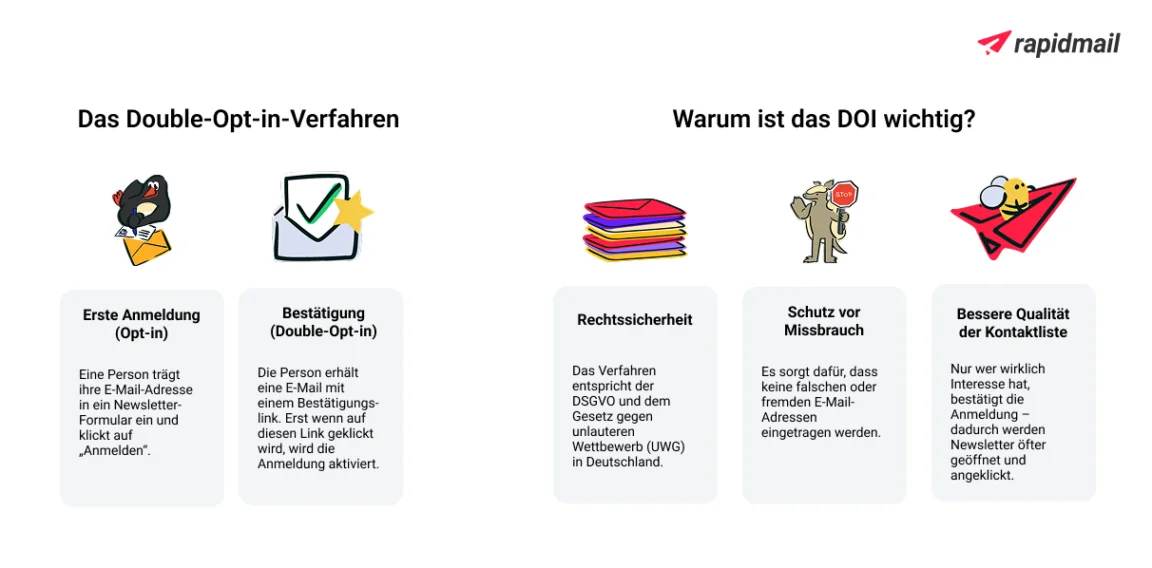
- ✅ Initial sign-up (opt-in): A person enters their email address in a newsletter form and clicks “Sign up”.
- ✅ Confirmation (double opt-in): The person receives an email containing a confirmation link at the email address they entered. Their newsletter subscription is activated only when they click this link.
Why is double opt-in important?
The double opt-in process provides legal protection, prevents misuse and improves the quality of your newsletter list:
- 🧑🏻⚖️ Legal certainty: Using the DOI process allows you to demonstrate compliance with the requirements of the GDPR and Germany’s Act Against Unfair Competition (UWG).
- 🛡️ Protection against misuse: Double opt-in prevents false or third-party email addresses from being entered in your newsletter sign-up form.
- 💌 A higher-quality contact list: Only people who are genuinely interested confirm their sign-up, which means your newsletter is opened and clicked more often.
What does DOI look like in practice for newsletters?
With double opt-in, interested people sign up for the newsletter by entering their email address in the sign-up form and accepting the consent to data processing. In a second step, new subscribers must once again expressly consent to receiving regular emails.
They do this by clicking the link in the confirmation email sent to them after they enter their email address in the sign-up form. Only then is the relevant email address actually added to the recipient list as an active newsletter contact. This ensures that the owners of the email addresses really did knowingly sign up for the newsletter themselves.
This also means that if the link in the double opt-in confirmation email is not clicked within a certain period, no newsletter will be sent to that address.
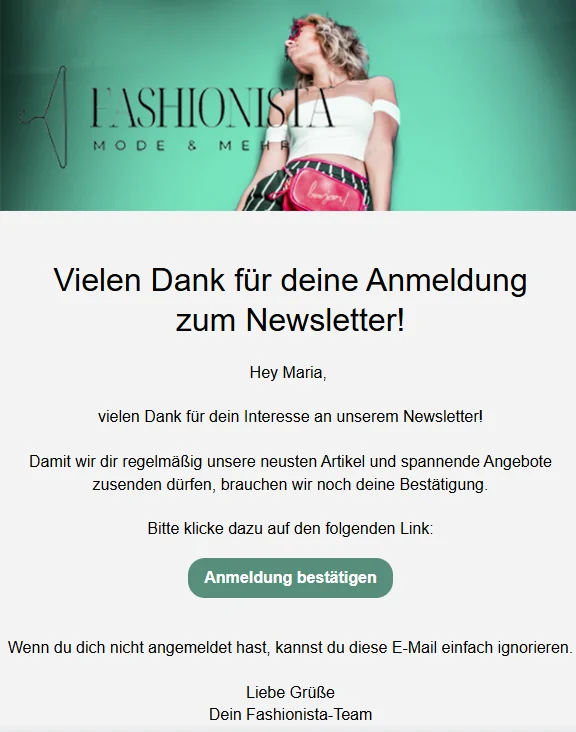
The text in your newsletter double opt-in confirmation email could look like this, for example:
Subject: Please confirm your newsletter subscription
Text:
Hello [First name],
Thank you for your interest in our newsletter!
We need your confirmation before we can send you our best content and latest news on a regular basis.
Please click the following link to complete your sign-up:
[Call to action with confirmation link]
If you did not sign up, you can simply ignore this email.
Best wishes,
[Your team name]
Single opt-in vs double opt-in: what is the difference?
With single opt-in (also known as a simple opt-in), interested people sign up for a newsletter by entering their email address in a sign-up form on the website. At the same time, they tick a box in the form to give their declaration of consent to the processing of their personal data under Article 6(1)(a) of the GDPR. When drafting this consent statement, it is important to take account of the conditions in Article 7 of the GDPR.
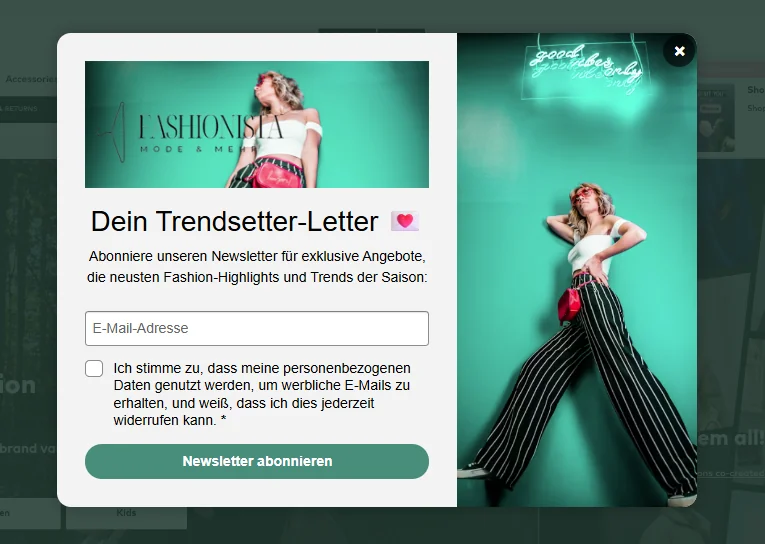
With the single opt-in process, interested people are then added directly to the email list without having to confirm their sign-up again.
The advantage of this process is that interested people simply need to enter their email address and tick a box to subscribe to the newsletter. They are not put off by a potentially cumbersome process that could cause them to lose interest before completing their newsletter sign-up.
However, single opt-in has one obvious problem: any website user can enter any email address in the form and therefore easily sign other people up for the newsletter. As a result, people may receive advertising emails without ever having consented to them. This is precisely where single opt-in conflicts with the GDPR: all newsletter senders must be able to demonstrate the legal basis for sending the newsletter, in this case consent to receive it, because the accountability principle under Article 5(2) of the GDPR applies. Single opt-in does not provide this proof.
But there is a simple solution: always use the double opt-in process when sending your newsletters.
What does confirmed opt-in mean?

Confirmed opt-in is a third option for the newsletter sign-up process, although it is not widely used in practice. As with double opt-in, recipients receive a confirmation email after entering their email address. However, the email contains no confirmation link for them to click to complete their subscription to the newsletter list. With confirmed opt-in, an email merely informs new contacts that they have signed up for the newsletter. However, this means that if someone else has signed them up against their wishes, they must actively unsubscribe from the newsletter themselves.
This approach is therefore controversial. The prevailing legal opinion is that an interested person’s consent cannot be obtained through their failure to take action.
2. Current legal position on DOI when sending newsletters
In practice, DOI is the most widely used process for newsletter sign-ups because it is considered a legally compliant process. An Austrian supervisory authority recently went so far as to classify the absence of double opt-in as a breach of data protection and secure data processing under Article 32 of the GDPR.
But what does this mean for sending newsletters in Germany? What legal basis must senders consider when choosing a sign-up process?
The key statutory foundations for a legally compliant newsletter sign-up are:
- 📄 the General Data Protection Regulation (GDPR), in force since May 2018
- 📄 the German Federal Data Protection Act (new BDSG), in force since July 2017
- 📄 the German Digital Services Act (DDG), in force since May 2024
These laws govern the handling, protection and processing of subscribers’ personal data, such as their name and email address.
But is double opt-in mandatory for newsletter sign-ups, and does failing to use it constitute a breach of German data protection law? To find out, we first need to look at the competition law provisions of the German Act Against Unfair Competition (new UWG of July 2004), which also forms part of the legal background to double opt-in.
The UWG states that a commercial practice is not permitted if it unreasonably harasses market participants. In particular, the UWG refers to advertising by means of an automatic calling machine, a fax machine or electronic mail without the recipient’s prior express consent.
When it comes to sending newsletters, this provision protects us from being inundated with unwanted advertising emails every day. The UWG therefore establishes that subscribers must expressly consent to receiving promotional newsletters.
Newsletter sign-up and the GDPR
The GDPR also applies to every type of newsletter: processing subscriber data is only lawful if the recipients concerned have consented to the processing of their personal data. In this case, that means storing their email address and other information they provided when signing up for the newsletter.
The GDPR does not state that the double opt-in process must be used to obtain this consent for newsletters. In other words, the absence of double opt-in when someone signs up for a newsletter does not in itself initially constitute a breach of the General Data Protection Regulation.
At the same time, however, it is in senders’ interests to use double opt-in as the sign-up process for their newsletters. This is because the GDPR also requires newsletter senders to be able to demonstrate at any time that their contacts have consented to the processing of their personal data. The only special exception applies to sending newsletters to existing customers.
Anyone who does not use the double opt-in process for newsletter sign-ups risks formal warnings for unauthorized advertising and fines for data protection breaches. It can also easily destroy subscribers’ trust, damaging the company’s reputation in the long term.
Anyone who sends a newsletter to contacts without double opt-in confirmation risks the data processing lacking a lawful basis. This constitutes a breach of Article 6 of the GDPR and may be punishable by a fine of up to 4% of turnover.
Nils Möllers, data protection lawyer and founder of Keyed GmbH
👀 Did you know?

With rapidmail you do not need to worry about this: whichever pricing plan you choose, all your newsletters are sent with DOI, keeping you on the right side of the law.
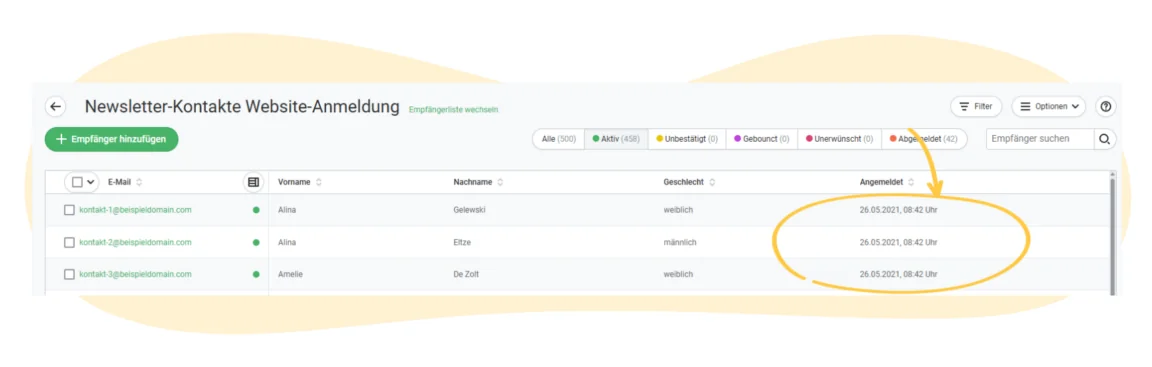
It would be very difficult for senders to provide this clear evidence using only single or confirmed opt-in. With double opt-in, however, senders automatically have proof: interested people must actively click a link in the confirmation email before they are added to the newsletter list. You simply need to make sure that your database records the precise time when each person signed up.
👀 Did you know?
With rapidmail, important legal data about your contacts is stored automatically when they sign up for your newsletter. Once interested people have consented to receiving the newsletter through the double opt-in process, you as the sender can easily view and export contact information, such as the time of newsletter sign-up, the time when the sign-up was confirmed and the current subscription status.
The GDPR also requires senders to take appropriate technical and organizational measures to ensure that recipient data is adequately protected. As explained in our expert article on OMR Reviews, digital sovereignty in email marketing is therefore not just a question of individual software features, but starts with server hardware, hosting and access control. In a dispute involving newsletter sign-ups without double opt-in, a court could find, given how straightforward the technical and organizational implementation is, that the sender had not done everything in their power to protect subscribers’ personal data. This is another reason why we strongly recommend double opt-in for newsletter sign-ups.
Besides providing legal protection, DOI also offers you a financial advantage as a newsletter sender: your newsletter is only sent to contacts who signed up because they are interested in its content. This helps you avoid unnecessary expenditure on sending emails to recipients who have no genuine interest in your newsletter. Double opt-in also makes newsletter statistics easier to evaluate because open rates and click rates remain meaningful: contacts who do not want the newsletter and would simply ignore it are never included in the statistics in the first place.
The rapidmail newsletter
Tips, ideas and news about email marketing, straight to your inbox.
3. Conclusion: is sending newsletters without double opt-in a GDPR breach?
The GDPR does not explicitly require double opt-in when new contacts sign up for a newsletter. However, if you send newsletters to your contacts’ email addresses without completing the double opt-in process, this may nevertheless constitute a breach of the GDPR.
Although the double opt-in process is not itself directly required by data protection law, under the UWG it is considered mandatory in the vast majority of cases. Companies must also ensure that an opt-in was actually completed by the owner of the email address. Only double opt-in can guarantee this.
Nils Möllers, data protection lawyer and founder of Keyed GmbH
We therefore expressly recommend that, as a sender, you take the precaution of using double opt-in sign-up. If there is ever any doubt, you will have every newsletter contact’s express consent to receive emails, which is necessary to demonstrate GDPR-compliant email sending. The single opt-in process cannot provide this proof because any website user can enter any email address in the newsletter sign-up form. At the same time, in the event of a dispute you can show a court that you took technical and organizational steps to protect recipient data by using double opt-in.
If you use rapidmail newsletter sign-up forms, the double opt-in process is applied automatically. All the data needed to prove contacts’ consent is stored, such as subscribers’ IP addresses and the date and timestamp of both sign-up and confirmation. We also advise rapidmail customers to send emails only to the email addresses of their existing customers and to addresses collected using double opt-in.
👀 Did you know?

As a rapidmail customer, you receive GDPR-compliant templates for expanding the privacy information on your website and for the declaration of consent used when someone signs up for your newsletter. With rapidmail as a 100% GDPR-compliant newsletter tool, you are therefore always on the right side of the law.
With rapidmail, you can also add a legally compliant newsletter sign-up form to your website in just a few steps, allowing you to send GDPR-compliant newsletters with complete peace of mind.
Send GDPR-compliant newsletters now
4. Bonus: avoid GDPR breaches with the free data protection checklist to download

GDPR requirements do not apply only when people sign up for your newsletter. There are also rules governing your privacy information, data storage, subscriber unsubscribes and many other areas of newsletter marketing that you must follow to remain compliant with data protection law.
But do not worry: the interactive data protection checklist for newsletters helps you keep track of everything without having to battle through complicated laws or court rulings. 😎
Simply download the checklist for free and see which data protection requirements you already meet and where you still need to take action to avoid GDPR breaches. Have fun!
Download the data protection checklist for free (PDF in German)
Do you have any questions?
This article is provided solely as non-binding information and does not constitute individual data protection advice. If you have further questions about the legal requirements for sending newsletters, it is best to contact your legal adviser or in-house legal team, or the experts at Keyed. They can also provide detailed information for your specific circumstances.