Build a newsletter list: How to win new contacts successfully
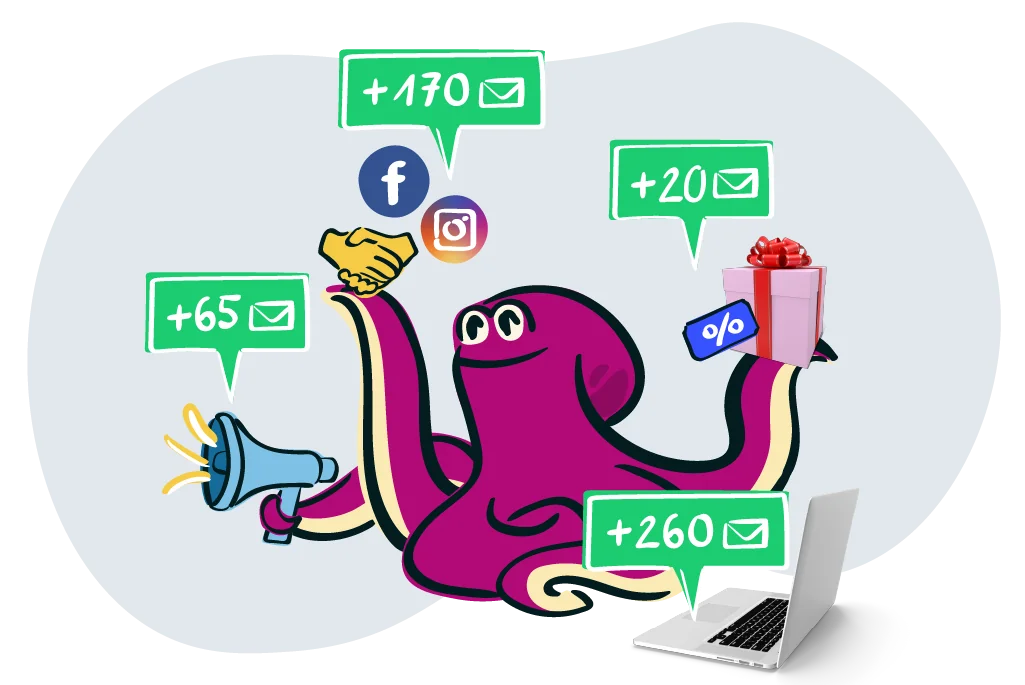
Especially at the beginning, before sending your very first newsletter, many senders wonder how they can build a high-quality newsletter list quickly and affordably. They often look for a simple solution, such as buying email addresses online, but that is not a good idea. Successful email marketing is not about having thousands of contacts in your mailing list. Instead, make sure your recipient list consists of people who have voluntarily signed up for your newsletter. You can then be confident that your new contacts are genuinely interested in your content. In this guide, we show you how to create a mailing list, add numerous high-quality email addresses to your newsletter list and reach even more potential customers by newsletter.
1. Your newsletter sign-up form: The foundation for building your email list
An appealing, highly visible and cleverly positioned newsletter sign-up form on your website or online shop is THE essential requirement for winning lots of new subscribers. Imagine putting a great deal of work and effort into advertising your newsletter, only to discover that interested people do not sign up simply because they cannot find the sign-up form on your website.
So do not hide your form on some subpage. Embed it prominently on as many pages as possible. A pop-up sign-up form for your newsletter is also an excellent way to “catch” website visitors in the right place at the right time and motivate them to subscribe to your newsletter with a compelling argument.
A good time might be when a visitor to your online shop is browsing your current products and has reached the halfway point: THE perfect opportunity to introduce your weekly newsletter, which regularly features the latest products!
👀 Have you seen this? How to create a mailing list
Would you like to learn more about building a mailing list for your email marketing? In the following video, our Content Manager Wiebke explains how to do it step by step. Roll the video! 🎬
Open video transcript
Chapter 1: Introduction
Especially when you are just getting started with email marketing, you may wonder how to build a large email list quickly. But even if you have been sending newsletters for some time, you will certainly want to keep growing your email list. Today, I will show you how to do that simply and, above all, legally.
You have made the right decision to get started with email marketing. Buuuut wait, stop: where do you actually find subscribers?
Hi, I’m Wiebke, and I will show you how to build an email list full of contacts who are keen to receive your newsletters.
Chapter 2: The most important basics for building your list
Please do not buy email lists! Sending to purchased addresses is not only illegal, but usually makes little sense too. Those contacts are unlikely to have much interest in your offers.
Instead, build your own email list with contacts who have a genuine, voluntary interest in your messages. The best part is that your email list belongs to you. You can communicate directly with your subscribers and are not dependent on platforms and their algorithms, as you are on social media.
But what do you need to build your email list yourself, step by step?
Chapter 3: Requirements for building an email list
A reliable email marketing tool is an essential building block for creating a successful email list. It allows you to collect and manage contacts and to design and send emails. You can use the software to create sign-up forms and embed them on your website. Numerous tools are available, including rapidmail. If you would like to consider other providers, our newsletter tool comparison can help you find the right solution. When choosing, consider which functions matter to you, whether you need complex features, value free support or depend on software that is 100% GDPR-compliant.
Another important point is the placement of the sign-up form. It should be embedded at strategically useful points on your website. You can choose whether the form appears as an eye-catching pop-up or is placed more discreetly in the footer. Take care not to overwhelm your visitors with too many pop-ups. Creating an appealing sign-up form is particularly easy with rapidmail. Simply enter your URL and rapidmail automatically creates a customized form featuring your logo and company colors. You can, of course, customize the form and then embed it on your website. As soon as interested visitors find the form, enter their email address and confirm the double opt-in process, they are automatically added to your email list.
Offer incentives to motivate more people to sign up. Visitors will not simply give you their email address without compelling benefits. Attractive offers such as discounts, free delivery, contests or exclusive content, including e-books and checklists, significantly increase the likelihood of a sign-up.
These basic steps lay the groundwork for building your email list. But there are a few more tips to help you get the most out of your sign-up process.
Chapter 4: Tips for the ideal sign-up process
A successful sign-up process ensures that interested people receive exactly the content that is relevant to them. You can offer different newsletter topics by letting them use tags to select the content they want to subscribe to. A travel agency, for example, could offer categories such as weekend breaks, cruises or tours. Contacts can then decide which travel offers they would like to receive by email, while you can use the appropriate tags to target your sends.
The sign-up process should be as simple as possible so that as many people as possible complete it. Too many mandatory fields can be off-putting. Asking only for the email address is usually enough. You can optionally add fields for first name and surname so that you can address your contacts personally later.
A compelling call to action can make signing up even more attractive. Instead of a dull “Sign up” button, a creatively worded prompt such as “Sign up now and save 10%!” is much more effective.
Legal compliance also plays a major role. Use the double opt-in process to ensure that people sign up voluntarily and that your contacts have confirmed their consent. Entry into a contest must not be conditional on signing up for the newsletter, and an option to unsubscribe must always be available.
To welcome new contacts from the very beginning, send a welcome email immediately after they sign up. First impressions count, and a friendly welcome can instantly strengthen their relationship with your company.
You should also use other channels to promote your newsletter. Social media, adverts and QR codes can help you win new subscribers. You can also collect contacts offline, for example through sign-ups by SMS or printed QR codes.
Chapter 5: Tips for a low unsubscribe rate
Choose the right sending frequency to prevent your email list from shrinking again straight away. There is no universal rule for the ideal sending frequency; it depends on your sector, company and target group. One rule of thumb, however, is to send emails only when you have valuable content to offer. If you are unsure, you can ask subscribers directly in the sign-up form how often they would prefer to hear from you.
Segmenting your recipient list is another important consideration. Not all subscribers have the same interests. Use personas and segments to provide tailored content. For example, customers in Hamburg could receive different offers from recipients over the age of 50.
Variety is important too. Nobody wants to read the same content all the time. Vary your topics and surprise your subscribers with new formats to keep the open rate high.
If your subscribers also follow you on social media, make sure you do not share the same content everywhere. The newsletter should offer clear added value, such as exclusive discounts or content available only to subscribers.
An appealing design is another key factor. Use high-quality images, a harmonious color scheme and a clear structure with plenty of white space to delight your readers visually.
Finally, do not send too much advertising. If readers feel that they are constantly being pushed to buy, it could be counterproductive. Instead, focus on providing valuable information and helpful tips, with only occasional promotional content.
Chapter 6: Conclusion: How to build your email list
If you follow these basics, your email list will grow step by step. But remember, Rome was not built in a day. Give the process time and appreciate every single contact who is genuinely interested.
I hope you enjoy building your email list and wish you every success! If you have any questions or comments, I look forward to your feedback in the comments.
Thanks for watching. See you next time!
Every new user should learn at some point during their visit that they ought to subscribe to your newsletter so that they do not miss valuable tips, offers or updates. A pop-up newsletter sign-up form ensures that visitors do not simply continue reading but give your newsletter offer their full attention.
The sign-up form on your website is therefore the foundation for growing your newsletter list. You should invest some work and time to ensure that not only your website but also the sign-up form looks professional and appealing. This is the only way for users to develop trust in your site and, in turn, your brand.
It also increases the likelihood that potential customers will become actual customers by signing up for the newsletter. Unlike purchased contacts, contacts generated through the newsletter sign-up form have already shown some interest in your content, products or services. Otherwise, they would not have subscribed to your newsletter. These are therefore valuable email addresses, making it worth the effort to create a compelling sign-up form.
Don’t have a newsletter sign-up form on your website yet? Then seize this opportunity!
… and win lots of new subscribers!
Follow these tips when creating your newsletter sign-up form to turn as many website visitors as possible into contacts:
- 📍 Place the sign-up in the right location on your website. With pop-up windows, for example, make sure you do not cover important content such as page titles. Also avoid displaying the sign-up form too soon, giving new users a chance to browse the website at their leisure first.
- 💥 Make sure pop-ups do not appear uncontrollably, for example every time someone navigates to another page on the website. If interested visitors find the pop-up annoying, they may unfortunately leave your website again very quickly.
- 🖌️ Be creative. The call-to-action button that users click in the sign-up form plays an important role in collecting as many newsletter addresses as possible. Choose original wording to stand out from your competitors’ “Sign up” and “Subscribe” CTAs. Ideally, highlight the advantages that subscribers have over other website visitors. A call to action such as “Sign up and save 10% on your first order” motivates even more users to subscribe to your newsletter.
- 📅 Mention how often you send newsletters. This reassures users who are worried that they will be inundated with marketing emails after signing up for your newsletter.
- 📨 Explain what you use the requested contact details for. Protecting personal data is a sensitive subject that raises many questions. Reassure concerned website visitors that you will use the data from the sign-up form only to send your newsletter and will not share it with others.
- 👋 Point out that unsubscribing from your newsletter is just as easy. New prospects are more likely to sign up if they know they can unsubscribe at any time with a single click on the unsubscribe link.
- 🏖️ Offer interested people a choice of newsletter topics. By allowing them to select different areas of interest in the sign-up form, you show users that you do not send spam, but want to provide content that is personally relevant to them.
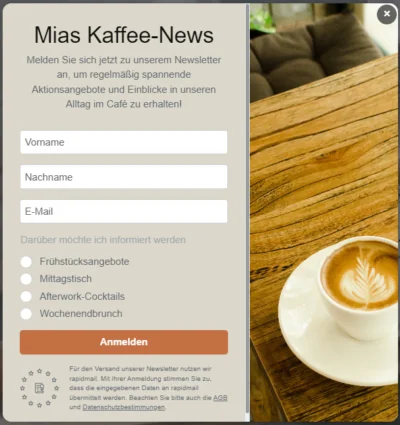
- ⚖️ Make sure your newsletter sign-up is legally compliant. State clearly in the sign-up form that interested people are subscribing to your newsletter, and do not try to hide or disguise the sign-up in any way.
👀 Did you know?
If you created your sign-up form with rapidmail, you are also on the safe side legally: every newsletter sign-up automatically goes through the GDPR-compliant double opt-in process, in which you obtain recipients’ express consent to receive your newsletter.
2. Offer relevant incentives for signing up for your newsletter
Why should website visitors subscribe to your newsletter if the same content is publicly available on your website?
If you cannot answer that question right now, your newsletter is probably missing something: a major advantage for your newsletter contacts over other website users. For example, subscribers might find out first when additional tickets become available for your next concert. Or your newsletter contacts might regularly receive free, informative white papers or study results, while website visitors can read only a few excerpts on your site.
To convince interested users to sign up for the newsletter, use motivating benefits, also known as “incentives”, and mention them in the sign-up form. Visitors to your website will find it difficult to resist signing up straight away. Put yourself in their shoes and imagine that you are in the mood to shop and are just about to add a product to your basket in an online shop. A pop-up then tells you that you can save 10% on your first order if you sign up for the newsletter. Wouldn’t you want to benefit from that discount too?
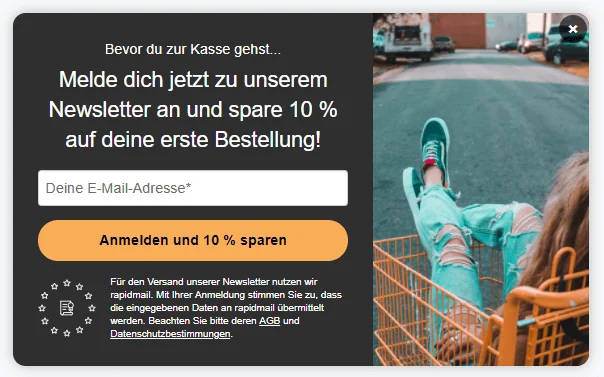
Discounts are, of course, not the only incentives for signing up for a newsletter. The following can be just as persuasive:
- 📨 Free delivery: for example, for ordered items and any returns
- 🎉 Contests: for example, entering all new subscribers into a draw for a shopping voucher
- ️ Free samples and freebies (promotional gifts): for example, a free audiobook sample
- 🕑 Advance offers: for example, your contacts can secure tickets to an event one day before everyone else
- 📚 Free e-books and white papers: for example, 55 creative newsletter ideas
- 📋 Tutorials, workshops, guides and expert tips: for example, product tests and reviews
- 📝 Free templates: for example, editorial calendars
Use one of these incentives in your sign-up form to turn lots of interested people into new contacts!
👀 Did you know? Contests help you grow your newsletter list
Yes, contests are another good way to generate lots of new newsletter addresses quickly. From a legal perspective, however, the prohibition on tying means that entering a contest must not require someone to sign up for the newsletter. Newsletter sign-up may only be offered as an option, for example with an additional checkbox. We recommend choosing a contest theme that fits your company and its product or service range. If an energy provider gives away a convertible car to one of its contacts, for example, there is a risk that most new recipients signed up for the newsletter only because of the car. If the contest prize is six months of free electricity instead, participants are also highly likely to be interested in the company as an energy provider and will remain satisfied customers even after the six months are over.
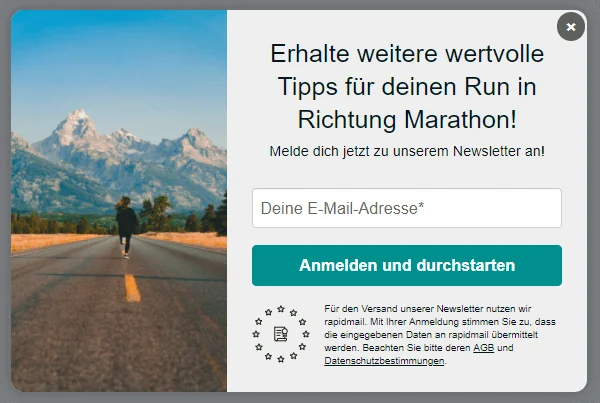
Alongside the incentives mentioned above, it also makes sense to connect the newsletter sign-up form to the topics on your website. For example, if a user reads a blog article on your fitness website with important tips for preparing for a marathon, they are highly likely to complete the following sign-up form for your fitness newsletter:
3. Advertise your newsletter with social media lead ads
A cleverly positioned newsletter sign-up form that offers relevant incentives is the foundation for winning numerous new contacts. However, this assumes that interested people have already found their way to your website, for example through a Google search or a recommendation from an existing customer. To generate additional newsletter contacts beyond these visitors, it is important to extend the reach of your newsletter advertising and include social media.
Today, Instagram, LinkedIn and TikTok are two important channels for increasing awareness of your company or brand locally, nationally and internationally. One way to do this is to run paid adverts for your newsletter on these two social media platforms. This generates lots of new newsletter contacts, who may even become new customers!
One major advantage of what are known as “Facebook Lead Ads” is that you can define your target group very precisely. For example, you can decide where the advert should be displayed and which interest groups will see your newsletter advertising in their news feed. As Instagram belongs to Facebook, Facebook Lead Ads lets you choose whether you want to advertise on Facebook, Instagram or both channels.
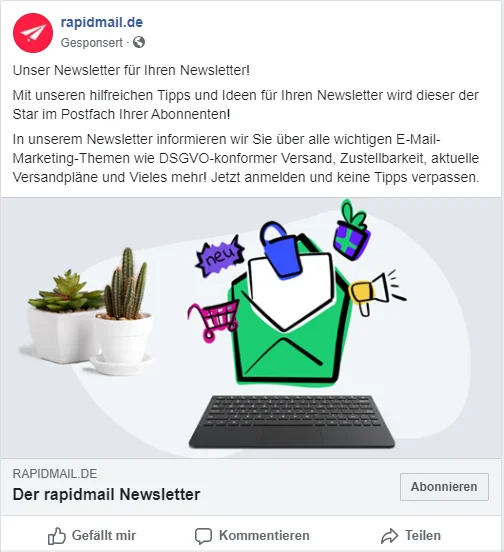
To generate more newsletter addresses through Facebook or Instagram, you can create a new advert with the objective “Get more leads” in the “Facebook Ad Center”. First, enter the URL that takes users to the newsletter sign-up form on your website. With rapidmail as your email marketing tool, you have three different options:
- 1️⃣ URL of your website’s dedicated newsletter sign-up page: If you have created a separate page for the newsletter sign-up form on your website, the lead ad can direct Facebook or Instagram users to that page.
- 2️⃣ URL of the newsletter sign-up form embedded on your website:If your newsletter sign-up form is embedded on your website, you can add an HTML anchor at this point. Add this anchor to the relevant URL in the lead ad to direct users straight to the footer and newsletter sign-up through the advert, for example www.my-website.com/#newsletter_subscription.
- 3️⃣ Shareable URL for your newsletter sign-up form: After you have designed and saved your newsletter sign-up form with the rapidmail form editor, you will automatically receive a URL for sharing the form. Simply copy it and enter it in the Facebook Lead Ad. Users are then taken directly to a page containing only the sign-up form.
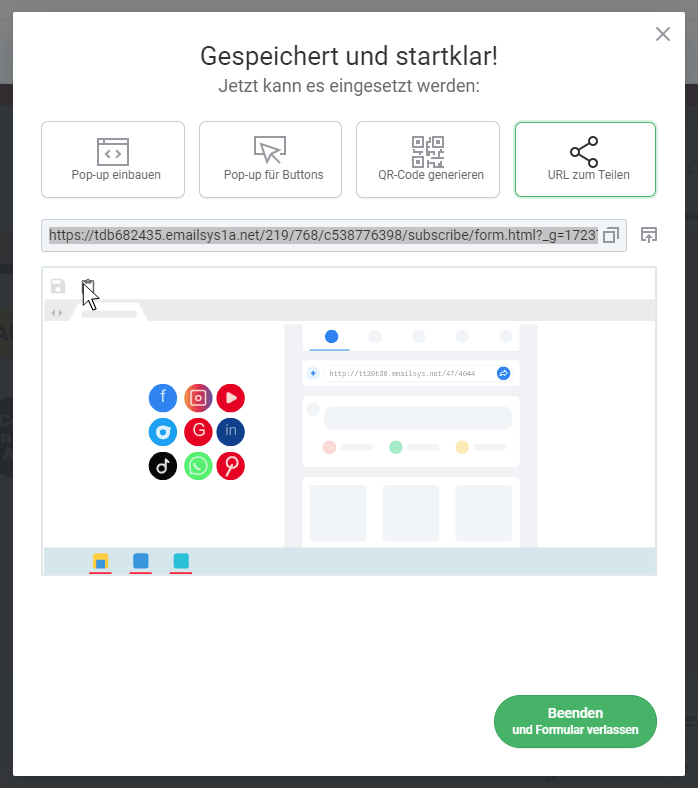
In the next step of creating your Facebook Lead Ads, you can define your target group, adapt the advertising copy and add a suitable image. Facebook also provides various possible labels for the call-to-action button in your lead ad. Facebook and Instagram users can click this button to reach your newsletter sign-up form. As you want to promote your newsletter, a CTA button labeled “Subscribe” is the best choice. Then all you need to do is enter your desired budget and your Facebook Lead Ad will be published. Just like that, your mailing list practically builds itself! 🚀
By the way: You can also advertise your newsletter on X (formerly Twitter). This works in a similar way to Facebook Lead Ads and is called “Promoted Ads”. Depending on which social media channels your target group mainly uses, it may be worthwhile promoting your newsletter there too, because social media and email marketing go hand in hand. Using a good mix of both channels offers countless benefits.
4. Advertise your newsletter through partnerships with relevant media organizations
Partnerships with relevant media organizations are also a good way to expand your newsletter contact list. Research online to find the specialist media (such as online magazines or forums) that are best known and most important in your sector, then ask whether they are interested in working with you. For example, you could offer to produce specialist articles on particular topics as guest contributions for the media organization. You can then mention your newsletter in a suitable place, or link to a more detailed white paper or e-book on your website. The free download takes place on your website, ideally in return for signing up for your newsletter, of course. 😉
The rapidmail newsletter
Tips, ideas and news about email marketing, straight to your inbox.
5. Advertise your newsletter offline too
It may sound surprising at first, but it is true: offline advertising for newsletters still works. Whether in a bakery, pharmacy, travel agency or university, if you want to build your email list, non-digital newsletter advertising is the ideal complement to the countless marketing measures available to you in online marketing.
If you own a shop, for example, you can display posters or signs advertising your newsletter in suitable places, such as at the till or in the store window. The same applies to companies that attend major events such as trade fairs. You can generate lots of new newsletter addresses there too and add them to your contact list.
1️⃣ The first option available to you with rapidmail is signing up for the newsletter by SMS. Interested people simply send the code, which you can display prominently on a sign at your till, for example, to the telephone number we provide. We take care of the rest! Your customers can sign up for your newsletter easily while waiting in the queue at the till.
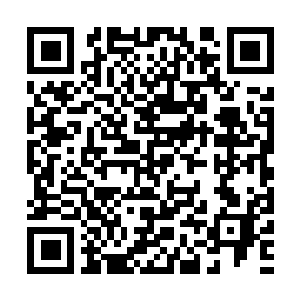
2️⃣ Another modern option is signing up by QR code. You can generate this automatically with our form editor and print it on any communication material, such as posters or information brochures. People passing by can scan the code with their smartphone and sign up for your newsletter while they are out and about!
👀 Is the double opt-in process also required when advertising a newsletter offline?
Yes! Although not using a double opt-in process for newsletter sign-ups is not a breach of the GDPR, we strongly advise all senders not to contact anyone without a prior double opt-in. Otherwise, in case of doubt, it can be difficult to prove that contacts expressly agreed to receive your newsletter. Sending is legally compliant only with this consent. Newsletter sign-ups by SMS or QR code that you generate through rapidmail automatically go through double opt-in.
Are you still unfamiliar with data protection in newsletter marketing and want to make sure you have not forgotten anything? Then our free data protection checklist is exactly what you need!
This checklist gives you, among other things:
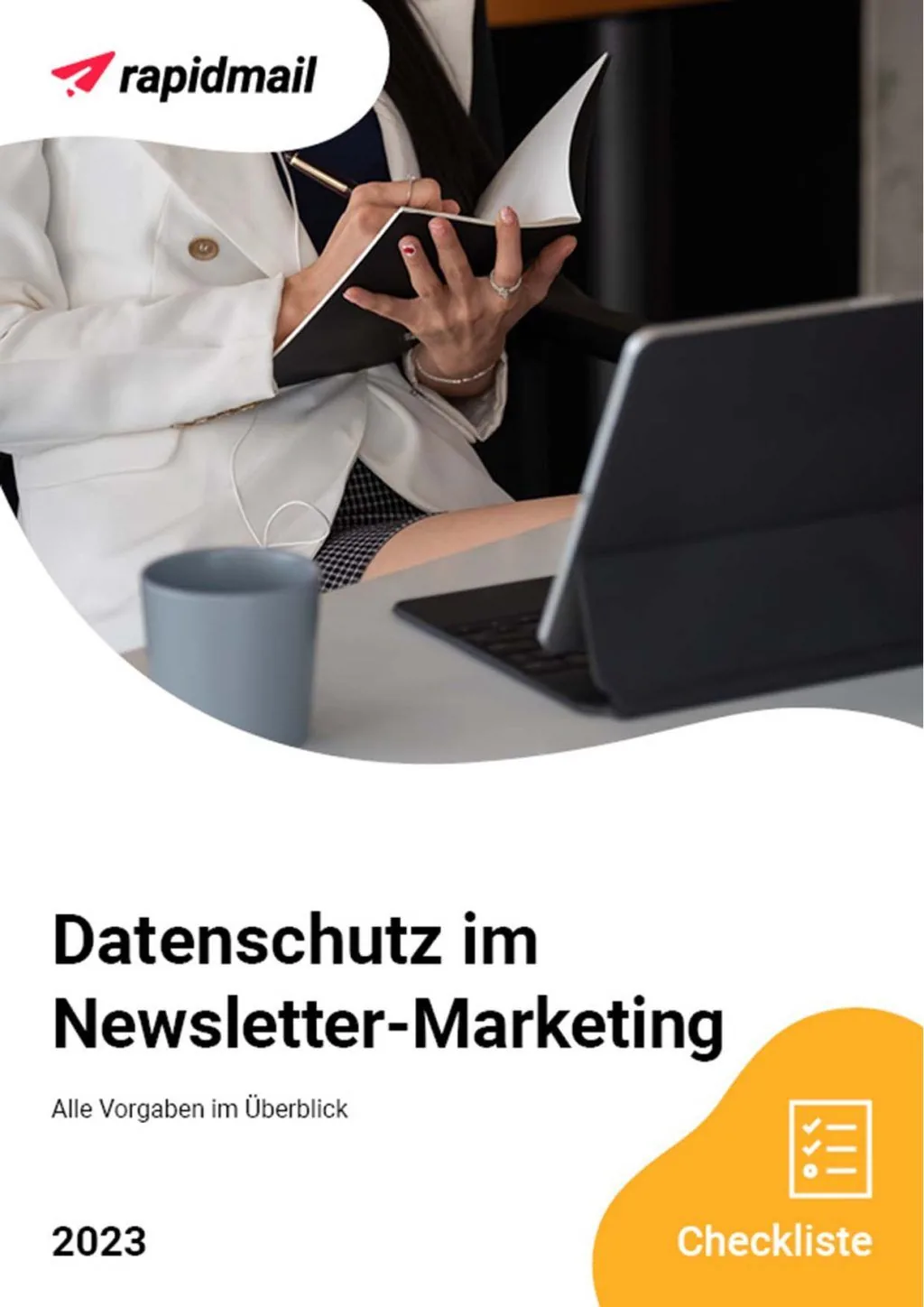
- Answers to the most important questions about data protection and the GDPR in email marketing, such as: Who does the GDPR apply to? What happens if I breach the GDPR?
- A practical summary of all the requirements you must meet to send 100% GDPR-compliant newsletters
- The benefit of interactively checking off the points you have already implemented successfully! ✨
Download the interactive data protection checklist for free (PDF in German)
6. Keep the newsletter sign-up process as simple as possible
Very few people want to enter dozens of different details in a sign-up form or read long passages before subscribing to a newsletter. So keep your sign-up form as simple as possible!
If you ask for too much data during sign-up, such as place of residence or date of birth, users may find it off-putting because these details seem completely irrelevant to the newsletter subscription. Interested people can quickly change their minds and may decide not to subscribe after all. Their email address and, if applicable, their preferred topics are usually entirely sufficient. Better still, ask for their first name and surname so that you can address your contacts personally in the newsletter, which has an immediate positive effect on customer loyalty.
Of course, some steps such as the double opt-in process are still necessary to send your newsletter legally. But here too, try to keep the double opt-in confirmation email and success page as simple as possible.
Conclusion: The effort required to build a high-quality mailing list is worthwhile
Building a high-quality newsletter list definitely pays off, even if you initially need to invest some energy and time. You have already taken the first step because you now know the different strategies for creating, building and expanding your mailing list, and can put them into practice straight away.
Be patient, especially at the beginning, because your recipient list will not gain hundreds of new email addresses overnight. It all takes time. Good things come to those who wait! In the end, however, you will reap the rewards of your work: a high-quality newsletter list does not contain random purchased email addresses, but contact details gained honestly from people who are genuinely interested.
It is then important to consider carefully what content the new subscribers expect in the newsletter. With the right analysis method, a little creativity and lots of attention to detail, your new newsletter contacts are sure to become true fans quickly. This further increases the likelihood that your subscribers will regularly open and read your newsletter and eventually become paying customers, making your email marketing a complete success!
Get started right away: use our form editor to design your individual newsletter sign-up form and share it to your heart’s content on all the communication channels presented above!
… and win lots of new subscribers!