Buying email addresses: 5 reasons not to

Buying email addresses is not an effective way to grow your mailing list for newsletter campaigns. Quite the opposite: contacting purchased contacts is not only unlawful, but also has a negative impact on email deliverability and your image as a sender. For these reasons, you should make your newsletter appealing enough for interested people to sign up voluntarily instead of buying lists of email addresses.
1. Buying email addresses in Germany is unlawful
Many newsletter senders who are just getting started with email marketing wonder how they can grow their recipient list quickly and efficiently. When searching for answers, it does not take long to come across tempting online offers: millions of business addresses in one go! And at fair prices, a dream come true! But appearances are deceptive: you are better off steering clear of purchased email addresses.
In fact, buying address data in Germany is not prohibited in itself. Even after the GDPR came into force, it remains legal in principle to buy email addresses online from third-party providers. However, there are very strict limits on how you may then use the purchased email lists for your own purposes.
This is because, under the GDPR, marketing emails may only be sent with recipients’ explicit consent. This means your contacts must have demonstrably agreed to receive the newsletter. The double opt-in process is normally used for this when sending newsletters.
The first problem with purchased email addresses is that you have no guarantee that the contacts ever consented to receive the newsletter. The second is that recipients’ consent, even if it was actually given, cannot and must not be resold together with the addresses. The address owners’ consent is always tied to the company that obtained permission. When you buy addresses, that is not you as the newsletter sender, but the third-party provider from whom you bought the contacts.
💡 rapidtip
If you want to gain new subscribers, it is equally unwise to make participation in a prize draw or the download of a white paper conditional on a mandatory newsletter sign-up, for example. The ban on tying services to newsletter sign-ups means that participants in a prize draw or users of a white paper cannot be automatically subscribed to the newsletter. Here too, you must obtain the recipients’ active and explicit consent. This was also confirmed by the Frankfurt Higher Regional Court (Oberlandesgericht Frankfurt) (June 27, 2019, 6 U 6/19).
In other words, despite the many offers claiming otherwise, it is generally unlawful to buy “email addresses with permission” from third-party providers and use them to send your own newsletters. If you want to send legally compliant newsletters, you should therefore use other ways to grow your recipient list. It makes no difference whether these are business addresses (B2B) or private individuals’ email addresses (B2C).
⚠️ Reason 1 not to buy email addresses
Sending newsletters to purchased email lists is unlawful.
2. Purchased email addresses harm deliverability
Did you know that buying email addresses has a negative impact on your newsletter’s deliverability? One reason is that purchased lists often contain inactive email addresses. For example, regular job changes and the associated changes of email address, which have now become almost commonplace, are often not taken into account in commercially available address lists. Since such lists have numerous buyers, the owners of the addresses being sold may also have moved to a new address long ago after receiving too many unwanted emails.
Contacting inactive addresses has several negative consequences for you as a newsletter sender:
- It triggers many bounces, meaning failed deliveries. Your newsletter therefore cannot be delivered to many addresses in your recipient list and “bounces” back.
- At the same time, many email clients use these permanently inactive email addresses as spam traps: if an email is sent to an address that has not been used for a long time, the provider’s spam filter will immediately and automatically classify the sender address as a spam sender.
- It is also highly likely that many recipients will mark your newsletter as spam, because they did not sign up for it and it still arrived unwanted in their email inbox.
A high number of failed deliveries and spam reports is an explosive combination for the overall deliverability of your newsletter: your recipients’ email programs will continue to flag your sender address in the future, mark your campaigns as “unwanted” or block delivery altogether. It makes no difference if only some of the recipient addresses were purchased, your good reputation as a sender is now history.
⚠️ Reason 2 not to buy email addresses
Sending newsletters to purchased email addresses has a negative impact on the delivery rate of your campaigns.
Focus on quality rather than quantity in your recipient lists and send newsletters that actually reach your subscribers.
3. Caution: buying email addresses can get you blocked by newsletter tools
Like most newsletter tools, rapidmail does not support the unlawful sending of newsletters to purchased recipient addresses. This is also stipulated in our terms and conditions: senders may only send their newsletters to email addresses whose owners have explicitly agreed to receive them.
If you do not follow these guidelines as a newsletter sender, your rapidmail account may be temporarily blocked or permanently suspended after the case has been reviewed. In addition to the fact that we naturally do not want to support legal violations, we also take this action to protect our own IP addresses. After all, we want to continue using them to send our customers’ newsletters securely and guarantee optimum deliverability. Our specialist article on OMR Reviews about sovereign newsletter infrastructure in Germany explains why these trust signals are created not only by clean recipient lists, but also at infrastructure level.
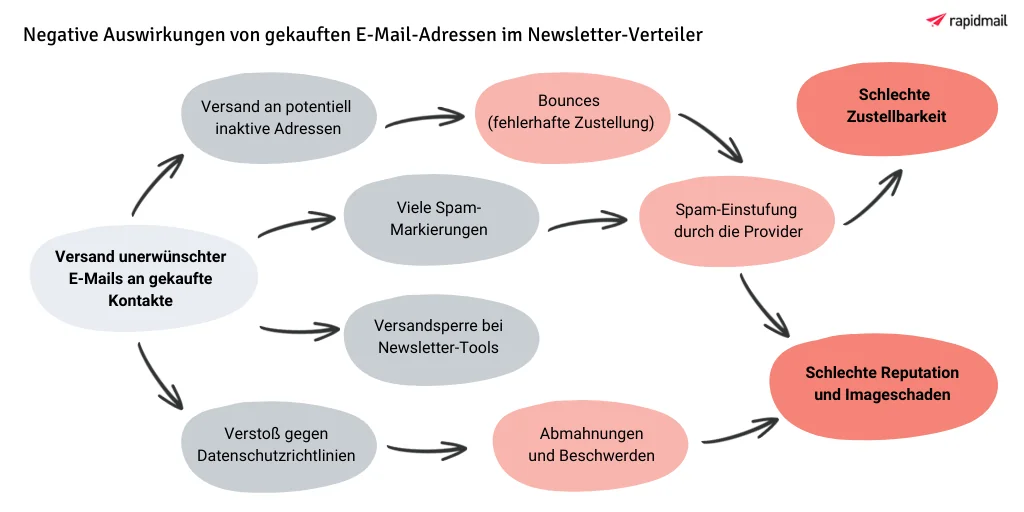
In short, if buying email lists gives you an extensive recipient list but no newsletter software will let you contact it, the purchase has not really paid off.
⚠️ Reason 3 not to buy email addresses
Most newsletter tools penalize the unlawful sending of emails to purchased email addresses by blocking your campaigns.
4. Be honest: purchased contacts are far from being prospects
The more, the merrier? Far from it! Of course, it sounds tempting for your newsletter to suddenly reach thousands more recipients thanks to purchased email addresses. But there is one thing you should not forget as the sender of such mass emails: the owners of these email addresses are not prospects! If they were interested in your product or service, they would probably have found your website on their own and signed up for the newsletter long ago.
The rapidmail newsletter
Tips, ideas and news about email marketing, straight to your inbox.
It is certainly possible that a few owners of the purchased addresses will only discover your company through the newsletter and then become customers. But numerous hurdles would have to be overcome before that could actually happen:
- The email address you contact must still be active.
- The newsletter must pass the spam filter and reach the contact’s inbox.
- The email must stand out among the many emails received each day.
- Recipients must not mark the unwanted message as spam.
- The sender name and subject line must capture recipients’ interest so that they open and read the campaign.
- The newsletter content must also happen to match their personal interests.
⚠️ Reason 4 not to buy email addresses
It is highly unlikely that purchased contacts will receive, open and read your newsletter, and actually be interested in your marketing message.
We would argue that the benefit of buying addresses is much smaller than the effort you will subsequently have to make to repair your damaged sender reputation after spam reports, bounces and legal warnings.
👀 How much does it cost to buy email addresses?
At just a few cents per email address, buying email addresses initially sounds like a real bargain. But that does not mean buying email addresses is worthwhile. This is especially true if you pay for your newsletter software based on the number of recipients contacted. In that case, investing in purchased address lists pays off even less. Unless, of course, you want to pay for the email addresses AND pay again to send to them, for a very poor result.
It makes much more sense to pay only to send newsletters to recipients who have actively subscribed to your newsletter and thereby shown an interest in hearing from you.
It is better to invest your money in other ways of turning users who are already browsing your website into newsletter subscribers. Be creative and convince prospects of the value of your newsletter instead of sending indiscriminate messages to random email addresses.
💡 rapidtip
To get prospects excited about your newsletter, it should offer clear added value. After all, there has to be a compelling reason or incentive to sign up for the newsletter. We have put together some of the almost endless ways in which you can enrich your recipients’ inboxes:
- Offers (discount vouchers, free delivery, loyalty gifts, etc.)
- Previews of new collections, features and products, plus advance offers
- New resources (guides, help videos, tips, white papers and ebooks)
- Free templates
- Invitations to events
- Prize draws and contests
- Important internal news from the sending company and exciting industry news
There are also many other creative ideas for gaining newsletter subscribers that are far better suited to successfully growing your recipient list than buying email addresses.
5. Goodbye credibility: reputational damage for the sending company
In the long run, buying email addresses also damages your company’s or brand’s image. You will know the feeling: the many spam emails that somehow arrive unsolicited in your inbox are annoying. After a while, you get tired of manually moving the emails to the trash and mark every unwanted message as spam. What remains is the memory of the sending company’s irritating emails.
Rather than helping you gain new customers, buying addresses is more likely to make the owners of those addresses associate your company with annoying spam emails that appear disreputable to them. Whether you will ever be able to convince them to trust you and your products or services after that is questionable.
What is more, your reputation as a spam sender among the owners of the purchased addresses can spread much further in the long term than you might initially expect. Do not underestimate word of mouth here: if your company or products come up in conversation among family or friends, the purchased recipients of your newsletters will certainly not hesitate to talk about their negative experiences.
⚠️ Reason 5 not to buy email addresses
Buying and contacting email addresses damages your brand image and earns you a disreputable image among your target audience and the people around them, causing lasting harm.