B2B email marketing: a simple step-by-step guide to effective B2B newsletters and campaigns
Compared with communicating with private consumers, B2B email marketing has some important differences. The target audience does not consist of private individuals with their own wishes, problems or needs who manage their own budgets. B2B campaigns address people who make purchasing decisions in their company’s interests, usually within inflexible budget requirements. Our step-by-step guide explains how email marketing can help you boost sales in the B2B sector too.
1. B2B email marketing: what is it and why is it important?
Let us start with the basics: what is business-to-business email marketing? Email marketing is one of the best-known and most popular forms of B2B online marketing. Transactional emails, automated emails such as birthday greetings, newsletters and promotional emails are regularly sent to business contacts who have previously signed up to receive them. Newsletter marketing is also a form of direct marketing because business customers or prospects are contacted individually with content tailored to the target audience.
👀 Would you like to get straight into email marketing?
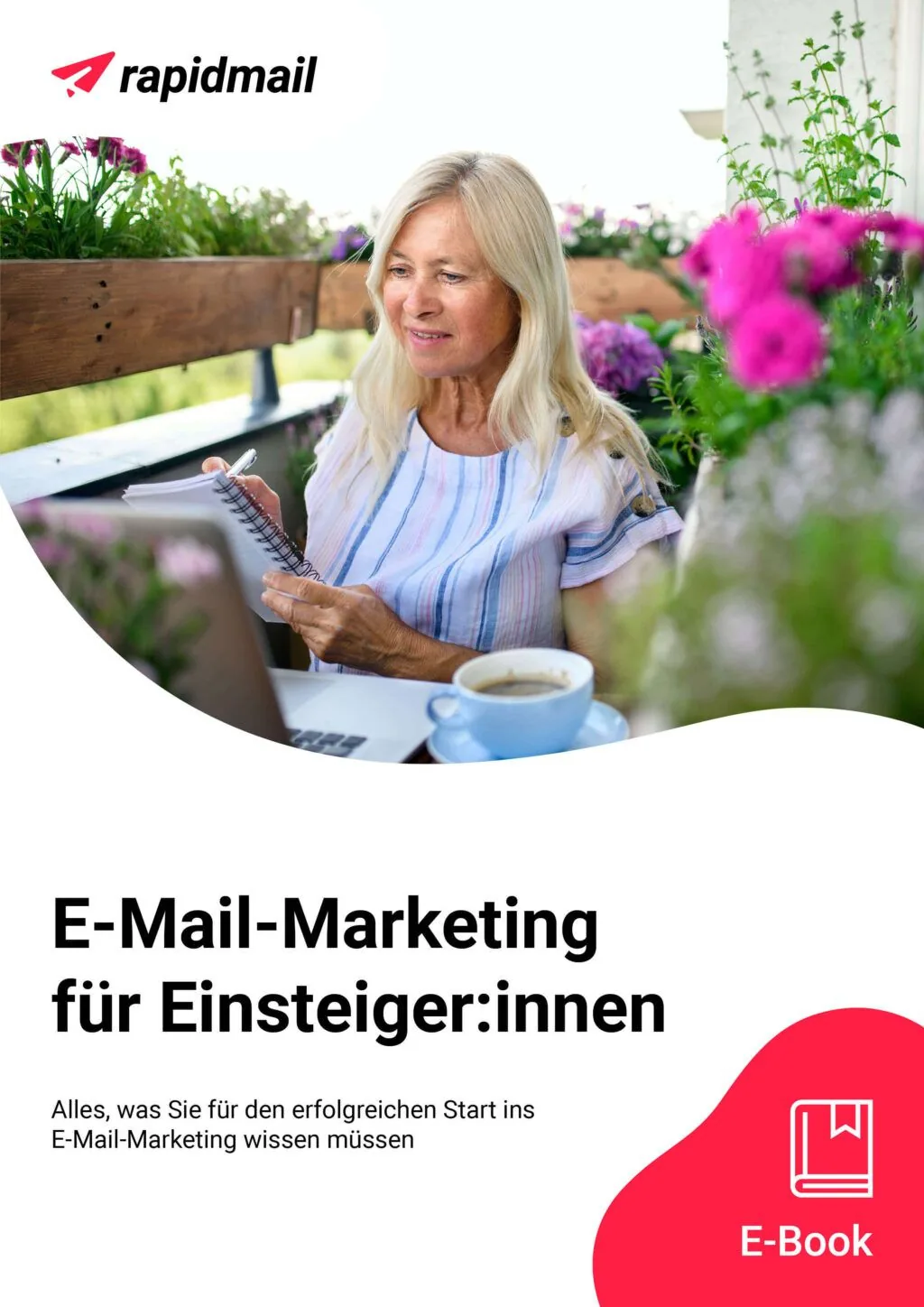
Our free e-book on email marketing for beginners tells you everything you need to know for a successful start in email marketing. Alongside essential definitions, it provides an overview of the benefits of email marketing for different types and sizes of company, plus tips for choosing suitable email marketing software. Perfect for complete beginners and anyone who wants to refresh their knowledge! ✅
This e-book includes, for example:
- Essential definitions
- An overview of the benefits of marketing emails
- The most important information about newsletter marketing for different types and sizes of business
- An overview of different types of marketing email
- Tips for choosing suitable email marketing software
- Tips for building an email distribution list
Download the email marketing e-book for beginners for free (PDF in German)
Another decisive advantage of email marketing is that recipients are not “strangers” among the general public who are unlikely to have much interest in your advertising message. Quite the opposite: because subscribers have already voluntarily signed up to your newsletter and shown an interest in your company, these contacts are particularly valuable. Consent-based newsletters tailored to the target audience are therefore much more effective than impersonal mass advertising in the B2B sector too.
Email marketing can help you achieve important company goals in the B2B sector in several ways:
- 🫱🏻🫲🏼 establish and strengthen interpersonal relationships
- 🧑💼 Win new business customers
- 👀 Spark interest in products and services
- 🧲 Generate leads
- 📈 Increase sales
- 📰 Inform customers and keep them up to date
- ♥️ Build long-term loyalty among business customers
- ⚙️ Expand B2B online marketing to create the ideal marketing mix
👀 Have you seen this? Email marketing for B2B companies
Would you like to win over your business customers and boost your B2B company’s sales? In this video, our content manager Wiebke shows you how to create the perfect plan for B2B email marketing in just 6 steps. Roll the film! 🎬
Open video transcript
Chapter 1: Introduction
Would you like to address decision-makers in companies directly? Then B2B email marketing is exactly right for you! This channel lets you reach the right contacts without significant wastage and accompany them throughout the customer lifecycle. Email marketing is also cheaper and less time-consuming than trade fairs or print advertising.
Hello, I’m Wiebke, and today I would like to show you how to put together the perfect email marketing strategy for your B2B company. This includes thoroughly defining your goals and target audience, building your mailing list, planning content, selecting the right design and timing, and of course analyzing your results. Let’s get started!
Chapter 2: What is B2B email marketing?
Email marketing involves sending emails in the form of newsletters, automated emails or transactional emails to contacts who have previously consented to receive them, in both the B2C and B2B sectors. The difference lies in the type of contact or target audience.
In B2B email marketing, you send commercial emails to business contacts. In contrast, B2C email marketing addresses private consumers. Emotional and entertaining content works well in B2C, whereas rational arguments have the strongest influence on purchasing decisions in B2B. However, that does not mean B2B content must be stiff and boring: people in this sector also appreciate a likeable, humorous tone.
Bear in mind that you often address trained specialists with high expectations and fixed budget requirements. Impulse purchases are rare, and decision-making processes frequently take a long time. This is precisely where email marketing offers a way to build long-term personal relationships. Regular information about features, pricing models and offers helps win over prospective customers.
Chapter 3: Step 1: Define goals for your B2B email marketing
Before you really get started, consider which overarching goals you want to achieve. This will make it easier to choose suitable measures later.
B2B email marketing can help you establish and strengthen interpersonal relationships, win new business customers and build their long-term loyalty, spark interest in your products and services, generate leads, increase sales, and inform customers and keep them up to date.
Set specific goals so you can identify the measures required. If a cleaning company wants to win ten new customers a month, for example, its newsletters should present the service attractively and explain why it is particularly relevant. If the company wants to increase sales from existing customers, its emails should promote additional offers and consultations.
Chapter 4: Step 2: Define the target audience
Defining the target audience is particularly important in B2B because it is usually smaller than in B2C. Winning over trained specialists with strict requirements and fixed budgets can be challenging, but a thorough analysis makes it possible.
Ask yourself the following questions:
Who is our product or service for? Which industries is our offering relevant to? How large are the companies that could use our offering? Which people make decisions in these companies? What characteristics define these decision-makers? What challenges do they face in their working day?
It can be helpful to speak to your sales team or customer service. Personas are fictional representatives of the target audience with typical characteristics. They help you understand prospective customers’ needs and decision-making processes more clearly.
Chapter 5: Step 3: Generate leads and maintain your recipient list
Because the target audience is smaller in B2B, collecting high-quality contacts is especially important. They should be involved in decision-making processes or participate in the flow of information within the company.
The foundation is an inviting sign-up form on your website. You can offer incentives to make signing up more attractive, such as discounts, free webinars or e-books. However, do not buy contact lists or add existing customers to your distribution list without consent.
The double opt-in process ensures that only people who actively sign up receive your emails. Prospects must verify their sign-up through a confirmation link in an email before they are added to the distribution list.
Chapter 6: Step 4: Plan relevant content for B2B emails
Appealing content that adds value can win over prospective business customers in the long term. Consider what content your contacts like to consume to spark their curiosity and build trust.
Possible B2B newsletter topics include product presentations, industry news, use cases, experience reports, special offers, and studies and reports containing relevant statistics and expert opinions.
Create a sending plan to distribute content regularly and in a structured way.
Chapter 7: Step 5: Find the right timing for B2B email marketing
Base send times on your contacts’ working day. Emails are generally read between 8 a.m. and 5 p.m., so test which time works best. Sending frequency is also crucial. Send emails only when you have relevant content. Monthly or occasion-based campaigns are often a good choice.
Good planning prevents you from overwhelming recipients with too many emails. Use automation tools to manage sending efficiently.
Chapter 8: Step 6: Analyze and optimize success
To optimize your B2B email marketing, keep an eye on important metrics:
The delivery rate, meaning how many emails actually arrive.
The open rate, meaning how many recipients open the email.
The click rate, meaning how many recipients click links or calls to action.
And the unsubscribe rate, meaning how many recipients unsubscribe from the newsletter.
These KPIs allow you to continually adapt and improve your strategy.
Chapter 9: Conclusion: achieve B2B email marketing goals in no time
As you can see, it takes just six simple steps to launch successful B2B email marketing. It is now up to you to plan and test your first campaign. With rapidmail, you can try your first campaign to up to 2,000 contacts for free.
Good luck with your B2B email marketing! I look forward to your questions and comments. See you next time!
2. B2B vs B2C email marketing: what are the differences?
Email marketing is classified as B2B or B2C depending on the target audience receiving a newsletter:
- B2B means “business-to-business”. B2B newsletter marketing includes promotional emails that companies send to prospective and existing business customers.
- B2C means “business-to-consumer”. B2C marketing emails are the “traditional” newsletters that companies send to private consumers.
Despite their different target audiences, both forms of email marketing offer numerous benefits. Sending newsletters with a suitable email marketing tool is not only inexpensive and quick, but also makes it easy to measure and analyze campaign success using specific metrics. You can continually optimize your advertising measures and tailor them to the target audience’s interests.
Whether you work in B2B or B2C, helpful and engaging content should always be at the heart of your customer communication. Newsletters that add value and provide information about relevant subjects can inspire readers and move you closer to your email marketing goals.
Of course, you can also send marketing newsletters that advertise your products. But be careful: too many purely sales-focused emails can quickly annoy subscribers and prompt them to unsubscribe. Interesting content is therefore indispensable for business-to-business email marketing.
Now let us take a closer look at the differences between B2B and B2C email marketing:
| B2B email marketing | B2C email marketing | |
|---|---|---|
| Typical industries | Wholesale, agencies, consulting, service providers, software companies, vehicle manufacturers, fashion, pharmaceutical companies, insurance | Retail/online stores, hospitality, fashion and cosmetics, fitness and healthcare, direct banks |
| Target audience | B2B campaigns target professional business customers and therefore address trained specialists. Ideally, they directly address the right contacts within the company who are responsible for purchasing decisions and business partnerships. | B2C newsletters are sent to private customers, or end consumers. |
| Newsletter distribution list | Because of the highly specific target audience and smaller market, recipient lists are usually shorter in B2B. It is therefore even more important to collect high-quality contacts and regularly maintain and review the recipient list. | Because there are many more private individuals than companies, B2C companies have a potentially larger target audience. B2C newsletter recipient lists therefore tend to contain more contacts. |
| Purchasing process | Because B2B companies usually offer relatively expensive products or services that require considerable advice, the purchasing process takes much longer and there are fewer impulse purchases. Rational, process-related arguments and budget requirements have a major influence on purchasing decisions. | Individual purchasing decisions are generally made quickly and often on the basis of emotional arguments. |
| Newsletter sending window | You have a smaller window for sending B2B campaigns because contacts only check emails during working hours, normally between 8 a.m. and 5 p.m., and not on weekends. | Although some send times are particularly effective, you can theoretically reach private customers on their smartphones, desktops and other devices anywhere and at any time. |
| Tone | The tone used with business customers does not always have to be stiff and particularly formal. You may communicate in a humorous and personal way in B2B email marketing, but should always remain professional. Naturally, the appropriate tone depends on the company’s image, industry, and advertised products or services. | A relaxed, entertaining tone of voice is particularly welcome in B2C newsletter marketing. Here too, the right tone depends on your company’s industry, type and style, such as a hair salon versus a funeral home, as well as the target audience’s technical affinity. |
3. Take care: legal requirements for B2B email marketing
Be aware that the same rules apply to B2B email marketing as to B2C. This means your business-to-business newsletter must comply with every requirement of the General Data Protection Regulation (GDPR).
Many newsletter senders mistakenly believe that a double opt-in process is unnecessary when new contacts sign up for B2B newsletters. In reality, this two-stage sign-up process is also the safest way to add new contacts to your distribution list in the B2B sector. In the event of a dispute, you can then prove that recipients actively and expressly consented to receive the newsletter and to the processing and storage of their data.
Only under very specific conditions do you not need to obtain separate advertising consent to send newsletters to existing customers. However, the legal boundaries are not very clear, so we recommend contacting only people whose double opt-in consent you have obtained. Prioritize building a newsletter distribution list containing high-quality contacts who have actively signed up themselves.
💡rapidtip
You should never buy email addresses. When you are just building your recipient list and searching for as many company contacts as possible, buying address lists online can seem tempting. But you do not have consent to send newsletters to these purchased business addresses, which can have legal consequences. Unwanted newsletters also damage your company’s reputation. It is much better and more efficient to expand your recipient list gradually with high-quality business contacts who are genuinely interested in your newsletter and therefore much more receptive to your advertising message.
4. What should I consider when choosing an email marketing tool?
When choosing a newsletter marketing tool, it is essential that the software fits your company’s needs perfectly and provides sufficient support when planning, creating and sending your B2B newsletter. Factors include how much prior design and marketing knowledge you have, which features you need and the level of data protection you require. Our comprehensive newsletter tool comparison offers some help with the decision.
We particularly advise you not to compromise on GDPR compliance in your email marketing. To ensure that you meet every legal requirement and avoid cease-and-desist letters, fines or a dubious reputation as a spam sender, choose software that automatically uses the double opt-in sign-up process.
It is also important for your newsletter tool to support test emails, design previews and rendering tests. This lets you calmly test whether your campaign will withstand close scrutiny from your specialist target audience.
In addition, rapidmail’s 1-click design allows you to create newsletters in your corporate design. Business customers then immediately recognize that the newsletter is from you when they open it, while you increase brand awareness. A free, easily accessible support team is also important for smooth newsletter creation, ensuring you always have a knowledgeable contact when questions arise. In B2B, it is also especially important to segment contacts in your email distribution list by industry, company size or role, for example. You can then tailor newsletter content for each subgroup to the interests and needs of its recipients.
5. How to create your first B2B newsletter
Are you curious and ready to start email marketing in your own B2B company? We have compiled all the steps to consider when planning and implementing your newsletter strategy.
Step 1: Define email marketing goals
We have already explained which major company goals B2B newsletter marketing can help you approach. When developing your own strategy, however, you should examine your individual starting position and define precise goals you want to achieve.
Would you like to win new business customers, for example? Give this goal a specific number, such as “win 50 new customers per month”. This makes it easier to check afterwards whether you actually achieved your goal.
The rapidmail newsletter
Tips, ideas and news about email marketing, straight to your inbox.
Step 2: Define the target audience
As always, defining the target audience plays a major role. Only a precise understanding of prospective business customers and the relevant contacts allows you to create relevant, effective content.
The special feature of B2B is that the target audience is more narrowly defined and usually much smaller than in B2C. You also address trained specialists with strict requirements and precise budget plans. Winning them over can be challenging, but the right target audience focus makes it entirely manageable.
Ask yourself the following questions:
- Who is our product or service for? Who are our ideal customers?
- Which industries is our offering relevant to? What legal structure and company size characterize our customers?
- What budget do the companies have? What is the maximum they can spend on our product or service?
- Which people in the company make purchasing decisions, and who influences those decisions?
- What characteristics define these people? What roles do they hold? Are they under time pressure? How open are they to innovation?
- How much specialist knowledge do the contacts have? Can my newsletter copy contain technical terminology without overwhelming readers? Or do they expect specialist language because they use it to assess the sender’s expertise?
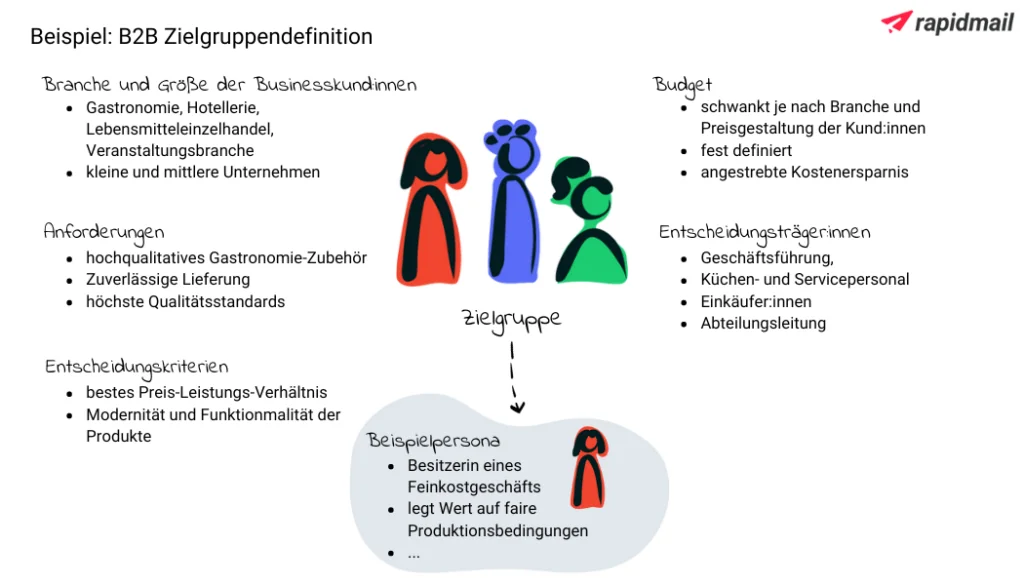
If you consider that a start-up has very different requirements from an established company, for example, you can tailor your newsletter strategy entirely to prospective customers.
Create target-audience-focused newsletters now
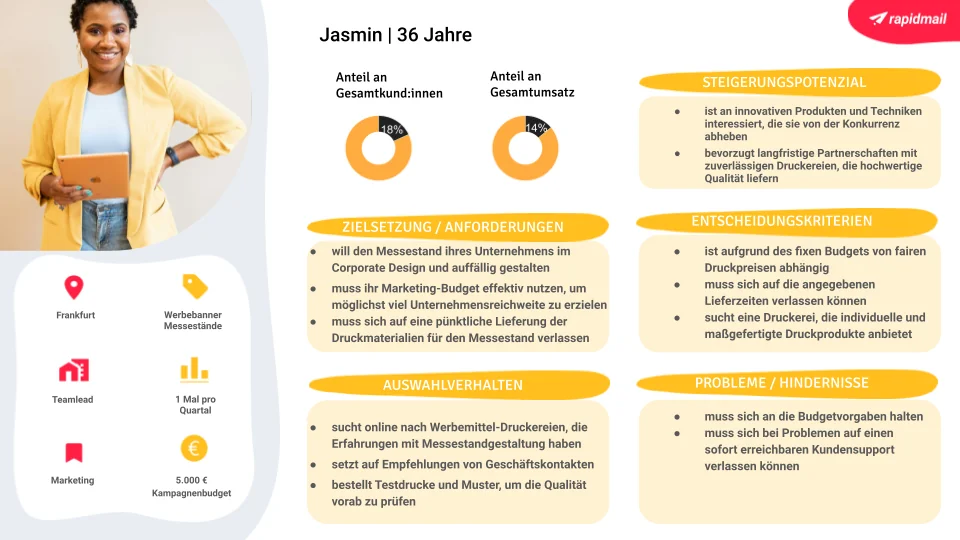
It is also worth creating personas for people who influence purchasing decisions. Personas are fictional representatives of your target audience who are assigned specific characteristics to build a detailed, varied picture of an audience that naturally consists of many individual decision-makers.
If you manufacture and distribute accessories for the hospitality industry, for example, your target audience definition might look like this in simplified form:
Step 3: Create, expand and manage recipient lists
In B2B newsletter marketing, it is especially important to contact the right people. It will not help if your newsletter reaches the wrong person in the company and the campaign ends up unread in the trash or, worse still, the spam folder.
Focus on quality rather than quantity:
Your newsletter distribution list should contain only high-quality email addresses belonging to people who initiate purchasing processes, make decisions, use your product, or are involved in the flow of information within a company and therefore help determine who receives your content.
Once you have imported your recipient list into your newsletter tool or created a new list, you should segment it by industry, company size, company type and organization, and sales, for example, grouping customers into A, B and C categories.
The tag feature lets you tailor newsletter content even more closely to subscribers’ interests. Prospects can specify the subjects they want to receive campaigns about when signing up.
Naturally, you should continually expand your recipient list. An inviting sign-up form on your website provides the foundation by encouraging prospects to subscribe and allowing you to stay in contact.
Step 4: Plan engaging content and ideal send times
The first foundations of your B2B email marketing are now in place, so you can focus on the heart of B2B newsletter marketing: good content that adds value. Engaging content can win over prospective business customers in the long term and accompany them through the purchasing and decision-making process. At the same time, B2B emails can highlight what sets you apart from competitors and makes your company special.
It is important to provide both rational arguments for your products and services and present yourself as a likeable, knowledgeable partner, creating a trusting customer relationship. Remember that although your offering is aimed at companies, the decisions within those companies are made by people. Both rational and emotional reasons therefore influence your target audience’s selection and purchasing behavior.
We have compiled some ideas for newsletter content that can communicate this message:
- 🛒 Present new products: if you plan to expand your offering, draw attention to your new product in the newsletter in good time. This lets you give business customers all the essential information and spark their interest. Make sure you do not use a “noreply address”, so prospects can reply to your campaign and contact you with questions. This moves you a significant step forwards in the purchasing process.
- 📰 Share important industry news: direct advertising messages are not the only suitable content for B2B emails. Engaging information about current developments in your industry also keeps readers up to date and makes you memorable through an informative, knowledgeable exchange.
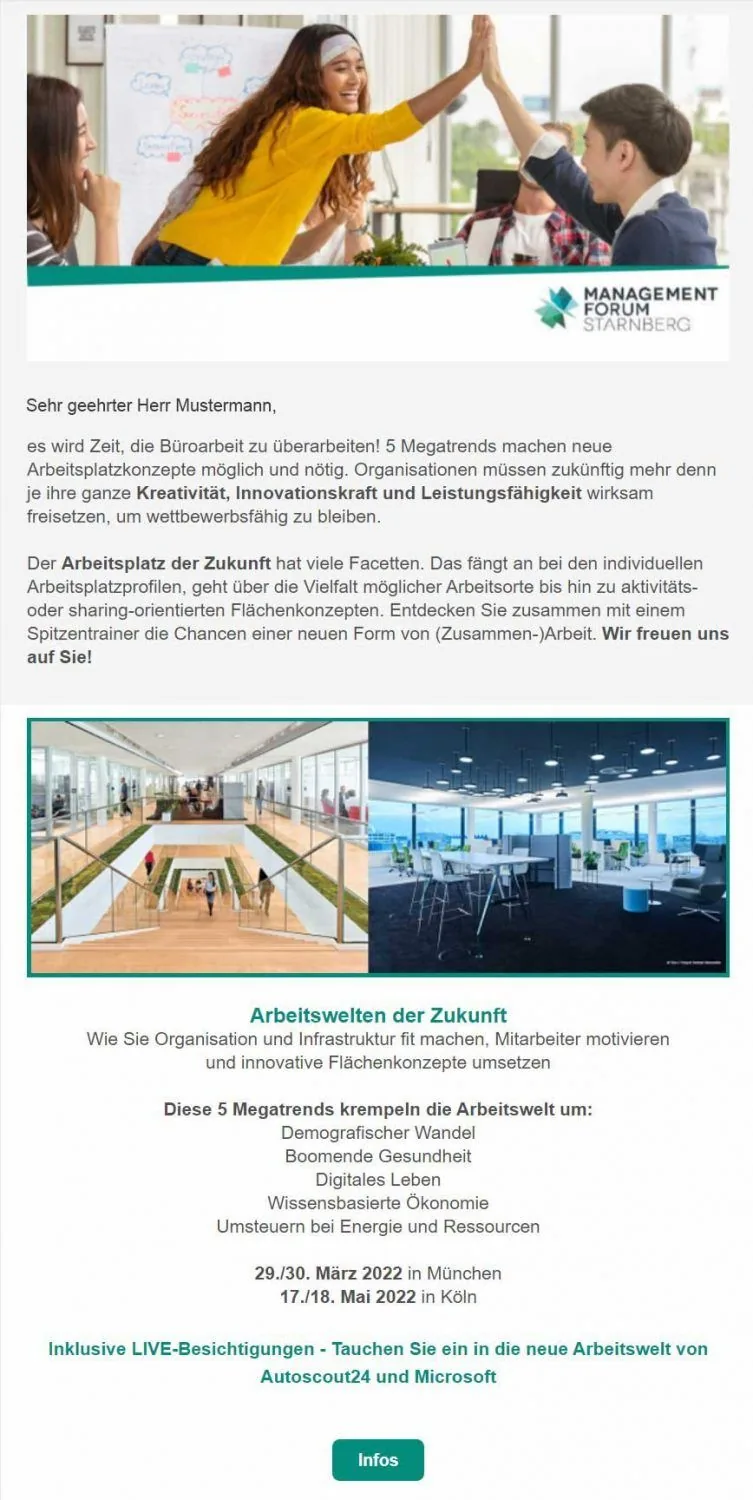
- 🔧 Show practical use cases: use cases demonstrate the purposes, problems and goals for which your products and services can be used. This helps prospective customers understand how they can use your offering and exactly how the products work.
- 🗣️ Report on experiences: case studies, testimonials and reports from customers and partners are ideal for creating a positive impression of your company and can also provide inspiration. Many positive reviews also increase your credibility and trust in your products.
- 💸 Individual special offers: meet newsletter subscribers halfway and consider how discounts or special promotions can maintain their interest.
- 💡 Include informative studies: do you know of a study that demonstrates the effectiveness or relevance of your products? Include the study, informative charts and interesting quotations from researchers and experts in your B2B newsletter to demonstrate your expertise once more.
Just as important as planning subjects is defining ideal send times in B2B email marketing. After all, you want to prevent your newsletter from disappearing in the daily flood of work emails and going unread. Reaching the responsible contacts at the right time with content that interests readers is a genuine bullseye.
Step 5: Create an appealing newsletter design
No matter how important engaging, helpful content may be, the best newsletter copy has no effect if the campaign is never opened. The sender, preheader and an inviting subject line that announces the newsletter content and sparks interest are therefore crucial to your B2B newsletter’s success.
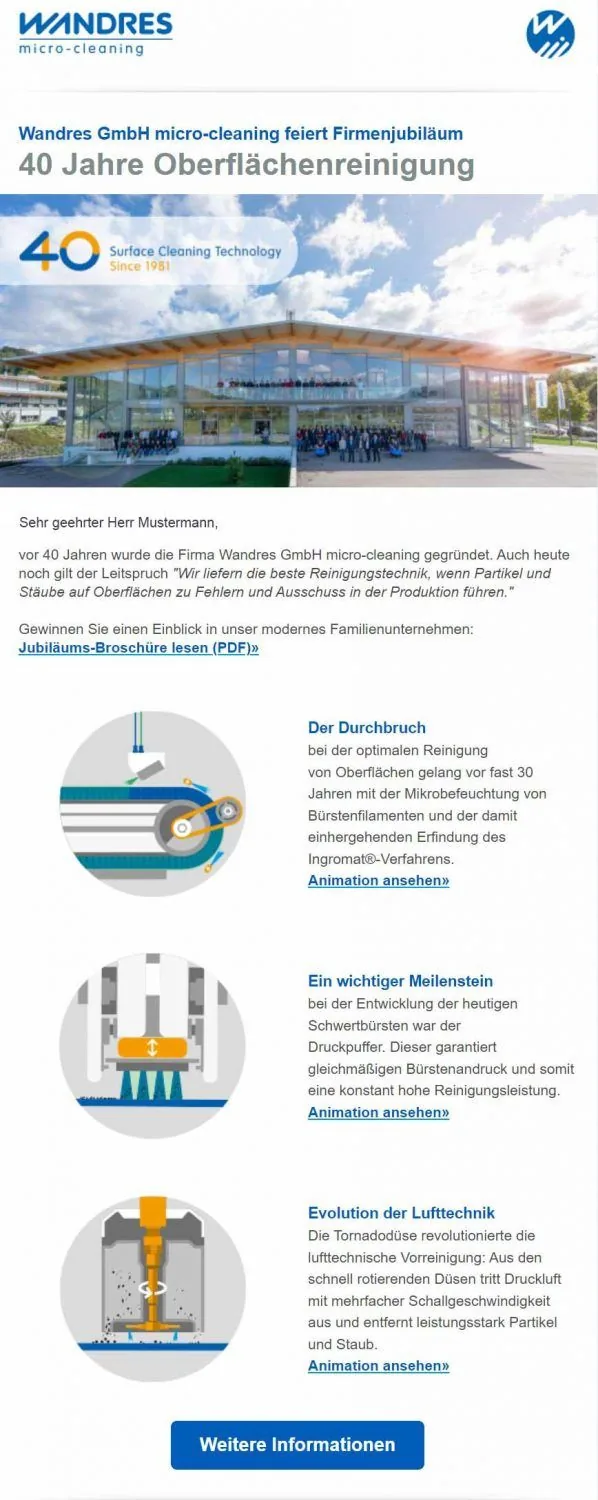
Once the newsletter has been opened, an appealing email design should impress recipients and immediately encourage them to read the content. Effective headings, high-quality images, well-structured paragraphs and cleverly placed call-to-action buttons help you present your message and content professionally. Readers’ attention is then drawn automatically to the most important parts of the newsletter.
👀 Did you know?
The call-to-action button is the most important element in a newsletter because it prompts readers to act and directs them to the sender’s website. This brings you a major step closer to a purchase or contract. To succeed, the call-to-action button should appear in the visible “above the fold” area that subscribers see when they open the campaign. Ideally, it should also follow a short section of copy. Choosing inviting wording is important too: the button label must make clear that clicking the call to action gives readers exactly what they want at that point after reading the preceding copy.
Once you have created a successful newsletter design tailored to your corporate design, you can retain it for future campaigns. You can also save existing design elements in the rapidmail editor and reuse them in later campaigns. This saves time while increasing your newsletter’s recognition value. Good newsletter design ensures that your campaigns, and therefore your company, remain positively memorable and that subscribers continue to enjoy opening your newsletters.
💡rapidtip
A campaign’s content and design are not the only factors determining how your newsletter is perceived by subscribers and B2B partners. The way you communicate and the tone you choose also have a significant influence on your company’s image. A consistent communication concept, from your website and support to your social media presence and newsletter, helps your company be perceived as a knowledgeable, trustworthy communication and business partner. Incidentally, newsletter personalization is a proven way to strengthen this impression.
Step 6: Analyze the success of B2B email marketing
To get the most from your B2B newsletter marketing, always keep an eye on the most important metrics. The delivery rate, open rate, click rate and unsubscribe rate from newsletter reporting tell you how well recipients have responded to your campaigns and whether you are achieving your goals. Analyzing newsletter statistics also allows you to identify improvements and optimize your marketing measures.
As you can see, 6 simple steps are all it takes to launch B2B email marketing, maintain contact with business partners and establish new business contacts. So what are you waiting for?