Writing newsletters: 11 tips for excellent copy

Writing a newsletter is not always easy. You know what you want to tell your readers, but where should you begin? And how do you make sure they actually read the copy? Our 11 tips will teach you how to write good newsletters, with copy that engages your subscribers and encourages them to click the call to action.
🥜 In a nutshell: How to write newsletters people actually read in 2026
Good newsletter copy is clear, personal and action-oriented. A strong headline, clear structure and unambiguous call to action are particularly important. These 11 tips will help you write newsletters that get opened, read and clicked more often.
✔️ Headline: First impressions count. A short, punchy headline determines whether someone continues reading your newsletter or clicks away.
✔️ Personal greeting: “Dear Jane” beats “Dear Sir or Madam” every time. A personal touch works.
✔️ Clear structure: Introduction, main section, conclusion. It sounds simple, but makes all the difference. The AIDA model shows you how.
✔️ Call to action: What should readers do after reading your newsletter? Tell them clearly and directly.
✔️ Cut filler words: “Actually”, “basically”, “so to speak”. They can all go. Your copy will thank you.
✔️ Avoid spam words: “Free”, “prize” and too many exclamation marks can land you in the spam folder faster than you can type “send”.
✔️ Write actively: Choose verbs instead of nominalizations. This makes your newsletter livelier and easier to understand.
✔️ Be specific: Use concrete figures and facts to make your newsletter copy more convincing and vivid.
✔️ Put readers first: Nobody enjoys reading pure advertising. Provide real value to build trust, because trust drives sales.
✔️ Use AI wisely: Artificial intelligence is a valuable sounding board for initial ideas and drafts. The final version, however, remains in your hands.
✔️ Ask someone to proofread: Two pairs of eyes are better than one. Always. Really.
1. Win readers over with a punchy headline
A good newsletter headline determines whether readers continue reading or close the email immediately. It should summarize the newsletter’s most important message briefly, clearly and engagingly.
First impressions count. Once your subject line and preheader have captured subscribers’ interest, a strong headline intensifies that curiosity when they open the email. Ask yourself: what is the central message of your newsletter, and how can you express it as concisely as possible? If the headline convinces them, your contacts will usually read the rest too.
👀 Have you seen this? How to write newsletters like a professional
Would you rather watch a video and learn how to write successful newsletters? No problem. In this video, our Content Manager Wiebke presents our 11 professional tips for excellent newsletter copy. Roll the film! 🎬
Open video transcript
Introduction
Do you regularly sit in front of a blank screen wondering how to write your newsletter?
I certainly know the problem. In my day-to-day work as a Content Manager at rapidmail, however, I have collected 11 tips that will help you overcome writer’s block in the future. So, let us simply write a newsletter together.
Tip 1: Write a compelling headline
The headline is the first thing your contacts see, so it should immediately spark their curiosity. Ask yourself what the newsletter’s main message is and summarize it briefly and concisely in a suitable headline. Try to use as few lines as possible, although you can work with a main headline and subheading, for example. Particularly large headlines in eye-catching fonts are on trend this year.
If you want to write your own newsletter straight afterwards, I have a little surprise for you. The first link in the video description gives you a 50% discount on your first rapidmail invoice.
Tip 2: Create a connection through personalization
In email marketing, you can afford to “make it personal” and greet your contacts by name. This immediately makes your newsletter copy feel much more personal and makes you and your brand appear approachable and likeable.
Different greetings may be appropriate depending on your industry and company:
If you are choosing between “Dear Mr/Ms …”, “Dear …” or simply “Hello …”, use the communication style you normally follow as a guide.
In my experience, however, email marketing is usually rather more relaxed. After all, you want your newsletter to connect with your target audience and build a lasting relationship. A warm “Dear Mr Miller” feels much friendlier and automatically creates a closer connection than the formal “Dear Mr Miller, Sir”. The latter sounds comparatively more distant, cooler and, in my opinion, somewhat old-fashioned.
For a personalized greeting, you naturally need your contacts’ first name and/or surname and, depending on the form of address, their gender.
Another tip:
Subscribe to other newsletters too. This puts you in the reader’s position and lets you see for yourself which subject lines, headlines or phrases appeal to you more and which appeal less.
Tip 3: Use a clear structure
Before I start writing the newsletter, I make a bullet-point list of all the information I want readers to take away. Put the different points into a suitable order, then consider which aspects belong in the introduction, main section or conclusion of your newsletter copy. The clearer and more structured your newsletter, the better you can communicate your message and achieve your goal.
Your introduction should build on the curiosity created by the headline and show contacts why they should keep reading.
For example, I could begin with a question such as: “Have you ever wondered how to captivate your readers with truly excellent copy?” This creates an immediate connection with readers and places them in a specific situation that they probably recognize.
The main section then contains your primary purpose, such as informing, selling or entertaining. As this newsletter is intended to inform, I provide a concise list of tips for good newsletter copy.
The conclusion is where you fully convince contacts and motivate them to click the CTA. State clearly why they should do so and which benefits they can expect. Then add a prominently placed, clickable CTA button that leads to your website.
Because I want readers to watch this video, I link to it with the eye-catching button and give them an incentive: they can get more tips while sitting back and relaxing.
The AIDA model can also help you write newsletters. A cruise ship? No. The AIDA principle is a marketing formula. A stands for “attention”, I for “interest”, D for “desire” and A for “action”.
- Interest: An attractive headline and an exciting opening sentence increase recipients’ interest, making them want to learn more.
That gives you the basic framework for your newsletter. Now I will show you how to improve your copy even further.
Tip 4: Keep it as short as possible
When writing your newsletter, keep it as short as possible. Information on the main topic, including the CTA, should also appear “above the fold”, in the upper section of the email that readers can see without scrolling.
Subtopics or related articles can be placed below to offer more reading material to interested people who have the time.
Need a little more inspiration for what a good newsletter looks like? We have collected 33 successful real-world examples in a compact PDF. As always, you can download it free through the link in the video description.
Tip 5: Cut unnecessary filler words
I really do have to admit that I should take this tip to heart myself. Filler words such as well, really, just, already, quite, relatively, simply and somehow unnecessarily pad out your newsletter copy and make it longer. At the end, read the whole text through once more from top to bottom and remove every unnecessary word without which the text remains just as easy to understand.
Tip 6: Avoid spam words
To keep your newsletter from being classified as spam, it is better to avoid certain words. Terms such as prize, free and not spam, as well as numerous exclamation marks or capital letters, can increase the likelihood that email providers classify your message as spam. This reduces newsletter deliverability, meaning fewer contacts will read your emails.
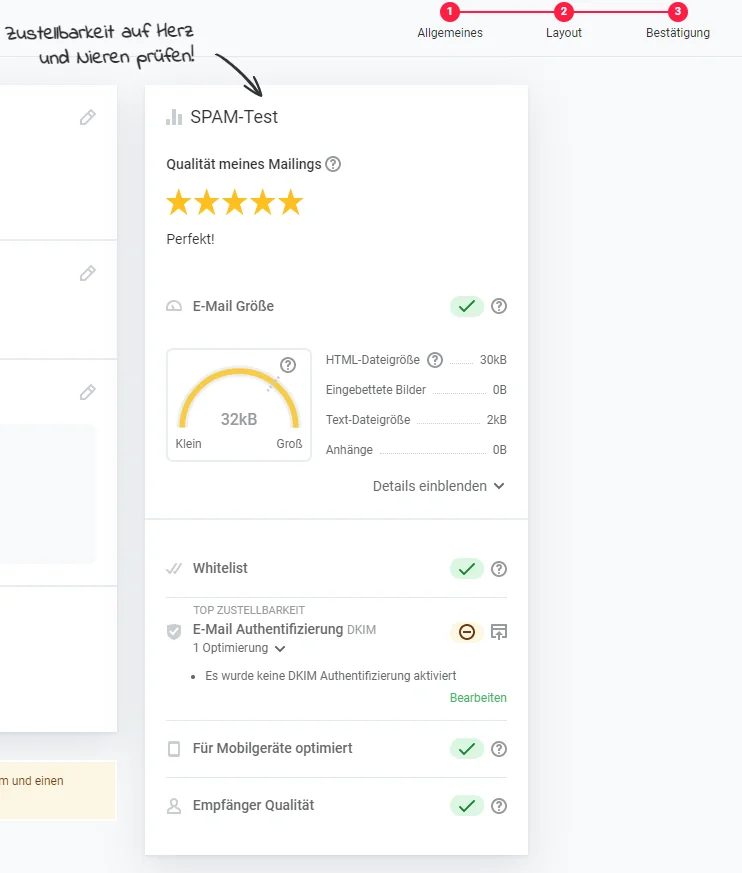
Did you know that rapidmail has an automatic spam check? Before sending, you can check how likely your newsletter is to be classified as spam. We also provide optimization tips to help your newsletter reach readers’ inboxes without obstruction.
A few clever phrases in the right places can help you get even more from your newsletter copy, for example with a clever call to action:
Tip 7: Choose a clever call to action
You probably do not want merely to give readers something to read with your newsletter. You also want them to take action. Whether that means visiting your website, buying a product or finding more information on a topic, a call to action takes contacts from your newsletter to another page.
For people to click the button, recipients should know what to expect after the click. Describe this in the preceding copy and give the CTA button an unambiguous label. The label should be short and punchy and motivate readers to click.
“Get more tips”, for example, works better here than “Go to video” or something similar because it puts the benefit to readers front and center. The popcorn emoji also catches the eye and reinforces the message.
Of course, AI can give you a helping hand when writing your newsletter. AI tools can be extremely useful when you need inspiration or ideas for phrasing. Do not forget to review AI-generated copy and add your own style so that you stand out from the competition.
Tip 8: Motivate readers with active verbs
To make your newsletter copy smooth and easy to read, avoid unnecessary nominalizations and use positive, active verbs instead.
An example:
“The division of your newsletter into an introduction, main section and conclusion is essential for the easy comprehension of the content by your readers.”
To make the message easier to read, more memorable and more personal, simply turn this complex sentence into the following:
“Divide your newsletter into an introduction, main section and conclusion so that readers can understand the content easily.”
Imagine that you are speaking to a colleague or talking to a customer on the phone, and write your newsletter just as you would explain it aloud.
Tip 9: Speak plainly
Beating about the bush will not help. Instead, provide specific information that helps readers and does not leave them guessing what you mean.
Not every topic is positive, of course. Price increases or removing a particular product from your range, for example, may be met with considerable incomprehension. At those moments, it is even more important to keep your newsletter copy positive, show empathy and demonstrate that you can put yourself in your readers’ position.
When writing newsletters, always ask yourself these questions:
How would I react to this message?
What advantages and disadvantages does it create for my subscribers?
What solution is available to recipients who might react negatively to my message?
How can I show subscribers that they matter to me?
There are only a few final checks left before you can send your newsletter, including whether your readers are at the center of it:
Tip 10: Put your readers first
You should not try to sell as much as possible in every newsletter. Constant advertising would probably soon annoy your contacts and lead to many unsubscribes.
Create variety and put yourself in your readers’ shoes: what interests them? What do they expect from your newsletter? How can you provide added value?
Helpful newsletters featuring important tips, step-by-step instructions, recipes, analyses and creative ideas show contacts that you are thinking of them. Over time, this builds a relationship between subscribers and your company or brand. That relationship, in turn, increases the chance of a successful newsletter conversion.
Tip 11: Have someone proofread your newsletter
Once you have finished writing your newsletter, you should definitely ask someone to proofread it.
We have probably all experienced this: you spend a long time working on a text, rewriting a sentence here and there and replacing a few words with better-sounding alternatives each time you read it. Eventually, you are more or less satisfied with the result and put it aside. The next day, you get a small shock when you notice how many typing errors you missed and that a few sentences sound rather strange.
That is completely normal. It is therefore always useful to ask colleagues for feedback. Two pairs of eyes are always better than one. Your colleagues are also not as immersed in the text as you are, so they can judge whether the newsletter is clear and error-free, or whether important information may even be missing.
Naturally, rapidmail lets you send test emails free of charge.
Conclusion: Goodbye, writer’s block!
You now have the perfect guide to writing a successful newsletter. Try it straight away and leave me a comment: which of these tips did you find most useful?
Do not forget: the link in the description gives you a 50% discount on your first rapidmail invoice.
Until next time, and have fun writing your newsletters! 🚀
How long should a newsletter headline be?
A newsletter headline should be as short as possible, even when that is difficult. It meets three criteria:
- It states the newsletter’s central message in one sentence.
- It sparks curiosity without revealing too much.
- It fits on one line and can be read without scrolling.
Headlines that extend over several lines can quickly feel intrusive. If you want to include more information, combine a main headline and subheading. Draw attention to the main headline with a larger font size, bold type or an eye-catching web font, while the subheading provides additional information without making the overall design visually overwhelming. Whether you place the headline above or below the header image is up to you: both work.
2. Personalize newsletters: a personal touch beats formality
Personalized newsletters feel more approachable. According to the Litmus 2024 State of Email Trends Report, 77% of marketers report measurable performance improvements from subject-line personalization and over 80% from personalization in general.
Before writing your newsletter introduction, greet recipients individually by name. This immediately makes your email feel much more personal and makes your company or brand more approachable to contacts.
Formal or informal: what suits your newsletter?
When choosing the right form of address, follow the communication style you normally use, for example on your website. The same applies to the greeting:
- “Dear Mr/Ms …”: formal and distant, more suitable for conservative industries
- “Dear …”: warm and approachable, well suited to most newsletters
- “Hello …”: casual and modern, a good fit for younger target audiences
In our experience, email marketing is usually rather more relaxed. A warm “Dear Mr Miller” feels much friendlier and automatically creates a closer connection than the formal “Dear Mr Miller, Sir”, which sounds comparatively distant, cooler and, frankly, somewhat old-fashioned. 😄
What do you need for a personalized newsletter greeting?
For an individual greeting, you need your contacts’ first name and/or surname and, depending on the form of address, their gender (for “Mr” or “Ms”). If you have this data, the rest is very simple. With rapidmail as your email marketing tool, you can add a personalized form of address to every email with one click. The appropriate name is inserted automatically for each recipient when you send, showing every contact that they matter to you.
💡 rapidtip
Subscribe to other newsletters too. This puts you in the reader’s position and lets you see which subject lines, headlines or phrases appeal to you more, and which appeal less. These insights from your own test are ideal for your campaigns. 🤓
Create a personalized newsletter now
3. Newsletter structure: how to organize your copy correctly
Well-structured newsletter copy follows a clear introduction, main section and conclusion, guiding readers step by step toward clicking the call to action (CTA).
The greeting is done. Time to continue. Before writing without a plan, make some notes. Use a bullet-point list to record the information you want to share with subscribers. Put the points into a suitable order and consider which aspects belong in the introduction, main section or conclusion of your newsletter copy. This will give you a well-structured newsletter.
The ideal structure for your newsletter 📝
To write your newsletter correctly, simply imagine that you are telling someone a story. Build the narrative arc so that, by the end, clicking the call-to-action button feels like the story’s only possible happy ending:
- Introduction: Rather than getting straight to the point, use an opening sentence to increase readers’ curiosity. Want to introduce a new collection that is now available in your online shop? Begin with: “Have you looked in your wardrobe and realized you do not have any cool outfits for this summer?” Subscribers who recognize the situation will definitely continue reading. It therefore makes sense to address a familiar everyday problem in the introduction.
- Main section: The newsletter content naturally varies according to your goal, such as informing, selling or entertaining. The main section should always present your purpose engagingly. You might reveal that your new collection is now online, point contacts to your latest blog article on a current topic or announce an unbeatable discount promotion starting today. For product changes and updates, you can also explain why you decided to make the update.
- Conclusion: Give the final section your all. The aim is to excite recipients so much that they want to learn more and click the call-to-action button. In the summer collection example, enthuse readers about your new outfits so that they want to browse your online shop. Include all the benefits customers will enjoy from the new trend items, such as becoming “real trendsetters in these outfits” or “upstaging the new luxury barbecue at the garden party”. If your newsletter is about a new blog article, explain how subscribers can apply its tips in everyday life to solve a particular problem.
Other popular solutions to problems that readers are sure to appreciate include saving time, discovering something new, staying healthy, saving money, simplifying processes, furthering their education and learning from real-world examples. The solution is followed by a prominently placed, clickable CTA button that leads to your website.
The AIDA model: the proven formula for newsletter copy
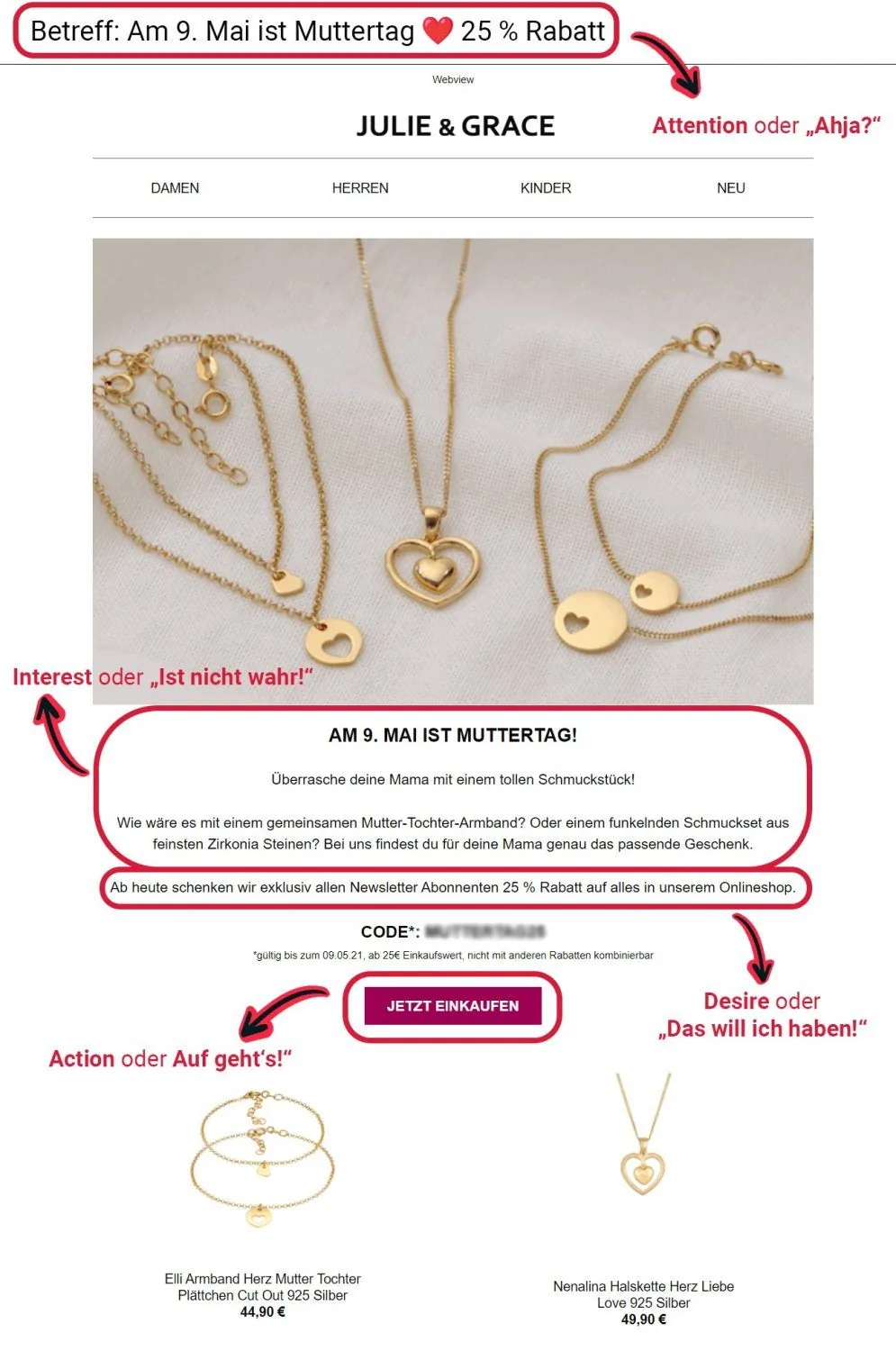
When writing your newsletter, keep the AIDA model in mind to get the structure right. A cruise ship? No. The AIDA principle is a marketing formula companies can use to guide their advertising and encourage consumers to buy. A stands for “attention”, I for “interest”, D for “highlighting the most important parts of sentences” and A for “action”. It applies to your newsletter too:
- Attention: An appealing subject line and modern header image spark subscribers’ curiosity and gain their attention.
- Interest: An attractive headline and engaging opening sentence increase recipients’ interest and make them want to learn more.
- Desire: The newsletter copy presents all the benefits and shows readers THE solution to their problems. This creates a desire to buy your product or learn more about the topic on your website.
- Action: An eye-catching call to action with a clever label encourages readers to click the button, taking them straight to your website.
Whatever your email is about, when writing the newsletter you should also follow these tips to keep your copy clear and well structured:
✔ Use several short paragraphs rather than a few long ones
✔ Use short sentences to make the copy easier to understand
✔ Leave sufficient white space to the left and right of the newsletter copy and enough space between lines
✔ Highlight the most important parts of sentences and keywords in bold so the copy is easier to scan
💡 rapidtip
When writing your newsletter, keep it as short as possible. Information on the main topic, including the CTA, should appear “above the fold”, in the upper section of the email that readers can see without scrolling. Subtopics or related articles can be placed below for interested people who have time for more. See our selection of successful newsletter examples from our customers.
By the way: AI can also give you a helping hand when writing newsletters. Tools such as ChatGPT quickly provide first drafts and ideas for the structure. Always review the copy critically and add your own style, because that is what makes your newsletter distinctive.
4. One click to success: the perfect call to action
Speaking of CTAs, you do not merely want to give readers something to read in your newsletter. You want to encourage them to take action. Whether that means visiting your website, buying a product or finding more information on a topic, a call to action takes contacts from your newsletter to another page.
What makes a good CTA button?
For people to click the button, recipients should know what to expect after the click. Describe this in the preceding copy and give the CTA button an unambiguous message. This is particularly important if you want to send accessible newsletters. At the same time, the label should be short and punchy so that it does not discourage readers from clicking in the first place.
What color should a CTA button be?
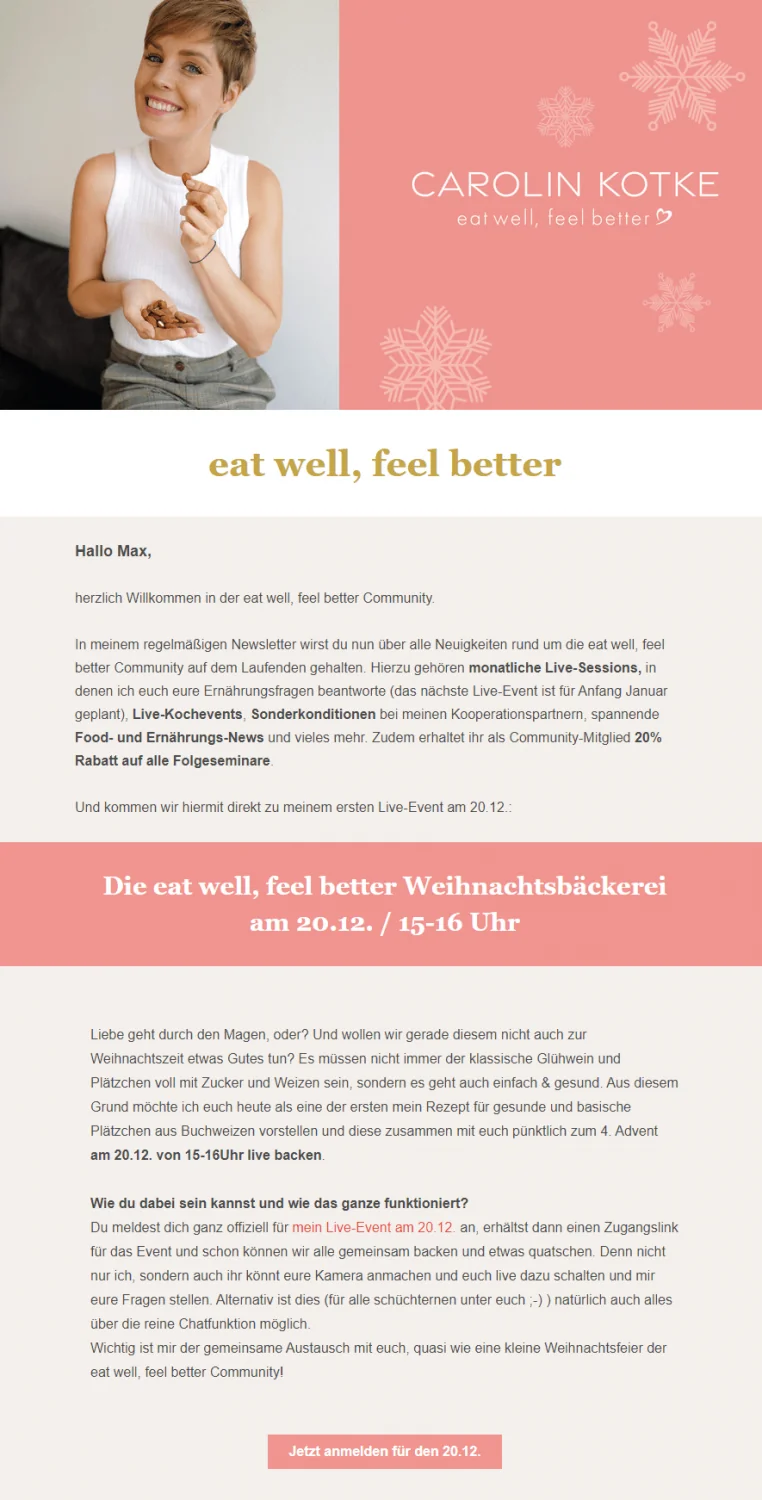
The CTA’s color also affects whether people click it. High-contrast colors are especially suitable because they make it stand out from the rest of the newsletter and attract contacts’ attention.
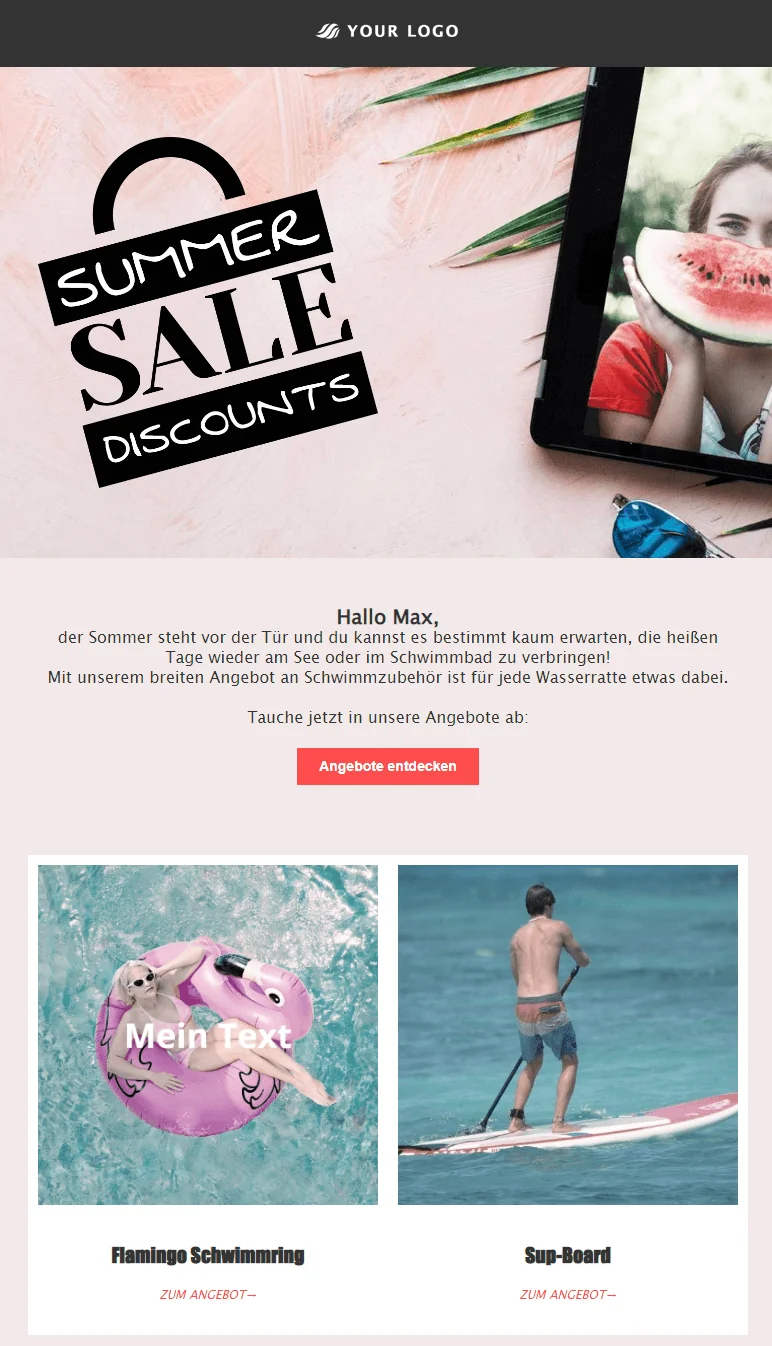
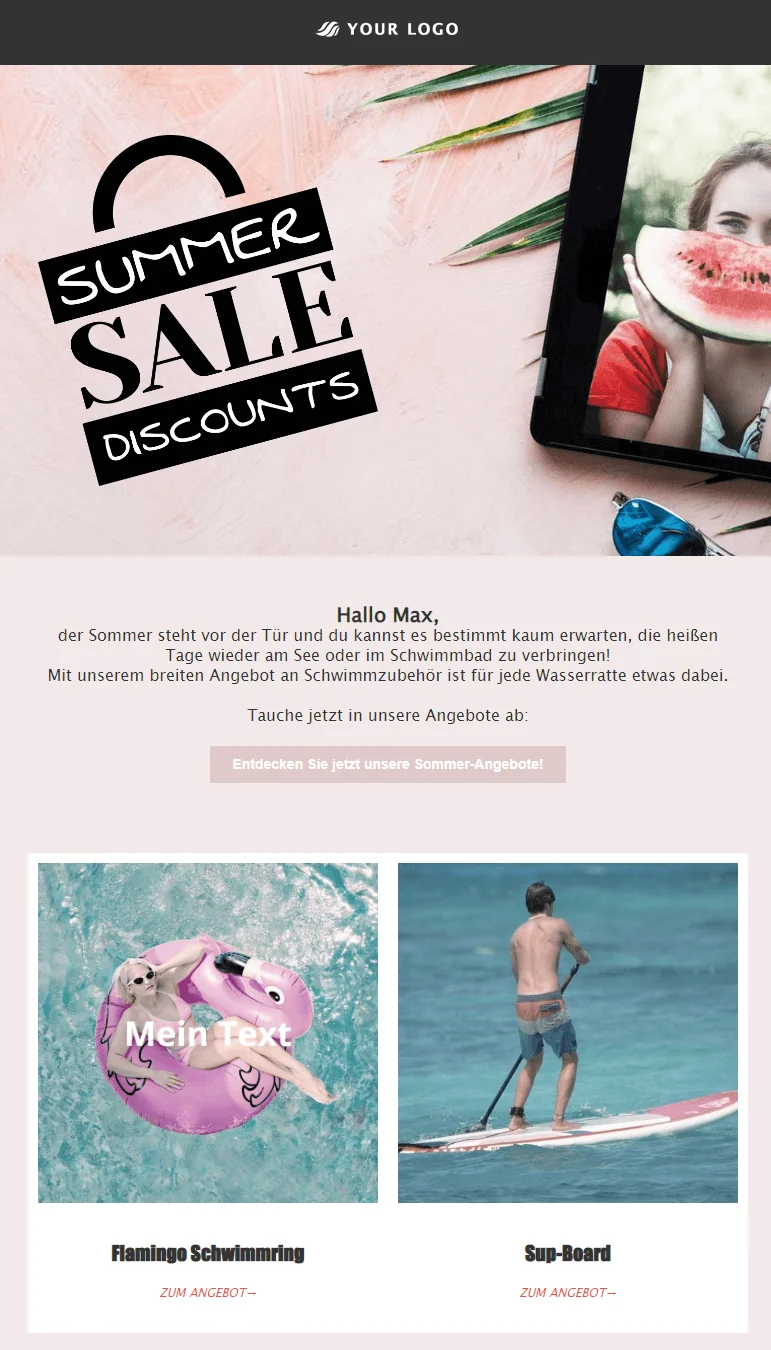
This example shows that the newsletter version on the left works better than the one on the right. The CTA button on the left catches the eye much more strongly while still fitting the newsletter’s design (created with rapidmail).
👀 Did you know?
With rapidmail A/B testing, you can test two different CTA variants against each other and find out which label and color work better for your target audience. Try it out.
5. Cut filler words: less is more
Filler words unnecessarily inflate your newsletter copy. The longer a newsletter is, the less likely recipients are to read all of it. According to a study, emails with fewer than 200 words are the most likely to be read.
Avoid filler words. They pad the text unnecessarily. This newsletter tip sounds simple but makes a major difference.
At the end, read the whole text through once more from top to bottom and remove every unnecessary word without which the text remains just as easy to understand.
You can usually omit the following commonly used filler words:
- well
- perhaps
- really
- just
- already
- quite
- relatively
- simply
- somehow
- in itself
- naturally
- you see
- actually
- basically
- so to speak
💡 rapidtip
Use specialist tools such as Wortliga to check your copy automatically for filler words, nominal style and passive constructions.
6. How to write newsletters properly: avoid spam words
To ensure your newsletter actually reaches contacts, take care when using spam words. Words such as “prize”, “free” and “not spam” in the subject line or newsletter copy reduce newsletter deliverability. Using too many CAPITAL LETTERS and exclamation marks!!!! also increases the likelihood of your campaign being classified as spam.
What are typical spam words in newsletters?
The most common email marketing spam triggers include terms such as:
- “prize” or “winner”
- “free” or “free of charge”
- “not spam”
- “buy now!!!”
- “100% free”
- “make money”
👀 Did you know?
rapidmail’s automatic spam check lets you assess the risk of your newsletter being classified as spam before you send it. Important optimization tips help ensure that nothing prevents your newsletter from reaching readers’ inboxes.
7. Write newsletters with active verbs: motivate people to read
Avoiding unnecessary nominalizations of unfamiliar technical terms improves a text’s comprehensibility and reduces the effort needed to read it. Excuse me? That is exactly our point: do not turn verbs and adjectives into nouns or add complex technical terms to your copy. Instead, use positive, active verbs such as “increase”, “benefit” or “save”.
Nominal style vs verbal style: the difference at a glance
The difference between nominal and verbal style sounds abstract, but it is not. These examples show how easily stiff phrases can become lively sentences:
| ❌ Nominal style | ✅ Verbal style |
|---|---|
| “The division of the newsletter takes place in three parts.” | “Divide your newsletter into three parts.” |
| “The implementation of the send is carried out.” | “Send your newsletter.” |
| “An increase in the open rate is the objective.” | “Increase your open rate.” |
Nominalizations may make your newsletter copy sound more professional, but let us be honest: your subscribers have neither the time nor the inclination to read your copy several times before they understand what you want to say. Keep it simple and write your newsletter just as you would speak to customers on the phone.
💡 rapidtip
Not sure whether your copy contains too many nominalizations? Copy it into an AI tool such as ChatGPT and ask: “Please make this copy more active and replace nominalizations with verbs.” You will immediately receive a livelier version.
The rapidmail newsletter
Tips, ideas and news about email marketing, straight to your inbox.
8. Put readers first when writing newsletters
Anyone who uses their newsletter solely as an advertising channel risks unsubscribes. According to ZeroBounce, 43% of users cite receiving too many emails as the main reason for unsubscribing from newsletters.
Newsletters are not always just about promoting and selling your products. Over time, that strategy will probably lead to more newsletter unsubscribes. Variety is key. Also send newsletters with special content that provides readers with added value.
If subscribers enjoy reading your newsletters, you already have a foot in the door. Your contacts will then be very likely to open your future campaigns to discover what you have come up with for them this time.
Over time, this builds a relationship between subscribers and your company or brand. That relationship, in turn, increases the chance of a successful newsletter conversion, such as readers ordering one of your products or registering on your website.
Which content provides genuine value?
Show recipients that you are thinking of them, for example through:
- 💡 Helpful tips and tricks from your specialist area
- 📝 Step-by-step guides to common problems
- 🍝 Recipes, ideas or inspiration
- 📊 Analyses, studies or interesting figures
- 🎨 Creative ideas and unexpected inspiration
- 🎁 Exclusive offers or discounts just for subscribers
- 📅 Appointment reminders or event invitations
- 🏆 Customer success stories and testimonials
- 📖 Reading recommendations or curated content from your industry
Which tone suits a newsletter?
In email marketing, the communication style can be a little more relaxed. There are, of course, still fields and industries where being too casual could appear unprofessional. You know your subscribers best and can judge how much informality is appropriate for your target audience.
Our advice here is the same: write your newsletter copy as though you were telling customers and prospective customers about the topic on the phone.
How should you communicate negative news in a newsletter?
Not every topic is positive, of course. Price increases or discontinuing a product may be met with incomprehension. At those moments, it is even more important to remain positive, show empathy and put yourself in the reader’s position. When writing newsletters, always ask yourself these questions:
- 📧 How would I react to this message?
- 📝 What advantages and disadvantages does it create for my subscribers?
- 🔍 What solution is available to recipients who might react negatively to my message?
- 🤍 How can I show subscribers that they matter to me?
9. How to write newsletters properly: speak plainly and present the facts
Specific figures and facts make newsletter statements more convincing, and convincing newsletters work.
“Online retail generated more revenue in April than in the previous year.” Suppose you use this statement in your newsletter. It may be interesting information for readers, but it lacks significance: more revenue could mean an increase of 0.5% or 50%.
Why are specific figures important in newsletters?
When making comparative statements or reflecting the opinions of existing customers, always support them with genuine facts. Specific figures make statements more tangible for readers, allowing them to compare the information with their own experiences. Evidence also makes your claims more convincing and encourages readers to take action.
How do you write a newsletter with specific statements?
To cut a long story short, this is how:
| ❌ Vague | ✅ Specific |
|---|---|
| “Our customers are satisfied with our product.” | “98% of customers recommend the product.” |
| “Learn more about a healthy lifestyle on our blog.” | “Our blog presents the 10 best tips for a healthy lifestyle.” |
| “Discover our end-of-summer sale offers now.” | “Save up to 20% on our products in the end-of-summer sale.” |
| “Many customers use our product successfully.” | “More than 5,000 customers already rely on our solution.” |
10. Two pairs of eyes are better than one: proofread before sending
You have done it: your copy is complete. Before sending a newsletter, always have it proofread. Ideally, ask another person who can assess the copy with fresh eyes and give it the final polish.
We have probably all experienced this: you spend a long time working on a text, rewriting a sentence here and there and replacing a few words with better-sounding alternatives each time you read it. Eventually, you are more or less satisfied with the result and put it aside. The next day, you get a small shock when you notice how many typing errors you missed and that a few sentences sound rather strange.
That is normal. It is therefore always useful to step away once you have finished writing your newsletter. Let the copy rest for a while so that you can clear your head.
How can I proofread a newsletter effectively?
Alongside reviewing it yourself, there are other ways to check your newsletter before sending:
- 👀 Step away: let the copy rest briefly, then read it again with fresh eyes
- 👥 Involve colleagues: ask people who are not immersed in the copy for feedback
- 🤖 Use AI as a proofreading assistant: copy the text into ChatGPT or a similar tool and ask: “Please check this copy for typing errors, unclear phrases and filler words”
- ✅ Use a spelling checker: use automated tools as your first safeguard
Why should colleagues proofread your newsletter?
Send the newsletter to your colleagues, for example, and ask for feedback. Two pairs of eyes are always better than one. Your colleagues are also not as immersed in the copy as you are, so they can objectively judge whether the newsletter is clear and error-free, or whether important information may even be missing.
💡 rapidtip
With rapidmail, you can send free test emails to colleagues before the final send. They can take another look at the newsletter before it reaches your contacts’ inboxes. You can also enable an automatic spelling checker with one click, preventing annoying spelling and typing errors from finding their way into the copy.
👀 Did you know?
Can you already picture your blank newsletter filling with imaginative copy? Then get started. With rapidmail, you can write your newsletter online step by step. Automatic saving ensures that not a single word is lost. With one click, you can enable an automatic spelling checker that prevents annoying spelling and typing errors from finding their way into the copy. You can also send free test emails to colleagues before the final send. They can take another look at the newsletter before it reaches your contacts’ inboxes.
Writing newsletters: succeed with these subject lines and copy examples
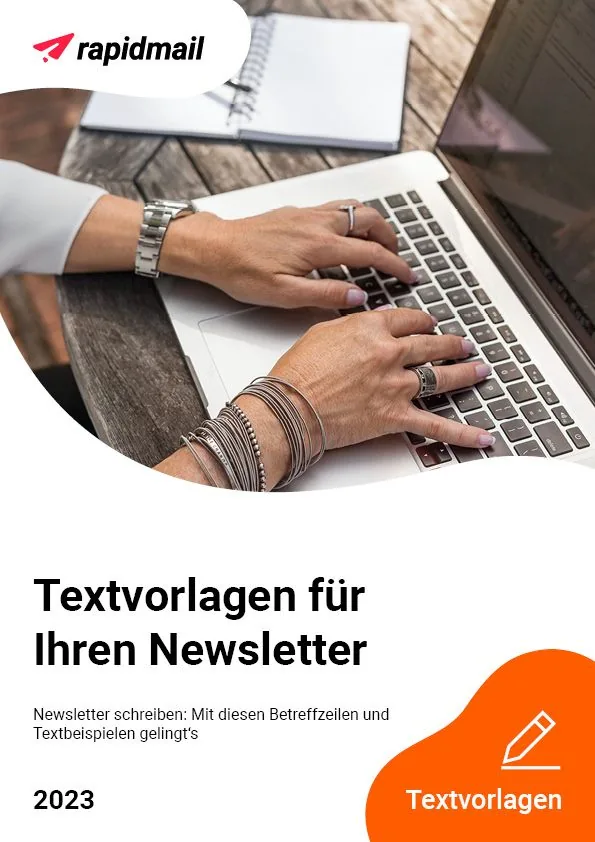
You have the basic idea but do not yet know exactly how to phrase your newsletter? Our newsletter subject lines and copy help you put your ideas into practice and provide a foundation for your newsletters.
What you will find inside:
- Subject lines for different occasions
- Examples of newsletter greeting copy
- An example of product introduction copy
- An example of invitation copy
- And much more
Download it free now and get started with our copy examples! 🚀
Download free copy templates for your newsletter now (PDF in German)
11. AI for writing newsletters: writer’s block? Not with artificial intelligence!
AI tools help you write newsletters, from the first idea to the finished subject line. According to HubSpot’s State of Generative AI, 95% of marketers who use generative AI for emails rate it as “effective”.
Blank page, empty mind, no idea where to begin? Many people know the feeling. AI tools such as ChatGPT, Gemini or specialized email marketing features can help you overcome writer’s block. 😄
How can AI help you write newsletters?
AI tools are especially useful for the following tasks:
- 💡 Gathering ideas: generate topic suggestions for the next newsletter
- ✍️ Creating first drafts: generate raw copy from a short description
- 📧 Testing subject lines: create several variants in seconds and choose the best
- 🔍 Optimizing copy: identify filler words, nominalizations and passive constructions
- 🌍 Translations: translate newsletters into other languages quickly
- 📋 Checking structure: check your draft’s logic, organization and clarity
What should you consider when using AI in newsletters?
AI is a powerful aid, but no substitute for your own “brand voice” and expertise. Follow these important principles:
- ✅ Always review AI-generated copy critically and refine it with your own style.
- ✅ Manually verify facts, figures and sources from AI responses.
- ✅ The final decision about tone, content and message always remains with you.
- ❌ Never use AI-generated copy without reviewing it first; your readers will notice.
💡 rapidtip
rapidmail also offers AI features that make writing newsletters easier. The AI subject-line generator creates several subject-line variants in seconds so you can choose the most compelling. Simply enter your company website’s URL in the email editor. Once you add a keyword, it will suggest subject lines that suit your company, products or services.
The URL allows the AI to learn about your company and provide suitable, individual subject-line suggestions. Its suggestions are tailored to your company and writing style.
Conclusion: write newsletters that resonate
Writing a newsletter that resonates with subscribers is not rocket science. It does not require exceptional writing talent, but above all one thing: technique. Once you know the most important ground rules and apply them consistently, you will quickly write better newsletters.
The 11 tips in this article can be summarized in three core principles:
- 📝 Structure beats length: A clearly organized, short newsletter with a strong headline, AIDA structure and unambiguous CTA is more convincing than a long block of copy with no clear thread.
- 🤝 Connection beats advertising: Anyone who provides subscribers with genuine added value builds lasting relationships. Relationships are the basis of every successful newsletter conversion.
- ✍️ Clarity beats complexity: Active language, specific facts and no filler words make copy easier to read, for people and AI systems alike.
Try our tips in your next campaign. If you need support, rapidmail helps you write, design and send your newsletter step by step, including AI features, automatic spelling checks and a free spam check. That leaves nothing standing between you and a newsletter your subscribers genuinely want to read.