The ideal newsletter subject line: How to get your emails opened and read

The newsletter subject line is the first thing your contacts see, so it is far more than just the icing on the cake of your emails. In fact, it is the foundation of a good campaign. In many cases, the chosen newsletter subject line determines whether your contacts open and read a newsletter or not. As a sender, you naturally want to prevent a poorly worded subject line from causing your newsletter campaign to fail before it has even really begun. Don’t worry: with our tips, you can start writing effective newsletter subject lines that make your recipients curious and eager to find out more, sending your newsletter open rates soaring!
Create newsletters with engaging subject lines now
1. The right length for a newsletter subject line
The same principle applies to newsletter subject lines: less is more. Try to summarize your newsletter content in the subject line using as few words as possible.
The ideal subject-line length varies depending on whether more of your contacts open your emails on desktop computers or read your newsletters on mobile devices: on desktop devices, the newsletter subject line should be between 30 and 60 characters long, while on mobile devices, the ideal length is 30–40 characters, as the screen is generally smaller.
Sticking roughly to this number of characters helps ensure that the subject line is displayed in full on as many devices and email clients as possible. This improves readability and also contributes to accessibility in your email marketing.
In addition to the screen size of the device your contacts use to read your emails, the email client they use, such as Outlook or Gmail, also determines how many characters of the email subject line appear in their inbox. To stay on the safe side, follow our recommended maximum of 60 characters for desktop and 40 characters for mobile here too.
| Email client | Screen | Visible characters in the newsletter subject line |
|---|---|---|
| Outlook | DesktopMobile | 60 characters40 characters |
| Gmail | DesktopMobile | 70 characters30–40 characters |
| Apple Mail | DesktopMobile | 65 characters30–40 characters |
| Thunderbird | Desktop | 65–70 characters |
| GMX | DesktopMobile | 60 characters30–40 characters |
| Web.de | DesktopMobile | 60 characters30–40 characters |
| T-Online | DesktopMobile | 60 characters30–40 characters |
Any additional information you want to give your contacts before they open the newsletter should go in the preheader. This is a short preview text for the email that many email clients, although not all of them, display in the inbox alongside the subject line. We recommend a maximum of 80 characters for your preheader so that all recipients see it in full without it being cut off.
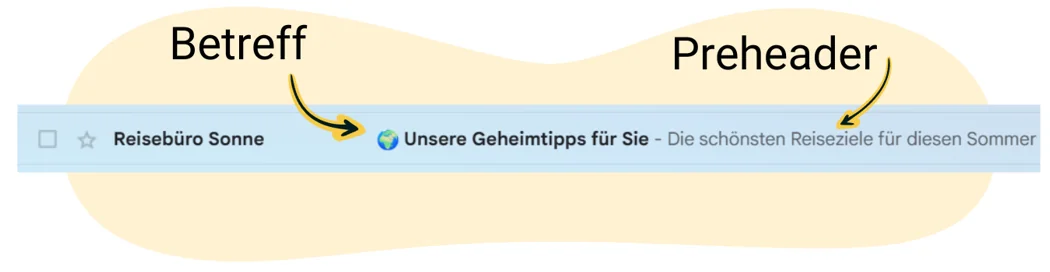
The same rule applies to both the newsletter subject line and the preheader: “first things first”. Put the most important information and keywords right at the beginning. Why? When we scan text, our eyes primarily take in the first words of a sentence or heading. The same applies to your newsletter subject line and preheader: placing meaningful words right at the front immediately attracts your readers’ attention. You should therefore avoid empty words such as conjunctions, pronouns or prepositions, especially at the beginning of your subject line.
Free subject-line collection to download
By the way, we have a complete collection featuring no fewer than 360 subject lines for every occasion, including:
- lively New Year greetings
- romantic Valentine’s Day messages
- Black Friday newsletters that hit the mark
Simply download it and return whenever you need inspiration! 💡
Download subject-line ideas for free (PDF in German)
2. Subject-line copy that sparks curiosity
Language is an art in itself: with a little creativity, you as a sender can paint vivid pictures in your contacts’ minds without any visual elements and tell a gripping story in just a few words. In this way, you can stir emotions in your contacts and encourage them to open your newsletter to read the rest of the story.
Adapted proverbs, idioms, well-known song lyrics and famous quotations are ideal for giving your subject line a personal, humorous touch.
We have come up with a few examples of original newsletter subject lines for different industries and occasions:
- A laaf ❤️ discounts – how about you, Ms Schneider? – Online shops / Carnival
- The holes are flying out of the cheese: today’s special is Bolognese 🍝 – Restaurants / Carnival
- Helau from the other side! 👋 – General / Carnival – A reference to Adele’s famous hit
- Dressed up like an Easter egg 🐣 – in our new collection! – Online shops / Easter
- Time to preserve – Exotic recipes for fruit from your garden 🍎 – Garden centers, DIY stores, restaurants, supermarkets / Summer
- Race through Berlin with the top down – Your convertible for a day! 🏎️ – Car dealership (convertibles) / Summer
- ☀️ Summer. Sun. Sales. Save 10% now! – Online shops / Summer
- You’re packing your suitcase, and you’re taking… ⛱️ – Online shops, drugstores, pharmacies / Summer
- Spooktacular offers that will give you chills – Do you dare? 👻 – Online shops / Halloween
- Back to Black: Hit the bullseye this Cyber Weekend! 🎯 – General / Black Friday – A reference to Amy Winehouse’s famous hit
- Do you know it’s Christmastime? 🎄 – General / Christmas – A reference to Band Aid’s famous festive earworm
- 🎁 All you want for Christmas: Perfect gift ideas for you! – General / Christmas – A reference to Mariah Carey’s famous Christmas hit
- Hit the gym! 🏋️ Your training plan to counter Christmas cookies – Gyms / Christmas season
- Not the same procedure as every year, Jonas! 🥂 – General / New Year – A reference to the famous New Year’s Eve sketch “Dinner for One”
💡 rapidtip: Newsletter subject line or content – which should you write first?

We recommend finishing the newsletter content first. Then you can consider which original subject line best sums up the content and makes readers want more. Need some inspiration?
Take a look at our newsletter subject-line examples for every industry.
Unfortunately, only a few newsletter senders really take the time to write original email subject lines that delight their recipients. Yet today it is more important than ever to use creative subject lines to stand out from competitors’ newsletters and make contacts curious about the email content.
As well as using humorous subject lines, you can also convince recipients that your newsletter is worth opening with the following email marketing subject-line strategies:
- ❓ Ask interesting questions and solve problems:By analyzing your newsletters and regularly reviewing which topics excite your recipients, you will get to know your target audience and its different personas better and better. Based on this knowledge, consider which questions your readers might currently be asking and address those exact questions in the newsletter subject line. Your contacts will be grateful when your newsletter makes a problem simply disappear. Phrasing the subject line as a question helps encourage subscribers to open the newsletter straight away to discover the answer. Asking interesting questions in the email subject line makes people curious to find out more, but of course only if you do not answer the question in the subject line itself. For example, instead of choosing the subject line “Will houseplants survive the summer vacation? 🌱 – They will with plastic bottles”, you should limit it to “Will houseplants survive a two-week summer vacation?” You can count on plenty of newsletter opens from worried plant lovers!
- 🔮 Be mysterious: To add a little variety to your newsletter subject line, you can also test how your subscribers respond to a subject line that gives no hint about the content. How about “We did something truly crazy…”, “You won’t believe what we discovered!” or “Psst – this stays between us, OK?”
- ⏰ Highlight the time limit: Limited-time offers that, for example, are valid “today only” and should therefore be “snapped up now” create the pressure needed to persuade subscribers to open the newsletter straight away. Known in marketing as “FOMO” (fear of missing out), this phenomenon describes the fear of missing important information and offers. With small incentives like these in the subject line, your subscribers are more likely to look at your newsletter immediately rather than postponing it until later. This reduces the risk of your newsletter being forgotten and never opened by a large proportion of your contacts.
- 💥 Prompt action with imperatives: Imperatives such as “snap it up now” or “book today” make us feel compelled to take immediate action. Compared with “Checket reservations for the next concert are open”, the newsletter subject line “Get your concert tickets today! 🎤” increases the likelihood that your contacts will open the newsletter as soon as they receive it. Of course, you should pay attention to your tone and make sure that the subject line does not sound like an order, as would be the case with “Open this email immediately!”
- 📈 Give measurable figures:Providing specific figures in the subject line gives your contacts a better idea of how extensive the newsletter is, for example, “Our 5 insider tips for your trip”, or what they can specifically achieve with the newsletter, for example, “How to improve your running time by 20%”
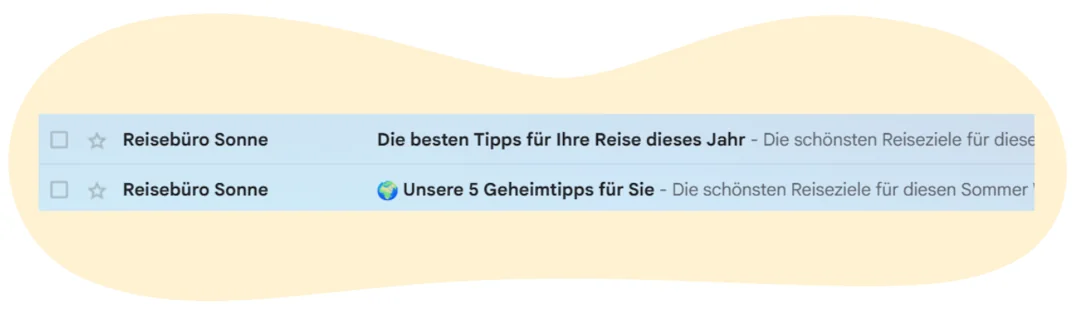
Which newsletter would you be more likely to open at first glance? And which subject line gives you a clearer idea of what to expect? The top email will most likely appeal to you more. That is because it gives you more specific information about what the newsletter covers. As a reader, you learn that one click will give you five tips to help you increase your newsletter open rate.
👀 Did you know? Use AI-generated subject lines with rapidmail
With rapidmail, you can also use AI in email marketing to your advantage and generate individual subject lines tailored perfectly to your brand in no time. Simply enter your company website URL in the email editor. Once you enter a keyword, you will immediately receive suggested subject lines tailored to your company, products or services.
The URL allows the AI to get to know your company and provide suitable, individual subject-line suggestions. The AI’s suggestions are then tailored to your company and writing style.
3. Emojis in newsletter subject lines – an eye-catcher
With so many emails arriving in your contacts’ inboxes each day, using visual messages is a great way to stand out. By adding one or two emojis to your newsletter subject line, you create visual appeal in your contacts’ inboxes. This draws your subscribers’ eyes straight to your newsletter, considerably increasing the likelihood that recipients will click on your email. It is best to limit yourself to one or two symbols and choose ones that suit the subject-line content.
For example, you can optimize your newsletter subject line with the following emojis:
- 🚀 A rocket taking off for the launch of your new product
- 🎃 A jack-o’-lantern for your Halloween newsletter
- ☀️ A bright sun for your brand-new summer collection
- 🎁 A gift for fantastic discounts in your subscribers’ birthday email
- 🎄 A Christmas tree for festive Christmas newsletters
- 🐣 A hatching chick for your Easter campaign
- 💌 A love letter for your Valentine’s Day email
- 🎉 A confetti cannon for your Carnival newsletter
- 🎆 Fireworks for your New Year campaign
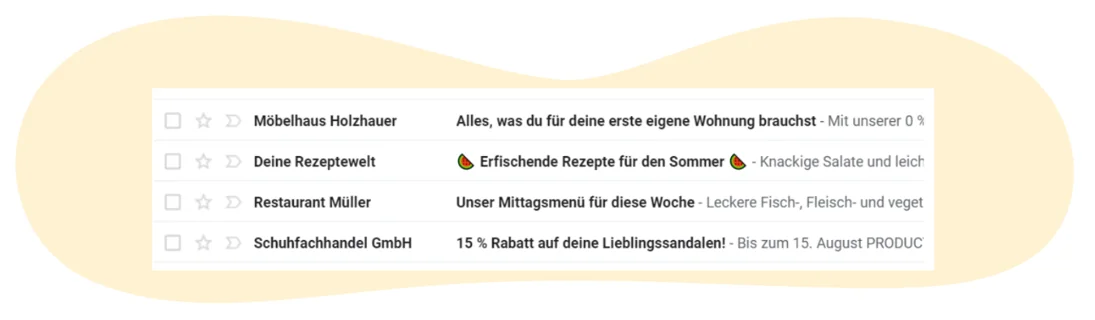
Of course, how well subject-line emojis are received by your contacts depends on your target audience. It is therefore best to use an A/B test first to find out which subject-line version your readers prefer, with or without an emoji. If your contacts respond positively, you can use emojis regularly to make your newsletter stand out in their inboxes.
💡 rapidtip
Before sending, you should always perform a test send to check how the emojis are displayed by different email clients. Only emojis that are clearly recognizable everywhere are suitable!
4. Show appreciation with personalized subject lines
What better way to show your customers that you value them than with a personal greeting in your newsletter? Using a personal salutation with your contacts’ first or last name or their location in the subject line makes your subscribers feel personally addressed as soon as they receive your newsletter. As the sender, you build a connection even before the email is opened while also increasing your newsletter open rate!
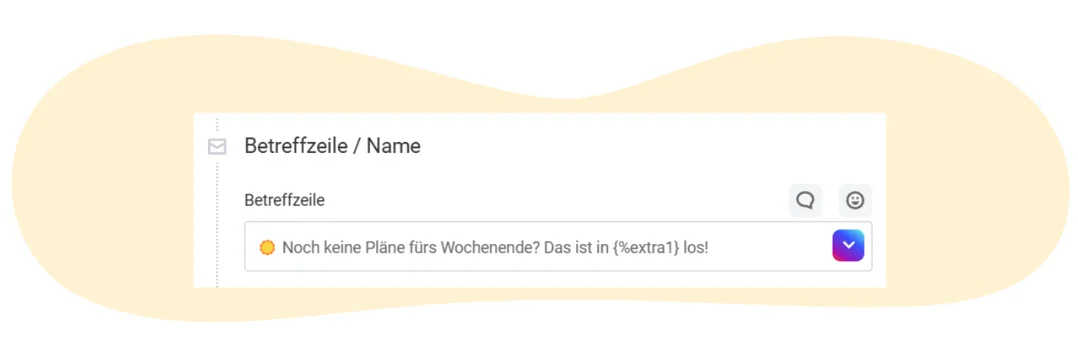
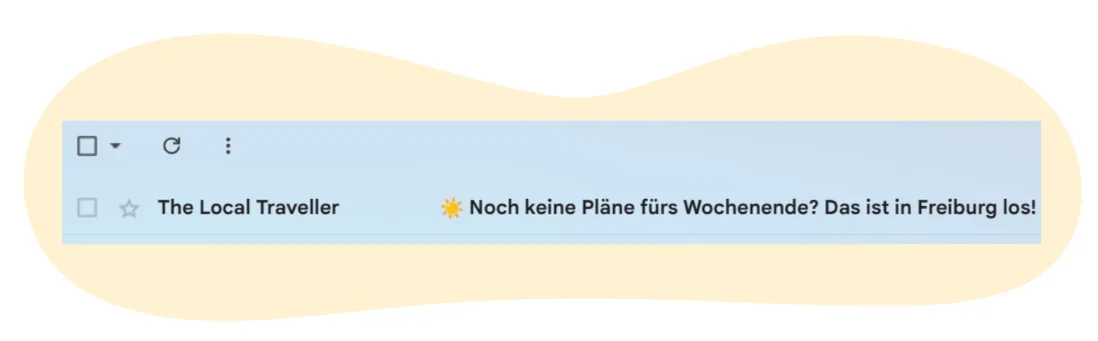
Personalizing the subject line with a location also helps you gain your readers’ trust. After all, spam senders do not usually have information about the location of the person who owns the email address, which may, for example, have been purchased.
The more clearly you can picture your target audience and the more precisely you define the different personas with a template, the better you will understand their interests, knowledge and needs. This allows you to tailor your newsletter subject lines perfectly to them. Segmented delivery is often useful for adapting all copy and content to the characteristics of your personas and sending highly individual newsletters.
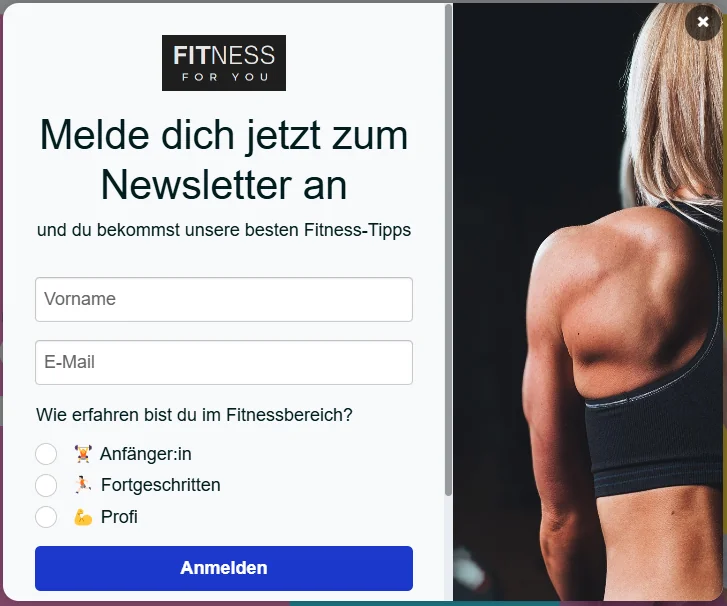
An example: Let’s assume that you own a gym and regularly send a newsletter. Your subscribers include experienced athletes who have been training at your fitness center for years, as well as beginners who are completely new to fitness training. Naturally, you want to provide both groups with valuable content. Segmented newsletter delivery is the best solution here. Ideally, ask new subscribers about their fitness knowledge when they sign up for the newsletter. They can then automatically receive the relevant keywords (tags). The “fitness professionals” receive campaigns from you with more detailed information and tips that require a certain level of prior knowledge, while you introduce beginners to the topic gradually and explain the basics in a straightforward way. This ensures that your contacts receive exactly the information that matches their level of knowledge. To avoid putting beginners off with complex technical terms in the newsletter subject line while also making sure advanced readers are not bored, you should also adapt the subject lines to your contacts’ respective knowledge levels, for example:
- For experienced athletes: “Improve your pace by 10% with interval training 🏃🏻”
- For beginners:“How to increase your running speed 🏃🏻”
💡 rapidtip: How to find out how much your contacts know
To write individual newsletter subject lines, you first need to find out what your contacts already know. Adding a suitable field directly to the newsletter sign-up form is a practical way to automatically assign new contacts to the appropriate recipient groups. However, make sure this is not a required field and that people can sign up for the newsletter without providing any additional personal information.
5. Newsletter subject-line no-nos
Now that you know everything you need to write the perfect subject line, we also want to explain what can go wrong. To ensure that your newsletters arrive safely in your contacts’ email inboxes and minimize the risk of them being intercepted by spam filters, you should avoid the following in the newsletter subject line:
- 💸 Promotional terms such as free, prize, gift, complimentary and so on
- 🙈 TOO MANY CAPITAL LETTERS
- ‼️Several consecutive punctuation marks !!! $$$ ??? === @@@ €€€
- 🫣 Incorrect spelling and grammar mistakes
- 🙅🏻♀️ Words such as urgent, immediately, jackpot, credit, money
- 🤯 Too many emojis ❗❗📢📢📢 💥💥
💡 rapidtip: Optimize newsletter deliverability further

Would you like more tips on ensuring your newsletters reach your recipients’ inboxes safely? Take a look at our comprehensive guide to maximum email deliverability!
To stay on the safe side, you should use a professional email marketing tool for your newsletter delivery that is included on a whitelist. This ensures that your emails are automatically delivered to recipients’ inboxes more reliably.
Create a newsletter with rapidmail now
6. Keep the promises made in your newsletter subject line
A promise is a promise! This little saying from childhood also applies to subject lines in email marketing. After all, a perfect subject line does not just shine through original, creative wording, eye-catching emojis and a personal touch, but also by delivering what it promises.
For example, if the subject line of your drugstore’s newsletter promises that subscribers will receive “5 care tips for bad hair days”, these should either be included directly in the newsletter or the newsletter should direct readers to the relevant page where you have collected your tips. An email marketing mistake would be to feature only your own hair product in the newsletter instead.
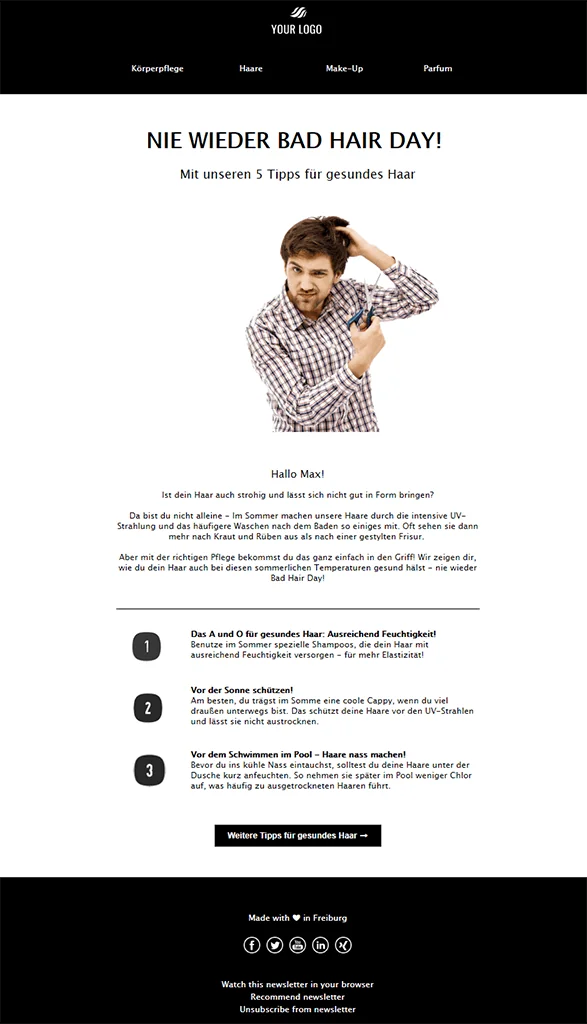
Show your subscribers that your newsletter is not just about selling your products, but also about entertaining and informing them and being there for them in every situation with valuable tips! This makes you appear more authentic and strengthens their connection to your brand and company at the same time. In this way, you earn your contacts’ trust and, in turn, increase the likelihood that your readers will automatically choose your product the next time they make a purchase.
If, instead, you try to deceive your contacts with a false promise in the newsletter subject line, they are sure to resent it. Especially if such campaigns become frequent, your subscribers will feel betrayed and lose trust in you. There is then a significant risk that they will no longer be interested in your newsletter in the future and may even unsubscribe altogether. After all, the same principle applies in email marketing: honesty is the best policy!
The rapidmail newsletter
Tips, ideas and news about email marketing, straight to your inbox.
7. A/B test and optimize your newsletter subject line
Emojis, personal greetings or funny sayings in the email subject line… not everyone has the same tastes or sense of humor. It is therefore best to test two different subject-line versions on a small group of subscribers each to find out which performs better. You can then select the winning subject line and send that newsletter to the entire recipient list. Especially at the beginning, testing helps you discover the best way to win over recipients with your newsletter subject line and what you should avoid.
You can use the rapidmail A/B test for this: even as you write the subject lines, their quality is checked against all the important criteria that will later affect your newsletter’s deliverability and open rate. These criteria include the number of words and characters, personalization, terms or characters that look like spam, and any emojis included. The overall rating shows you at a glance which of your subject lines receives more stars ⭐ in the live subject-line check and is therefore of higher quality.
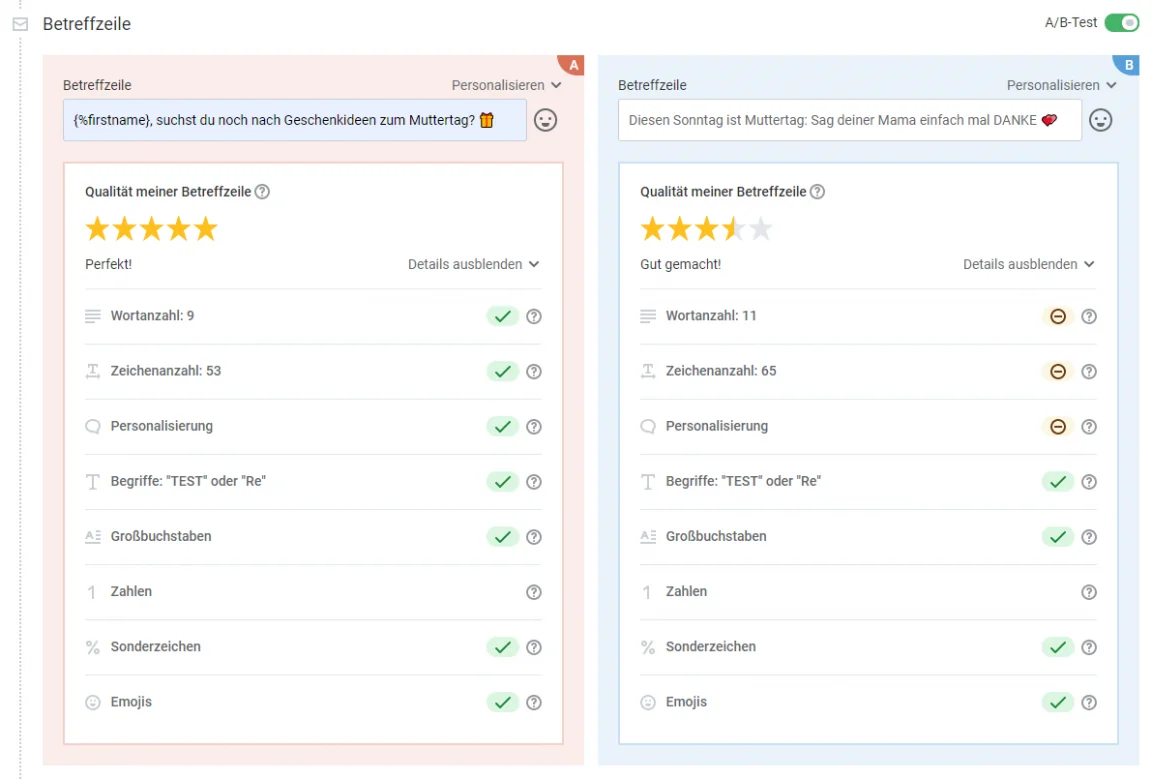
In the final step before sending your newsletter with rapidmail, you can specify how many contacts from the recipient list should receive each of the two versions. You can then choose whether to decide for yourself which subject line “wins” and is sent to the remaining recipients, or whether the more successful subject line should be selected automatically, for example based on its higher newsletter open rate. Over time, this helps you discover which subject lines work best for your target audience!
Register now and try it for free
8. Conclusion: Impress with useful tools and creativity in the subject line
There is no doubt about it: a compelling newsletter subject line determines whether your email is opened or disappears unread in the inbox. Although there is no universal recipe for success, several proven email marketing methods help you optimize the subject line and increase the open rate:
- ✅ Keep it short and concise
- ✅ Put the most important information first
- ✅ Use emojis strategically
- ✅ Use a personal greeting
- ✅ Build suspense or spark curiosity
- ✅ Carry out A/B tests
- ✅ Add a preheader to the subject line
With a combination of creativity, testing and clever tools such as the live subject-line check and rapidmail’s tailored AI suggestions, you can improve your subject lines over the long term and inspire more readers to open your newsletter! 🚀