Data privacy in newsletter marketing: All the key guidelines at a glance

Email marketing is not possible without personal data: anyone who wants to send a newsletter inevitably collects and processes email addresses and consent records. Data privacy in newsletter marketing is therefore essential and provides the basis for lawful, trustworthy customer contact. To send your newsletter in compliance with data privacy law and meet all statutory requirements, it is important to address newsletter data privacy guidelines at an early stage. Together with data privacy lawyer Nils Möllers from Keyed, we show you step by step, without complicated legal jargon, how GDPR-compliant email marketing works in practice.
🥜 In a nutshell: The essentials of data privacy and newsletters
Data privacy in newsletter marketing, explained simply: this guide takes you step by step through the data privacy guidelines you must observe when sending newsletters and shows you how to meet the requirements easily, even without legal expertise.
All newsletter data privacy requirements at a glance:
- 🔒 Consent: As a general rule, newsletters may only be sent with prior, voluntary and verifiable consent, for example through double opt-in.
- 🔒 Transparency: Prospective subscribers must be clearly informed during sign-up about what happens to their data in the privacy policy.
- 🔒 Tracking: Click and usage behavior may only be analyzed if the relevant consent has been given and transparent information is provided.
- 🔒 Data minimization: The email address may be the only required field in the sign-up form. Any other details must be optional.
- 🔒 Coupling prohibition: Contests, ebooks or other incentives must not automatically be linked to a newsletter sign-up.
- 🔒 Choice of tool: When using external newsletter software, a data processing agreement (DPA) is required and servers located in the EU are advisable.
- 🔒 Accessibility: You should avoid no-reply sender addresses so that people are not hindered in exercising their data protection rights.
- 🔒 Unsubscribing: Subscribers must be able to unsubscribe from the newsletter easily at any time. An unsubscribe link is best practice.
- 🔒 Deletion: In addition to unsubscribing, contacts have the right to have their personal data completely deleted, known as the “right to be forgotten”.
👀 Did you know? With rapidmail, you send newsletters in 100% compliance with data privacy law, including double opt-in, an automatic unsubscribe link, a DPA and servers located exclusively in Germany.
1. Data privacy for newsletters: Why it is essential
Whether you send your newsletter to existing customers, association members or subscribers who have signed up through a form on your website, sending newsletters always involves processing personal data. Under the General Data Protection Regulation (GDPR), an email address is already considered personal data, as are sign-up times, IP addresses and consent records.
That makes it all the more important to address data privacy for newsletters and the legal foundations of email marketing at an early stage. The GDPR, which has applied since 2018, contains binding requirements for collecting, processing and storing this data and therefore directly affects newsletter distribution.
Anyone who fails to comply risks formal warnings, regulatory action and substantial fines. Data privacy is therefore not an optional extra in newsletter marketing, but an essential prerequisite for operating lawfully.
Personal data shall be:
a) processed lawfully, fairly and in a transparent manner in relation to the data subject (“lawfulness, fairness and transparency”);
b) collected for specified, explicit and legitimate purposes and not further processed in a manner that is incompatible with those purposes (“purpose limitation”);
c) adequate, relevant and limited to what is necessary in relation to the purposes for which they are processed (“data minimization”).
Art. 5(1) GDPR
Do not worry: for GDPR-compliant email marketing, you do not need to know the GDPR by heart or understand every sentence in it. That is what this guide is for. We explain all the key requirements simply, clearly and step by step, with specific practical examples that help you send your newsletters lawfully with ease.
Data privacy and newsletter tools: What you need to consider today
Since the invalidation of the EU-US Privacy Shield in the Schrems II judgment of 2020, the choice of newsletter tool has attracted increased attention from data protection authorities. The reason is that transferring personal data to so-called third countries, particularly the USA, is permitted only under strict conditions.
For you as a newsletter sender, this means:
- 🔎 Check carefully where your contact data is stored
- 🇪🇺 Prefer servers located within the EU, where a consistent level of data protection applies
- 🤝 Conclude a data processing agreement (DPA) with your newsletter provider
Since July 2023, there has once again been an European Commission adequacy decision for the USA, the EU-US Data Privacy Framework. This means US newsletter tools may be used lawfully under certain conditions, such as when the provider participates in the framework and all other GDPR requirements are met.
However, the adequacy decision does not automatically apply to every US provider, and the legal assessment still requires extensive review and documentation in each individual case.
A decision by the Bavarian State Office for Data Protection Supervision, or BayLDA, from 2021 shows how seriously German supervisory authorities treat this issue. It found that transferring data to Mailchimp, a newsletter tool based in the USA, was unlawful.
Data privacy protects not only recipients, but you too
The purpose of judgments and data privacy requirements like these is not to make life difficult for reputable businesses and newsletter senders. Instead, data privacy guidelines for email marketing are intended to ensure that:
- 🛡️ your contacts’ security and privacy are protected
- 🚓 it is harder for spammers to misuse data
- 💌 businesses can send reputable newsletter advertising that prospective customers want and use
When implemented correctly, data privacy even has a positive effect on your email marketing: it strengthens trust in your brand, improves acceptance of your newsletters and helps ensure that email marketing is perceived as a reputable, welcome communication channel.
Data privacy is therefore not only an obligation, but a genuine opportunity to make your newsletter marketing sustainable and professional.
👀 Did you know?

Data privacy requirements for sending newsletters do not apply only in commercial contexts, such as online shops. The guidelines apply equally to associations, non-profit organizations, publishers and private individuals. Wherever personal data is processed, the General Data Protection Regulation comes into play.
2. Data privacy guidelines in newsletter marketing: The requirements you must meet
Clear data privacy requirements apply to sending newsletters and are binding on every business, association and organization, regardless of sector or size.
The following guidelines form the basis for GDPR-compliant newsletter marketing. They cover the lawful sign-up process, distribution and analysis as well as the handling of contact data.
Depending on your business model, target group or newsletter tool, additional data privacy requirements may also be relevant to you. To be on the safe side, we therefore recommend contacting your internal or external data privacy adviser.
👀 Have you seen this?
In this video, data privacy lawyer Nils Möllers from Keyed and rapidmail content manager Wiebke explain all the guidelines for sending GDPR-compliant newsletters. Roll the film! 🎥
Open video transcript
Chapter 1: Introduction
Wiebke: Does the GDPR sound complicated? Today, we are making it simple. Together with data privacy expert Nils Möllers from Keyed, we show you step by step how to send GDPR-compliant newsletters in a way that is easy to understand and put into practice.
Chapter 2: Why is it so important for newsletters to comply with the GDPR?
Nils: Protecting personal data is very important. A company that does not take that protection seriously must expect fines, compensation claims or, in the worst case, the loss of its customers’ trust. The GDPR applies whenever we process personal data. Personal data is any data that makes it possible to identify a person. In this context, that includes their email address, first name and surname. But do not worry, there is good news: a few basic rules can protect you from these risks. My name is Nils Möllers, I am the founder of Keyed, and we are a team of lawyers that provides comprehensive external data privacy support to companies, including rapidmail.
Chapter 3: The most important basics: Consent and DOI
Wiebke: Let us begin with the most important requirement for lawful newsletter marketing: consent.
Nils: The GDPR should be understood as a general prohibition subject to permission. This means that, in principle, no personal data may be processed unless you have an appropriate legal basis. Applied to newsletters, that means no consent, no newsletter, at least in most cases. There are also exceptions when communicating with existing customers where contracts already exist between companies and data subjects, but those are special cases that we will not consider here. Consent must always be voluntary, informed and, above all, unambiguous. This is very important because if the validity of consent is compromised, the result may often be that the consent is treated as though it had never existed. Germany is in a special situation because the Unfair Competition Act also requires an additional, two-stage confirmation. This is known as double opt-in. It is an excellent way to meet the accountability requirement because it makes it possible to confirm that the owner of an email address really requested the newsletter. There can then be no doubt that consent was given. The process works as follows: the user enters their details on the website as usual. A confirmation email is then sent to the recipient. After receiving the email, they confirm that they consent to the processing, in this case newsletter distribution. Only then may the newsletter be sent.
Chapter 4: What else you need to consider during sign-up
Wiebke: There are a few other things to consider during sign-up. When setting up your sign-up journey, you should include a link to your website’s privacy policy in the sign-up form. With rapidmail, you can use ready-made components for this very easily. In addition, only the email address may be a required field in your form. All other details, such as a name, date of birth or areas of interest, may only be optional fields. In other words, people must not be forced to provide this information.
Now you know what to consider when adding new contacts to your newsletter. Next, we will look at the elements that are mandatory in every legally compliant newsletter.
Chapter 5: Mandatory elements of a newsletter
Nils: To create a compliant newsletter, you have to meet three requirements. The first is a clearly identifiable sender, and please do not use “noreply@” addresses, so that direct communication remains possible for complaints or unsubscribe requests. The second requirement is an unsubscribe link. You will now usually find this at the end of a newsletter, where recipients can unsubscribe with one click. Unsubscribing must be just as easy as signing up or giving consent, so there must be no unnecessary barriers. The third requirement is the legal notice, a privacy policy, information identifying the provider and, where applicable, contact options. These must always be included.
Wiebke: Alongside the sign-up process and the structure of your newsletter, there are also several factors to consider when choosing your newsletter software if you genuinely want to send GDPR-compliant newsletters.
Chapter 6: Choosing the right GDPR-compliant newsletter tool
Nils: Finding the right newsletter tool is certainly not easy, and it becomes even harder when you want a GDPR-compliant tool because some providers unfortunately claim compliance but ultimately fail to deliver it. I will therefore give you four aspects to consider so that you stay on the safe side when choosing. The first is the data processing agreement. You must always conclude a compliant data processing agreement, or DPA, with the provider. If you are unsure whether the draft agreement is compliant, please consult a knowledgeable data protection officer, who will be able to assess it relatively quickly. The second important aspect is the storage location. It is always advisable to look for at least a European solution because it saves an enormous amount of bureaucracy. If you want to use providers from insecure third countries, you always incur additional risks. These must be assessed and remedial measures must be introduced, which ultimately costs far more time and money than using European solutions. The third aspect is to respect the rights of data subjects. If end customers contact you to exercise the “right to be forgotten” or “right to rectification”, it must be possible to export their data from the newsletter software in a machine-readable format and, of course, delete or amend it. If this is not possible, you cannot implement the software in compliance with data privacy law. That is very important. These measures will essentially keep you on the safe side. However, if you are unsure about the details, you can consult external data protection officers such as those provided by Keyed. They will certainly be able to help.
Chapter 7: Common mistakes
Wiebke: Finally, we will go through a few common mistakes that you should definitely avoid.
Nils: In our daily work as external data protection officers, we see very typical mistakes when newsletters are sent. The classic example is purchased email lists used for newsletter distribution. We strongly advise against this because the lawfulness of the data cannot be reliably guaranteed. You may not know when particular data was collected or whether it was collected in a way that informed people you would use it to send a newsletter. That is generally not the case, leading to a very large number of liability cases, so stay well away from it. We also often see incomplete double opt-in processes, which means it cannot later be proved reliably that consent was given, as well as tracking without information or consent. We mentioned this at the beginning of the video: people often forget that newsletter software also includes performance measurement, for which tracking is essential. You must provide information about this and obtain consent. Finally, there is the ultimate classic mistake: sending openly using CC rather than BCC. This is not related to newsletter software, but happens when no newsletter software is used at all. It is, of course, a worst-case scenario when every recipient’s details are disclosed to all the others. This is often a reportable data breach and can result in very severe penalties. We advise against it, which is why you should consider compliant newsletter software at an early stage.
Chapter 8: Conclusion
Wiebke: If you follow the rules, establish a clear unsubscribe process with double opt-in, include all mandatory information in your newsletter and choose compliant software, you will definitely be on the safe side. We have also prepared a data privacy checklist that you can check off. You can download it free of charge using the link in the video description and go through everything again at your leisure to make sure you are covered. If you feel that you need a little more support with data privacy, you are very welcome to contact the Keyed team. They will be happy to help and provide solution-focused advice. You will also find their contact details in the information box below. Do you still have questions or comments about data privacy in newsletter marketing? If so, please leave them in the comments. We can then record a second episode with Nils in which he answers all the questions.
Thank you very much for watching. See you next time!
The following points must generally be considered for GDPR-compliant newsletter marketing:
Requirement 1: Contacts’ consent as the legal basis for sending newsletters
The fundamental principle in newsletter marketing is: only people who want to receive newsletters and marketing emails may be contacted. For every contact you approach by newsletter, you therefore generally need prior, voluntary and explicit consent.
For this consent to be legally valid, you must not only obtain it, but also be able to prove it if necessary. The General Data Protection Regulation explicitly stipulates this requirement:
Where processing is based on consent, the controller shall be able to demonstrate that the data subject has consented to processing of his or her personal data.
Art. 7(1) GDPR
The sign-up form should therefore make it clear to prospective subscribers that they are subscribing to your newsletter. We recommend a separate checkbox for consent to data processing that must be selected to complete the sign-up. This ensures that your contacts consciously and voluntarily agree to receive the newsletter.
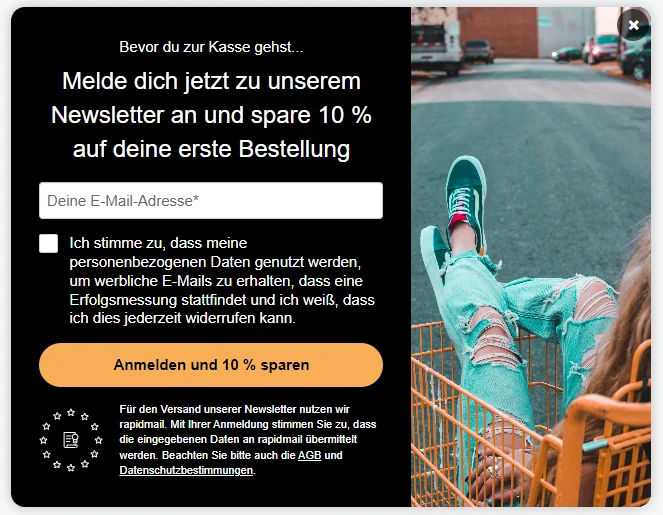
The safest method, and the one recommended in practice, for documenting consent in a legally reliable way and proving it in the event of a legal dispute is the double opt-in process (DOI).
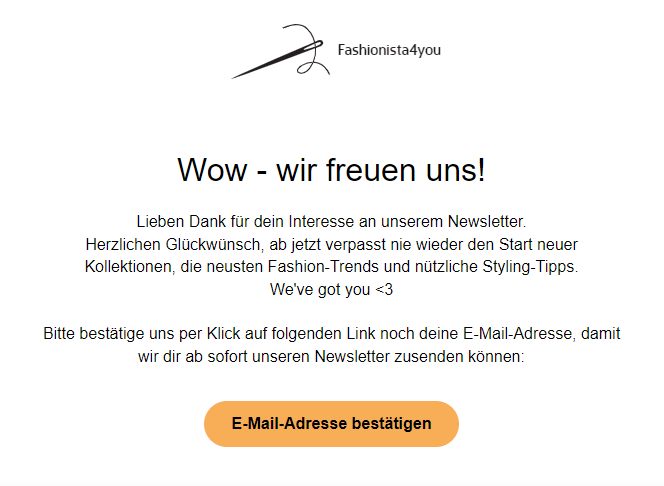
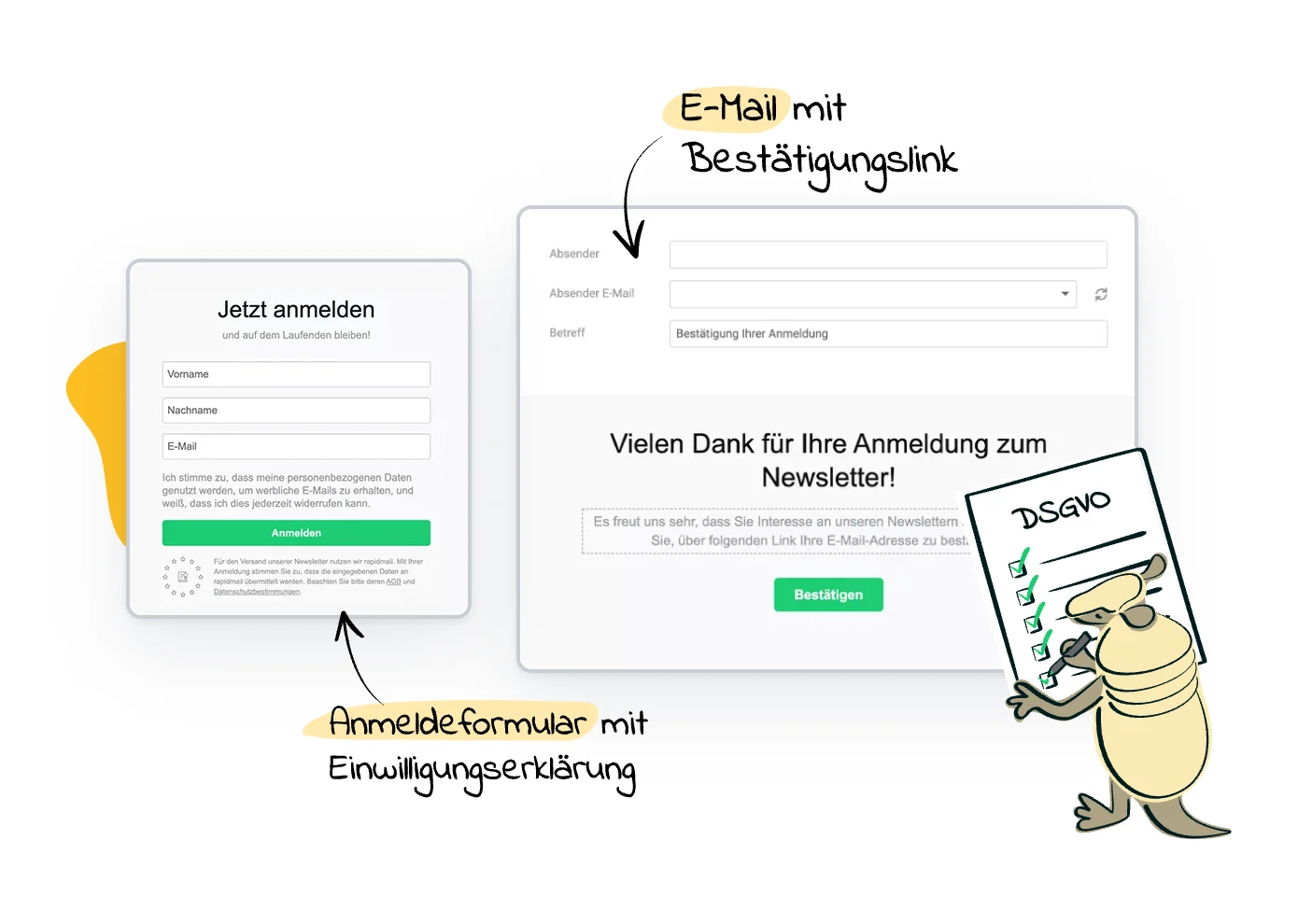
New contacts confirm their sign-up in two steps, known as “double opt-in”:
- 🐾 Step 1: Enter their email address in your newsletter sign-up form
- 🐾 Step 2: Confirm their sign-up using a link in the confirmation email
Your contacts’ consent is considered to have been given only after they click the link in the confirmation email. When you use rapidmail, for example, the date and time of consent are documented directly in the newsletter tool, making it easy to prove consent in the event of a dispute.
👀 Did you know?
All rapidmail newsletter sign-up forms automatically use double opt-in: new contacts must always confirm their sign-up through a confirmation email before they are added to your active newsletter list.
This ensures that:
- ✅ only genuine, correct email addresses are added to your list
- ✅ every sign-up is voluntary and traceable
- ✅ you can prove your contacts’ consent if necessary
In short, with rapidmail, your GDPR-compliant email marketing is on the safe side from the outset.
Exception: Sending newsletters to existing B2B customers without explicit consent
Only newsletters sent to existing customers may be permissible without prior DOI consent under strict conditions and exclusively in B2B email marketing. This exception does not arise from the GDPR, but from the German Act against Unfair Competition:
Unreasonable harassment shall not be assumed in the case of advertising using electronic mail where:
a trader obtained the customer’s electronic mail address in connection with the sale of goods or services,
the trader uses the address for direct advertising of their own similar goods or services,
the customer has not objected to its use, and
the customer is clearly and distinctly advised when the address is collected and whenever it is used that they may object to its use at any time without incurring any costs other than the transmission costs at the basic rates.
Section 7(3) UWG
However, we advise you to have it carefully checked in advance whether these specific conditions are actually met in your case.
👀 Did you know?

According to a recent judgment by the Court of Justice of the European Union of November 13, 2025, a free registration with a commercial objective, such as a free trial, webinar or tool registration, may also be treated as equivalent to a purchase. This means that a free registration can now serve instead of a completed purchase as the basis for existing-customer email marketing in the B2B sector, provided that all other requirements are met.
In practical terms, this means the following for you as a sender: for you not to need explicit newsletter consent, all the following conditions must be met simultaneously:
- 🤝 B2B context: You send exclusively to business customers and contacts.
- ☑️ No objection: Your contacts have not objected to receiving newsletters or marketing emails.
- 👋 Clear option to unsubscribe: You have informed your contacts that they can object to receiving the newsletter at any time and explained how to do so free of charge.
- 👛 Only similar offers: Your newsletters advertise only similar products or services that meet the same need.
- 💌 Email address provided by the contact: Your contacts provided their email address themselves when purchasing a product or service or signing up for a free service with a commercial objective, such as a free trial, tool registration, webinar sign-up or ebook download.
👉 Also important: Incomplete purchases such as abandoned baskets still do not constitute a basis for sending newsletters. You continue to need your contacts’ explicit and verifiable consent before you may add them to your newsletter list.
Purchased email addresses are not permitted
The rule remains unchanged: buying email addresses and subsequently using them to send your newsletters violates data privacy requirements under Art. 6(1) GDPR. Without valid consent or a legally permissible exception, you have no legal basis for sending your marketing emails.
Alongside potential legal consequences, purchased email address lists also harm:
- 📭 the deliverability of your emails: purchased contacts often report your emails as spam or ignore them completely, which has a negative impact on your sender reputation.
- 📉 your brand’s reputation: unwanted marketing emails are perceived as disreputable and can permanently damage trust in your business.
- ❌ your business relationship with your newsletter software provider: most newsletter tools follow an anti-spam policy and penalize unlawful distribution to purchased email addresses by blocking campaigns.
As you can see, purchased address lists are neither legally sound nor effective. Sustainable and successful email marketing is always based on voluntary, transparent newsletter sign-ups.
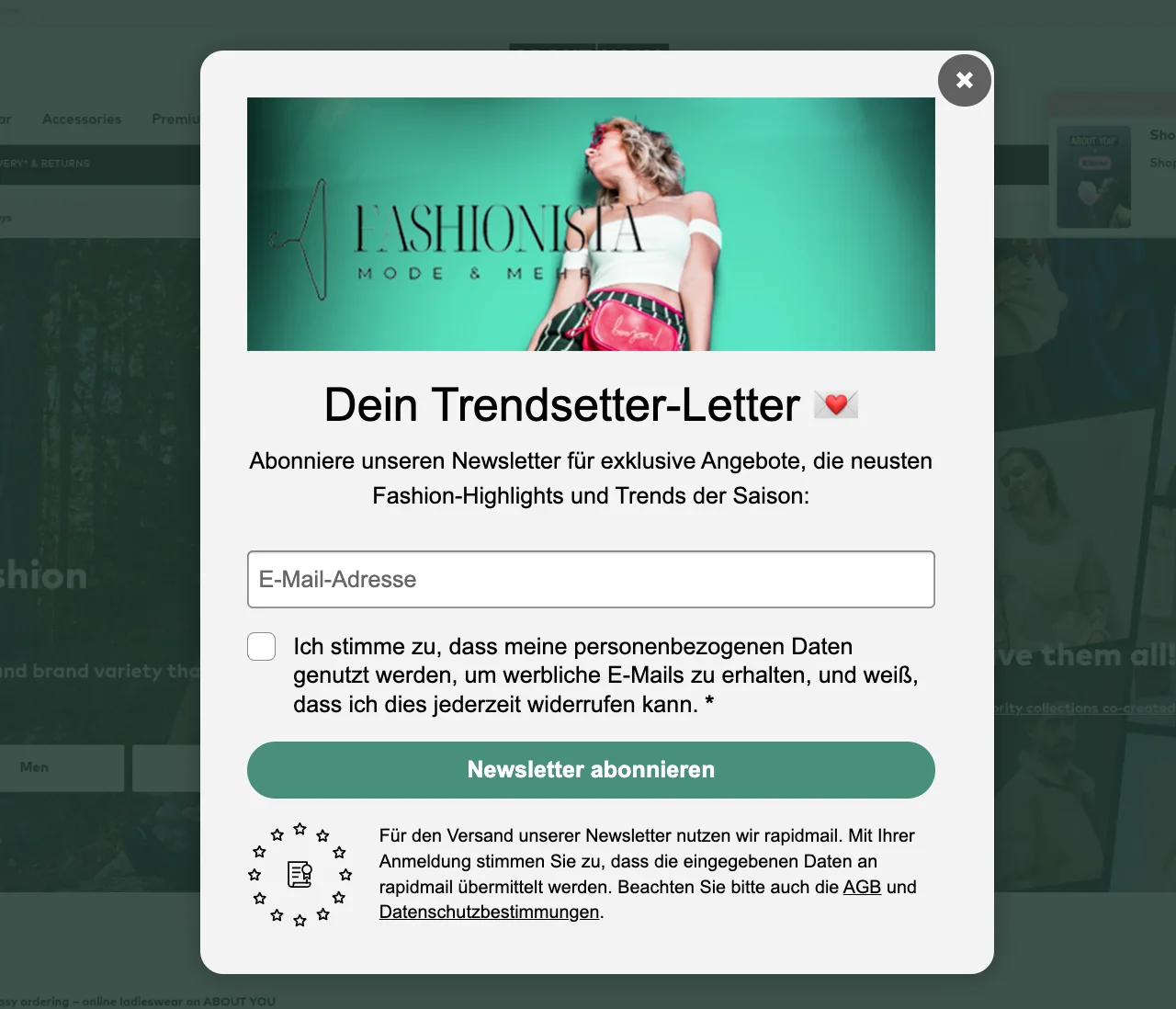
Requirement 2: Refer to the privacy policy during newsletter sign-up
Let us take one step back. Before obtaining new subscribers’ consent through double opt-in, you need to consider data privacy requirements when designing the newsletter sign-up journey. Under the GDPR (Art. 12 et seq.), you must inform prospective subscribers about your website’s privacy notices in the sign-up form or, at the latest, in the double opt-in email, because the information must be provided transparently, accessibly and intelligibly.
Where personal data relating to a data subject are collected from the data subject, the controller shall, at the time when personal data are obtained, provide the data subject with all of the following information:
a) the identity and the contact details of the controller, […]
c) the purposes of the processing for which the personal data are intended as well as the legal basis for the processing.
Art. 13(1) GDPR
For newsletter sign-ups, this means specifically that the form should refer to your privacy policy, which should clearly explain:
- ✍️ which personal data you process for your newsletter marketing, such as email address and sign-up time
- 💌 the purpose for which the data is used, such as a monthly newsletter
- 💾 how long the data is stored
You should also state transparently which newsletter software you use for distribution. If you use an external tool, we recommend linking directly to its privacy policy and terms and conditions. This tells your subscribers exactly who processes their data and under which conditions.
By displaying a clear reference to your privacy policy, you not only meet statutory data privacy requirements, but also create trust, an important foundation for successful and reputable newsletter marketing.
👀 Did you know?
With rapidmail, you can easily incorporate privacy notices into every newsletter sign-up form. With just one click, you add a clearly visible notice including links to the terms and conditions and privacy policy, with no technical knowledge required.
This ensures that prospective subscribers feel transparently informed from the moment they sign up, that all important data privacy information is easily accessible, and that your newsletter sign-up form meets data privacy requirements.
Requirement 3: Include information about link tracking in the privacy policy
To offer your subscribers newsletter content that is as relevant and interesting as possible, it is worth reviewing your most important newsletter metrics. For example, you can see which links were clicked or which content is particularly well received.
When you use rapidmail as your newsletter tool, link tracking automatically provides a statistical analysis after every campaign. This includes information on recipients’ click behavior. Newsletter links can also include additional tracking parameters, such as UTM parameters for Google Analytics, if you use external analytics tools.
Under Art. 6(1)(a) GDPR, you need your contacts’ explicit consent to analyze and use this tracking data, because tracking recipient behavior involves processing personal data.
Processing [of personal data] shall be lawful only if […] the data subject has given consent to the processing of his or her personal data for one or more specific purposes.
Art. 6(1)(a) GDPR
It is therefore important to provide transparent information about the use of tracking. All relevant information about link tracking and the analysis of recipient behavior should be included in your website’s privacy policy. This is another reason why you should draw prospective subscribers’ attention to these privacy notices during the newsletter sign-up journey.
If you do not want recipient behavior to be analyzed automatically, you can disable link tracking completely in your rapidmail account at any time. Existing statistics for sent campaigns will be anonymized. However, please note that disabling link tracking limits some features, such as A/B tests and follow-up emails.
👀 Did you know?
rapidmail provides a GDPR-compliant template for your privacy policy. It was created and reviewed with the data privacy experts at Keyed, making it an ideal, reliable basis for your newsletter marketing.
Requirement 4: Make the email address the only required field in the newsletter sign-up form
A personal greeting in the newsletter, a birthday discount or invitations to local events: personalization plays an increasingly important role in newsletter marketing. It is therefore tempting to request as much information as possible about new contacts when they sign up for the newsletter.
In addition to the email address, sign-up forms therefore often include extra fields such as first name, surname, date of birth or individual interests. But this is precisely where caution is needed.
The GDPR prescribes the principle of data minimization: you may collect and process only the personal data that is genuinely necessary for the relevant purpose.
Personal data shall be adequate, relevant and limited to what is necessary in relation to the purposes for which they are processed (“data minimization”).
Art. 5(1)(c) GDPR
For your newsletter marketing, this means specifically that your contacts’ email address is sufficient to send a newsletter. You must therefore allow prospective subscribers to sign up even if they wish to provide only their email address.
In other words, the email address may be the only required field in your newsletter sign-up form. Other personal data, such as name, date of birth or place of residence, may only be requested voluntarily through an optional field.
This not only keeps you GDPR-compliant, but also lowers the barrier to sign-up for new subscribers, a clear advantage when building your list.
The rapidmail newsletter
Tips, ideas and news about email marketing, straight to your inbox.
Requirement 5: Observe the coupling prohibition for newsletter sign-ups
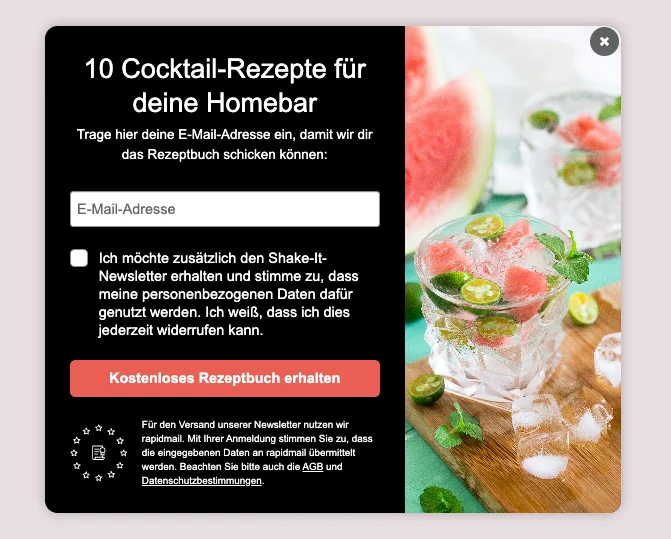
Lead magnets such as contests, free ebooks or white papers are often used to attract new newsletter contacts. However, caution is needed here too: to protect personal data, you must not generally make entry into a contest or the download of content automatically conditional on a newsletter sign-up.
This so-called coupling prohibition under Art. 7(4) GDPR is intended to ensure that consent to receive newsletters is always given voluntarily and is not forced by offering a benefit.
When assessing whether consent is freely given, utmost account shall be taken of whether, inter alia, the performance of a contract, including the provision of a service, is conditional on consent to the processing of personal data that is not necessary for the performance of that contract.
Art. 7(4) GDPR
What does this mean specifically for lead magnets?
As a general rule, you may not make an ebook download or entry into a contest conditional on users also being required to sign up for your newsletter if the newsletter is not strictly necessary for the relevant purpose.
For you to use lead magnets like these to expand your newsletter list in compliance with the GDPR, one of the following two cases must apply:
- 📃 Coupling where an ebook download or contest contract exists: You have had an experienced data privacy expert draw up an ebook or contest contract. This states that entry into the competition or the ebook download is automatically linked to data processing in the form of newsletter distribution. You should use this option only in exceptional cases and after obtaining individual legal advice.
- 💌 Newsletter subscription as a voluntary additional option (recommended solution): Before prospective subscribers click the “Enter contest” or “Download ebook” button in your website form, offer them a newsletter sign-up checkbox. Website users can select it if they also want to receive your newsletter in addition to entering or downloading. This option not only keeps you on the right side of the law, but also gives your target audience a fair opportunity not to subscribe if they are not interested.
Requirement 6: Conclude a data processing agreement (DPA) with external newsletter tools
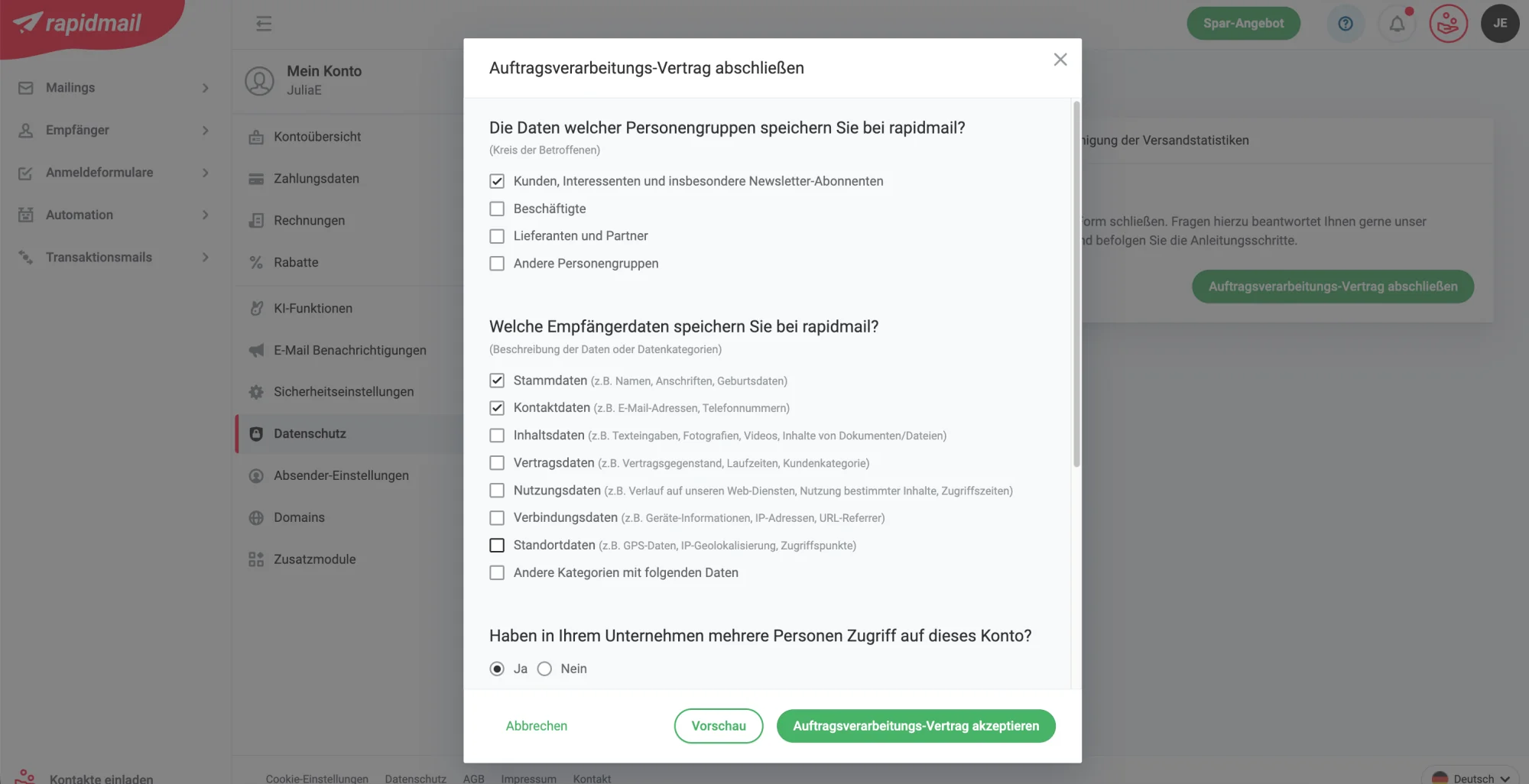
If you use external newsletter software for your email marketing, your provider theoretically has access to your contacts’ data. All personal data that you import into your account there, such as your contacts’ names and email addresses, is stored on the newsletter provider’s servers.
This is known as processing on behalf of a controller: you remain responsible for data privacy, while the newsletter provider processes the data on your behalf.
Art. 28 GDPR specifies that in this case, as a business or organization, you must conclude a data processing agreement with the external newsletter provider:
Processing by a processor shall be governed by a contract or other legal act under Union or Member State law, that is binding on the processor with regard to the controller and that sets out the subject matter and duration of the processing, the nature and purpose of the processing, the type of personal data and categories of data subjects and the obligations and rights of the controller.
Art. 28(3) GDPR
Concluding a DPA ensures that you provide full data privacy for your newsletter because:
- ✅ the newsletter provider processes the data only on your instructions
- ✅ appropriate technical and organizational measures (TOMs) are taken to protect the data
- ✅ data is not disclosed unlawfully to third parties
Without an agreement of this kind, using external newsletter tools is not GDPR-compliant.
👀 Did you know?
When you use rapidmail as your newsletter tool, you can conclude a data processing agreement (DPA) for sending your newsletters easily and entirely electronically in your rapidmail account. This enables you to meet a central data privacy requirement quickly and simply, without additional administrative work.
Requirement 7: Store and process contact data only within the EU
Under the GDPR requirements in Art. 44 et seq., storing and processing personal contact data is generally straightforward only within the EU, where a uniform level of data protection applies.
When choosing your newsletter tool, you should therefore ensure that all contact data is stored and processed exclusively on servers within the EU.
The situation is different if, for example, you use newsletter software such as Mailchimp with servers in the USA and transfer or process personal data in so-called third countries outside the EU. The GDPR imposes specific requirements in this regard:
Any transfer of personal data […] to a third country or to an international organization […] shall take place only if the conditions laid down in this Chapter are complied with by the controller and processor, […] in order to ensure that the level of protection of natural persons guaranteed by this Regulation is not undermined.
Art. 44 GDPR
The provider in the non-EU country must therefore be able to guarantee that its own level of data protection meets the EU requirements under the GDPR. The European Commission must also first make a general, official determination that the third country provides an adequate level of data protection.
Your contact data may be transferred to newsletter software whose servers are located outside the EU only if one of the following two conditions is met:
- 🧑⚖️ there is an adequacy decision by the European Commission for the relevant third country
- 🧑⚖️ suitable additional safeguards are introduced and deemed sufficient, such as standard contractual clauses, individually negotiated contractual clauses or an approved certification mechanism
Why newsletter tools with EU servers are the simplest option
As you can see, transfers to third countries are legally possible when sending GDPR-compliant newsletters, but they entail more extensive review and documentation. If you want to avoid this work, newsletter software with servers located exclusively within the EU is the simplest and most legally reliable solution.
With a newsletter provider that complies with the EU GDPR, you benefit from:
- 🔒 clear legal conditions and maximum data privacy compliance
- 🔒 less review and administration to ensure an adequate level of data protection
- 🔒 a greater chance of growing your newsletter list because you can guarantee new contacts full data privacy
👀 Did you know?
With rapidmail, your contact data stays in Germany: we store all personal data belonging to our customers and their contacts exclusively on high-security servers in Germany. Thanks to our close collaboration with the data privacy lawyers at Keyed, our newsletter tool complies 100% with data privacy guidelines at all times.
Requirement 8: Do not use a no-reply address as the newsletter sender
“noreply@my-company.com”, “do-not-reply@mycompany.com” or “no-replies@mycompany.com”: many businesses still send their newsletters from a no-reply address. They generally want to prevent a flood of replies to a newsletter they have sent.
However, a no-reply address is a questionable choice for the newsletter sender, not only in terms of customer relationships and reader loyalty, but also from a data privacy perspective. Newsletter senders that use no-reply addresses operate in a legal gray area, even though they do not in principle violate applicable data privacy laws.
Under the General Data Protection Regulation (Art. 15 et seq. GDPR), users must be able to obtain information at any time about all personal data collected about them.
The data subject shall have the right to obtain from the controller confirmation as to whether or not personal data concerning him or her are being processed, and, where that is the case, access to the personal data […].
Art. 15(1) GDPR
For newsletter distribution and data privacy, this means specifically that subscribers must have an easy way to contact the sender if they want information about their stored data, have questions about the newsletter or wish to exercise their right to rectification or deletion.
The GDPR does not explicitly require a sender address that can receive replies. However, using a no-reply address makes communication unnecessarily difficult and could be interpreted as a failure to “facilitate the exercise of data subject rights” under Art. 12(2) GDPR, creating a legal gray area that is easy to avoid.
💡 rapidtip: Provide an easy way to get in touch
To avoid risks under data privacy law while strengthening your relationship with your subscribers, you should avoid using a no-reply address as your newsletter sender. Instead, use a sender address that your newsletter contacts can reach at any time with questions.
This offers several advantages:
- 📬 Data-privacy-friendly newsletter: questions about personal data are easy to submit
- 🤝 More trust in your business: subscribers feel taken seriously and heard
- 📈 Better newsletter deliverability: replies and interactions have a positive effect on your sender reputation and therefore on the successful delivery of your emails
Being accessible therefore pays off in terms of data privacy, technology and your relationship with newsletter subscribers. 💌
Requirement 9: Include an unsubscribe link in every newsletter
It is naturally disappointing when subscribers unsubscribe from your newsletter. Nevertheless, you should never try to make unsubscribing unnecessarily difficult or prevent it. Continuing to send newsletters to contacts who have no genuine interest offers you no benefit. In addition, an easy unsubscribe option is a clear requirement for a GDPR-compliant newsletter unsubscribe process.
The GDPR in Art. 7(3) stipulates that consent to receive the newsletter must be capable of being withdrawn at any time, and doing so must be as easy as giving consent in the first place:
The data subject shall have the right to withdraw his or her consent at any time. […] It shall be as easy to withdraw as to give consent.
Art. 7(3) GDPR
This means your readers must be able to unsubscribe from your newsletter easily at any time.
The data privacy guidelines therefore do not explicitly require every newsletter to contain an unsubscribe link. In practice, however, an unsubscribe link in the newsletter is the simplest, most user-friendly and legally reliable solution for both recipients and senders. It reduces inquiries, minimizes the risk of complaints and helps avoid formal warnings or legal disputes.
👀 Did you know?
Every newsletter created with rapidmail automatically contains an unsubscribe link. You can customize the link text and communicate clearly and transparently that your subscribers can unsubscribe at any time. This enables you to meet a central data privacy requirement without any extra effort.
Requirement 10: Respect your contacts’ “right to be forgotten”
When subscribers unsubscribe from your newsletter, it means they will no longer receive email newsletters from you. What happens to their personal data then depends on the technical solution used by your newsletter tool. It is therefore all the more important to choose GDPR-compliant newsletter software from the outset that also allows you to delete contact data lawfully.
With a standard newsletter unsubscribe, your contact is not usually deleted completely, but is given an inactive or blocked status. This also makes sense from a data privacy perspective: the email address remains stored as “unsubscribed” so that you do not accidentally contact it again. Other personal data that is no longer required to send the newsletter, such as a name or date of birth, can be deleted.
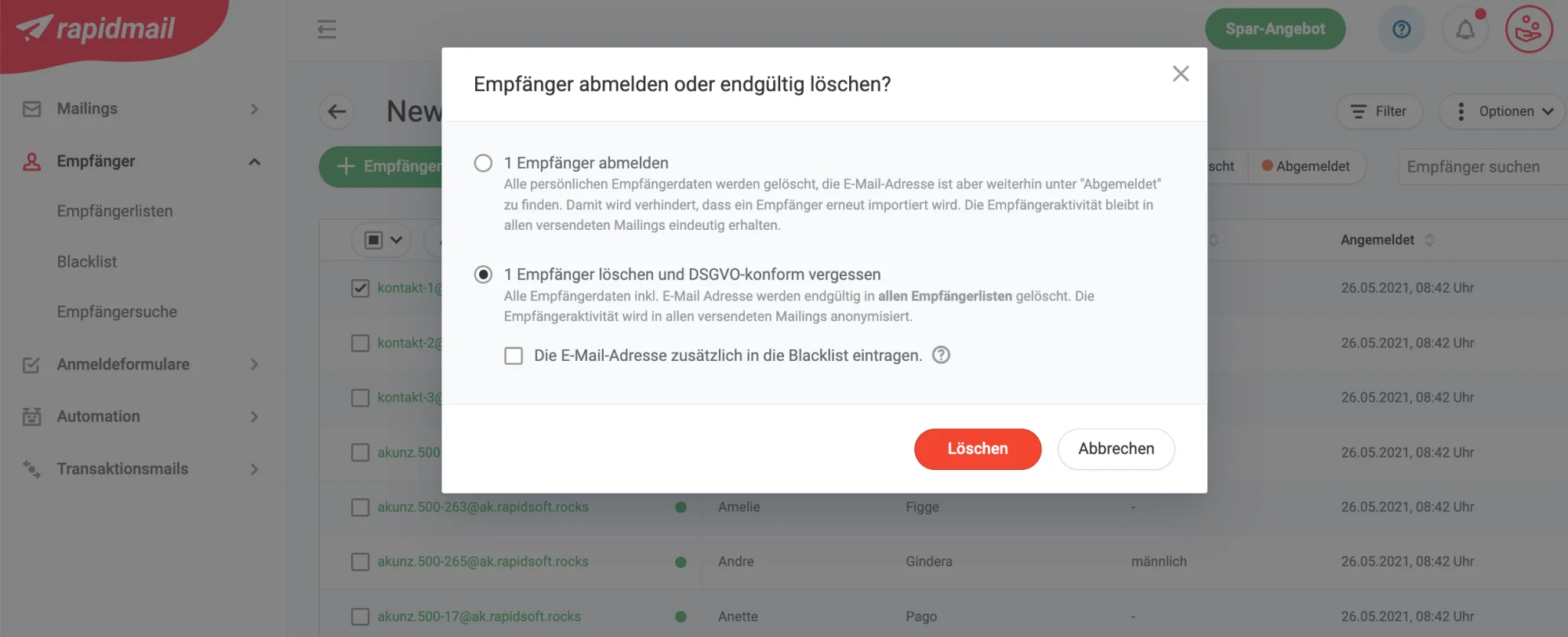
With rapidmail, for example, your contact automatically changes from “active” to “unsubscribed” after unsubscribing. Additional personal data is removed, while the email address remains recorded as unsubscribed, solely to prevent another campaign without consent.
Right to complete deletion (“right to be forgotten”)
Alongside the standard newsletter unsubscribe process, your subscribers have another important right under Art. 17 GDPR: the right to erasure, also known as the “right to be forgotten”, which goes beyond simply unsubscribing.
The data subject shall have the right to obtain from the controller the erasure of personal data concerning him or her without undue delay and the controller shall have the obligation to erase personal data without undue delay […].
Art. 17(1) GDPR
For you, this means that your subscribers may request the complete deletion of all their personal data, including their email address, from all servers and systems, provided that this does not conflict with other statutory retention obligations.
👀 Did you know?
In addition to the standard unsubscribe process, rapidmail enables you to “delete and forget in compliance with the GDPR” your subscribers’ data from the recipient list when necessary. All data is removed from every relevant system, ensuring that the data subject’s request is implemented in a legally compliant manner.
3. Free newsletter data privacy checklist to download and check off
You now have a good overview of how to reconcile newsletters and data privacy easily. To help you get started straight away, our free data privacy checklist guides you step by step toward GDPR-compliant newsletter distribution. Download the interactive checklist and check off every requirement you have already implemented successfully. Ready, set, go!
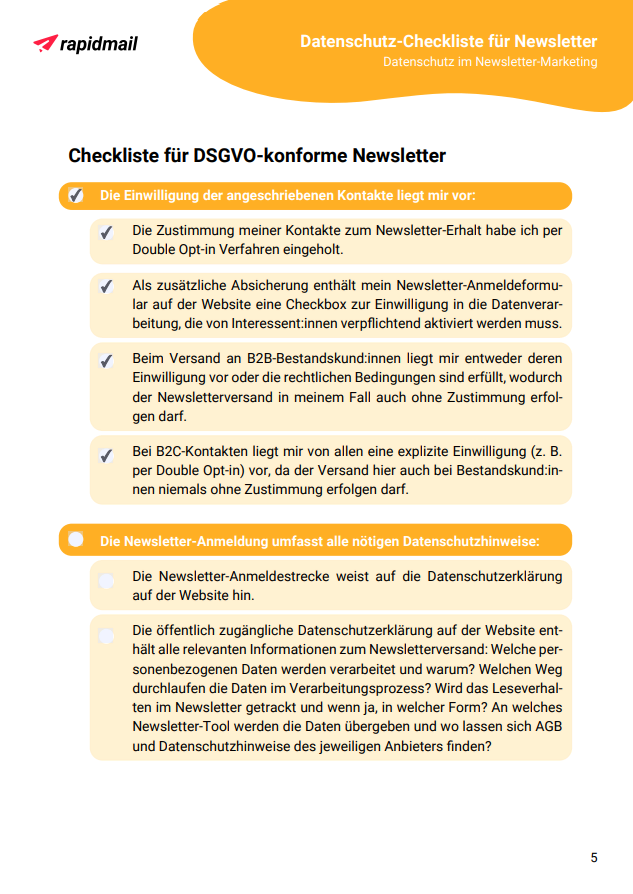 (PDF in German)
Download the data privacy checklist (PDF in German)
4. Conclusion: How important is data privacy to successful email marketing?
Data privacy plays an increasingly central role in email marketing. Since the General Data Protection Regulation (GDPR) came into force and following numerous court decisions, including those on transferring data to newsletter tools in third countries, one thing is clear: data privacy is no longer a peripheral issue, but a fundamental requirement for professional newsletter distribution.
It is therefore all the more important to address data privacy for newsletters at an early stage and make your email marketing consistently GDPR-compliant.
This includes:
- 🔒 choosing newsletter software with transparent data privacy standards
- 🔒 clear, traceable consent processes for your newsletter contacts
- 🔒 securely handling unsubscribe and deletion requests from subscribers
When implemented correctly, data privacy not only protects you against formal warnings or fines. It also creates trust among your subscribers, providing a stable foundation for successful email marketing over the long term.
Send GDPR-compliant newsletters now
Still have questions about data privacy when sending newsletters?
No problem. For data privacy questions concerning our newsletter tool, our rapidmail support team will be happy to help. For general advice on data privacy in your company and tips on how to improve your level of data protection, you can contact our data privacy partners at Keyed.
FAQ: Frequently asked questions about data privacy in newsletter marketing
What does data privacy in newsletter marketing cover?
Data privacy in newsletter marketing covers all legal requirements for collecting, processing and storing personal data generated when newsletters are sent. This includes email addresses, consent, sign-up times and tracking data in particular. The basis is the General Data Protection Regulation (GDPR), which you must observe in newsletter marketing.
What data privacy guidelines apply to newsletter marketing?
There are several data privacy requirements that you must observe when sending newsletters. The fundamental rule is that newsletters may only be sent with the recipients’ explicit and verifiable consent.
Can I send newsletters without my contacts’ consent?
As a general rule, no. Newsletters may normally only be sent with recipients’ prior, voluntary and verifiable consent. An exception may apply to B2B newsletters for existing customers under very strict conditions. Explicit consent is always required for B2C contacts.
Is double opt-in mandatory for newsletter sign-ups?
The GDPR does not explicitly prescribe double opt-in, but it is considered best practice for proving consent in a legally reliable way when necessary. In practice, double opt-in is therefore the safest method of documenting your contacts’ voluntary newsletter sign-up.
What data can I request in the newsletter sign-up form?
Only the email address may be requested as a required field. Additional information such as name, date of birth or interests is permitted if it is voluntary.
Do I need consent for newsletter tracking?
Yes. As soon as you analyze click or open behavior or use tracking parameters, such as UTM parameters, you need your contacts’ consent. You can obtain it in the sign-up form, for example. You must also provide transparent information about tracking in your privacy policy.
Can I link contests or ebooks to a newsletter sign-up?
As a general rule, no. The coupling prohibition means that a service, such as an ebook download, must not automatically be made conditional on a newsletter sign-up. A voluntary additional checkbox for the newsletter in the download or contest form is permitted. Exceptions are only possible with a clear contractual basis and legal review.
Why do I need a data processing agreement (DPA) when using a newsletter tool?
If you use an external newsletter tool, the provider processes personal data on your behalf. In this case, a data processing agreement under Art. 28 GDPR is mandatory to clearly define responsibilities, instructions and security measures. When using rapidmail as your newsletter tool, for example, you can easily conclude a DPA electronically in your account.
Does newsletter data have to be stored in the EU?
Storing your contacts’ personal data within the EU is the simplest option from a data privacy perspective. Additional requirements apply when data is processed in third countries, such as the USA, including an adequacy decision or standard contractual clauses. This requires more review and documentation. The simplest solution is therefore newsletter software whose servers are located exclusively within the EU.
Can I use a US newsletter tool under the GDPR?
Under the GDPR requirements, personal data can be processed within the EU without additional safeguards. When choosing your newsletter tool, you should therefore ensure that all contact data is stored and processed exclusively on servers within the EU to avoid additional administrative work.
Does every newsletter have to include an unsubscribe link?
The GDPR does not explicitly prescribe an unsubscribe link. However, it requires people to be able to withdraw their consent to receive newsletters easily at any time. An unsubscribe link in the newsletter is therefore the simplest and most legally reliable solution for recipients and senders.
What happens to contact data after someone unsubscribes from a newsletter?
After unsubscribing, subscribers must not receive any further newsletters. In practice, the email address is often stored as “unsubscribed” to prevent another campaign. Other personal data can be deleted.
What is the “right to be forgotten” in newsletter marketing?
The right to be forgotten (Art. 17 GDPR) allows subscribers to request the complete deletion of their personal data, including their email address, provided that no statutory retention obligations prevent this.
How does rapidmail help me send GDPR-compliant newsletters?
rapidmail supports 100% GDPR-compliant newsletter marketing with features including:
- automatic double opt-in for sign-up forms
- integrated unsubscribe links in every newsletter
- easy management of unsubscribes and deletion requests
- simple electronic conclusion of a DPA directly in the account
- servers located exclusively in Germany