New data protection ruling from Baden-Württemberg: Will an EU server location soon no longer be enough for GDPR compliance?

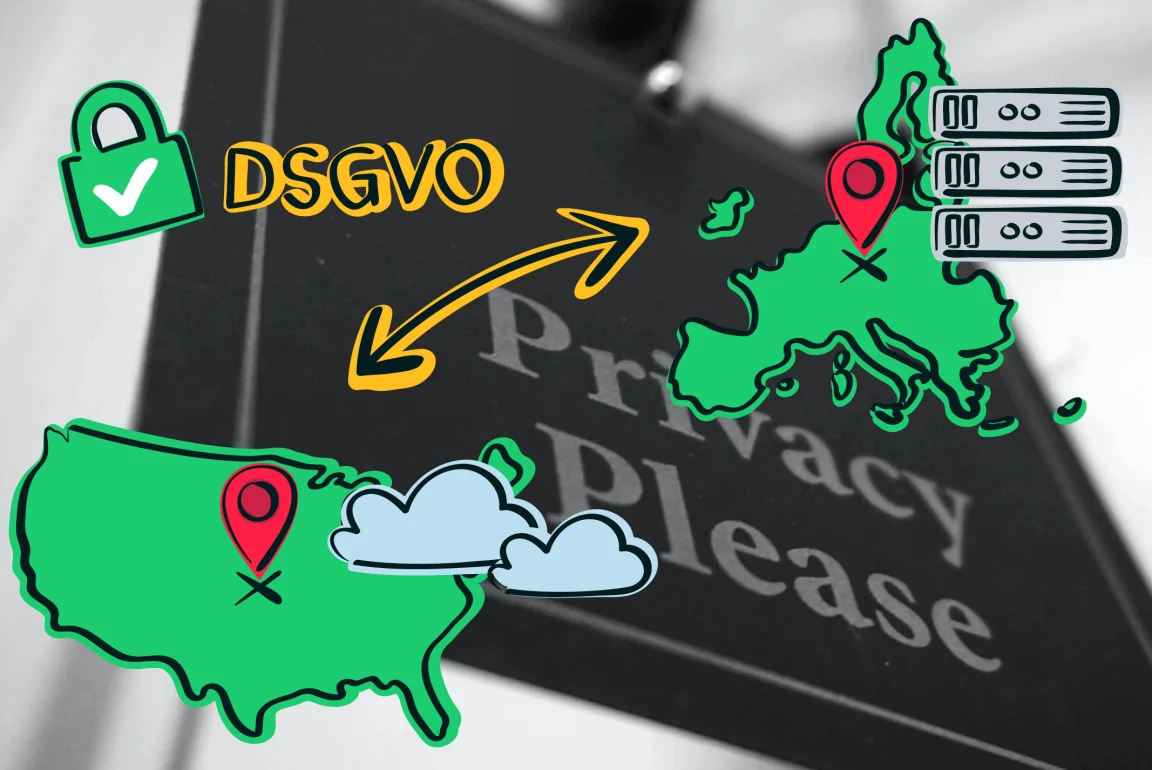
There is important data protection news: on July 13, 2022, the Baden-Württemberg Public Procurement Tribunal issued a landmark ruling. It could even spell the end of GDPR compliance for many businesses if they store personal data on servers and in clouds within the EU that are operated through European subsidiaries of US providers such as Google, Amazon, Microsoft and others. Even the mere dependence of European providers on a US company, for example through the sale of company shares, could affect the GDPR compliance of European businesses. Our rapidmail data protection partners at Keyed have summarized the ruling and explain how you can find out whether your business uses affected IT and software services.
1. Review: How data transfers to US companies were previously regulated
Efforts to find suitable rules for transferring data from EU countries to the USA did not begin only when the General Data Protection Regulation (EU GDPR) came into force in 2018. The sensitive issue stems from the different data protection requirements that apply in the EU and the USA. Matters are further complicated by US surveillance laws, such as the “CLOUD Act”, which cannot be reconciled with EU data protection laws. Cross-border data protection agreements have been used repeatedly, but unsuccessfully, in attempts to find common ground and enable businesses to transfer personal data from the EU to the USA with legal certainty.
After the first data protection agreement, “Safe Harbor”, between the EU and the USA was suspended in 2015, the “Privacy Shield” agreement came into force in 2016. It was intended to ensure that US companies receiving personal data from EU businesses processed it under the same strict data protection rules as those in the EU. The European Parliament was not alone in viewing the agreement’s level of data protection as highly problematic and inadequate: the Court of Justice of the European Union (CJEU) reached the same conclusion and invalidated the EU-US Privacy Shield again in 2020.
The judgment and the absence of new rules have made GDPR-compliant data transfers between EU Member States and the United States considerably more difficult. If an EU business wants to transfer data to the USA, it must find other ways to ensure legally compliant data processing.
As a rule, the EU Standard Contractual Clauses are used as the basis for lawful data transfers. On June 4, 2021, the European Commission published new standard data protection clauses, commonly referred to as Standard Contractual Clauses (SCCs). Standard data protection clauses can serve as safeguards for transfers of personal data to third countries (that is, countries outside the European Union), pursuant to Article 46(2)(c) GDPR. At the same time, data subjects in the third country concerned must have enforceable rights and effective legal remedies available to them. But the requirements have also become increasingly stringent in recent years, meaning that entering into the SCCs alone is no longer sufficient.
Entering into Standard Contractual Clauses alone is no longer sufficient for GDPR compliance today.
Nils Möllers, data protection lawyer at Keyed
At the same time, many US companies, including IT, software and hosting providers, exploit gray areas in data protection law by storing personal data through European subsidiaries in data centers within the EU.
The ruling by the Baden-Württemberg Public Procurement Tribunal, issued on July 13, 2022, came suddenly but, in view of the failed agreements, was not a major surprise. It could serve as a “guide” for the further development of data protection law in Germany.
2. What the new ruling by the Baden-Württemberg Public Procurement Tribunal is about
The Baden-Württemberg Public Procurement Tribunal is a review body. Its role is to review the award of public contracts to private companies. In this context, a dispute arose between two companies participating in a tendering procedure for a cloud platform.
One of the companies that had submitted a bid demanded that another company be excluded from the evaluation of bids. The demand was based on the claim that the company was in breach of the GDPR because it worked with a subsidiary of a US-based company for server and hosting services. It argued that the fact that this European subsidiary’s servers were located in Germany was irrelevant because of its dependence on the US parent corporation.
The accused company countered that Standard Contractual Clauses had been agreed for this purpose, together with a “GDPR Data Processing Addendum” (known in Germany as an “Auftragsverarbeitungsvertrag”, or “AV-Vertrag” for short) containing supplementary provisions, as required by the Court of Justice of the European Union in such cases.
The Baden-Württemberg Public Procurement Tribunal therefore had to decide whether the company concerned was in fact in breach of the GDPR by working with a European subsidiary of a US corporation despite the agreed Standard Contractual Clauses.
3. Findings of the public procurement ruling
On July 13, 2022, the Baden-Württemberg Public Procurement Tribunal issued its ruling on “GDPR: Admissibility of using infrastructure services provided by European subsidiaries of US cloud providers”.
The outcome
- In the view of the Baden-Württemberg Public Procurement Tribunal, following the invalidation of the EU-US Privacy Shield, it is not permissible to transfer personal data to servers if their operators are subsidiaries of US providers even if the servers used for IT and software services are operated within the EU.
- Entering into Standard Contractual Clauses or a data processing agreement (known in Germany as an Auftragsverarbeitungsvertrag or AV-Vertrag) would not in itself be sufficient to justify transferring data to EU servers belonging to a US parent corporation.
- The decision was based on the possibility that the non-European parent company could access the data held. The mere possibility would constitute a transfer of data to a third country within the meaning of the GDPR (Articles 44 et seq.), irrespective of whether the US corporation actually accesses the data. For businesses in which US corporations own shares, this relationship of dependence alone could therefore mean that full GDPR compliance can no longer be achieved.
The rapidmail newsletter
Tips, ideas and news about email marketing, straight to your inbox.
4. When does the data protection ruling take effect?
According to the latest information as at August 15, 2022, the tribunal’s ruling is not yet final, and the proceedings for its acceptance and review are still ongoing.
We believe it is highly likely that the ruling will prevail and thus serve as a “trailblazer” for similar decisions by courts and authorities, including in the private sector.
Nils Möllers, data protection lawyer at Keyed
However, if the ruling takes legal effect, it is highly likely to serve as a “guide” for supervisory authorities and other courts in similar cases. This applies not only in the public sector but also in the private sector. The decision by the Baden-Württemberg Public Procurement Tribunal therefore potentially has far-reaching consequences for cooperation between German businesses and US IT and hosting providers or their subsidiaries: if the ruling takes legal effect and businesses nevertheless continue to work with US providers or their subsidiaries, this would mean that they were no longer operating in compliance with the GDPR.
5. How to check whether your business is affected
If the ruling takes legal effect, courts and supervisory authorities are highly likely to follow it in the private sector as well.
For your business, this would mean that you should…
- ensure that your business does not work with any server, hosting or software provider that stores personal data on servers dependent on a parent corporation in the USA. Well-known examples of US corporations offering server services in the EU include cloud services from Amazon Web Services (AWS), Microsoft Azure and Google Cloud Platform. Examine the corporate structure of your European software and hosting providers to find out whether they are connected to a parent company in the USA.
- review the privacy notices of all online tools and IT service providers you work with. Check carefully which servers the providers use to store your personal data. A label stating “data stored on EU servers” would no longer automatically be sufficient for GDPR compliance, as those EU servers may be operated by a US provider. Nor would agreeing Standard Contractual Clauses or supplementary data protection agreements be sufficient to establish GDPR compliance.
- as a precaution, also check the data processing agreements of your IT and software providers to see whether they list companies based in the USA as “subcontractors”. If so, this could mean in the near future that working with the provider in question is no longer lawful.
6. What the ruling means for rapidmail customers
We can reassure you straight away: rapidmail’s email marketing tool is and will remain 100% GDPR-compliant, with no asterisks or small print.
Even before the GDPR and comprehensive legal requirements, data protection was a top priority for rapidmail. Why? Because the rapidmail team wants to handle its customers’ data in the same way it would want other tools to handle its own personal data. For this reason, rapidmail has also brought the team at Keyed on board as external data protection lawyers.
Even if the ruling by the Baden-Württemberg Public Procurement Tribunal takes legal effect, you have nothing to worry about as a rapidmail customer:
- With rapidmail, all personal data is stored on servers in Germany, exclusively with providers that do not belong to a company based in a third country.
- All IT and hosting providers used by rapidmail have previously undergone a comprehensive review by our team of data protection experts.
All you need to do is focus fully on your email marketing. Together with our data protection partner Keyed, we ensure that your use of rapidmail remains GDPR-compliant at all times.
Send GDPR-compliant emails now
rapidtip: Data protection checklist for newsletter marketing
What do you need to bear in mind when sending your newsletters? Which contacts are you allowed to email, and does every newsletter really need an unsubscribe link? Our data protection checklist for your newsletter marketing helps you stay legally compliant.
7. Conclusion and assessment: What happens next?
For now, the answer is to wait. We need to wait and see how the Baden-Württemberg Public Procurement Tribunal explains its ruling and how the ongoing proceedings at the Higher Regional Court (Oberlandesgericht, OLG) in Karlsruhe ultimately conclude.
However, in our view, the ruling is consistent with the trend in decisions by European courts and authorities to reject high-risk approaches to transferring personal data to third countries such as the USA.
We therefore believe it is highly likely that the ruling will prevail and thus serve as a “trailblazer” for similar decisions by courts and authorities, including in the private sector. Businesses would therefore be well advised to initiate the corresponding changes today. After all, refraining from using tools and providers with servers belonging to US corporations already increases the level of data protection in any event.