Running a newsletter contest: How do you make it GDPR-compliant?

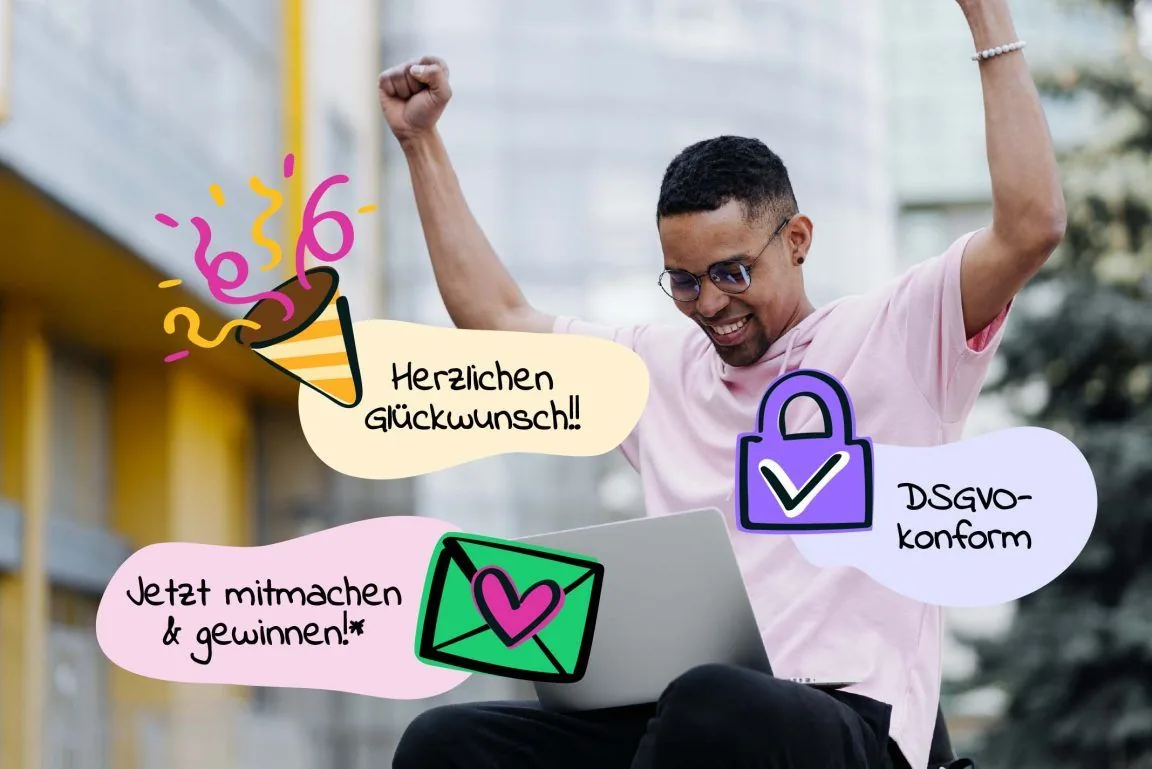
We all love winning something! You can make that wish come true in email marketing too by using your newsletter to run a contest. However, because contests involve data that needs to be protected, there are legal requirements you should follow.
1. How do I run a contest via newsletter?
“Hooray, you’ve won!” It is a message that is sure to release a rush of feel-good hormones in all of us. After all, who would not like to hit the jackpot and emerge as the winner of a contest?
A contest is a great way to strengthen your relationship with your newsletter subscribers. Why? For one thing, winning something is fun. Contests are also ideal for building trust with your readers, or even growing your customer base.
How do you approach a newsletter contest?
- 📋 Before sending the newsletter: Think about the goals you want to achieve with the contest. You should also define your target audience so that you can tailor the prize, entry requirements and style of the contest newsletter to them. The terms and conditions should also be clearly defined.
👀 Did you know?
They sound similar, but there is a subtle difference: a contest’s terms and conditions cover the legal rules, while the entry requirements are the conditions you set for entering the contest.
| Terms and conditions | Entry requirements |
|---|---|
| The terms and conditions contain the rules for entering, information about the prizes, how entrants' data is processed and their rights to object or withdraw consent. | You set the entry requirements that entrants must meet to be included in the prize draw. These might include liking your social media account, taking part in a survey or answering a quiz question. |
- ⚖️ Legal safeguards: Entrants are not the only ones who have conditions to meet. As the contest organizer, there are several points you need to consider to ensure that you are legally protected. The most important aspects are communicating the terms and conditions and requesting and processing sensitive customer data. We will come back to that later!
- 🎨 Designing the newsletter contest: As always, the design of your newsletter determines whether your readers find it appealing and want to read it in the first place. Engage your readers with an appealing design and persuade them to enter the contest with compelling copy.
💡 rapidtip
Your subscribers must be able to see the entry requirements and terms and conditions. However, as we all know, brevity is the soul of wit, so you do not necessarily have to put them in the newsletter itself. Relevant links or a call to action can direct your readers to a landing page on your website that explains the conditions of entry in detail.
- 🍀 Launch the contest: Now it is time to get down to business. Your subscribers can give it their all for the chance to be crowned the winner. Give them enough time to enter so that as many people as possible can take part. Promote your contest on social media as well to reach even more people or remind your loyal fans about it. If you are concerned that you did not choose the best time to send your contest newsletter, send a follow-up email a few days later to remind your readers.
- 📊 Evaluate the newsletter contest: One contest ends and the next begins! First, it is time to pick the winner. Contact the chosen person, as it is now time to award the prize. You may also want to thank the other entrants for their submissions and participation in a newsletter. As with virtually all marketing activities, the next step after running the campaign is to evaluate it: Did you achieve your goals? What could you do better next time? What worked particularly well?
2. Benefits: Why running a newsletter contest is worthwhile
You now know how a newsletter contest works. If you are still wondering whether it is worth the effort, we can reassure you: it is! Contests are like magnets and practically attract entrants by themselves. If the entry requirements are manageable and the prize is appealing, many people will try their luck. After all, why would they not?
Here are some reasons why running a contest as part of your email marketing is worthwhile:
- increase the visibility of your brand or business
- reach prospects and customers and increase sales
- strengthen loyalty and trust among existing customers
- give customers and prospects something valuable
- create an emotional response by offering the chance to win
The rapidmail newsletter
Tips, ideas and news about email marketing, straight to your inbox.
Occasions and ideas for contests
There is no shortage of occasions for newsletter contests. Contests are versatile and do not have to be tied to a particular event. However, seasonal events such as Christmas, Valentine’s Day, Easter or Black Week work particularly well. These are peak marketing periods when customers regularly look for gifts, so they are even more delighted to receive a little something, either to keep for themselves or give to someone else.
You can also get creative with the design of your contest. Because you set the entry requirements yourself, there are almost no limits.
At Christmas, for example, you could create a digital email Advent calendar with the chance to win a small prize behind each door. At Halloween, you could combine your contest with a costume contest: Who can send you the spookiest photo?
But you can also run contests outside seasonal events:
- 💭 Make entry a survey designed to help you improve your newsletter.
- 💭 Increase your reach by using business-related hashtags (#) that raise awareness of your company.
- 💭 Ask an estimation or general knowledge question that your readers have to answer by email. The best answer wins!
- 💭 Encourage your subscribers to get creative: launch a contest in which entrants design a logo or slogan that suits your company.
- 💭 Even very simple entry requirements are enough. Entrants might only need to follow you on the social media platform of your choice to be included in the prize draw.
Who should enter my contest?
We have already established that you should define a few goals in advance that you want to achieve with your contest. These also influence its target audience.
If you want to encourage interaction with your existing subscribers, there is little standing in the way of your contest and you can get started straight away.
At this point, consider whether it makes sense to segment your recipient list for the contest. Is the newsletter contest relevant to all your recipients? Which recipient group is likely to respond strongly? Does the contest have a local focus, making place of residence a relevant criterion? Is there a prize that would particularly appeal to a specific age group? By making targeted use of segmentation, you avoid unwanted wasted reach and can be confident that your contest will be especially well received by your readers.
👀 Did you know?
rapidmail lets you create any segments you need. This not only helps you maintain an overview, but also makes it easy to organize your recipient list. Alongside predefined segments such as age, ZIP code and gender, you can use additional fields to add criteria tailored to your industry.
If your goal is to expand your recipient list through the contest and win new subscribers, things become a little more complicated. Several legal requirements come into play here. You may request sensitive customer data, such as a name and email address, for the purposes of the contest. However, that does not mean you may automatically reuse this data afterwards to send entrants your newsletter. We explain how to protect yourself in this situation in the next step.
3. Protecting data: Making newsletter contests GDPR-compliant
There are already legal requirements for sending newsletters and data protection guidelines, so it is hardly surprising that contests are also subject to GDPR requirements.
Because the prospect of winning is so tempting, consumers can easily be persuaded to act “without thinking” and may disclose data without considering the implications. Unfortunately, some unscrupulous contest operators exploit this to obtain personal data easily. The introduction of the General Data Protection Regulation (GDPR) therefore brought in a number of rules to protect consumers as effectively as possible and prevent them from falling victim to fraudsters.
That makes it all the more important for your brand image to comply with all data protection requirements for your contest and provide entrants with transparent information. To make your newsletter contest GDPR-compliant, you should bear the following points in mind:
3.1 Linking entry to newsletter sign-up
If you want your contest to reach not only existing subscribers but also win new newsletter contacts, there are additional legal requirements to consider.
“Enter our contest here by providing your email address. By doing so, you consent to receiving emails from us about products and news in the future.”
Newsletter sign-ups are often linked to contest entry in this or a similar way. But is that actually permitted?
The principle of “service in exchange for data” has been controversial at least since the GDPR was introduced. An important concept here is the prohibition on tying newsletter sign-up to a service.
When the GDPR was introduced, this prohibition applied absolutely and without exception. However, a ruling by a German Higher Regional Court (OLG) in 2019 and a recent statement by the State Commissioner for Data Protection and Freedom of Information of North Rhine-Westphalia (LDI NRW) have now called the prohibition into question.
Entering into a contract instead of consenting to receive a newsletter
As a solution to this problem, data protection expert Nils Möllers from Keyed recommends entering into a contest contract under Article 6(1)(b) GDPR instead of merely obtaining consent under Article 6(1)(a) GDPR to receive the newsletter.
Processing personal data in connection with a contest and sending newsletters on that basis can be lawful if the requirements arise from a contract between the contest provider and the entrant. The contest would then not be free, but contractually linked to the provision of data. This contract can also be concluded by ticking a checkbox. A subsequent double opt-in process is still required. Just as with a newsletter sign-up, this means that entrants must confirm that they are entering into the contract, for example by clicking the link they receive from you by email.
Follow these important criteria if you want to use your contest to collect new newsletter contacts:
- ✔️ The contract covering the contest and receipt of the newsletter must be voluntary.
- ✔️ The contract must be unambiguous and provide transparent information.
- ✔️ The contract and the double opt-in specifically for receiving the newsletter must be confirmed to meet the documentation requirement.
Data obtained through contest entries therefore cannot simply be used to send newsletters. A separate contract with the entrants is required for this purpose: they must explicitly agree both to enter the contest and to receive your newsletter in the future.
To summarize briefly:
- Linking contest entry to receipt of the newsletter requires a contract between the organizer and the entrant.
- Entrants can agree to this contract, for example, by ticking a checkbox and then confirming it using double opt-in.
- The contract can be placed on a landing page so that the amount of information does not make the newsletter excessively long.
3.2 Terms and conditions
You must state the terms and conditions when running a contest, as they form its legal foundation. The terms and conditions correspond to the contents of the contract drawn up between the organizer and the entrants.
The terms and conditions define the details: Who can enter? How does the contest work? What can entrants win?
Your terms and conditions should include the following information:
- Who can enter? (for example, possible age or residence restrictions)
- When can people enter? (particularly the closing date and time)
- What entry methods are available? (for example, in person, online, by post, by email, etc.)
- How will the winner be selected? (for example, a prize draw, selection by a panel, etc.)
- What can entrants win? (Please note: the information provided here must be accurate and any additional costs must be mentioned.)
- How will the winner be notified?
- Who is running the contest?
- What are the grounds for disqualification? (for example, multiple entries or employees being excluded)
- Which data protection conditions do entrants consent to? (What data will be stored? Will it be processed further? Will it be deleted after the contest ends?)
💡 rapidtip
Because the terms and conditions are relatively extensive, you may want to put them on a landing page on your website instead of in your newsletter. After all, your newsletter copy should be short and succinct, while the terms and conditions tend to get in the way of that.
3.3 Announcing the winner
Once you have run your contest, the next step is to select the winner. But how should you announce who has won?
Whether you use a newsletter, social media or your website, you need the person’s consent to publish a winner’s name. As the organizer, this means you must include the publication of the winner’s name in the terms and conditions. Alternatively, once you have selected the winner, you can contact them by email and ask for permission.
However, you can avoid this extra effort relatively easily by anonymizing the winner’s name, for example by shortening it. An anonymized name does not require any further consent. The announcement might then look like this:
Congratulations! Anna B. from Düsseldorf has won our October contest and can look forward to 4 free issues of our culture magazine. Congratulations 🎉.
4. Contests on social media: What is permitted
Alongside announcing your contest via newsletter, you can also promote it on your social media platforms. Email marketing and social media work extremely well together because you can benefit from your reach across different channels and encourage people to enter in different ways.
For example, use your newsletter to announce the contest and direct readers to your social media channel, where they can find all the other information. Or take the opposite approach and promote your latest newsletter on social media, where the details of how to enter the contest are revealed. This not only increases your newsletter open rate, but also gives you the chance to win new subscribers.
However, social media is also subject to legal requirements that you should follow. Did you know, for example, that some platforms do not allow you to require “Likes” as a condition of entering a contest?
First, a few basic rules. If you promote your newsletter contest on social media, your subscribers should be able to identify who is running it. The entry requirements and terms and conditions should be easy to access and clearly worded.
For a GDPR-compliant contest on Facebook, for example, the description must make it clear that the customer data generated is collected by your company for the purpose of the contest and is not passed on to Facebook. In other words, the data collection has nothing to do with Facebook. You can explain this with a disclaimer such as: “This contest is not sponsored or administered by Facebook in any way. The sole point of contact is XY Ltd.” The same also applies to Instagram.
What guidelines apply to contests on Facebook and Instagram?
| permitted | – follow an account or like a page– like a post– comment on a post– post a photo on the organizer's page– send private messages to the organizer– the comment or photo with the most likes wins | – post your own photo + hashtag– the photo with the most likes wins– reply to a Story |
|---|---|---|
| not permitted | – share the organizer's post on personal timelines– tag other people in comments | – tag yourself or other users in photos in which you or they are not pictured |
5. At a glance: Contests deliver results
Although there are several rules to follow, running contests is still worthwhile in every respect. You reward your loyal subscribers, give them something to enjoy and strengthen customer loyalty at the same time.
There are plenty of occasions for contests, so you can experiment a little. One time, you might run a vacation photo contest; another time, you might conduct a survey that helps you offer your customers an even better experience on your website in the future. Based on your readers’ response, you can decide how often to run contests and which strategy works best for you.
You are sure to find that it is worth the effort! Once you have familiarized yourself with the data protection requirements, you will become a contest professional in no time.
Curious? Try it now!