Newsletter timing: when is the best time to send a newsletter?

According to the “Inxmail Email Marketing Benchmark 2026” (based on 4 billion emails from Germany, Austria and Switzerland), an average of only one in four newsletters was opened in 2025, an open rate of 24.1%. The sending time is one of the few levers you can adjust to improve performance without changing the content or design.
That sounds simple, but it is not. There is no single perfect time. The right sending time depends on your target audience, sector and specific newsletter objective. In this article, you will learn what current studies say about newsletter timing, which five questions will help determine the right time and how testing can reveal your personal best.
🥜 In a nutshell: the essentials
When you send your newsletter helps determine how many people open it at all. The essentials at a glance:
- ✔️ The first few hours after sending are crucial; the likelihood of an open then falls rapidly.
- ✔️ B2B newsletters perform best on Saturdays and Fridays; during the working week, Thursday and Friday deliver the highest click rates.
- ✔️ B2C newsletters achieve their highest open rates on Mondays and perform surprisingly strongly between 3 and 6 a.m.
- ✔️ No universal best time: your target audience, sector and newsletter objective determine the ideal sending time.
- ✔️ Testing beats guessing: A/B tests and your rapidmail statistics reveal what genuinely works for your contacts.
👀 Did you know?
rapidmail lets you schedule the sending time in advance, after which the newsletter goes out automatically. You can also test your first send to up to 2,000 contacts free of charge.
1. Deliverability comes first: the prerequisite for timing
The perfect sending time is of little use if your newsletter never reaches the inbox. Before experimenting with timing, make sure your deliverability is right. It is a prerequisite, not a bonus.
The figures show how large the gap often is. According to the Email Marketing Benchmarks 2025 from absolit Dr. Schwarz Consulting in cooperation with the DDV, only one company in eight (13%) has a fully protected sending domain with correctly configured DKIM, active SPF and active DMARC with complete alignment. More than half (54%) do not even meet every basic hygiene factor for good deliverability, such as an exemplary Sender Score or sending through a dedicated email service provider.
Domain reputation is not improving for everybody either: around one company in five (19%) saw its Sender Score worsen year on year. The study suggests that one possible reason is insufficient attention to basic hygiene factors such as list maintenance and engagement analysis.
The rapidmail deliverability page explains how rapidmail itself ensures high deliverability.
What it depends on:
- Clean recipient lists: double opt-in rather than purchased addresses
- Correctly configured DKIM, SPF and DMARC
- A good sending reputation for your IP addresses
💡 rapidtip:
Use the spam test before every send. It shows potential improvements before you even consider the timing.
2. Why does the sending time affect the open rate so strongly?
The first few hours immediately after sending your newsletter are decisive. They show how many recipients open it, read it and click the call-to-action button.
Later, new messages push the newsletter further down the inboxes of people who have not opened it. Its likelihood of attracting attention falls with every hour.
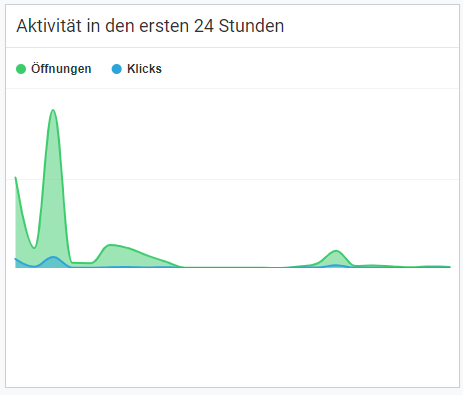
As always, there are exceptions. Some subscribers open the newsletter the next day or even the following week. Apart from these individual cases, however, a large proportion of recipient activity takes place during the first hours after sending. Choose a moment when recipients have enough time to pay attention. Only then can contacts interact after opening and follow a link to your website or online shop, where they will hopefully become buyers or request a service.
3. What do current studies say about the best sending time?
Current study data from German-speaking markets provide useful benchmarks, although no benchmark knows your own target audience.
The most popular sending day is not always the most effective
According to the Inxmail Benchmark 2026, Thursday is the most frequently used B2B sending day: 22.7% of all B2B campaigns go out on Thursdays. The open rate is a solid but not leading 23.1%. Friday and Saturday achieve higher B2B open rates, 23.5% and 25.2% respectively, although only a fraction of senders are active on these days. This may indicate that counter-cyclical times mean less inbox competition.
In B2C, the strongest day comes at the start of the week
B2C campaigns achieve their highest open rate, 26.9%, on Mondays (Inxmail Benchmark 2026). Thursday, by contrast, is the weakest B2C working day despite its high sending volume. A high sending volume on a weekday does not automatically mean a high open rate.
Surprising finding: the early morning performs strongly
The Inxmail Email Marketing Benchmark 2026, based on 4 billion emails from Germany, Austria and Switzerland, shows that campaigns sent between 3 and 6 a.m. achieve the highest open rates of all time windows, 41.2% overall and 42.5% in B2C. One possible explanation is the low sending volume during this period, but the benchmark does not establish a causal connection. Only your own tests can reveal whether it works for your target audience.
The most important finding from every study
Studies show trends, not guarantees. Your subscribers are not averages. Your own statistics are the only way to determine the best weekday and time for your particular newsletter. Chapter 9 explains how.
4. Sector differences: where newsletters perform best
The Inxmail Email Marketing Benchmark 2026 clearly shows how strongly newsletter success varies between sectors. Here is an extract from the sector comparison of open and click rates:
| Sector/target audience | Open rate | Click rate |
|---|---|---|
| Tourism | 51.2% | 15.2% |
| Culture | 42.9% | 17.3% |
| Electronics | 35.1% | 5.4% |
| B2C | 24.7% | 3.4% |
| Overall (Germany, Austria and Switzerland) | 24.1% | 3.3% |
| B2B | 22.8% | 3.2% |
| Fashion | 19.6% | 3.8% |
| Services | 18.8% | 3.3% |
| Leisure | 17.4% | 1.5% |
These figures from the Inxmail Email Marketing Benchmark 2026 are a good starting point for your first test, but do not replace your own analysis. Target audiences and contact behavior differ even within a sector.
5. Cyclical vs counter-cyclical sending: go with or against the flow?
With cyclical sending, you send your newsletter at times when most campaigns are sent anyway, such as weekday mornings. The advantage is that contacts expect the email then. The disadvantage is an overcrowded inbox and intense competition for attention.
With counter-cyclical sending, you deliberately deviate from this. According to the Inxmail Benchmark 2026, around 70% of all campaigns across sectors go out between 6 a.m. and 3 p.m., so a targeted deviation may be worthwhile, such as the 3–6 p.m. window or Saturday, when only 2% of B2B campaigns are sent but the week’s highest open rate is achieved. According to absolit, the proportion of B2B campaigns sent before normal working hours (before 7 a.m.) rose from 19% in 2023 to 24% in 2024 and 26% in 2025. One possible reason could be a desire for less inbox competition, but the study does not establish this motivation.
There is no general answer as to which strategy works better. Test both cyclical and counter-cyclical times and compare the results. Looking at competitors’ sending times in question 5 of chapter 6 can provide further pointers for suitable tests.
6. When is the best time for your newsletter? These 5 questions will help
To identify the best time for your newsletter, first try to understand recipients better. The perfect weekday and time depend heavily on the target audience, so no single time suits your entire list. These five questions will help:
Question 1: B2B or B2C, whom are you addressing?
Whether you address business customers or private consumers is one of the most important indicators for timing. B2B and B2C contacts often differ in when they read email and have time to respond. Characteristics such as age, profession, position, location and purchasing behavior also help tailor sending more precisely to individual segments. Divide contacts into target groups according to availability and send at different times using segmentation.
This applies especially when contacting people in different time zones: an email sent at 10 a.m. Central European Time reaches US subscribers in the middle of the night.
B2B newsletter delivery: the best times at a glance
| Weekday | Suitable for B2B? | Explanation |
|---|---|---|
| Monday | Generally no | On Monday morning, newsletters often compete with many unread emails and the start of the working week. Use your own data to check whether Monday is unsuitable for your target audience. |
| Tuesday to Thursday | Yes, test ✅ | During the working week, the B2B open rate ranges from 22.2% on Tuesday to 23.1% on Thursday. Thursday achieves the highest click rate in this period at 3.5% (Inxmail Benchmark 2026). The windows from 10–11 a.m. and 3–6 p.m. are suitable tests; slightly offset times such as 10:22 a.m. or 3:07 p.m. are also worth trying. |
| Friday | Yes, test ✅ | Friday performs better in B2B than its reputation suggests. An open rate of 23.5% and click rate of 3.4% make it one of the better working days and therefore a suitable test day. |
| Saturday | Recommended test | Saturday achieves the week's highest B2B open rate at 25.2%, with only a 2% share of sends (Inxmail Benchmark 2026). It is therefore a targeted test day, not a universal standard. |
👀 Have you seen this? Email marketing for B2B companies
In this video, our content manager Wiebke shows you the six steps to creating the perfect B2B email marketing plan. Roll the film!
Open video transcript
Chapter 1: Introduction
Do you want to reach decision-makers in companies directly? Then B2B email marketing is exactly the right choice. This channel lets you reach the right contacts without excessive wastage and support them throughout the entire customer lifecycle. Email marketing is also more cost-effective and saves more time than trade fairs or print advertising.
Hello, I’m Wiebke, and today I’d like to show you how to put together the perfect email marketing strategy for your B2B company. This involves carefully defining your goals and target audience, building your mailing list, planning your content, choosing the right design and timing, and, of course, analyzing your results. So, let’s get started!
Chapter 2: What is B2B email marketing?
Email marketing involves sending emails in the form of newsletters, automated emails or transactional emails to contacts who have previously agreed to receive them, in both B2C and B2B contexts. The difference lies in the type of contacts or target audience.
In B2B email marketing, you send commercial emails to business contacts. By contrast, B2C marketing targets private consumers. While emotional and entertaining content performs well in B2C marketing, B2B purchasing decisions are influenced primarily by rational arguments. That does not mean communication has to be stiff and boring, however: people in the B2B sector appreciate a friendly and humorous tone too.
It is important to bear in mind that you will often be dealing with trained professionals who have high expectations and fixed budgets. Impulse purchases are rare, and decision-making processes often take a long time. This is exactly where email marketing can help you build long-term personal relationships. Regular information about features, pricing models and offers helps convince prospective customers.
Chapter 3: Step 1: Define your B2B email marketing goals
Before you get properly started, consider which overarching goals you want to achieve. This will make it easier to choose the right measures later on.
B2B email marketing can help you establish and strengthen personal relationships, win new business customers and retain them over the long term, generate interest in your products and services, generate leads, increase your revenue, and keep customers informed and up to date.
Set specific goals so that you can identify the measures required. For example, if a cleaning company wants to win ten new customers each month, its newsletters should present the service attractively and explain why it is particularly relevant. If the company wants to increase revenue from existing customers, its emails should promote additional offers and consultations.
Chapter 4: Step 2: Define the target audience
Defining your target audience is particularly important in the B2B sector, as the audience is usually smaller than in B2C. Convincing trained professionals with narrow requirements and fixed budgets can be challenging, but a thorough analysis makes it achievable.
Ask yourself the following questions:
Who is our product or service aimed at? Which sectors is our offering relevant to? How large are the companies that could benefit from our offering? Who makes decisions at these companies? What characteristics define these decision-makers? What challenges do they face in their daily work?
Speaking to your sales team or customer service team can be helpful here. Personas are fictional representatives of the target audience with typical characteristics. They help you understand prospective customers’ needs and decision-making processes more clearly.
Chapter 5: Step 3: Generate leads and maintain your recipient list
Because the target audience is smaller in B2B marketing, collecting high-quality contacts is especially important. These contacts should be involved in decision-making processes or participate in the flow of information within the company.
The foundation is an inviting sign-up form on your website. You can offer incentives to make signing up more attractive, such as discounts, free webinars or e-books. However, do not buy contact lists or add existing customers to your mailing list without their consent.
The double opt-in process ensures that only people who actively sign up receive your emails. Interested people must verify their registration by clicking a confirmation link in an email before they are added to the mailing list.
Chapter 6: Step 4: Plan relevant content for B2B emails
Engaging content that offers added value can convince prospective business customers over the long term. Consider which content your contacts enjoy consuming so that you can spark their curiosity and build trust.
Possible topics for B2B newsletters include product presentations (introducing new products or services), industry news (sharing current developments and relevant information), use cases (showing practical examples of how products are used), testimonials (using customer opinions and case studies), special offers (offering personalized discounts and promotions), and studies and reports (including relevant statistics and expert opinions).
Create a sending schedule so that you can send content in a structured and regular way.
Chapter 7: Step 5: Find the right timing for B2B email marketing
Base your send times on your contacts’ working day. Emails are generally read between 8 am and 5 pm, so test which time works best. Sending frequency is also crucial. Only send emails when you have relevant content. Sending monthly or for a particular occasion is often a good choice.
Good planning helps you avoid overwhelming recipients with emails that arrive too frequently. Use automation tools to manage your sends efficiently.
Chapter 8: Step 6: Evaluate and optimize your results
To optimize your B2B email marketing, you should keep an eye on key metrics:
The delivery rate, meaning how many emails actually arrive.
The open rate, meaning how many recipients open the email.
The click-through rate, meaning how many recipients click links or calls to action.
And the unsubscribe rate, meaning how many recipients unsubscribe from the newsletter.
You can use these KPIs to continually adapt and improve your strategy.
Chapter 9: Conclusion: Achieve your B2B goals in no time with email marketing
As you can see, it takes just six simple steps to make a successful start with B2B email marketing. Now it is up to you to plan and test your first campaign. With rapidmail, you can try your first send to up to 2,000 contacts free of charge.
Good luck with your B2B email marketing! I look forward to your questions and comments. See you next time!
B2C newsletters: when evenings and weekends matter
According to the Inxmail Benchmark 2026, B2C campaigns achieve their highest open rates on Mondays at 26.9%. Sunday sends perform weakest at 21.8%, so the widespread advice to send B2C newsletters on weekends requires a nuanced view. Nevertheless, weekend sending continues to grow: according to absolit, the proportion of B2C campaigns sent on weekends rose from 17% in 2023 to 21% in 2024 and 24% in 2025. Most strikingly, the 3–6 a.m. window achieves a 42.5% B2C open rate, although with very low sending volume. This unusual window can be tested regardless of recipients’ affinity with devices.
During the summer, sending after work on a weekday can be a sensible test if the weather draws people outdoors and weekends are used for excursions.
Question 2: what interests and habits do your contacts have?
Depending on your sector, you may already have assigned tags in rapidmail describing recipients’ interests or purchasing behavior. Use them to send the newsletter to different profiles at different times.
Do certain recipients regularly shop in your online store at night? Test how these night owls respond to a late newsletter.
If you run a bookshop, group subscribers by favorite genre. Does barbecue season begin next week with the first temperatures of 20°C? Send a newsletter to all cookery book buyers by Monday at the latest, leaving enough time to order the right book, choose a recipe and buy the ingredients.
Or, as the chair of an association, do you know that members meet socially each month? An association newsletter the day before will provide fresh topics of conversation.
👀 Test idea:

Depending on your offer, even the weather could affect user behavior. Test whether campaigns perform differently on rainy and sunny days. 🌦️
Question 3: when does your website usually record the most activity?
To find the best time to send your newsletter, also look at user activity on your website or online shop.
You can use a tracking tool such as Google Analytics. In the latest version, Google Analytics 4, select “Reports” in the left sidebar, followed by “Life cycle”, “Engagement” and the detailed “Engagement overview” report.
Clicking the statistics icon opens a sidebar on the right with a detailed overview of website visitor activity.
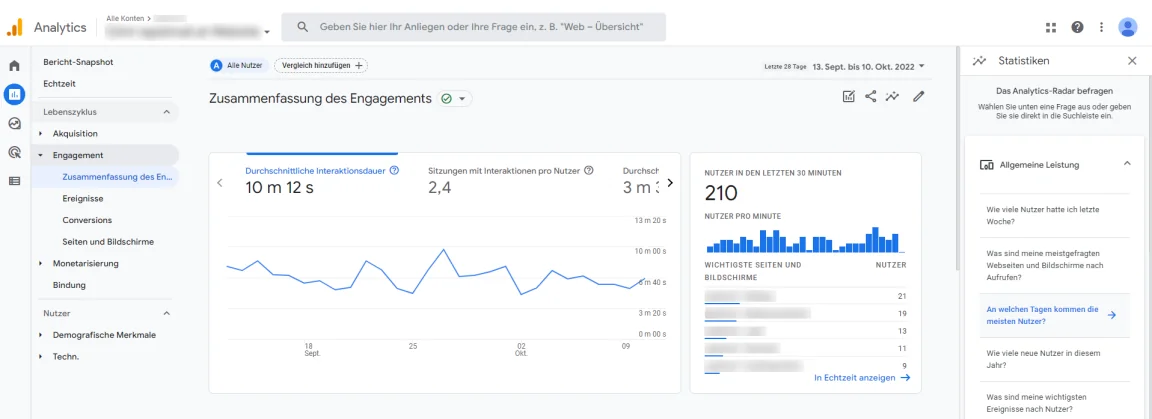
The results for a selected longer period indicate which weekday your target audience is easiest to reach. This can also guide newsletter delivery. If, for example, your website records especially high relevant activity on Wednesdays over several months, Wednesday may be a sensible candidate for a sending test. A comparison of email metrics will then show whether website usage transfers to your newsletter.
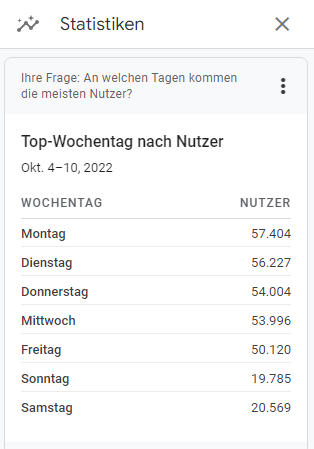
Here too, it is important to identify different peaks in website activity yourself and test them as newsletter sending times. Contacting one part of the recipient list in the morning and another in the afternoon on the same day, for example, can reveal at which time subscribers are more active and open your newsletter.
Question 4: what is your newsletter’s objective?
The newsletter’s objective directly affects its optimal sending time:
-
Advertising an expensive product? Sending at the start of the month may be worthwhile if your target audience typically has more budget then, and this is easy to test.
-
Inviting people to an event? Send neither too early, when it will be forgotten, nor too late, when calendars are already full. One to two weeks’ notice often works well, depending on the effort required to participate.
-
Communicating a promotional discount? Vouchers and similar offers must be timed to suit the campaign and give subscribers enough time to respond.
💡 Have you discovered your individual AI sending plan?
Based on a short company profile containing its name, keywords and brief description, the rapidmail AI planner creates an individual newsletter plan with creative sending occasions for the whole year.
Question 5: when do your competitors send their newsletters?
You have surely subscribed to competitors’ newsletters to stay up to date. Pay close attention to when they send their campaigns.
Do your two most important competitors always send on the same weekday? Then it is worth breaking ranks. Sending at a different time may reduce direct competition for inbox attention. Sending earlier can also make sense when being up to date is crucial to the message.
The rapidmail newsletter
Tips, ideas and news about email marketing, straight to your inbox.
7. How does mobile use affect the sending time?
When somebody opens a newsletter now depends strongly on the device they use. Preferred opening times may plausibly differ by situation and device, but the benchmarks used here do not provide device-specific times.
Depending on the target audience, smartphone use can also play an important role outside traditional office hours. For test planning, this means:
- For B2B contacts who commute, you can test early times around the start of the working day. This is a target-audience-specific test idea and is not equivalent to the absolit trend for B2B sends before 7 a.m.
- For B2C subscribers who work during the day, evening times and selected weekend windows can form part of your tests. Do not automatically prefer Sunday: in the Inxmail Benchmark 2026, it has the lowest B2C open rate at 21.8%.
An important measurement note: Apple Mail Privacy Protection (MPP), active since September 2021, noticeably inflates open rates for Apple Mail users. Since its introduction, the Inxmail Benchmark has shown clear shifts in open-rate trends, especially in B2C. This means that the click rate is more meaningful than the open rate alone when comparing sending times. Learn more in the rapidmail guide to analyzing and optimizing newsletters.
💡 rapidtip:
Check rapidmail statistics to see which devices subscribers use to open newsletters. If the mobile proportion is especially high, test times outside traditional office hours.
8. How often should you send a newsletter?
When you send is always related to how often you send. Timing and frequency are two sides of the same coin.
According to the Inxmail Email Marketing Benchmark 2026, the median sending frequency in Germany, Austria and Switzerland in 2025 was four campaigns per month overall, three for B2B and seven for B2C.
But there is no blanket answer here either. An excessively high frequency can encourage unsubscribes; with a very low frequency, by contrast, your brand is less present. The right frequency depends on your content, target audience and resources.
As a rough guide:
- Once a month: an introductory frequency for new senders, with a low unsubscribe risk
- Twice a month: a solid rhythm for most SMEs and associations
- Once a week: worthwhile only if you regularly have highly relevant content
- More often: special cases, such as media, sectors with daily news or specific automations
Everything you need to know is in our article: Ideal newsletter frequency: how often should you send?
9. Testing newsletter timing: how to find your personal best
Studies and rules of thumb provide a good starting point for when to send your campaign. Ultimately, only your own statistics know the best sending time for your newsletter.
Step 1: set up an A/B test
The most direct approach is an A/B test using the sending time as the test variable: the same newsletter and content, but two different times. Randomly divide your recipient list into two comparable test groups. Group A receives the same newsletter at 10 a.m., group B at 2 p.m. The open rate, and better still the click rate, then shows which window worked better.
➡️ Run A/B tests with rapidmail
Important: For meaningful results, the test groups should come from the same list and have a comparable composition. Otherwise, you are comparing apples and oranges.
Step 2: analyze the statistics
After sending, the rapidmail newsletter statistics show the exact activity pattern: when was it opened, when did people click and which devices did they use? This data helps you plan the next send even more precisely.
Remember Apple Mail Privacy Protection (MPP). Apple MPP can load remote content in the background. Opens may therefore be recorded without evidence that the person actually opened the email, making the open rate a less precise comparison. Rely more heavily on the click rate. Learn more in the rapidmail guide to analyzing and optimizing newsletters.
Step 3: test over several months
One test may be distorted by outliers: a public holiday, an unusually beautiful summer day or breaking news that attracts all the attention. Reliable findings emerge only when you compare sending times over several months. And even then: test, test and test again!
💡 rapidtip:
The rapidmail scheduling feature lets you set the date and time in advance. The newsletter goes out automatically even if you are speaking to a customer.
10. Can you schedule a newsletter for later?
You have now narrowed down the perfect sending time. But do you really need to sit at the computer punctually every time? Of course not!
That is exactly what rapidmail’s practical scheduling feature is for. Once your newsletter is finished, simply set the day and time at which it should be sent. This then happens automatically, with no need to log in.
rapidmail’s practical scheduling feature lets you plan when newsletters are sent in just a few clicks.
Conclusion: there is no off-the-shelf best sending time
It is worth answering the five questions in this article before sending your newsletter. Each answer brings you one step closer to the right time.
The data shows that Friday and Saturday achieve the highest B2B open rates, while Thursday and Friday have the strongest click rates, although most senders choose Tuesday to Thursday. In B2C, Monday is strongest and Sunday weakest. For those prepared to rise early, the window between 3 and 6 a.m. has the highest cross-sector open rates despite very low sending volume (Inxmail Email Marketing Benchmark 2026, based on 4 billion emails from Germany, Austria and Switzerland).
Before experimenting with timing, first check your deliverability in chapter 1. Otherwise, even the optimal timing will be wasted.
The secret remains the same: test, test, test. Anybody who regularly tries different times and then analyzes newsletter statistics will gradually approach their own best result.
FAQ: newsletter sending times, frequently asked questions
What is the best time to send newsletters?
There is no single optimal sending time. It depends on your target audience, sector and newsletter objective.
When is the best time to send a B2B newsletter?
During the working week, Thursday and Friday lead the way: B2B click rates are highest on these days at 3.5% and 3.4% respectively (Inxmail Benchmark 2026). If you want less contest in the inbox, test sending on Saturday: only 2% of B2B campaigns go out on Saturdays, with an open rate of 25.2%. In B2B, largely avoid Monday and Friday afternoons.
When is the best time to send a B2C newsletter?
In B2C, Monday achieves the highest open rate at 26.9% (Inxmail Benchmark 2026), while Sunday is the weakest day. One striking benchmark figure is that the 3–6 a.m. window achieves a B2C open rate of 42.5%. One possible explanation is the very low sending volume in this window, but the benchmark does not demonstrate a causal connection. You should therefore test whether it works for your target audience. In summer, sending after work during the week may make more sense.
What does newsletter timing mean?
Newsletter timing means deliberately planning the sending day and time with the aim of reaching recipients when they are active and able to pay attention. Good timing can improve open and click rates without changing the content or design.
How do I find the best sending time for my newsletter?
First check your deliverability. Then analyze your target audience (B2B or B2C?), examine your website activity data in Google Analytics and see when competitors send. Next, begin with an A/B test: the same newsletter, two different sending times and the same recipient list. Click rates and conversions are more meaningful than the open rate here (because of Apple MPP).
Can I schedule my rapidmail newsletter in advance?
Yes. rapidmail’s scheduling feature lets you set the sending date and time once the newsletter is finished. It will be sent automatically at the scheduled time.