Email marketing for non-profit organizations: How newsletters support a good cause
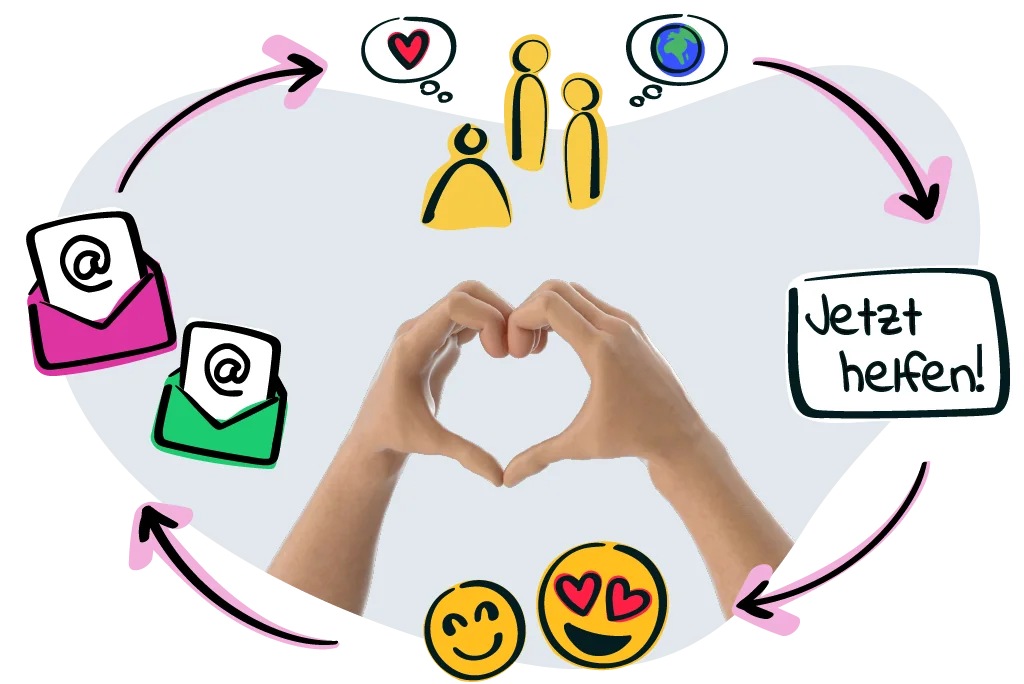
Sending newsletters gives non-profit organizations (NPOs for short) an excellent opportunity to expand their reach. These organizations and their members work tirelessly toward their shared mission: making the world a little better, one step at a time. By supporting valuable projects in areas such as animal welfare, environmental protection and the arts, they make an important contribution to society. They often depend on investors and donations for funding. We show you how to use email marketing and non-profit newsletters to attract the public attention you need without incurring high costs.
1. Email marketing for non-profit organizations: Is it worthwhile?
It is certainly worthwhile. Non-profit organizations also have a great deal of communication work to do, for example sharing information about current activities and achievements, publishing fundraising appeals and sending thank-you messages, to attract the necessary public attention and maintain good relationships with donors. Newsletters and targeted marketing emails are particularly well suited to this. So let’s start by answering the question “Why?”:
- 💰 Cost-effectiveness: One of the many benefits of email marketing is that it allows you to reach many people at a low cost. As non-profit organizations often have to work with limited budgets, this means they do not need to spend much money on expensive online or offline advertising.
- ⌛ Time efficiency and resource conservation: In addition to reducing costs, non-profit newsletters can reduce the amount of time you spend on marketing activities. Staff resources are generally limited in NPOs too. Save time and money by doing away with printed information brochures that need to be packed and addressed by hand, and opt instead to send a newsletter. The environment will also thank you for switching from paper post to a digital alternative.
- 🤝 Stronger relationships: You can use your newsletter to tell compelling stories from your organization’s day-to-day work and connect with your readers on an emotional level. Regular updates in their inbox automatically make your contacts part of your journey. This makes them even more willing to support your cause because they are actively involved in your activities and successes, to which they contribute through donations or voluntary work.
- 🙋 Win new contacts: You can also encourage website visitors who are learning about your organization online to subscribe to your newsletter. Using newsletter sign-up forms gives you a way to establish regular contact with interested people. Informative campaigns about your projects can persuade readers to become members or provide financial support.
- 👀 Prompt a response: Encourage readers to take the desired action in your newsletter. For NGOs, this often means a willingness to donate. For you as an organization, it means conveying emotional messages in your emails and inspiring action. The advantage is that, unlike telephone conversations or information stands at events, a newsletter does not come across as too intrusive. Supporters can decide for themselves whether and how much support or attention they can offer you at that time. By making targeted use of call-to-action buttons and images that tell stories, you appeal to people’s instinct to help.
In short: Email marketing is worthwhile for non-profit organizations. Think of your newsletter as a mouthpiece through which you can inform your target audience efficiently, purposefully and thoughtfully, and ultimately turn them into members or donors.
👀 Did you know? NPO newsletters vs NGO newsletters: What’s the difference?
Email marketing and newsletters are important tools for communication and fundraising for both non-profit organizations (NPOs) and non-governmental organizations (NGOs). Nevertheless, there are some key differences:
| NPO newsletters | NGO newsletters | |
|---|---|---|
| Target audience and content | Non-profit organizations often have a broader target audience made up of many members, including local supporters, volunteers and donors. Their newsletters and email marketing content are usually locally focused and highlight community events, local projects and direct achievements to foster a strong connection with the immediate area. | Non-governmental organizations, by contrast, often operate nationally or internationally and address a global audience. Their email communications frequently include reports on international projects, global partnerships and wide-ranging campaigns. The content is designed to inform and mobilize supporters across regions and countries. |
| Fundraising appeals and strategies | Fundraising appeals from non-profit organizations are often more personal and focus on supporting specific local projects or programs. Email campaigns include concrete examples of how donations are used locally and emphasize the direct impact on the community. | Non-governmental organizations use email marketing to support larger global initiatives. Their fundraising appeals often emphasize the need for extensive financial support to address global challenges. The emails frequently include reports on worldwide activities and success stories to convey the urgency and broad impact of their work. |
2. The cost of newsletter marketing for charitable causes
As we mentioned briefly above, sending newsletters for non-profit organizations not only saves time and resources, but also ensures that you do not have to spend a fortune. The budget you need to allocate to your campaigns depends on the system you use to send them.
👀 Did you know?
rapidmail is the only email marketing tool to offer a no-obligation plan with no advance payment, where you only pay when you actually send newsletters. You are not tied to a monthly contract term or notice period.
For organized, predictable sending, we recommend using a professional email marketing tool. Several criteria play a decisive role when choosing your newsletter tool, as providers can differ significantly. Ask yourself what matters to you in your email marketing: Are data protection and GDPR-compliant email marketing your top priorities? Is the available budget the deciding factor when choosing software? Should it be simple and intuitive to use? Do you want creative design options that you can tailor perfectly to your organization? Would you like to be able to call a support team that can help with your questions?
With rapidmail, you get all of this alongside many other benefits. And the best part is that we want to support associations and charitable organizations with a special discount on our monthly plans, saving you up to 50% of the standard plan price.
💰 rapidmail discounts for non-profit email marketing
We would like to support your non-profit organization’s mission by offering you a discount on your newsletter sending. Choose between the following two options to make your email marketing even more cost-effective:
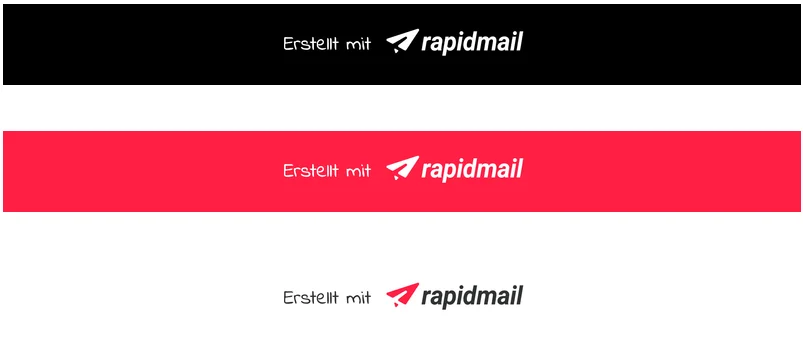
- Receive a 50% discount in return for promoting our software a little. Simply include one of the rapidmail banners in your newsletters.
- Receive a 20% discount if you would prefer to send newsletters without advertising.
3. Building a mailing list for your non-profit newsletter
Without interested people who want to read your email, the effort you put into your NGO newsletter is wasted. So how do you build a recipient list? And how can you ensure it grows steadily and attracts more interested contacts?
To draw attention to your newsletter in the first place, you can use other communication channels that are already part of your online marketing. For example, you can add sign-up forms to your website to encourage visitors to subscribe to your newsletter. Or you can use your social media channels to promote it.
In addition to promoting your newsletter online, you can also gain subscribers offline. For example, use QR codes in brochures and on eye-catching posters, or provide printed sign-up forms at an information stand or similar venue. Our detailed guide offers more useful tips on building your newsletter mailing list.
Buy recipient lists? No, thank you!
Be careful! We strongly advise against buying email addresses. It may initially seem tempting to build a large recipient list quickly in this way, but the disadvantages clearly outweigh the benefits:
Firstly, you risk legal consequences, such as warning letters or fines. The quality of the contacts is also crucial: there is no benefit in sending your newsletter to dozens of contacts who have no interest in the content. Instead, your open rate will decline, and your newsletter may increasingly end up in the spam folder.
Quality over quantity
It is better to focus on the quality of your recipients rather than the quantity. Your contacts must sign up for your newsletter voluntarily. This way, you know that your subscribers are genuinely interested in it. Voluntary registration offers greater potential for a long-term relationship and makes readers more willing to support your mission. According to the data protection requirements for sending newsletters, voluntary, independent registration is also a fundamental requirement for email marketing.
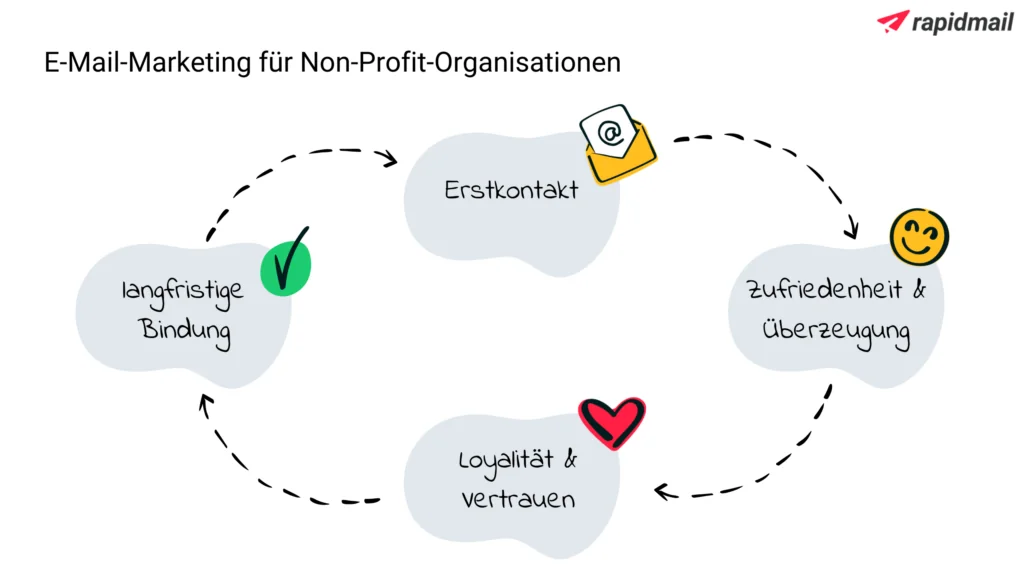
Build trust with welcome emails
Once you have gained new subscribers, the next step is to build trust with them. This is where you can shine with compelling welcome emails, because first impressions are crucial in non-profit email marketing too. We recommend personalizing your welcome message to make an immediate positive impression. This makes new subscribers feel welcome straight away and helps them become part of your mission.
More relevant content through segmentation
Segment your contacts to make your newsletter even more interesting for different target groups. Your contacts’ age or location, for example, may be important criteria. This allows you to adapt the tone of your newsletter or highlight specific events in particular locations.
You can also assign tags to your subscribers that reflect their interests, such as different projects. You can ask about these as an optional part of newsletter registration, assign them yourself based on a person’s reading behavior or determine them later through a survey.
💡 rapidtip: Manage newsletter contacts with rapidmail
rapidmail makes it easy to manage your recipient lists. New contacts are automatically added to your recipient list through the newsletter sign-up form. You can also upload your existing contact lists to rapidmail as a file. In your profile, you can then segment them as you wish, assign tags, delete contacts in a GDPR-compliant manner and much more.
4. Add value: Address your target audience effectively
You need a well-considered communication strategy for a successful non-profit newsletter. Shape this around your target audience: Who exactly do you want to address and reach?
Non-profit organizations often aim to reach potential supporters through marketing activities. As there are different personas within this group, it is important to tailor your email marketing to them. The following table summarizes the various personas that may be relevant within a non-profit organization’s target audience.
👀 Did you know?
In marketing, a persona is a detailed, fictional profile of a person who belongs to the target audience. Defining personas helps you understand your supporters better and address them more effectively.
| Persona | Intention and type of action | Aim and content of the newsletter |
|---|---|---|
| “Doer” type | – wants to get involved– believes in your mission | – kept up to date through regular progress reports– responds to specific calls to action in the newsletter |
| “Benefactor” type | – seeks recognition for good deeds– enjoys giving | – interactive newsletter that they can share or respond to, for example– thanks for their support |
| Passive supporter type | – tends to provide support out of guilt→ sporadic support | – creates a sense of community– communicates achievements and new projects, for example |
| Connection-seeking supporter type | – needs a sense of belonging→ wants to become part of your mission | – creates a sense of community– thanks for their support– invitations to events for members and supporters |
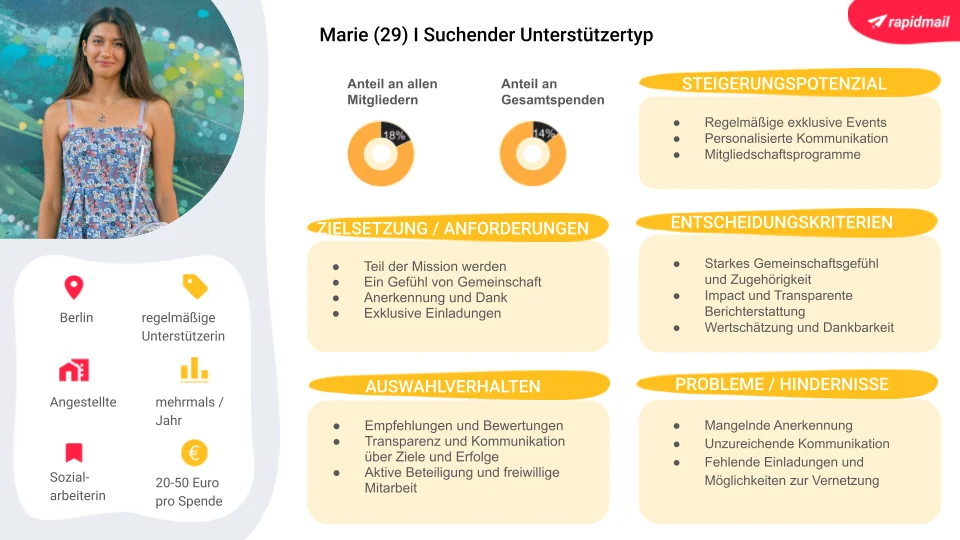
To keep your target audience engaged with your newsletter, your emails should offer value to readers. This could take the form of…
- … conveying recognition and a sense of community 🎗️
- … offering the opportunity to participate actively in your mission 💪
- … education and information 📖
- … reminders about and invitations to events 🗓️
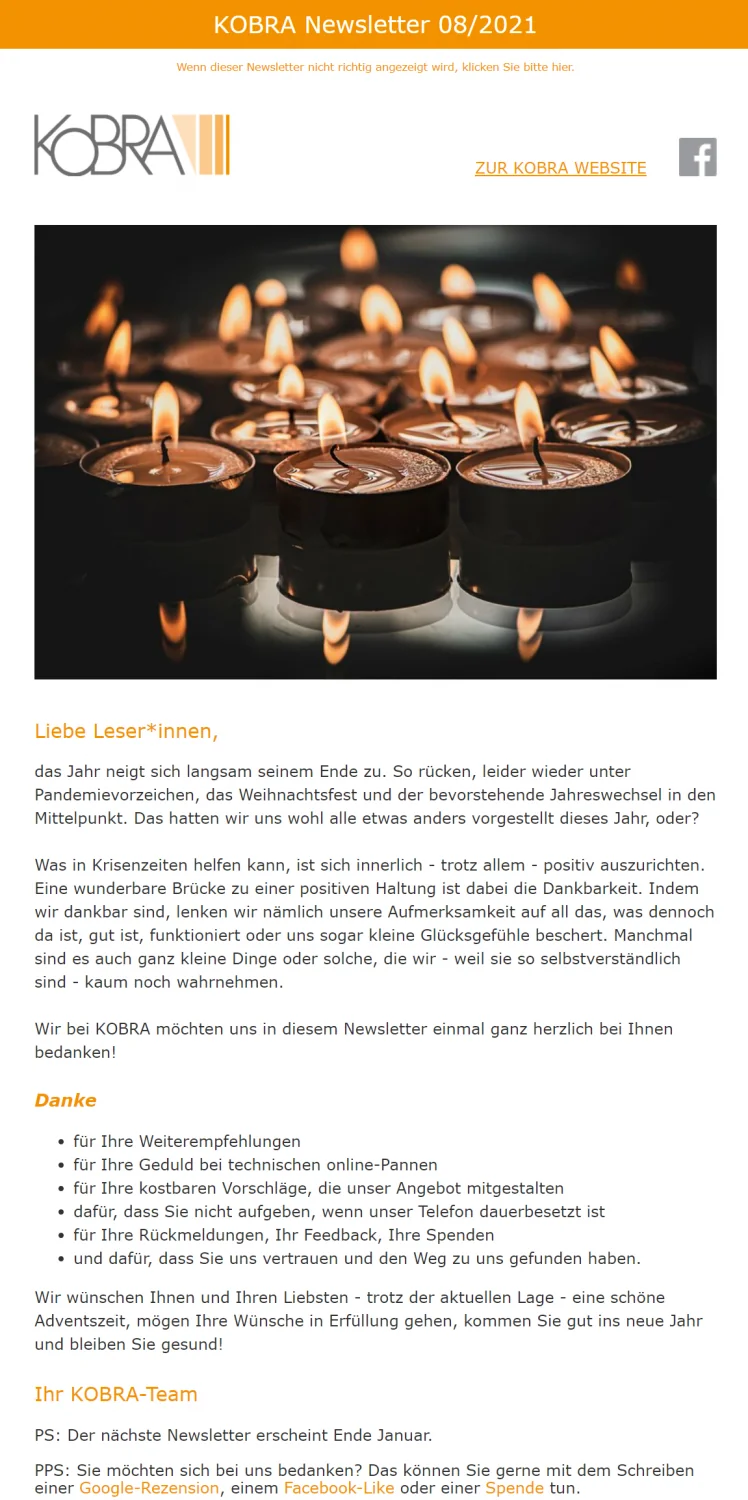
It is also important to show your readers that you value them. Supporters who feel they are taken seriously will remain committed over the long term. Always show gratitude and respect toward your community.
5. Newsletter content for NPOs and NGOs
The content you can use in your newsletters as a non-profit organization is extremely varied. Naturally, your mission is the primary consideration: What exactly is your objective?
The first step is to define your goals. Common email marketing goals for non-profit organizations include gaining and retaining new supporters, sharing information, building an appropriate image, communicating values and prompting action.
You can build your newsletter around these goals. For example, it can perform the following tasks:
- 🫂 Build trust: Tell your readers about your organization’s work and what you have already achieved. Share the story of how you started and how you got to where you are today.
- 💡 Answer questions: You can use your newsletter to address questions you are frequently asked by email, phone or on social media. This allows you to clear up any uncertainty proactively.
- 👀 Spark curiosity: Direct readers to website content or your social media accounts to increase traffic there. Use striking social media icons and buttons in your newsletter to encourage readers to click.
- 📢 Promote dates and events: Advertise online or live events to encourage subscribers to take part. These could include calls to join demonstrations, discussions or interviews with experts.
- 🗣️ Ask for help: Turn your contacts into activists by adding calls to action to your newsletter. This allows you not only to generate donations, but also to recruit volunteers for your mission or circulate petitions.
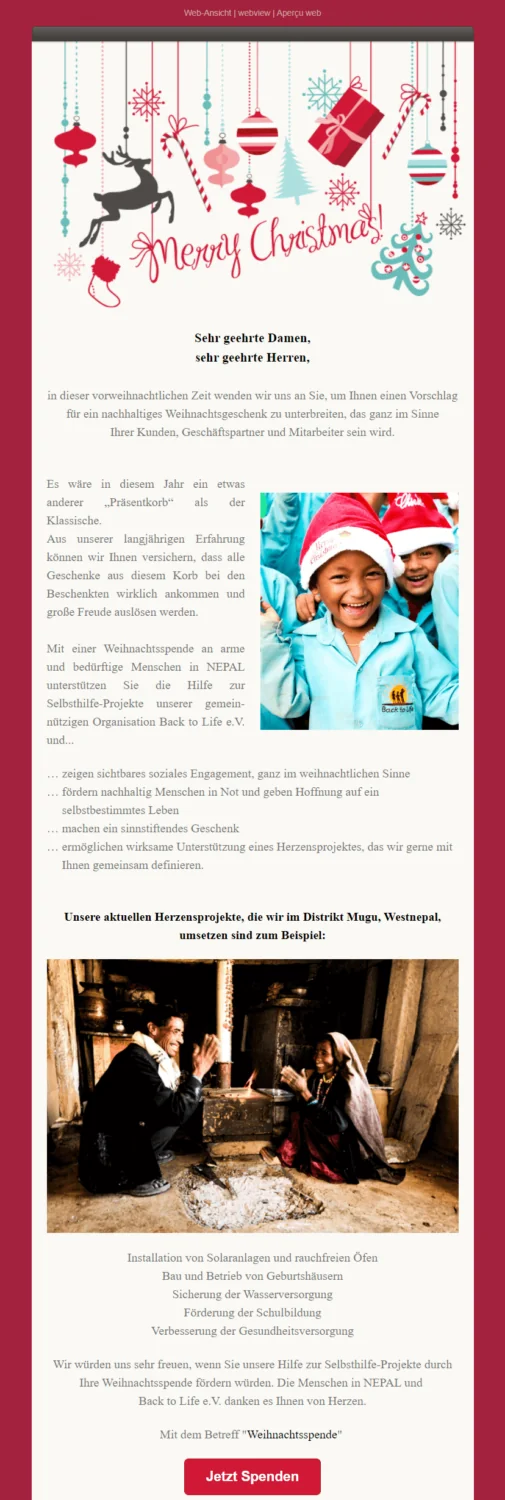
- 💐 Say thank you: Simply say thank you when you have successfully completed a project with the help of your supporters. You would not be where you are today without their helping hands!
- 📰 Inform members: Newsletters sent within your organization are important for keeping all members up to date. For example, report on planned or completed projects, send out meeting minutes or communicate changes in office.
- 🔔 Remind people about your organization: Show former donors who are still subscribed to your newsletter your current projects and encourage them to become active again.
- 👋 Welcome newcomers: New subscribers in particular should be welcomed with an engaging newsletter sequence.
- First, welcome them with a welcome email that briefly explains what readers can expect from your newsletter.
- In the next step, introduce your organization, for example, and tell them about successful past projects. Show them what you have achieved so far.
- Demonstrate transparency by explaining where collected donations go and who they help, for example. This enables you to build trust quickly.
- The new subscribers are now fully informed, and you can move on to current projects. What are you working on at the moment? And how can readers help?
The rapidmail newsletter
Tips, ideas and news about email marketing, straight to your inbox.
6. Design tips for non-profit organization newsletters
The basic framework for your non-profit newsletter is now in place. In the final step, we look at the specific design of your campaigns: What must they include? And what should you pay particular attention to?
Subject line and preheader
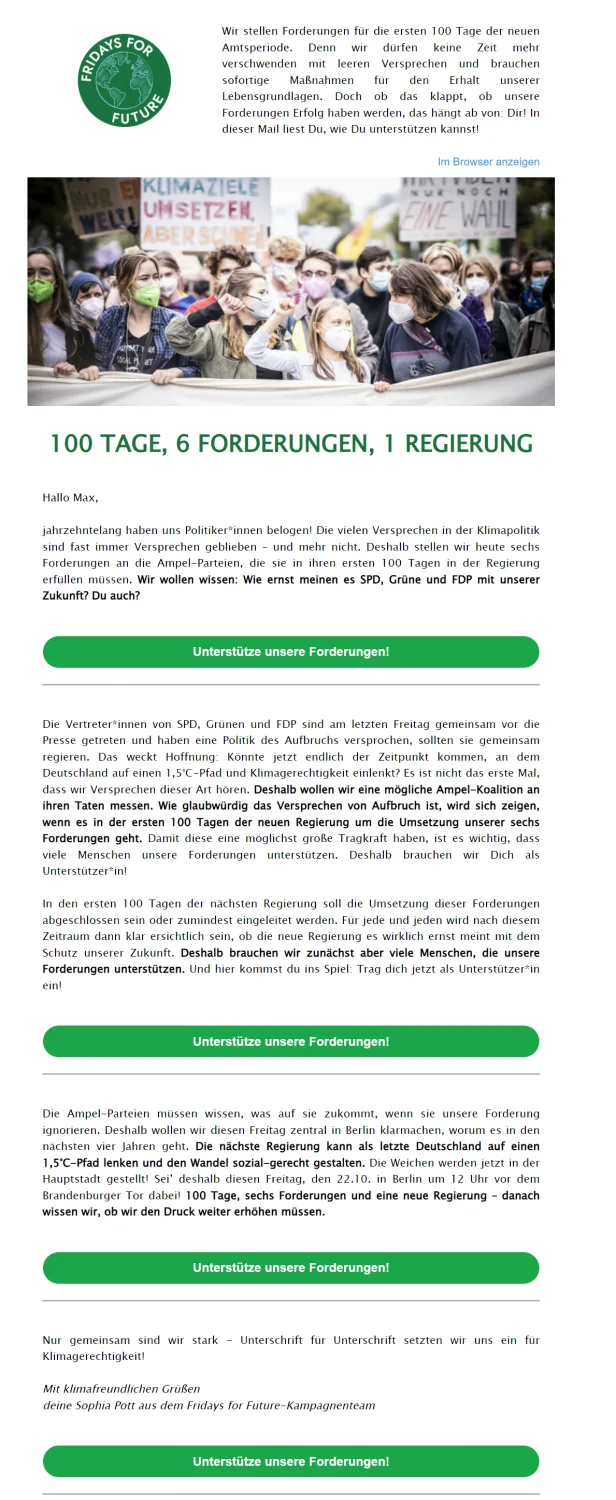
Your subject line is the first part of your newsletter that subscribers see, so it should be meaningful and, above all, not too long. Spark your readers’ curiosity and attract their attention by using an emoji. Subject lines and preheaders with a personal form of address or active calls to action such as “Help now” also increase the likelihood of the email being opened.
Personal storytelling
Tell personal, compelling stories that reflect your missions. Your newsletter copy should move readers and show them that they are part of an important cause. After all, they subscribed to your newsletter because they believe in you and your work, and you should make use of that.
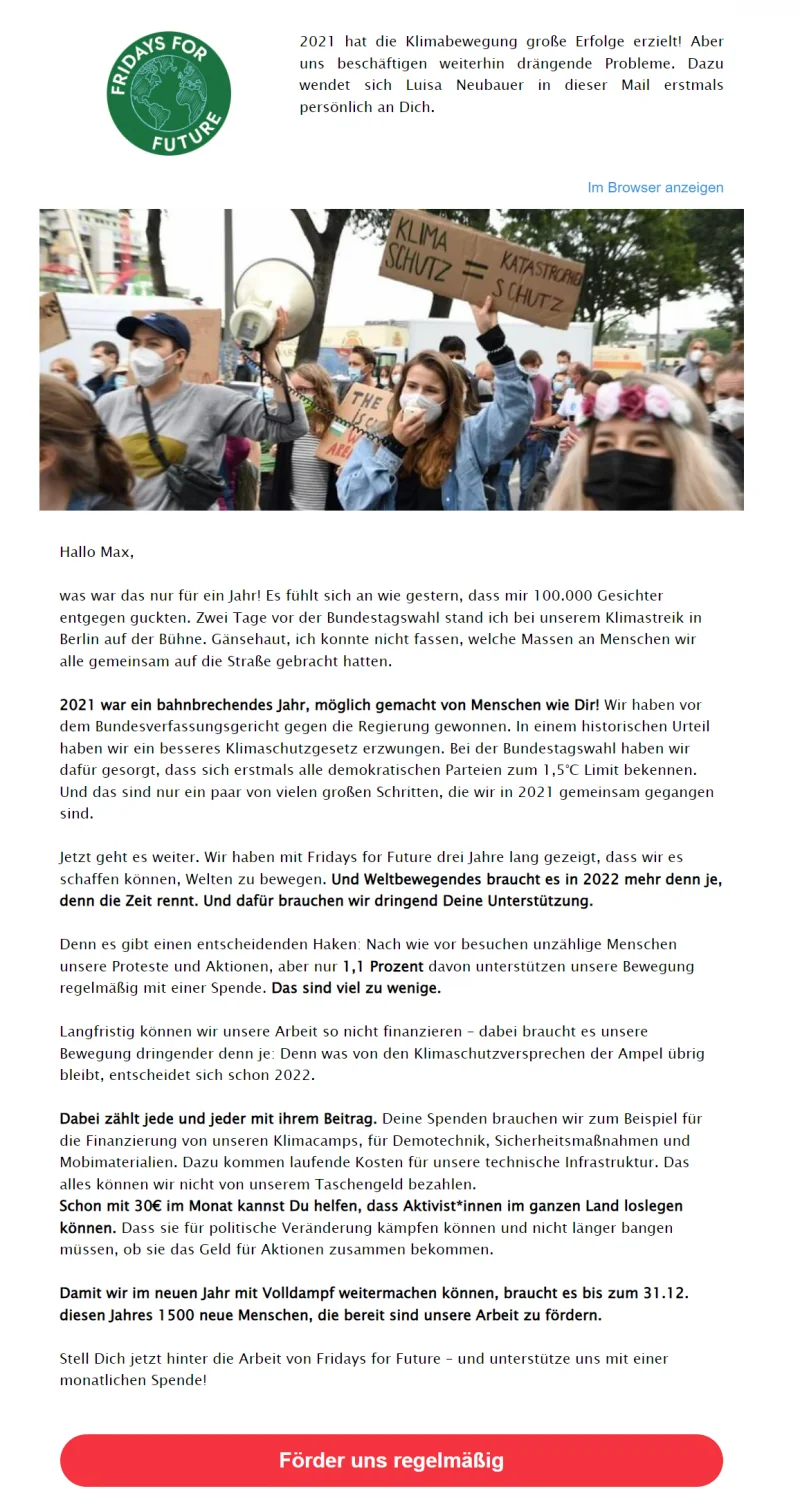
Strong headings
Use meaningful headings that speak for themselves and spark curiosity. Readers should understand immediately what your newsletter is about. Clearly worded headings allow them to jump straight to the content that is most relevant to them.
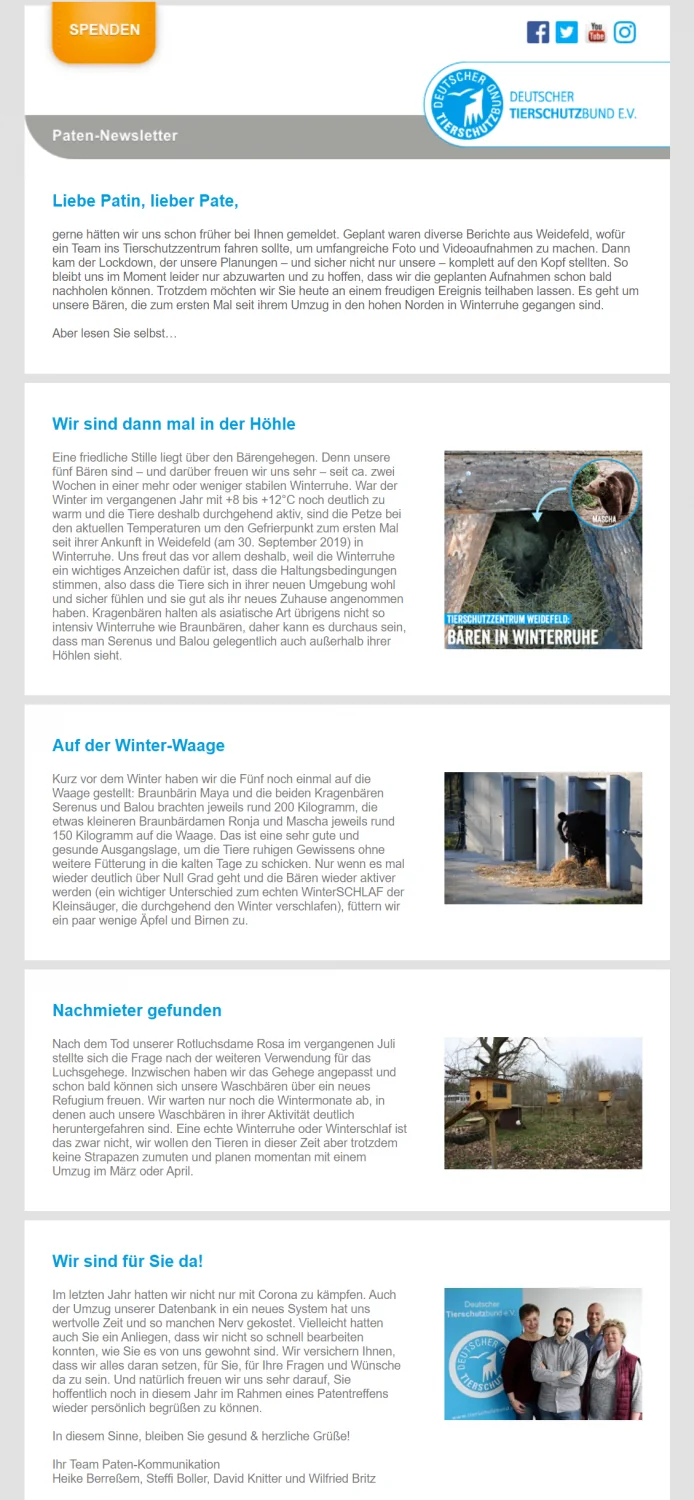
Powerful images
“A picture is worth a thousand words” may be a cliché, but that does not make it untrue. Images make your mission, which may initially seem abstract, tangible and understandable. Images in newsletters are also the first thing to catch readers’ attention before their eyes move to the text. Use emotional images that reinforce your words. You should also link your images so readers can click them to access further information on your website, for example.
💡 rapidtip
Our email editor includes more than 1.5 million high-quality, royalty-free images for you to browse until you find the perfect one for your newsletter. You can also use the integrated image editor to give each newsletter image a personal touch.
Meaningful calls to action
Particularly if your aim is to recruit volunteers or collect donations, your calls to action should be clearly worded and well positioned. For example, make them stand out with striking colors and creative labels. With newsletter tools such as rapidmail, you can check the statistics after sending to see how many people clicked your call to action. This allows you to continue optimizing it, for example in terms of its placement and design.
Personalized copy
Addressing your readers personally always works well. As emotional topics are often the focus, recipients feel even more directly addressed when they are greeted by name rather than with an impersonal “Hello member”. An email signature that clearly comes from a real person also gives your newsletter a personal touch. Use one of our 40 web fonts to make your signature even more authentic.
7. Conclusion: Why you should get started with non-profit email marketing now
Sending newsletters is an efficient, cost-effective and purposeful marketing activity for non-profit organizations. It gives you numerous opportunities both to keep your readers up to date and to inspire them to support good causes.
Your email marketing can draw readers’ attention to your mission and give them food for thought. Effective storytelling sparks emotions in your target audience that can lead to a desire to help and, ultimately, active support. You can then enjoy your committed community, while its members enjoy joining you in making the world a better place!