Boost sales with online marketing: basics, tips and examples for beginners
Would you like to get started with online marketing, but are not quite sure where to begin? Don’t worry: we know the sheer number of options and the complexity of the channels can seem overwhelming at first. But it is worth taking the plunge. Online marketing gives you a fantastic opportunity to raise awareness of your business and boost sales. In this guide, we take you through the basics of online marketing step by step, with practical tips and inspiring examples.
1. Online marketing basics at a glance: definition, objectives, advantages and disadvantages
Definition: what exactly is online marketing?
Online marketing includes advertising activities that use technology and the internet to promote products or services. It reaches people through devices such as computers, smartphones and tablets, which is why it is also frequently called internet marketing. 💻
Accordingly, online marketing encompasses a wide range of activities and channels, including email marketing, social media marketing and search engine optimization. But let’s stick to the basics for now: why is online marketing so important today? Digitalization has made the internet indispensable. According to one estimate, there were more than 5.4 billion internet users worldwide in 2023 (We Are Social & Hootsuite, 2023).
Look at it this way: your customers are online every day, so if you want them to find you, that is exactly where you should place your advertising messages. 🎯 A well-considered online marketing strategy therefore benefits almost every industry. Different online marketing strategies and tools can deliver lasting results:
Objectives you can achieve with online marketing
- 👤 Generate leads: Online marketing makes it much easier to win new potential customers than offline marketing. Once content marketing and search engine optimization have brought interested people to your website, for example, you can obtain their contact details in exchange for an appealing “incentive”, such as a white paper or discount code, and maintain the relationship by sending newsletters.
- 🛒 Generate sales: It is obvious that online marketing can support sales in your online shop, as users can reach it with a single click. Targeted advertising can also increase sales and order inquiries or encourage offline purchases in your local shop.
- ✨ Increase brand awareness: You decide what information to share and how to present it, allowing you to influence how your target audience perceives your business. The more relevant online channels you use, the better known your brand becomes.
- 🔗 Strengthen customer loyalty: Give existing customers excellent offers, behind-the-scenes insights and valuable content, and stay in regular contact through different online marketing channels. They will reward you with greater loyalty.
- 💸 Increase revenue: All in all, online marketing campaigns tailored precisely to your target audience’s interests and needs help increase your company’s revenue.
👀 And what exactly is inbound marketing?
Inbound marketing is when a company publishes interesting, useful content about a particular topic to attract prospective customers, for example through newsletters, ebooks, blog posts, infographics or social media posts. That is why this form of advertising is also known as “pull marketing”. By contrast, outbound marketing “pushes” advertising messages toward the target audience. This applies to most traditional marketing activities, such as cold calling, TV and radio advertising, and print ads.
Advantages and disadvantages of online marketing compared with other forms of advertising
Online marketing has become an essential part of many companies’ marketing mix and opens up entirely new possibilities compared with traditional offline advertising. Whether you use social media, email campaigns or search engine optimization, the different forms of online marketing are varied and enable you to target potential customers precisely. To give you an overview of the opportunities and challenges compared with traditional offline advertising, we have summarized the key advantages and disadvantages:
| Advantages | Disadvantages |
|---|---|
| ✅ Wide reach and accessibility: The internet’s vast number of users allows you to reach an enormous audience. Unlike billboard, radio or TV advertising, online marketing is not restricted by place or time: people can access it anywhere and at any time on smartphones, laptops and other devices. ✅ Precise targeting: Using specific data and algorithms, you can tailor online marketing activities precisely to particular users, addressing only relevant contacts and speaking to them individually. ✅ Support throughout the customer journey: By coordinating different online marketing channels, you can gradually turn undecided prospects into enthusiastic customers by addressing your audience’s individual needs and challenges. For example, targeted social media ads can spark potential customers’ interest and encourage them to sign up for your newsletter, after which informative campaigns can win them over. ✅ Measurability: Online marketing results are clearly measurable, such as how many contacts clicked an ad and subsequently bought your product. You can often monitor campaign performance in real time and easily identify room for improvement. ✅ Low costs: Online marketing is often more cost-effective than traditional advertising. Precise targeting minimizes wasted coverage, helping you get the most from your advertising budget. ✅ More interaction and engagement: Most online marketing channels enable direct contact with your target audience, for example through newsletters or social media comments. | ❌ Sometimes labor-intensive: Some activities, such as website maintenance or SEO (search engine optimization), require considerable effort and take time to produce results. However, many useful tools can now help you achieve good results quickly without investing a great deal of time. ❌ Fast pace of change: Online trends follow one another rapidly, making topicality and flexibility essential. Fast-moving technology can be a challenge, particularly for smaller companies with limited resources. Even so, online marketing activities generally require less time and fewer staff than offline advertising. ❌ Competition: Because online marketing is so attractive and popular, advertisers need distinctive tactics and creative content to stand out and capture their audience’s attention. |
Online marketing in B2B and B2C
What do you need to consider when starting online marketing in the B2B or B2C sector? 🤔 B2B (business-to-business) companies direct their marketing messages at other businesses. B2B online marketing therefore tends to focus on providing specialist information that supports other companies’ purchasing decisions and wins them as long-term business customers.
B2C (business-to-consumer) companies direct their advertising messages at end consumers. Emotional messaging can play a central role here, addressing customers’ personal needs and motivating them to buy.
💡 rapidtip:
Just because your company operates in the B2B sector does not mean you must write only factual copy. After all, companies are staffed by people who will probably prefer a relaxed advertising message with a clever pun or two to dry marketing copy. Use B2B email marketing to stay in touch with potential and existing business contacts, and win a place in your audience’s hearts with effective newsletter copy.
The customer lifecycle: how online marketing helps you win and retain loyal customers
For your online marketing to succeed, you need to understand how potential customers come into contact with your business and build a relationship with it. The customer lifecycle model represents the different stages potential customers pass through, from their first encounter with your brand to long-term loyalty.
By examining the customer journey and incorporating it into your online marketing strategy, you can support potential customers across different channels throughout their journey and maximize the effectiveness of your activities.
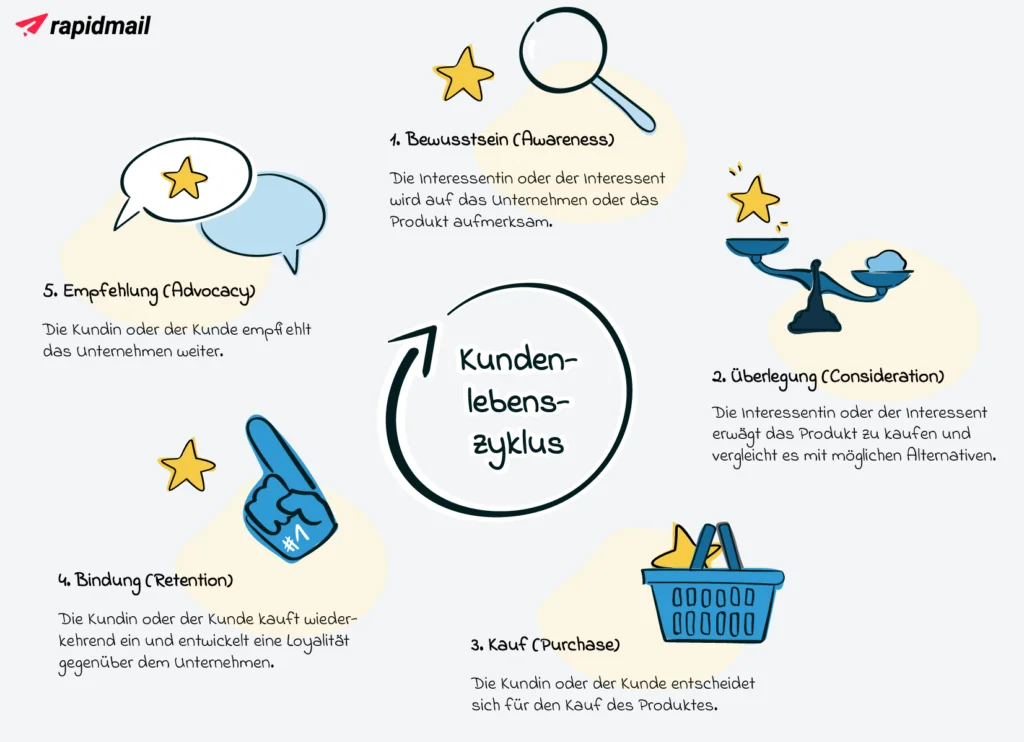
Suppose, for example, that you run the Sportfit gym and want to analyze your company’s customer journey. One possible customer lifecycle could look like this:
- 🌟 Awareness: Mike is a 25-year-old student in Berlin who wants to become more active and is looking for a gym that offers both a reasonable price and special training options to motivate him. During his search, an online ad draws his attention to Sportfit, which offers equipment training, unlimited drinks and individual personal-training sessions for €50 per month.
- 💭 Consideration: Mike uses various search engines and social media to learn about other gyms nearby, comparing their prices and services. He is particularly interested in personal-training sessions and a reasonable price.
- 🛒 Purchase: Mike now has a shortlist of suitable gyms. On a video platform, he sees clips of a well-known fitness influencer endorsing Sportfit gyms and explaining all the benefits of the membership. Mike concludes that Sportfit offers the best value for his needs and visits its website to take out a membership.
- 🔄 Retention: Mike begins with a three-month membership at Sportfit. He soon becomes so enthusiastic about the classes and the overall range of services that he considers extending his contract. Having subscribed to the Sportfit newsletter, Mike receives useful training tips and regular attractive offers for discounted annual memberships, and eventually decides to renew for the long term.
- 📣 Advocacy: Mike is so pleased with his gym that he recommends Sportfit to friends, both those still looking for a gym and those who already belong to another one. He tells them about the excellent offers and encourages them to switch. Mike participates in a refer-a-friend program offered by Sportfit through its website and newsletter. He also leaves a positive review on the company’s Google profile to share his experience and persuade other prospective customers to sign up.
At first glance, managing so many online marketing channels simultaneously may seem like a lot of work. But don’t worry: once you have set up the main platforms for your business and developed a suitable online marketing strategy, your processes will run more smoothly and success will follow. Begin with the most important channels, then expand into others once they work well. It is also worth taking a closer look at local online marketing to reach audiences in your region. This will eventually lead you to your ideal marketing mix. If you are considering starting online marketing, go for it! This guide is designed to help even complete beginners get started with ease. 🤗
2. Online marketing channels and examples for a successful mix
Online marketing offers numerous channels to integrate into your strategy, from fundamental options such as websites, landing pages and content marketing to video and multichannel marketing, SEA (search engine advertising), PR (public relations) and affiliate marketing. It can certainly feel overwhelming at first, and you may wonder where best to begin. Don’t worry: we will introduce the different online marketing tools and activities one by one and help you identify the channels that fit your online marketing mix perfectly. 🔍
Websites and landing pages
A website is a collection of interlinked web pages available under a shared domain, the internet address through which users access it. A website is effectively a company’s digital home on the internet. 🏠 It contains different types of company-related content, such as text, images and videos.
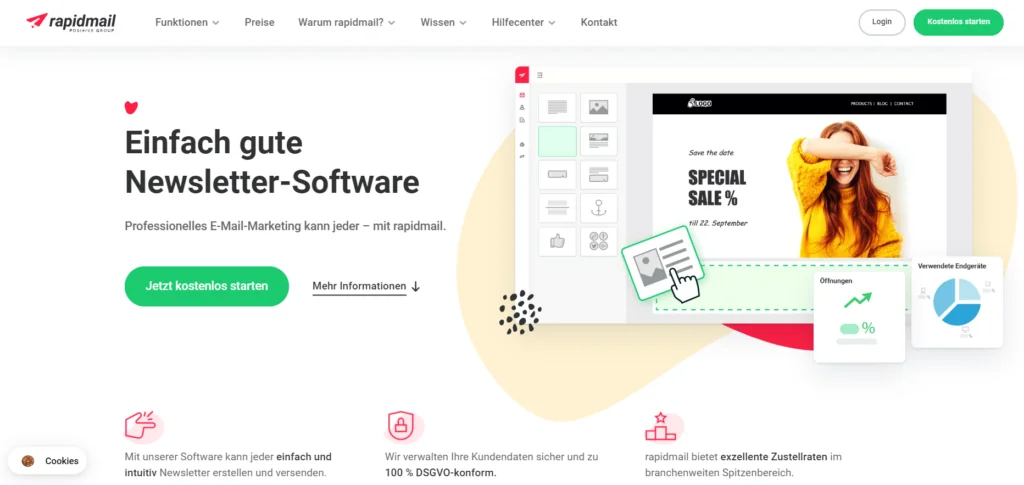
A landing page is a web page tailored to a specific activity or campaign. While a company homepage provides a comprehensive overview of the business and its offers, for example, a landing page focuses on one particular offer or activity.
The website is one of the fundamental online marketing channels and serves purposes such as:
- 📚 Providing information: Websites contain all the essential information about a company, its products or services, including detailed product descriptions, the company history, blogs and FAQs.
- 💬 Communication: Websites enable interaction with visitors through contact forms, comments or live chat.
- 🛒 Ecommerce: For ecommerce businesses, the website is a sales platform where products and services can be offered and sold directly. An associated online shop usually forms the basis of all ecommerce marketing activities.
- 🔍 Search engine optimization (SEO): Optimizing a website for frequently searched terms can improve its search engine ranking and attract more organic traffic, meaning visitors who arrive through search results.
- 💼 Brand presence and credibility: Your website’s design reinforces the credibility of your brand and company. It provides prospective customers with comprehensive information about your business, products and services.
Despite the many intuitive online marketing tools available, creating and managing a website requires basic technical knowledge or outside support. A site also needs regular content and security updates to ensure optimal performance. Even so, a website is a genuine must-have for every company engaged in online marketing: it forms the foundation of every online marketing strategy and makes it possible to develop further channels.
Content marketing and SEO
Content marketing is an online marketing strategy that aims to create valuable, relevant content for a specific target audience. Rather than using direct advertising or sales messages, content marketing provides useful information, entertainment or inspiration to spark potential customers’ interest and build long-term relationships. White papers, ebooks, blog posts, videos, podcasts and social media posts are all ideal formats.
Search engine optimization (SEO) plays a decisive role in ensuring interested people can find this content. SEO is the process of designing and improving your website so that it appears as high as possible in the results of search engines such as Google when users search for relevant terms in a particular field. 🔍
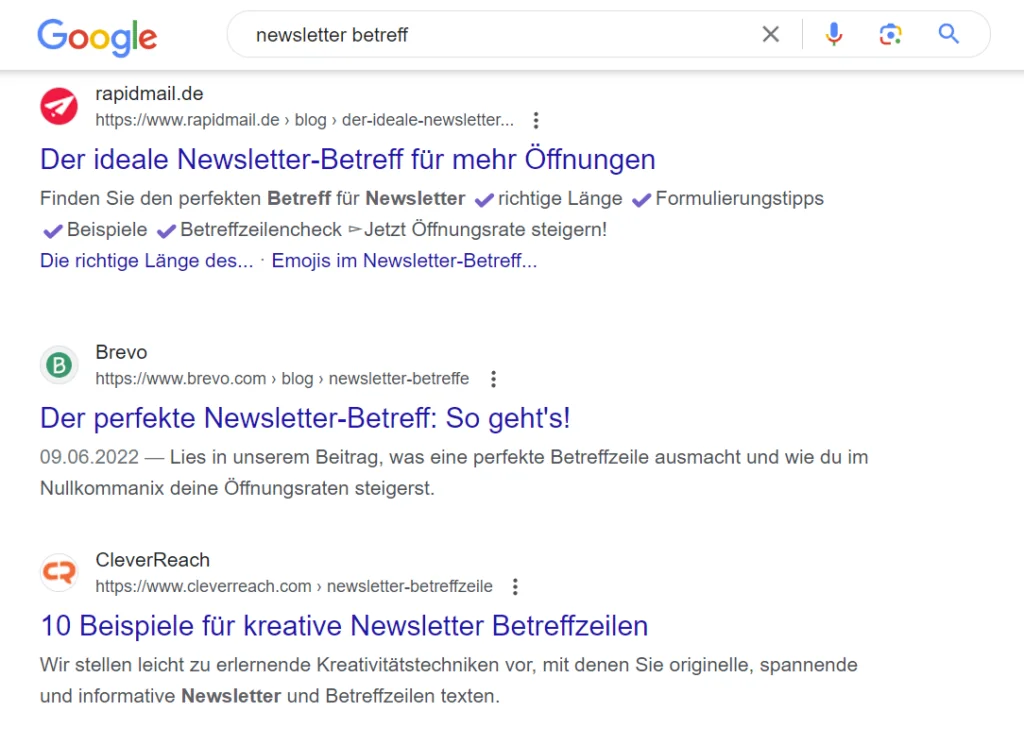
Content marketing and SEO offer these advantages:
- 👀 Better visibility: High-quality content that attracts prospective customers can increase your brand’s visibility. Improved search engine rankings also bring you more “free” visitors.
- 🔬 Positioning as an industry expert: Informative content positions your business as an expert in its field, which in turn reinforces your brand’s trustworthiness.
- 🔗 Strong customer loyalty: If users know they can rely on you for useful content, they will return to your website time and again.
Content marketing and SEO are time-consuming, however. You need plenty of time to create and regularly revise high-quality content, and must then allow your SEO activities time to take full effect. But trust us: your patience will pay off with good long-term rankings and results. 🏆
Email marketing
Email marketing is a form of online marketing that uses newsletters and marketing emails specifically to send messages to potential and existing customers. 💌
These emails can feature a wide range of content, from promotional offers and product launches to newsletter surveys and event invitations. As you can see, email marketing is extremely versatile. It lets you stay connected with potential and existing customers, inspire enthusiasm for your business and boost sales.
The rapidmail newsletter
Tips, ideas and news about email marketing, straight to your inbox.
A few more advantages of email marketing:
- 🧩 Personalization and segmentation: Emails are easy to personalize and audiences can be divided into segments to address contacts’ needs and interests. This increases the messages’ relevance and effectiveness.
- ⚖️ Affordable prices: Compared with other online marketing channels, newsletter and marketing email costs are low. With rapidmail, for example, you can get started from just €15 per month.
- 📈 Measurability: Immediately after sending, you can monitor and measure how successful your emails are and optimize them straight away if they have not yet achieved the desired results.
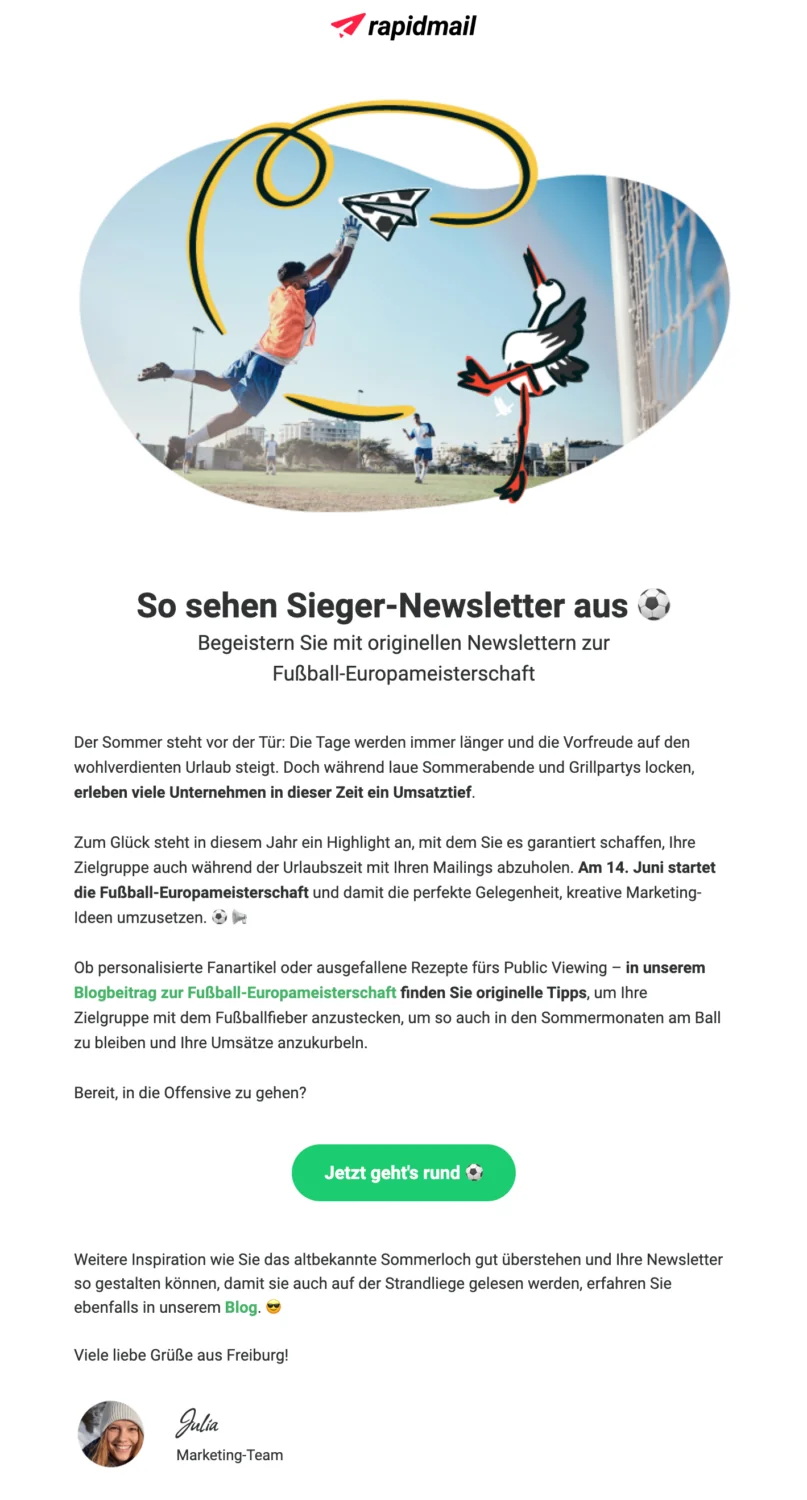
💡 Five rapidtips for email marketing
- ✂️ Segment your customers into subgroups: Divide target audiences by industry, company size or specific needs. Discovering your customers’ interests and buying habits and tailoring newsletter content accordingly can increase the click rate in your newsletters and drive more traffic to your company website.
- 💡 Don’t send product offers alone: If your newsletter advertises only products and discounts, subscribers will eventually grow bored. Maintain their interest with varied newsletter content, for example by offering a glimpse behind the scenes, customer success stories and exciting industry insights.
- 🖌️ Design newsletters in your corporate style: Your online marketing strategy should be consistent. That includes a coherent newsletter design that matches your website and other communications, improving brand recognition. Incidentally, rapidmail’s 1-click design automatically creates newsletter templates in your individual corporate design. Alternatively, you can begin with pre-designed newsletter templates and simply add your content.
- 👍🏻 Find out what interests your contacts most: Once one newsletter has gone out, it is time to think about the next. After every send, take a moment for newsletter analysis. Which content and topics generated the most interest? Which subject lines work better? As you get to know your audience, you can tailor newsletter content more closely and keep contacts engaged for the long term.
- 📈 Place newsletter signup forms on frequently visited pages: To gain more newsletter subscribers, do not hide the form in your website footer. Display it prominently on well-visited pages, for example in the sidebar or as a pop-up.
Consistent data protection and maximum deliverability are also crucial to email marketing success. Even the most beautiful emails are useless if they end up in spam or do not arrive at all. Fortunately, with the right email marketing tool you need not worry. Our industry-leading delivery rates and 100% GDPR-compliant tool put you in safe hands with rapidmail.
SEA and ads
SEA, or search engine advertising, is a strategy in which companies pay to rank highly in search engine results for certain keywords, provided their ad is relevant to the user’s query. You can recognize these ads by labels such as “Ad” or “Sponsored”. 🔍
Online ads are paid advertisements placed on different platforms, such as social media, websites and mobile apps. They allow companies to reach target audiences in a variety of digital locations.
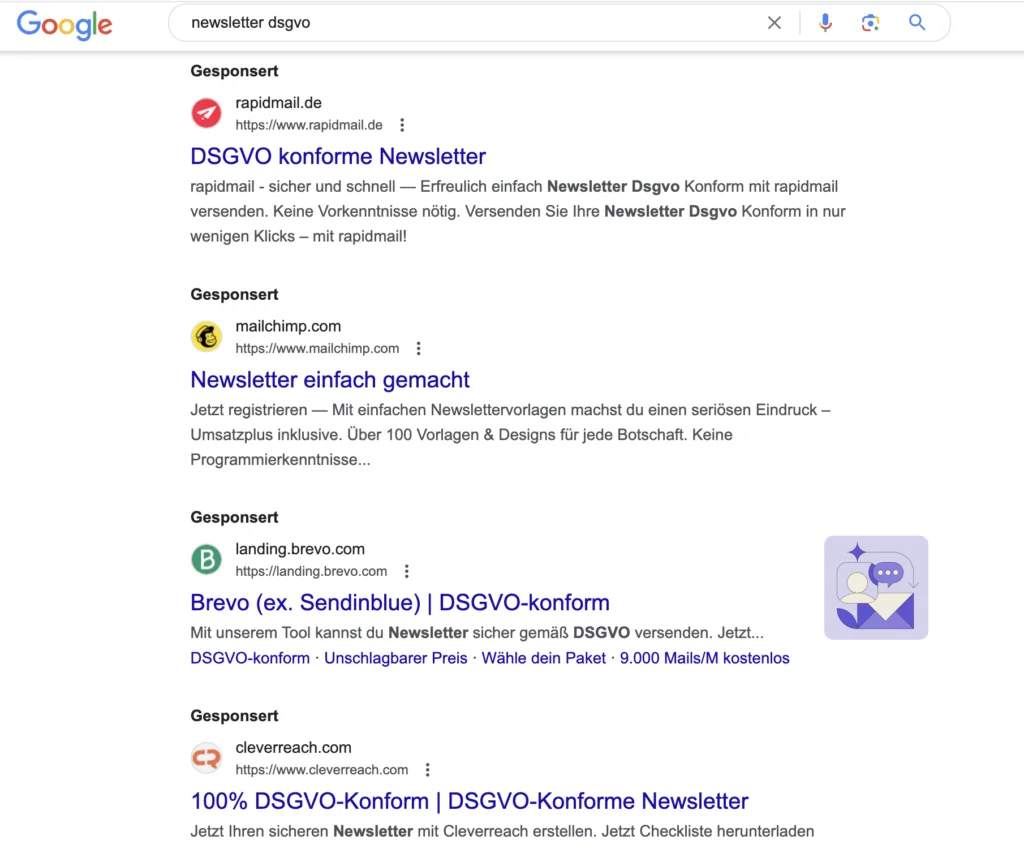
SEA offers these advantages:
- ⚡ Immediate visibility: Ads go live immediately and can deliver quick results.
- 🎯 Audience targeting: Search engine advertising enables precise ad placement based on an audience’s demographics, interests and behavior.
- 📏 Measurability: Performance is easy to measure and analyze, with detailed reports on clicks, impressions, conversion rates and more.
Search engine advertising has many benefits and delivers visibility quickly compared with other online marketing activities. However, SEA and ads can involve very high costs, particularly for fiercely contested keywords or popular platforms. Many users also develop a form of banner blindness, which can reduce the reach of your SEA and ad campaigns.
PR (public relations)
Public relations (PR) is a strategic communication practice that aims to promote and maintain a company’s image, reputation and relationships with its various target audiences. It uses a wide range of tactics and techniques, such as media relations, crisis management, event planning, influencer engagement and content development.
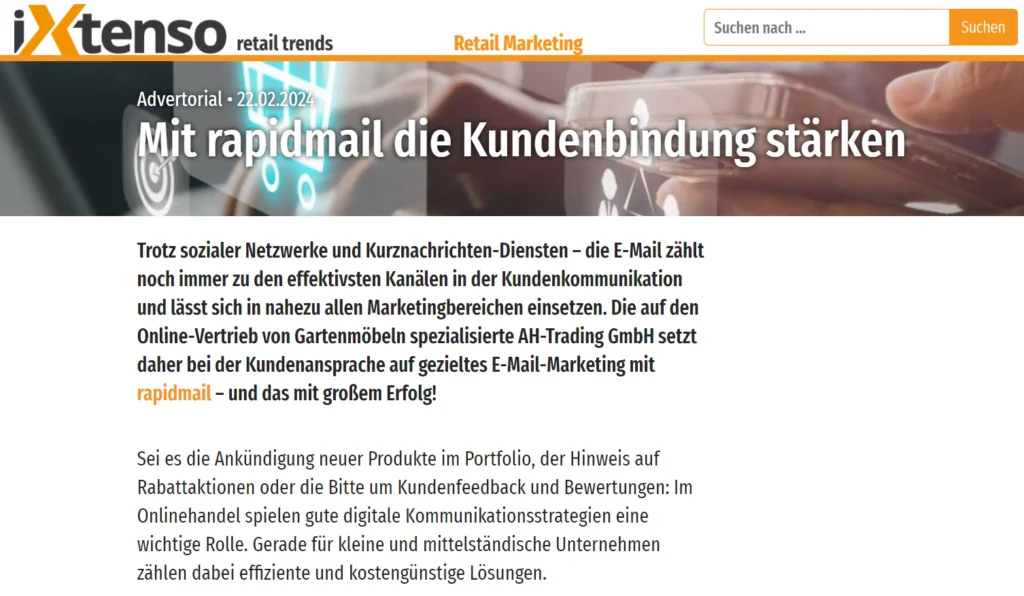
PR offers these advantages:
- 🛡️ Credibility and trust: PR activities allow an organization to reinforce its credibility and its audience’s trust, because independent third parties, such as journalists and the press, distribute the information and messages.
- 📰 Media presence: Media relations can increase a company’s visibility in relevant media channels and help it reach a wider audience.
- 🆘 Crisis communication: PR enables companies to respond effectively to crises and protect or restore their image in difficult situations.
Having a public presence naturally also entails certain risks. When developing a PR strategy, remember that companies often have only limited control over media coverage, and that inadequate or misguided PR can damage their reputation or lead to negative public perceptions.
👀 Did you know?
Multichannel marketing describes both offline and online marketing strategies in which companies try to engage and reach their audience through different communication and sales channels. It allows them to address broader audiences and extend their reach. Multiple sales options also enable products and services to be adapted to different customer needs.
Affiliate marketing
Affiliate marketing is a form of online marketing in which companies, acting as advertisers, pay partners called affiliates to promote their products or services. Affiliates earn a commission when they generate a sale, lead or another desired action.
Affiliate marketing offers these advantages:
- 📡 Wider reach: Affiliate marketing can introduce products or services to a broader audience.
- 🤝 Credibility: When partners outside the company recommend products or services to their audience, this feels more like a personal recommendation than conventional advertising. It can strengthen trust in the brand.
- ⚖️ Performance-based costs: Companies pay only for results, such as sales or leads, which significantly reduces their financial risk.
💡 rapidtip: we also have an affiliate program

As a rapidmail affiliate partner, you receive 25% commission on every invoice paid by each rapidmail customer you refer, for ever!
Video marketing
In online marketing, video marketing is a strategy that uses the visual and auditory impact of videos to promote products or services and strengthen a brand. It can be used on platforms such as YouTube, television, Instagram, TikTok and other digital channels.
👀 Have you seen this?
We have discovered video marketing for ourselves too, so why not visit our YouTube channel? Our Content Manager Wiebke explains how beginners can get started with email marketing and become experts in no time. Roll the film! 🎬
Open video transcript
Chapter 1: Introduction
Isn’t email marketing completely outdated? It’s a fair question, as email is more than 50 years old. Today, I want to show you that email marketing is far from dead. On the contrary, it is one of the most effective and popular marketing activities. But what exactly is email marketing, and how do you get started? There are lots of questions, and I’ll answer them today. Hi, my name is Wiebke, and I’d like to accompany you on your email marketing journey.
In this video, you’ll discover the most important email marketing basics you need for a successful start. Together, we’ll look at exactly what email marketing is, the advantages it offers and what you need to begin as a newcomer.
I’ll also explain how to find the right email marketing tool and how to build your newsletter mailing list.
Ready to get started with email marketing? Let’s go!
Chapter 2: Definition: what exactly is email marketing?
Email marketing is one of the best-known and most popular forms of online marketing.
Emails, such as newsletters, are used to build a relationship with your target audience and send them various promotional messages. This produces plenty of positive effects:
Email marketing can help you win new customers.
Once you have attracted potential customers’ interest and convinced them to subscribe to your newsletter, for example, you can maintain contact by email and steadily increase their interest with suitable content until they
eventually become paying customers.
Newsletter marketing also helps increase customers’ loyalty to your business.
Marketing emails create a direct connection with your contacts and remind them of your company time and again. If your content appeals to them, they will associate your emails, and your brand over the long term, with a positive feeling.
Emails sent in your company’s name act as a mouthpiece. This gives you an excellent opportunity to distribute the information that matters to you. You can actively ensure your business leaves a positive impression. Recurring emails containing your company name, products or other brand features increase your visibility and, over time, brand recognition.
And, of course, all this is reflected in your revenue:
Marketing emails offer many ways to motivate your audience to buy, such as sending discount codes or promoting special offers.
But be careful: one of the most important rules in email marketing is that you may contact only people who have explicitly agreed in advance to receive the emails.
Instead of sending unwanted spam to thousands of people, you contact only interested contacts, individually and in a targeted way. There is an enormous difference between unlawful spam and GDPR-compliant, interest-based emails.
That deals with the first misconception, that newsletters are nothing but spam. Let’s move straight on to the next one: is email marketing still worthwhile today?
Chapter 3: Is email marketing still worthwhile today? (Display and highlight chapter heading)
TikTok, Pinterest, Instagram… Admittedly, email marketing is not the newest form of advertising. However, it is every bit as effective as social media marketing or search engine advertising and is the ideal complement to them. Combining different communication channels is advisable in any case, as it helps you reach as many people as possible.
A study by the German Retail Federation showed that emails and newsletters are still consumers’ second most popular channel for communicating with companies. Only personal contact is more popular.
That is why more and more companies are discovering email marketing. We conducted a survey on precisely this topic and found that more than 90% of the almost 800 companies surveyed use email for marketing purposes. A large proportion said that email marketing had become more relevant in their view, and many assumed it would become even more important.
If you would like to read our study at your leisure, simply follow the link in the video description.
Chapter 4: Advantages of email marketing
But why exactly is email marketing so popular? Let’s look at the advantages of this marketing channel.
Compared with other marketing channels, email marketing stands out for its affordable, transparent prices. With rapidmail’s email marketing tool, for example, you can get started for just €15 per month. And the money invested is worthwhile:
The return on investment (ROI) of email marketing is particularly high. Specifically, every euro spent on email marketing generates an average of €44. That makes email marketing the advertising channel with the best cost-benefit ratio.
If you think you have too few staff, too little time or insufficient prior knowledge to begin email marketing yourself, let me reassure you. A professional email marketing tool lets you create and design your emails quickly and, above all, easily, then send them to any number of contacts simultaneously.
The right email marketing tool gives you practical features that minimize the time required, such as a drag-and-drop editor, stylish design templates that automatically adapt to your corporate design, and the option to edit images directly within the tool.
Email has an enormous reach, as almost everyone has at least one email address.
At the same time, you can reach your contacts by email virtually anywhere and at any time. After all, people now read emails not only on computers but also on smartphones and tablets while out and about.
Your contacts do not even need to check their inboxes actively, as push notifications automatically alert them to new emails.
This allows you to plan precisely when and under what circumstances you want to reach your target audience. Would you rather do so in the morning on their way to work, during working hours or while they relax in the evening?
You already know that GDPR-compliant email marketing permits you to contact only people who want to hear from you. That may sound like an inconvenient restriction at first, but it is anything but one.
Consent means that only contacts genuinely interested in your brand and advertising join your list. You present yourself as a trustworthy, credible business and avoid significant wastage because you are not squandering your advertising budget on people with no interest in your products and offers.
What’s more, email marketing even allows you to address interested contacts by name, using a salutation that automatically draws on their contact data. That creates a personal, trusting basis for communication.
It is easy to use customer data such as names, locations, gender, buying behavior and interests to tailor your emails to each individual contact.
Would it be even better to adapt not only email content but also ensure messages reach inboxes at exactly the right time? Automated emails make this possible.
They are triggered either by a specific contact action, such as subscribing to your newsletter, or sent at a defined time, such as on November 30 or after five days.
For example, an online shop selling products for babies and children could send customers a campaign about balance bikes one year after they order a pushchair, responding perfectly to those contacts’ current circumstances.
But emails are not simply sent out blindly. Immediately after sending, you can monitor and measure how successful they are.
Email marketing continuously collects important metrics showing whether and how well your emails appeal to your target audience.
For example, you can check how many contacts received the emails, how many opened them and how many clicked a link. An additional tracking tool such as Google Analytics can also show how much revenue an email generated. If your figures still leave room for improvement, you can optimize your marketing emails with a few simple adjustments.
Have all these benefits convinced you to try email marketing? Then I’ll explain how you can get started.
Chapter 5: Requirements: how can a beginner get started with email marketing?
You need only three simple things: an email marketing tool to create and send emails, a website where you can place a signup form, and website visitors or contacts to whom you can write in the future.
But why do you need a specialist email marketing tool? In principle, you could send marketing emails using a provider such as Outlook, but it is not advisable. These programs lack the correct sending infrastructure for a large contact base and other important features, such as contact management, varied design options and email display testing.
To take advantage of everything email marketing offers, including quick and easy email creation, personalization and reporting options, you need professional applications created specifically for the purpose.
Chapter 6: How do I find the tool that suits me best?
Choosing an email marketing tool is not entirely straightforward, as countless providers operate in the market. To discover which tool suits your company, first draw up an overview of what you require from your ideal email marketing tool.
I recommend considering whether you need an extensive range of features or whether easy operation of the most important basic functions matters more to you.
You should also consider the data protection standards of the tools in question. In my view, support is another area where you should not compromise, because prompt, expert help is extremely valuable whenever you get stuck.
The video description contains a link to our tool comparison. We examined a few popular tools and compared their features, data protection standards, prices and other important decision criteria. It may help you choose your email marketing tool.
Chapter 7: As a beginner, how do I build a mailing list for my marketing emails?
Once you have chosen an email marketing tool, you can turn your attention to contacts. But how do you build a newsletter mailing list?
As a newcomer to email marketing, you probably do not yet have an enormous mailing list. But with the right steps, gradually building your contact list is not difficult.
Buying a large list of email addresses in one go is not a good idea. Contacting purchased contacts is unlawful because they have not given you permission, and they are unlikely to be interested in your messages anyway. It is much safer and more sensible to collect contacts with a genuine interest in your company and its products or services.
You therefore need to persuade people to sign up for your newsletter voluntarily. The simplest way is with a signup form on your website.
You can create this form easily with your email marketing tool. When website visitors complete it, their data is
automatically transferred to your contact list in the software.
However, the benefit of signing up must be obvious. Otherwise, why would potential contacts provide their data at all? Think about incentives that could spark your audience’s interest in your emails.
You could use special offers, such as a discount code or early access to new products. It may also be enough to make clear that your newsletter keeps interested people up to date with new collections, resources, current events, contests and exciting company news.
If too few people encounter your signup form through your website, advertise your newsletter through other channels, such as social media. Offline signs and posters can also draw attention to it. Building your list does require a little patience, as your contact list will grow gradually.
Chapter 8: Conclusion: what happens next?
We have now covered all the email marketing basics, and you are essentially ready to create your first newsletter and send it to your contacts. Our tutorial shows you how to do that with rapidmail.
Thanks for watching, and see you next time!
Video marketing offers these advantages:
- 🔥 Greater engagement: Videos often generate more engagement than text-only posts because they capture viewers’ attention more quickly and encourage more interactions, such as likes, comments and shares.
- 👀 Visual presentation: Videos communicate complex information quickly and attractively. Their visual nature makes it easier to arouse emotion and create a direct connection with viewers.
- 🔍 SEO benefits: Video marketing increases search engine visibility and improves positions in search results. Well-optimized titles, descriptions and tags help increase organic reach.
- 🔁 Shareability: Videos are easy to share on social media. If viewers find a video appealing, they are highly likely to share it with friends and followers, spreading your content more quickly and effectively. You can also use fake-player graphics to embed videos in your newsletters and increase contact engagement.
Be aware that producing high-quality videos is not easy and, particularly at first, requires plenty of preparation and learning, for example to obtain the necessary equipment or master video editing. Effective video marketing requires not only investment in equipment and production but also expertise in areas such as video editing and scriptwriting.
🔮 rapidfuture: what the future of online marketing could look like
Videos will not be the only advertising format to remain at the forefront of online marketing. There are several other online marketing trends you should keep an eye on to stay abreast of the times. One is artificial intelligence (AI), which has become increasingly important, and above all increasingly capable, in recent months and years. AI can already perform some tasks for you, or at least make them easier. For example, it can inspire topics for your next newsletter or formulate copy for a blog post. Artificial intelligence can help you understand or even predict customer behavior by analyzing large volumes of company data. After all, personalization and audience targeting will continue to determine online marketing success. Topics such as sustainability and social responsibility will remain relevant too, playing an important part in many consumers’ purchasing decisions.
3. Online marketing tips: the most important success factors
To succeed in online marketing, you need to stand out from the crowd and win over prospective customers with a unique touch. The following factors in particular determine whether your online marketing activities succeed and have a lasting impact.
- 🎨 Corporate design: To ensure that prospective customers who encounter your business online recognize it again, the design of your online marketing activities should reflect your brand identity. Consistent colors, logos and typefaces improve recognition and emphasize your professionalism.
👀 Did you know?
rapidmail’s 1-click design lets you adapt your newsletters to your individual corporate design with a single click. Simply enter your website URL and click the “Next” button, and your newsletter will appear in your company’s style.
- 🎯 Audience targeting: Define your target audience or audiences so you can tailor your messages to different online marketing channels and groups. This increases the chances of your activities reaching precisely the people who are interested in your content and encouraging them to interact.
- 🛠️ User-friendliness: For a positive user experience, visitors should be able to find what they are looking for quickly and easily. Short load times and an optimized mobile display are essential. A simple, appealing design that is easy on the eye, together with content tailored precisely to your audience’s wishes and needs, also helps visitors feel comfortable and encourages them to return.
- 🏷️ Meaningful calls to action: Use clearly visible calls to action such as “Buy now” or “Learn more” across your online marketing channels to guide people and increase conversions. A compelling call-to-action button can often be the key to prompting visitors to act.
- 💬 Consistent, personable tone: Keep the tone of your content marketing copy and communication channels consistent and friendly. An authentic, personable style that suits your brand builds trust in your company and promotes customer loyalty.
4. Plan activities intelligently: how to develop your online marketing strategy
Define your online marketing objectives
First, think about what you actually want your online marketing to achieve. Do you want to increase sales, strengthen customer relationships or simply drive more traffic to your website? Clearly worded objectives are the cornerstone of a successful online marketing strategy, helping you turn plans into action. 💪
But how do you define good objectives? 🤔 We recommend a framework that makes it easier to check how effective your objectives are: the SMART framework is a checklist containing the following points:
- Specific: Be clear and precise. One exact objective could be: “I want to generate 500 new website visitors next month.”
- Measurable: Choose objectives you can measure, meaning those that include concrete figures, such as: “I want to gain 50 new newsletter subscribers per month.”
- Attractive: Set objectives that are important and appealing to you and your team, such as: “We want to generate 30% more revenue next year.”
- Realistic: Be ambitious but realistic, for example: “I want to achieve 20% more sales over the next six months.”
- Time-bound: Set a deadline. This will help you work toward your objectives more quickly and effectively. One example is: “I want to gain 200 new customers by the end of the year.”
This framework makes it easy to formulate good objectives and implement them smartly. 🤓
Analyze your target audience
Target audience analysis helps you find out who is interested in your products or services. What problems does your product solve? How do you make customers’ lives easier? Who is excited by your offers? A company that knows the people behind the purchasers of its products or services can tailor its online marketing strategy precisely and work sustainably while conserving resources.
To analyze your target audience, collect data from existing and potential customers. Age, gender, income, location and lifestyle often play an important role. You can obtain this data through newsletter signup forms, social media and downloadable content on your website, for example. Surveys with prize draws can also motivate contacts to reveal more about themselves. You gain valuable insights while subscribers enjoy a chance to win, creating a genuine win-win situation. 🤝
Once you have gathered the key data and insights about your target audience, the next step is to derive buyer personas from that information.
👀 Did you know?
Buyer personas are detailed, semi-fictional representations of ideal customers based on real information and a small creative element. They enable companies to perceive their target audience not as a homogeneous mass but as real people with wishes and needs, and to tailor their offer more effectively.
Look at what your customers have in common. What is their average age? What professions do they have, or which industries do they work in? Which online marketing channels do they use most frequently? 🕵️♀️
Try to understand their objectives and challenges, and consider how you can support them. Use these insights to develop vivid profiles, giving them names, photographs and precise descriptions of their objectives, challenges and interests.
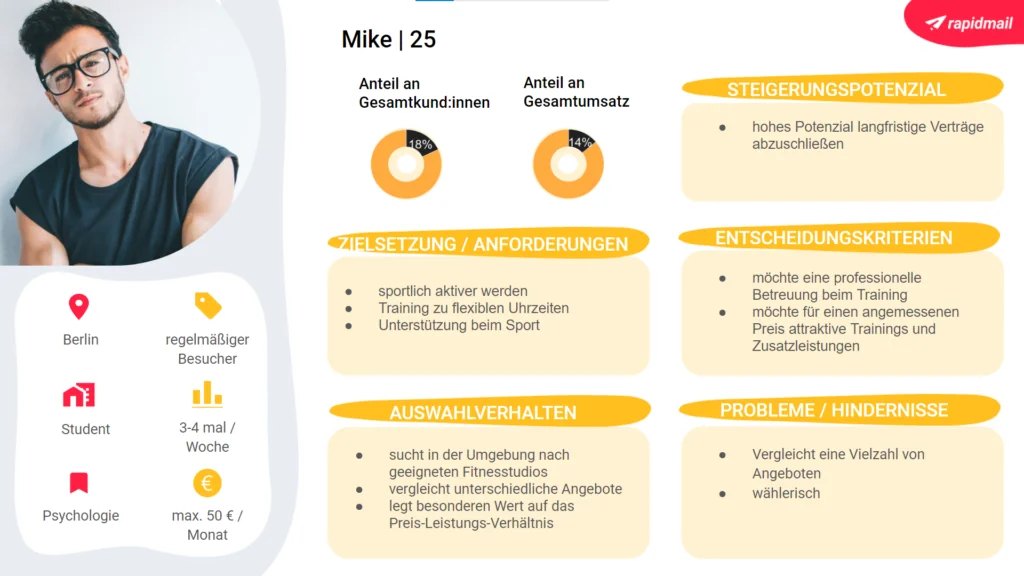
Buyer personas allow Sportfit to tailor its content and offers to the needs and interests of similar customers rather than creating generic advertising messages for unknown people. Suitable online marketing activities might include blog posts with fitness tips for student life, social media posts about flexible training hours, fitness email marketing featuring interesting newsletter discount codes for students, or videos with free exercise instructions. Potential and existing Sportfit customers will be delighted by tailored offers that reflect their needs and wishes.
Evaluate communication activities and assemble your individual activity mix
To get your online marketing strategy off to a flying start, do not treat it as a rigid concept. View it as a process that you continually adapt and optimize.
Regularly review the results produced by your online marketing activities and channels. Are they delivering the desired outcomes? Consider whether it makes sense to continue or adapt your strategy. Compare the results from different channels to discover which are performing particularly well and which are weaker. You can then invest your energy where it pays off most. Various tools are available to track and evaluate the success of your online marketing channels.
💡 rapidtip: tracking with Google Analytics 4
Are you looking for a suitable tool to evaluate your campaigns? Google Analytics lets you track and analyze the target values you achieve reliably. Our newsletter guide contains detailed step-by-step instructions for newsletter tracking with Google Analytics 4.
When evaluating online marketing channels, do not consider only their current status. If a channel was activated only recently or newly integrated into your strategy, examine how its metrics have developed in relation to the period of use and the costs incurred. This will help you assess the activities’ actual effectiveness. You can then use these insights to refine your individual online marketing mix. ✨
Begin with cost-effective activities
Online marketing can be a challenge, particularly for small businesses and beginners. We understand this obstacle: faced with so many possibilities and offers, you may wonder where to start and which tools are genuinely worthwhile. 🤔
As is so often the case, the motto “start small, achieve big things” works well when entering online marketing. Begin with unpaid activities and find your feet gradually, allowing you to understand the basics without immediately spending your entire marketing budget.
Suitable activities and channels for beginners finding their feet in online marketing include:
- 🔍 Website optimization and SEO: Optimizing your website can increase awareness and credibility among your target audience directly without paying for advertising. Content marketing and SEO create a solid foundation of helpful content that you can later repurpose effectively for other marketing channels.
- 📱 Social media profiles: Creating and maintaining social media profiles allows you to present your brand to a wide audience free of charge.
- 📧 Sending newsletters: Sending newsletters enables you to communicate directly with contacts, regularly informing them of news and offers and thereby strengthening their loyalty.
💡 Advanced rapidtip: use marketing automation tools
Once you have taken your first steps in online marketing, set up the most important channels and even seen your first successes, you can consider expanding your activities. This often requires better organization of the channels and the data they store. An email automation tool such as rapidmail, user.com or HubSpot can be useful here.
Use paid advertising channels
Once you have your organic channels under control and are using them successfully, you can expand your online marketing repertoire with paid advertising. Paid ads can entail a certain risk because they require a large share of your marketing budget. But they also offer immediate visibility and reach your target audience exactly where they spend time online.
Paid advertising also allows you to respond quickly to market changes and adapt your online marketing strategies. Whether you want to promote seasonal offers, launch new products or simply increase your brand’s reach, paid advertising can be a valuable online marketing tool for achieving your objectives and moving your company forwards. Ultimately, combining free and paid online marketing activities lets you build a comprehensive, long-term online presence and establish your brand successfully. 💻🚀
Analyze and optimize your results
Is there anything better than seeing your hard work bear fruit and watching your online marketing strategy race ahead? 🏎️ But even if your online marketing does not perform as well as planned, analyzing the key metrics can show you which adjustments will deliver the greatest possible success.
💡 rapidtip
KPIs (key performance indicators) are measurable metrics that quantify the success of online marketing strategies and campaigns, among other things. They help companies identify weaknesses and continually adjust their strategies to get even more from online marketing.
The most important online marketing KPIs include:
- Click rate: The click rate shows how many users clicked a particular link, for example in a newsletter, relative to the number of views, such as newsletter opens.
- Open rate: The open rate shows the percentage of contacts who opened an email relative to the total number of emails sent.
- Conversion rate: The conversion rate measures the proportion of visitors to a website or landing page who complete a desired action, such as making a purchase or filling in a form.
- Bounce rate: The bounce rate shows the percentage of visitors who leave a website after visiting it without taking another action.
- ROI (return on investment): ROI shows the relationship between the profit or benefit and the cost of a marketing activity.
👀 Did you know?
Email marketing has a particularly strong average return on investment of €44 (source: EmailTooltester, 2021). Every euro spent on email marketing generates €44. 🤑
But don’t forget to give yourself a pat on the back too. A little self-praise is always allowed when you achieve the objectives you have worked hard for! 💪🎉
Free ebook: online marketing best practices
When you are just getting started with online marketing, all the different channels and possibilities can feel a little overwhelming. Our ebook, packed with online marketing best practices, is designed to lend a helping hand and use successful real-world examples to show you what makes an online marketing campaign effective. 🚀
Our online marketing ebook includes:
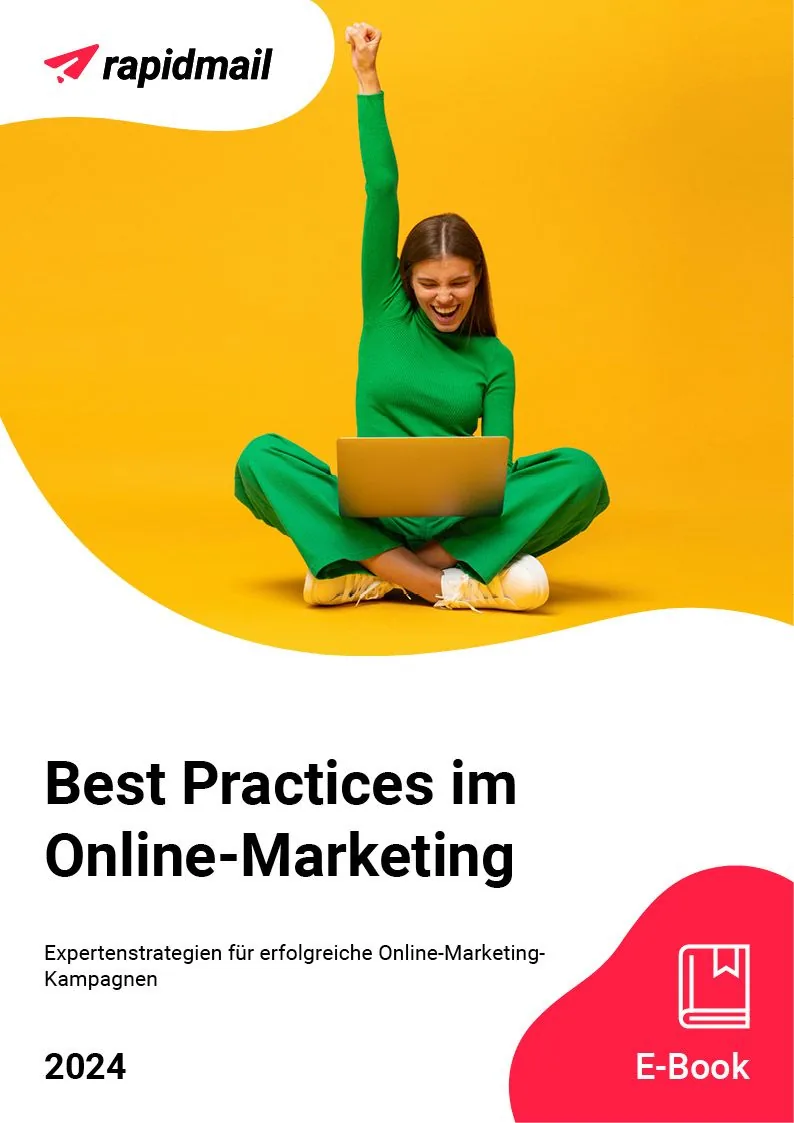
- ✨ 12 inspiring best practices that can teach both online marketing newcomers and genuine experts something new
- 🧠 plenty of expert tips and strategies for a wide range of online marketing campaigns, from social media and image campaigns to recruitment campaigns
- 👀 a concise conclusion with the most important best practices for all online marketing channels
Download online marketing best practices for free (PDF in German)
5. Ready, set, go: how rapidmail helps you get started with online marketing
Now that you have learned quite a bit about developing an online marketing strategy, you are probably eager to get started straight away.
We can warmly recommend rapidmail as you take your first steps in online marketing. Our email marketing tool focuses on simplicity and intuitive use: we want everyone, regardless of prior knowledge or resources, to be able to send newsletters in their corporate design with just a few clicks and thereby address their target audience affordably, precisely and personally. 💌
With rapidmail, you can easily design signup forms and place them on your website’s most frequently visited pages. This enables you to “collect” a few prospective customers at the start of the customer lifecycle and accompany them throughout their journey with your business by sending regular newsletters. In this way, rapidmail helps you win more and more enthusiastic customers through online marketing, step by step.
Ready to get started with online marketing? 🚀