Email marketing ROI explained simply: Get more from your newsletters
You regularly send newsletters and are pleased with solid open and click rates. You can probably also see sales rise immediately after sending them. But how can you find out whether email marketing is really worthwhile as a channel for your company? This is where return on investment (ROI) comes in. In this guide, you will learn how to calculate email marketing ROI correctly and discover 7 practical tips for generating even more profit from your newsletters with the same investment. Let’s do this! 💪🏼
🥜 In a nutshell: The key facts about email marketing ROI
ROI (“return on investment”) measures the financial success of your newsletter campaigns. Knowing your ROI helps you make better-informed decisions, optimize more effectively and get the most from your budget.
The key facts about email marketing ROI at a glance:
- ✔️ Definition: ROI shows how much profit a campaign generates in relation to its costs.
- ✔️ Calculation: The simplified formula is: profit ÷ costs × 100. Example: An ROI of 4,000% means that you generated forty times your investment as profit. For every euro invested, you receive €40 in profit. To make it easier to understand, ROI is therefore often also shown as an absolute figure, in this case 40.
- ✔️ Objectives: Measure profitability, allocate budgets effectively, convince stakeholders, compare marketing channels and make data-driven decisions
- ✔️ Benefit: ROI provides clear, accessible figures that help you measure success, optimize campaigns and use your budget more efficiently, including when communicating with decision-makers who do not have a marketing background.
- ✔️ Applications: You can track ROI using UTM parameters in links, voucher codes, built-in conversion pixels or campaign reports, and by evaluating newsletter conversions such as purchases, downloads or event registrations.
- ✔️ Best practices for a high ROI:
- Targeted communication (segmentation and personalization)
- Compelling subject lines and relevant content
- Automation throughout the customer journey
- List maintenance and regular A/B tests
- Analyze metrics, especially open rate, click rate, conversion rate and unsubscribe rate
👀 Did you know? With rapidmail, you can track the most important metrics for your newsletter campaigns, such as open, click and unsubscribe rates, in real time after sending, helping you make data-driven email marketing decisions.
1. Definition: What does ROI mean in email marketing?
As a metric, ROI (“return on investment”) tells you how profitable your email campaigns are. Put simply: How much profit remains after accounting for the costs incurred? If, for example, your email marketing ROI is 40, this means that for every euro you invest in this marketing channel, you receive €40 in profit. Sounds good, doesn’t it? 💰
There are (at least) three good reasons to keep an eye on email marketing ROI:
- 🔍 ROI reveals what works and what does not: Only by calculating ROI regularly will you know which email campaigns perform well and make money. If one newsletter generates €400 in profit while another comparable campaign generates only €200 despite both costing the same, you can quickly see where improvements are needed and where you can scale. This allows you to make informed decisions based on clear figures instead of relying solely on instinct.
- 📣 ROI gives stakeholders a clear picture: ROI is easy to understand, even for people without a marketing background. Rather than confusing them with abstract percentages or click rates, a clear statement is enough: “For every euro we invested in the summer campaign, we earned €35.” This also convinces senior management and other decision-makers in your company and builds confidence in your email marketing work.
- 💰 ROI shows which channels are genuinely worthwhile: ROI helps you allocate your (limited) budget to the marketing channels most likely to deliver results, especially when you run several initiatives in parallel. If an ROI comparison shows that your email campaigns significantly outperform your Facebook ads or paid Google advertising, you know which online marketing activities deserve more budget and where you can save instead.
👀 Did you know?
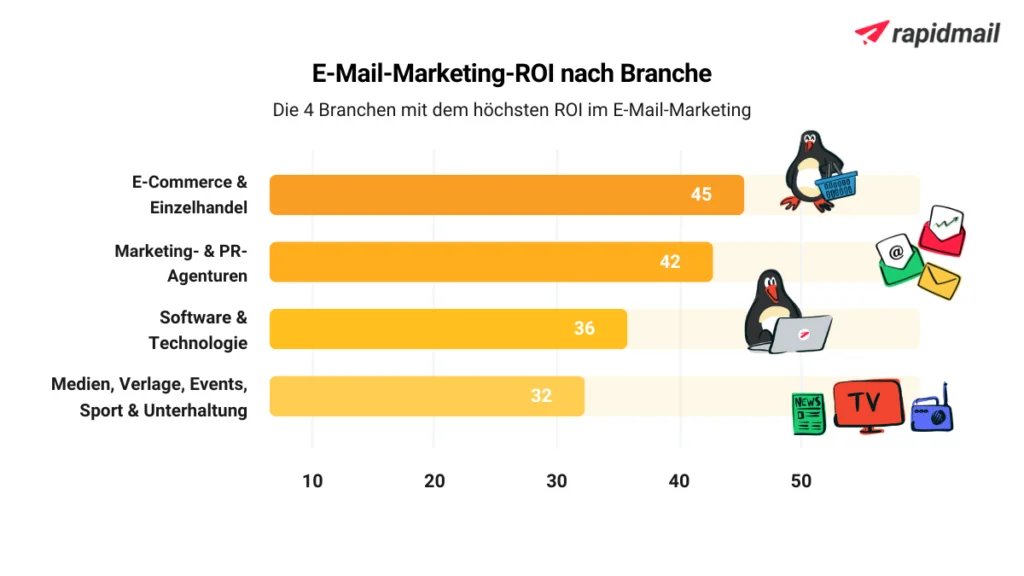
With an average ROI of 42 (source: summ-it, 2025), email marketing continues to lead the marketing mix, ahead of all other digital sales channels. For every euro spent, an average of €42 comes back to you, compared with only 5–€10 in social media marketing.
However, one important point must not be overlooked: ROI varies by industry, as the following overview of typical newsletter marketing ROI figures by industry shows. Sectors with loyal customers perform particularly well, including ecommerce, marketing agencies, media publishers, and sport and entertainment.
2. Calculating newsletter ROI correctly: Here’s how
Because various individual factors affect the ROI calculation, it is not displayed as a standard metric in the statistics provided by common email marketing tool providers. But don’t worry: you do not need to be a math genius to calculate it yourself.
In practice, there are two common ways to express return on investment, either as a percentage or as an absolute figure. Both methods provide valuable insights but differ in their presentation and meaning. To help you understand exactly what each means and which is best suited to your needs, our cheat sheet explains both calculation methods briefly and clearly:
📐 rapidCheat sheet: Two ways to calculate and express ROI
This traditional percentage calculation shows how much profit your email campaign generated in relation to its costs:
✍🏼 ROI (%) = (profit from email campaign ÷ campaign costs) × 100
Example calculation:
Revenue: €5,000, costs: €100 (e.g. for tools and staff)
Profit from email campaign = revenue from email campaign − email campaign costs = €5,000 − €100 = €4,900
👉 ROI = (4,900 ÷ 100) × 100 = 4,900%
This means you generated forty-nine times your investment as profit, or, put another way, you generated €49 in profit for every euro invested.
In marketing, and especially in studies or industry comparisons, you will often read: “Email marketing achieves an ROI of 42.” Here, ROI is expressed as an absolute figure and can be calculated as follows:
✍🏼 ROI = profit from email campaign ÷ email campaign costs
Example calculation:
Revenue: €5,000, costs: €100 (e.g. for tools and staff)
Profit from email campaign = revenue from email campaign − email campaign costs = €5,000 − €100 = €4,900
👉 ROI = 4,900 ÷ 100 = 49
Here too, this means that you generated €49 in profit for every euro invested.
Percentage or absolute figure: Which should I use when calculating ROI?
Whether you should calculate ROI as a percentage or an absolute figure often depends on why you are calculating this email marketing metric and what information you want it to convey:
| For whom? 🎯 | ROI figure 🔢 | Benefits ✅ | Example 🔍 |
| Investors, managers, marketing professionals, agencies | Percentage | Easy comparison of different channels regardless of the budget invested | ROI = 4,000% → Forty times the investment generated as profit |
| Other internal teams, external stakeholders | Absolute figure | Direct representation of actual profit, easy to understand | ROI = 40 → €40 profit per euro invested |
Depending on the purpose, you can express your email marketing ROI in two different ways.
How to record costs and revenue for the ROI calculation
For your ROI figure to be not only impressive but also accurate, you need the right data. This includes all costs associated with sending the emails and the measurable revenue generated by the campaign, which together determine your profit.
What counts as an email campaign cost?
Do not overlook any email marketing expenditure: an estimate that is too narrow quickly produces a “massaged” and therefore useless ROI.
Include these cost items when calculating your email marketing ROI:
- 💻 Tool costs: Fees for your email marketing software
- 👨🏻💻 Staff costs: Time spent on copy, design, planning and sending your newsletters
- 🛟 External support: Agencies, freelancers or designers who create graphics or templates for your newsletters, for example
You may now be wondering how to assign costs to individual newsletters or campaigns. This may be relatively straightforward for tool fees. Staff costs are more complicated: what if an external copywriter works on four newsletters at the same time? How should these costs be divided fairly?
Two methods of allocating costs are possible:
- ⏳ By time spent: Using time tracking or self-assessment, for example.
- ⚖️ Equal allocation: Every newsletter receives the same share of the costs. This is simple, but less precise.
The rapidmail newsletter
Tips, ideas and news about email marketing, straight to your inbox.
What counts as campaign revenue?
Only revenue that can be clearly attributed to a campaign may be included in the calculation. The following methods help you determine revenue:
- 🔗 UTM tracking for newsletter links: Individual links with UTM parameters (e.g. utm_source=newsletter&utm_campaign=summer2025) help with conversion tracking. Tools such as Google Analytics or Matomo then show which revenue can be attributed to which email campaign. For example, if someone visits your online shop by clicking through from the summer newsletter, clicks a product link with a UTM parameter and buys an item, that revenue can clearly be attributed to the campaign. Without the email, the sale would not have happened. If the link parameter is missing, however, you will not know what happens on your website after the link is clicked, making it impossible to determine ROI.
- 🏷️ Campaign-specific voucher codes: If you use an exclusive discount code such as “summer25” in a campaign, every redemption and the resulting revenue can be assigned directly to the campaign. This is particularly useful for seasonal promotions or retargeting campaigns.
- 📈 Conversion tracking directly in the newsletter tool: Most email marketing tools offer integrated tracking features. These show at a glance who opened your email, clicked a link and, with some tools, even made a purchase, provided your online shop is connected through a plugin, for example. By placing a tracking pixel on the order confirmation page and a cookie in the browser when an email link is clicked, a purchase and its revenue can then be assigned easily to an email campaign.
💡 rapidtip

The more accurately you record costs and revenue and assign them to individual campaigns, the more meaningful your ROI will be. Incidentally, purchases are not the only actions with a value that can be included in your ROI calculation. Other newsletter conversions, such as downloads or event registrations, also have value even if they do not generate immediate revenue.
Calculating ROI: Why it can sometimes be complicated
Newsletters go out, sales come in. That sounds like a simple calculation, doesn’t it? In practice, however, calculating email marketing ROI is not always so straightforward because the paths customers take before making a purchase are often more complex than you might think.
It is therefore no surprise that almost a quarter of marketers rank measuring email ROI among the three biggest challenges in newsletter marketing (source: Mailjet Email Marketing Benchmark, 2022).
This is where calculating email marketing ROI reaches its limits:
- 🔄 Many paths lead to a purchase, but which one was responsible? A single email is rarely enough to convince your contacts to buy. Other marketing activities and channels often contribute to a conversion too: Google Search, social media, a website visit, and your newsletter. Imagine this scenario: a customer reads your newsletter on day 1, googles your offer on day 2, sees a LinkedIn post on day 3 and clicks a retargeting banner on day 4 before finally buying. Which channel “owns” the financial success?
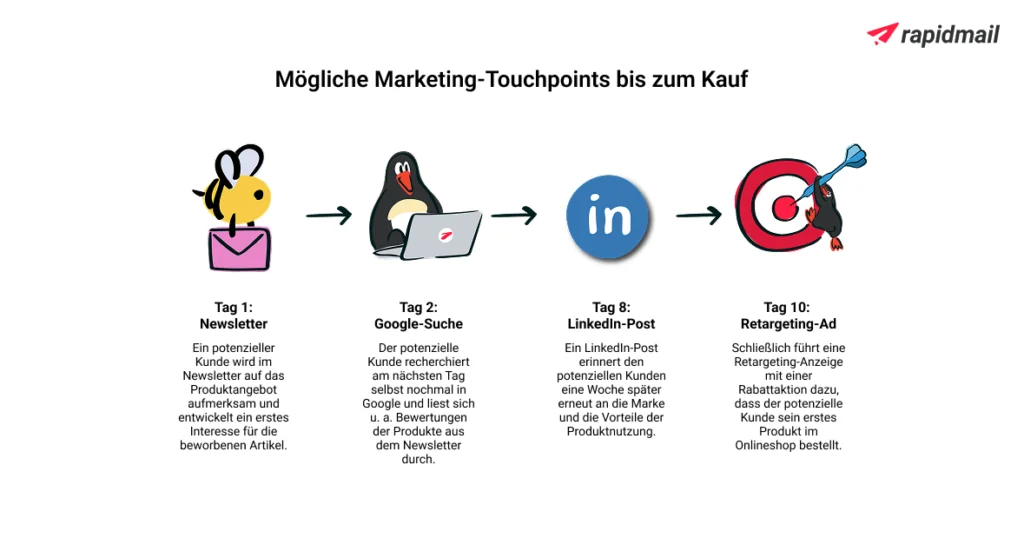
This is where an attribution model comes in. It defines how much each touchpoint with your company or website contributed to revenue. Your email ROI can look very different depending on the model your company chooses:
- 🖱️ Last click: Only the final contact counts. In our example, all the revenue would be assigned to the retargeting banner.
- 🖱️ First click: The email receives full credit for the revenue because it started the customer journey and the purchase would not have happened without it.
- ➖ Linear: All channels share the revenue equally.
- 📊 Data-driven: Algorithms calculate each channel’s influence individually (only useful with a large amount of data).
💡 rapidtip: Why make it complicated when it can be simple?

For simple email marketing campaigns, the “last-click” model is often sufficient for calculating return on investment because it lets you see quickly whether the final email led directly to the purchase.
- ⏳ Delayed purchases: Where tracking reaches its limits: A newsletter click is a long way from a click on the “Buy now” button. With products that require more consideration, many people take days or even weeks before making the final decision. The problem is that if the purchase happens on the tenth day after the newsletter is sent but your tracking stops after 7 days, the revenue disappears from your ROI calculation, even though the newsletter may have prompted the purchase. It can get even more complicated: if contacts block tracking entirely, for example with Apple Mail or other tools, the conversions never appear in your campaign statistics. The result is incomplete data and an ROI that obscures true performance.
- ❤️ ROI sees only numbers, but not everything has a price: Email marketing often delivers more than immediately measurable revenue. Awareness campaigns are one example: your brand becomes better known, valuable trust is built and customers develop a lasting connection with your company. These softer factors do not appear in any ROI formula, yet they are extremely valuable and can still generate revenue later.
💡 rapidtip: How to use ROI

You have probably noticed that in some cases it is simply far too time-consuming to calculate the exact costs and precise revenue of an individual email campaign. This makes it all the more important to view ROI as a long-term, holistic metric, for example when finding out how profitable email marketing is compared with social media marketing.
3. Other important metrics for optimizing ROI
ROI shows how financially successful your email campaigns are, but only as the sum of many individual factors. If you want to improve or realistically assess your ROI, you should also know the most important supporting metrics, which reveal a great deal about the success of your email marketing:
Delivery rate: The foundation of your campaign
Before someone can click a newsletter link and buy something from your online shop, your email first has to reach your contacts’ inboxes rather than their spam folders. The delivery rate shows whether your messages have any chance of generating revenue. Undelivered emails, known as bounces, caused by outdated addresses or technical errors, for example, can reduce this figure considerably.
💡 rapidtip: How to improve your delivery rate

Keep your lists clean, send newsletters through certified servers such as those used by rapidmail and pay attention to technical authentication methods such as SPF and DKIM. Sound complicated? Take a look at our guide, which explains how to improve newsletter delivery in just 9 steps.
Open rate: Attention at first glance
How many contacts open your marketing emails? To achieve the highest possible newsletter open rate, consider the following points carefully before every send:
- 📢 Subject: How can you write your newsletter subject line so that as many subscribers as possible open your message?
- 📩 Sender profile: Which email sender address and name will inspire trust and be recognizable in the inbox?
- ⏰ Sending time: What sending time should you choose to reach as many contacts as possible at a good moment?
If no one opens your newsletter, no one can click a link, and email marketing ROI will suffer. To achieve more conversions, you should first attract the right contacts and increase your newsletter open rate.
👀 Have you seen this? How to increase your newsletter open rate
Could your newsletter opens be better? In the following video, our content manager Wiebke explains why that may be and how you can quickly increase your open rate, clearing the way for a high return on investment. Let’s roll! 🎬
Open video transcript
Chapter 1: Introduction
You regularly send newsletters and put a lot of effort into them, but the open rate leaves something to be desired? Then you have come to the right place!
In this video, you will learn what a good open rate is, how to measure it and, most importantly, how to improve it straight away with 8 specific tips. Let’s get started!
Chapter 2: What is a good open rate?
The open rate shows how many of your recipients actually opened your newsletter. It is measured as a percentage and displayed automatically in your newsletter tool.
A good open rate is generally between 20% and 30%. However, it can vary considerably by industry. I therefore recommend that you do not compare yourself with others. Instead, look at your own open rate, monitor how it develops across different campaigns and try to improve it step by step.
Chapter 3: Reasons for a low open rate
There are many reasons why your open rate might still be a little low. You may be using an odd or untrustworthy sender address, such as a no-reply address. Your subject line might be dull or fail to arouse interest, or you may have chosen the wrong sending time, such as late in the evening or during peak inbox hours. Even the best newsletter is ineffective if no one is checking their inbox. You may also have too many inactive contacts who have not opened your emails for a long time and are dragging down your rate. Or perhaps your newsletter has not provided value in the past, so people are no longer interested.
Incidentally, email providers’ privacy features mean that not all opens can now be counted reliably. You should therefore treat the open rate only as a guide and not take it too seriously. Be sure to consider other metrics too, especially the newsletter click rate.
Those may be the reasons why your newsletter open rate is not yet as high as you would like. Let’s move straight on to the tips for improving it noticeably.
Chapter 4: Quick tips for a higher open rate
Tip one: Choose a trustworthy sender name.
The sender name is one of the first details your recipients see. A personal sender such as “Julia from rapidmail” builds trust and increases the open rate.
Tip two: Optimize your subject line.
The subject line determines whether your email is opened. Keep it short (50–70 characters), spark curiosity and use emojis to attract attention.
Fortunately, this is really easy with rapidmail because our AI generates individual subject line suggestions for you. You only need to enter your URL so that the AI can get to know your brand. Directly below, our subject line checker shows how good your subject already is and what you could improve.
If you are unsure which wording resonates best with your contacts, an A/B test makes it easy to find out. You can send 2 variants to a small proportion of your contacts and observe which subject line produces more opens. The winning variant is then sent to the remaining contacts.
Tip three: Use the preheader.
This is the short preview text next to the subject line. Many people forget it, but it lets you add valuable information and arouse curiosity about the newsletter content.
Tip four: Choose a good sending time.
When it comes to sending time, experimentation is the best teacher. If you feel that few contacts open your emails immediately, try a different time of day. In B2B, it is generally best to send your newsletter during working hours, for example first thing in the morning or shortly after lunch. In B2C, early morning or after work may be better. As always, these are only guidelines, and you need to find out what works best for your business and industry.
You can schedule your newsletter in advance with rapidmail. Simply design the newsletter, choose all your settings and select the desired sending time. Then there is nothing else for you to do.
Tip five: Try personalization.
There is another subject-line lever worth using: personalization fields let you address recipients directly. Their own name in the subject line can work wonders because your contacts feel personally addressed.
To make this work, ask for your contacts’ names in the sign-up form.
Tip six: Segment your contact list.
Newsletters are often sent to the entire contact list. With large lists containing many contacts, however, it is very unlikely that everyone will be interested in the same topic.
I therefore recommend dividing your contacts into different subgroups. With rapidmail, you can use segmentation to distinguish contacts by gender, age or ZIP code, for example. You can also assign different interests using tags.
When sending, select the segments and tags for which your current campaign may be relevant. This increases the proportion of interested contacts and therefore the open rate.
Tip seven: Win people over in the long term with good content.
More generally, ensure that your newsletter provides value. If you send one discount promotion after another and only ever try to sell, your contacts will feel as though they are watching non-stop advertising and will probably stop opening your campaigns eventually. You can find ideas for varied newsletter content in this video.
Tip eight: Say goodbye to inactive contacts.
Time to say goodbye! Even if parting is difficult, remember that inactive contacts offer no benefit. In fact, they cost you money unnecessarily because you pay your newsletter tool for contacts who have not opened your emails for a long time.
My tip is to send automated reactivation emails to rekindle inactive contacts’ curiosity. In rapidmail, you can use a practical template to create an automated workflow and, for example, automatically send a reactivation email with a special discount after 3 months of inactivity. If even that does not work, it is time to remove the contact from the list.
Your contact list may then be smaller, but the open rate will immediately be higher again.
Chapter 5: Conclusion
The key lesson from this video is that newsletter open rate is a good indicator of your target audience’s interest in your emails, but it is not the ultimate measure because the click rate, for example, is much more meaningful.
If you send your newsletter at the right time with an interesting subject line and preheader, personalization and a trustworthy sender profile, include engaging content and regularly remove inactive contacts, nothing stands in the way of high open rates.
So test plenty of ideas, keep going and be patient. As always, it is not about being perfect, but about getting better.
Let me know in the comments which tip helped your newsletter open rate the most, or what interesting observations you have made yourself.
I would be delighted if you gave the video a thumbs up and subscribed to our channel so you never miss another tip about successful email marketing.
Thank you for watching, and see you next time!
Click rate: Interest becomes visible
Your newsletter’s click-through rate (CTR) shows how well your content is received, meaning how many readers click a link after opening your email. Anyone who clicks is actively interested and well on their way to converting. Is your CTR weak? Then it is worth taking a closer look at your newsletter topics, copy, images and CTA buttons. 🔍
Download our free collection of ideas for newsletter topics that attract clicks
Your newsletters should remain varied to generate enough clicks. Only when readers click in your newsletter is there an opportunity for conversions such as a purchase in your online shop or registration for your event, and therefore a chance to increase your email marketing ROI.

Our newsletter idea collection includes:
- 🖌️ Creative suggestions for making your newsletters enjoyable, attracting clicks and keeping contacts interested
- 💡 Inventive tips for strengthening your relationship with newsletter subscribers
- 🤓 Essential expertise for building your authority through good newsletter content
- 👀 Helpful examples you can use for inspiration when showcasing your company’s success in a campaign
Download the idea collection now (PDF in German)
Conversion rate: Where ROI is really created
This is where initial interest turns into revenue. The conversion rate measures how many email contacts who click actually complete the desired action, whether a purchase, registration or download. Conversions determine the financial success of your campaigns, so be sure to include this metric in your newsletter tracking.
Unsubscribe rate: When contacts quietly say goodbye
A high unsubscribe rate is a clear warning sign. Was your content too general? Did you annoy subscribers with an excessively high newsletter frequency? Or was the content not tailored closely enough to your target groups? Every unsubscribe reduces your reach and lowers your long-term revenue potential, and therefore your email marketing ROI.
👀 Did you know?
rapidmail newsletter statistics make it easy to monitor and continuously optimize all relevant metrics, helping you increase your newsletter ROI sustainably. After every send, you can track the open and click rates achieved in real time. A click map also helps you discover which links your contacts click most often in the newsletter.
4. 7 tips for boosting your email marketing ROI
You do not need to spend a fortune or run huge campaigns to improve your email marketing ROI noticeably. Adjusting the right levers is often enough to achieve significantly more with the same budget. Here are 7 simple, practical tips for boosting your email marketing ROI.
1. Set clear goals
Before you start writing or designing, ask yourself a simple but crucial question about your email marketing strategy: What exactly do you want your email to achieve? More sales, new event registrations or stronger customer loyalty? Each goal requires a different tone, structure and suitable call to action.
Why clear goals are worth their weight in gold (or a high ROI):
- 🎯 Greater focus: Every image, line and button serves a clearly defined purpose.
- 🧩 Coherent structure: Content, newsletter design and sending time can be perfectly aligned with the goal.
- 📊 Easier performance measurement: You can measure whether you succeeded only if you know what you wanted to achieve.
💡 rapidtip
Email marketing ROI depends significantly on the goal you set. Do you want to increase revenue, generate leads or improve the click rate? Without a goal, the result is unclear, and so is the ROI. When getting started with email marketing, take enough time to set meaningful, measurable goals.
2. Address subscribers precisely
A great offer is only half the battle. If it reaches the wrong people, it has no effect. This is where segmentation and personalization come in. The more precisely you address recipients with your content, the more effectively you invest your resources and the more successful your campaigns become.
What does this mean in practice?
- ✂️ Segmentation: You divide your target audience into meaningful subgroups, using tags, for example, based on interests, purchasing behavior or region.
- 💬 Personalization: Each group receives tailored content, from a name in the salutation to individual product recommendations. Generic-sounding emails are unfortunately often destined for the digital trash.
With targeted communication and helpful content, your contacts are more likely to respond as hoped. They click links and buy products, producing better email marketing ROI with the same effort.
3. Write compelling subject lines
What use is the most beautiful email if no one reads it? Whether someone opens your email is decided within seconds by a glance at the subject line. As is so often true in real life, first impressions count.
A strong subject line draws your contacts’ attention to your newsletter. Compelling wording combined with the perfect sending time not only increases the open rate, but also gets the campaign moving, directly improving your email marketing ROI.
What makes a successful subject line?
- 🎯 Clear and specific, with no empty phrases
- 👀 Arouses curiosity without clickbait
- ✂️ Short and punchy
- 💬 Personal or emotional, depending on the target audience
- 🏃🏻 Communicates urgency or a benefit, e.g. “Today only: 15% off your favorite product”
💡 Practical example:
A hotel wants to boost last-minute bookings in the low season. Instead of the unremarkable subject line “Fall offers at a glance”, this subject-line example lands in the inbox: “🧘🏼♀️ Recharge on a short break: Save 20% today”. It sounds much more inviting, inspires a desire to travel and generates more clicks and ultimately more bookings through hotel email marketing. This is how the right subject line increases ROI.
👀 Did you know?
Create a compelling subject line at the touch of a button? rapidmail makes it possible. Simply enter a keyword describing the topic of your planned campaign in the subject field. In no time, our AI presents different subject line suggestions tailored to your company and industry, from which you can choose the most persuasive for your campaign.
The website URL entered in advance helps the AI learn about your company and provide relevant, personalized subject-line suggestions. The AI’s suggestions are tailored to your company, industry and writing style.
4. Offer valuable content
A newsletter should delight rather than bore. It should inform, inspire and ideally turn readers into satisfied customers who love your brand. The key to success is relevant content that provides exactly what your contacts currently need in their everyday working or personal lives.
These are the qualities of relevant content that boosts return on investment:
- 💘 Engaging newsletter content strikes a chord with your target audience.
- ➕ It offers genuine added value instead of product offers alone.
- 🏗️ It has a clear structure and is easy to understand.
- 📢 Clear calls to action encourage clicks.
💡 Practical example:
Instead of a traditional offer leaflet, a gym sends new members a newsletter containing a concise guide with valuable tips for starting their training, including motivational advice and a suitable choice of classes. The result is higher click rates, fuller classes, longer memberships and increased email marketing ROI.
5. Send campaigns automatically
Do you want to be present at the right moment in your potential customers’ journey? Then automated email campaigns are just what you need. Once set up manually, they run reliably in the background and ensure that contacts automatically receive the right message at the desired time.
What automated campaigns can do:
- 📈 Increase relevance: Emails arrive precisely when they are needed.
- ⏰ Save time: No manual sending or constant adjustment is required.
- 💸 Drive conversions: Automatically sent reminders or recommendations often resonate especially well with contacts, increasing the conversion rate and your ROI.
Typical applications:
- 👋🏼 Welcome emails immediately after newsletter registration
- 🎂 Birthday emails with a personal offer
- ⏎ Reactivation emails when contacts have been inactive for some time
- 📅 Appointment reminders for upcoming events or appointments
👀 Have you seen this? How to get started with email automation
With rapidmail’s email automation tool, you can create simple or complex automation workflows without technical jargon. In the video, our content manager Wiebke explains why automated email marketing is worthwhile for your company too.
Open video transcript
Chapter 1: Introduction
Did you know that email automation is an extremely powerful marketing tool? Automated emails such as annual birthday greetings, appointment reminders or multi-part email sequences provide every contact with exactly the content relevant to them, at an individually tailored time.
Hi, I’m Wiebke. In this video, I will show you exactly what email automation is and how automated emails can take your marketing strategy to the next level. To help you get started straight away, we will go through the three most popular email automations together.
Chapter 2: What exactly is email automation?
Email automation means using a specialized tool to send marketing emails automatically. Emails are created once and then sent automatically to defined target groups when certain conditions are met. These may be triggered by a specific action from a contact, such as registering through a form or clicking a newsletter link. Certain behavior over a defined period can also be a trigger, for example when a contact has not opened any of your emails in the past three months. Alternatively, an email can be sent at a set time regardless of contacts’ behavior, such as when new course lessons are released every two weeks or appointment reminders are sent.
If you owned a florist, for example, you could schedule a reminder for early February to remind contacts that Valentine’s Day is approaching. Add attractive pictures of your bouquets and an offer of free delivery, and advance orders are almost guaranteed.
Within an email automation, you can create an entire workflow of individual automated messages sent in a defined sequence.
Chapter 3: How is it different from sending a regular newsletter?
Newsletters are regular emails sent simultaneously to a contact list and usually contain general information such as news, discount promotions or product launches. Email automation is quite different. A newsletter must be created each time and its delivery triggered or scheduled manually, while automation emails are sent automatically to the right target audience. However, both forms of email marketing complement each other well. Newsletters keep readers informed and strengthen customer loyalty, while automation emails are tailored to each contact’s individual circumstances and accompany them throughout the customer lifecycle.
Chapter 4: Benefits of email automation
If you have already explored email marketing, you will be familiar with its usual benefits: cost-effectiveness compared with other marketing methods, direct communication with the target audience without dependence on algorithms or platforms, and highly measurable results. Email automation offers many additional benefits.
Automated emails let you send targeted offers perfectly aligned with your target groups’ interests and purchasing behavior. This improves your sales opportunities and revenue. At the same time, regular, personalized emails strengthen trust in your company and encourage customer loyalty.
Returning to the florist example, you could reward customer loyalty by sending a small surprise to their inbox one year after their first purchase. You can also win new customers by convincing leads with relevant content and offers.
Another benefit is cost savings. If/then branches in your workflows and precisely defined sending triggers ensure that automated emails reach only the contacts for whom the message is currently relevant. This avoids sending to huge recipient lists full of contacts who are not currently interested in your offer.
Automating recurring tasks such as welcome messages, appointment reminders or course lessons also saves valuable time and increases efficiency.
You do not need to worry that contacts will feel bothered by too many automated emails. If you build and personalize your automations carefully, recipients will not notice any difference from a manually created email. Instead, they receive precisely the content most relevant to them.
A high-quality email marketing tool such as rapidmail also provides various control functions, including previews and free test sends of all automation emails in the workflow. You can, of course, deactivate or reactivate your automations at any time.
Chapter 5: Requirements for email automation
For email automation to work successfully, you need a powerful email marketing tool with automation features, such as rapidmail. A well-structured, properly maintained contact list is also essential. You must comply with data protection guidelines: automated emails may be sent only to people who have expressly given their permission.
Chapter 6: Three email automations for every business
Different automations may be useful depending on your company, industry and target audience. However, these three email automations are always worthwhile:
Welcome messages for new contacts are important because first impressions count. Give subscribers who have just registered for your newsletter a warm welcome with a single email or an entire email series. Use this opportunity to introduce yourself, preview future content and thank them for subscribing with a small discount.
Birthday greetings are another excellent way to strengthen customer loyalty. Warm wishes and a small gift are guaranteed to delight your contacts. If you run a florist, for example, you could surprise the birthday celebrant with a free bouquet.
Reactivation emails to inactive recipients help you re-establish contact with customers who have drifted away from your brand over time. A targeted reactivation email can remind them about you, encourage another purchase or request feedback.
Chapter 7: Conclusion: Get started easily with email automation
As you can see, email automation makes it easy to address contacts in a targeted, individual way. This allows you to accompany customers throughout the lifecycle and build long-term loyalty.
With rapidmail as your email automation software, you can choose the pricing package that best meets your needs. The Starter package lets you create one automation sequence from just €15.00 per month. You can find all the details of the different packages and their features on our pricing page.
Do you have any questions or comments? I look forward to answering them in the comments. I wish you every success and plenty of enjoyment with your first email automation. Thank you for watching, and see you soon.
6. Test, evaluate and continuously improve
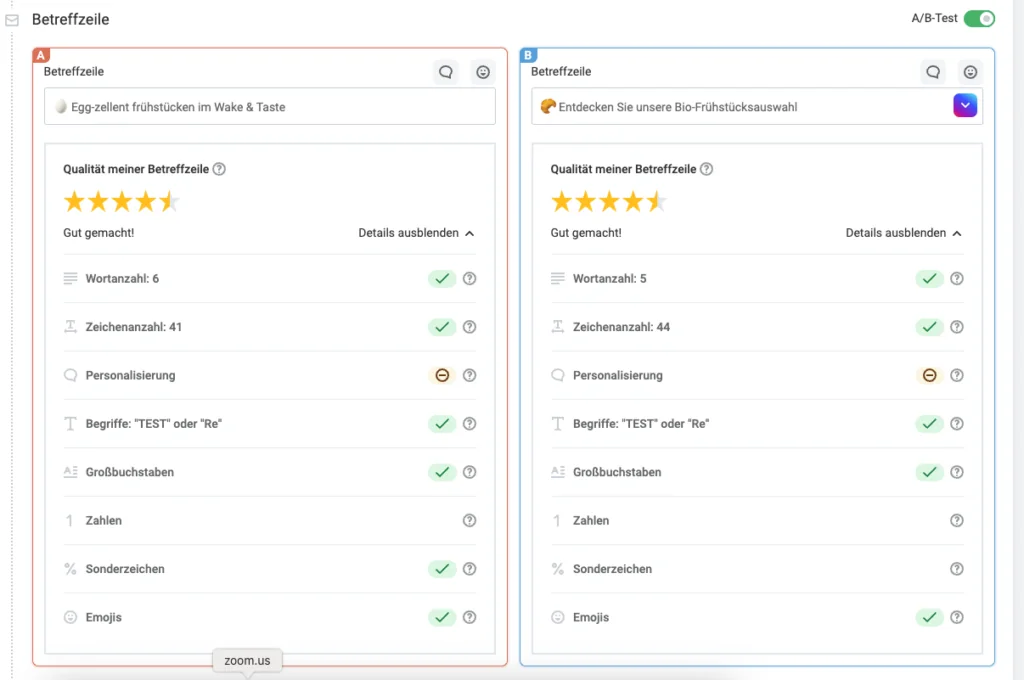
Have you already done many things right with your newsletter strategy? Then it is time for fine-tuning. Every send gives you an opportunity to improve your email campaigns a little further. A/B tests are ideal for this because they provide data-driven answers, for example about which subject lines truly appeal to your contacts.
What exactly is an A/B test? In an A/B test for your newsletter subject, you create two versions of the subject line. Half of your recipients receive version A and the other half version B. You then assess which performed better based on opens, clicks or conversions.
Through A/B testing and continuous analysis of your newsletter campaigns, you can gradually establish what works well, what does not and what you can optimize further to continue increasing your email marketing ROI.
👀 Did you know?
rapidmail makes it easy to create A/B tests for your newsletter subject and sender profile. You decide how long the test runs and how many recipients participate before choosing a winning variant and sending the winning campaign to the rest of your contacts, either manually or automatically.
7. Maintain your email list
When considering email marketing ROI, many people first think about content, automations or newsletter design. But there is another crucial factor that many overlook: the quality of your email list.
A large list is worthless if a high proportion of the contacts are inactive or no longer exist. Outdated or purchased email addresses cost money, reduce the delivery rate and distort your campaign statistics. As a result, your emails land in spam folders more often, important insights from tests are inaccurate and your resources do not produce the desired effect, so ROI is significantly lower.
Why it is worth regularly “cleaning out” your contact lists:
- 🧹 Higher delivery rates: Fewer bounces and a better reputation with email providers.
- 🧹 More realistic statistics: Only active contacts provide meaningful open and click rates.
- 🧹 More efficient use of resources: Less wasted coverage and better performance per newsletter.
- 🧹 A foundation for long-term success: A well-maintained list is the basis for sustainable email marketing.
💡 rapidtip

Would you like to win new subscribers for your newsletter? In our guide to building a newsletter list, we explain how to collect the right contacts legally, putting a high email marketing ROI within reach.
Conclusion: Use ROI as a management tool for successful email marketing
ROI shows how profitable your newsletters really are and makes email marketing success measurable. By defining clear goals, tailoring newsletter content intelligently to your target audience and continuously optimizing your emails, you can increase profit over the long term without increasing your budget.
Use email marketing ROI as a compass and long-term management tool for successful campaigns. rapidmail supports you as intuitive, GDPR-compliant email marketing software.