Blog vs newsletter: Which is more effective?
 Lea·
Have you been sending a newsletter to your subscribers for some time? If so, you may have wondered whether you should also write a blog featuring useful tips and insights. Or perhaps you already have a blog and are wondering whether email marketing could help you distribute your blog content. We shed some light on the subject and take a closer look at both blogs and newsletters: when should you use each one?
1. First things first: Definitions of blogs and newsletters
Blog vs newsletter: two widely used terms in marketing. Both formats are designed to share content and are excellent ways to connect, and above all stay connected, with your target audience. But what exactly is a blog? What is a newsletter? What purpose does each serve? Does it even make sense to compare the two formats as “competitors”?
There are plenty of questions, and we aim to answer them throughout this article. Let’s get started!
What is a blog?
The term “blog” originally came from combining the words “web” and “log”, essentially a small notebook that can be viewed online and used to record information. Blogs were originally often similar to diaries.
That definition has since evolved. Blogs are increasingly used in a business context, not least because they are an excellent marketing tool. Company blogs address their particular target audience: potential or existing customers with specific questions or needs. Blog posts provide interested readers with engaging content and information that moves them one step closer to becoming loyal customers. Blogs therefore also serve as a communication tool.
👀 Did you know?
WordPress is one of the most popular tools for starting a blog. Its basic version is free to use, and you do not need any programming knowledge to get started.
Blog posts are generally published on your own website, whether the blog is written by an individual or a company. This makes them publicly accessible, and anyone who finds them through channels such as a Google search can read them.
The various blog posts appear in chronological order on the website and can be assigned to different categories as required. This helps readers find their way around and quickly locate relevant content.
Blog posts stand out for their depth of content. Information presented briefly and succinctly in newsletters or on social media can be explored fully and from different perspectives in blog posts.
As a blog author, you can adapt to your target audience and communicate with them as equals. You can tailor both the language and the content of your posts so that your audience remains engaged and always looks forward to new content.
What is a newsletter?
A newsletter is a type of circular that is usually sent by email and therefore arrives directly in the recipients’ inboxes. The people receiving your newsletter subscribed to it beforehand, actively choosing to receive your emails.
👀 Did you know?

Subscribers must complete a double opt-in process when signing up for your newsletter so that you can send it in a legally compliant way. You may only send them emails once they have confirmed their email address.
A newsletter always communicates a particular message. Its subject matter can be extremely varied: you can use your newsletter to highlight discount campaigns and summer sales, announce ebooks or white papers, publicize a change of employee, invite people to online or offline events, or introduce new product features. Whatever industry you work in, you are guaranteed to find engaging newsletter content!
In theory, you could of course communicate exactly the same content through social media or your blog. A newsletter, however, ensures that subscribers are actually reached, unlike social media posts whose reach may be restricted by the platforms’ algorithms depending on the content.
👀 Have you seen this?
Is newsletter marketing still new territory for you? No problem, we have just what you need: our content manager Wiebke explains how beginners can get started with their first newsletter. The video is part of a newsletter course that teaches you everything important about email marketing, step by step. Roll the film! 🎬
Open video transcript
Chapter 1: Introduction
Welcome to my newsletter course, which will turn you from a beginner into a real expert. There are 12 episodes in total, teaching you step by step how email marketing works and how you can achieve your goals.
Today we are starting right at the beginning with the most important basics: what exactly is email marketing? Is it really still worthwhile today? And what can you actually achieve with newsletters?
Chapter 2: Definition: What exactly is email marketing?
As the name suggests, email marketing is a form of advertising that uses emails. For example, you send newsletters to a list of contacts to provide them with specific information or encourage them to make a purchase.
The most important point is that you only contact people who have previously agreed to receive the emails. When done correctly, email marketing therefore has nothing to do with spam or fraud. Quite the opposite: your contacts actively sign up to receive your emails themselves!
We take a detailed look at how you can collect contacts for your mailing list in episode 2.
Chapter 3: Is email marketing still worthwhile today?
I often hear people asking whether email marketing is still worthwhile today. That is understandable, because topics such as influencer marketing and social media are currently on everyone’s lips. BUT the relevance of email marketing has actually increased steadily in recent years. rapidmail discovered this in an extensive survey of nearly 800 companies! I’ll link the study in the information box so you can read through the results at your leisure.
The fact is that email marketing is still one of the most profitable advertising channels. For every euro invested, you get between 35 and €42 back.
And that is just one of many benefits:
Chapter 4: Benefits of email marketing
Unlike social media, email marketing does not make you dependent on algorithms, apps or updates: your contact list belongs to you alone. Or think of expensive television advertising, where your advert is seen by so many people who have no interest in your offers. Email marketing gives you a direct connection to your potential customers, so there is much less wasted coverage than with other advertising channels.
You alone decide which messages you want to send your readers. If you can appeal to your contacts with your content, they will develop trust and a close relationship with your brand.
Emails have a huge reach because almost everyone has at least one email address. And nowadays, we no longer read our emails only on a computer, but also on a smartphone while out and about. You can therefore reach your target audience virtually anytime and anywhere: you decide when.
Email marketing is also relatively inexpensive. Depending on the software, you can get started for between 7 and €20 per month. Or you can choose a tool that lets you try things out and pay only for each actual send, without a monthly subscription.
Best of all, the emails are not simply sent into the void. Immediately after sending, you can see how successful your emails are. Metrics such as open and click rates are collected automatically, showing you how well your emails are received by your target audience.
If you are now thinking that you do not have enough staff, time or prior knowledge, I can reassure you: professional email marketing tools offer many useful features, such as a drag-and-drop editor and stylish design templates, so you can create your emails quickly and easily. You really do not need to be an expert!
Sounds good, doesn’t it? Now let’s look at what you can achieve with email marketing in practical terms.
Chapter 5: Goals you can achieve with email marketing
You can win new customers. Once you have sparked your contacts’ interest and they have subscribed to your newsletter, you can maintain that connection through your emails and gradually increase their interest until they are convinced by your offers or products and become paying customers.
You can then immediately improve customer loyalty. If your contacts repeatedly receive positive, helpful emails from you, they are likely to return, remain loyal, identify with your brand and simply love it!
You can also shape your company’s image by using your emails specifically as a mouthpiece. You have the opportunity to share exactly the information that matters to you, actively helping your company make a good impression and become associated with positive values among your target audience.
This also increases brand awareness. Recurring emails that contain your company’s name, values and products increase your visibility and, over time, recognition of your brand.
And all of this is reflected in revenue. Marketing emails offer many ways to encourage your target audience to make a purchase, for example through discount codes or special offers.
Chapter 6: Conclusion
So, now you know exactly what email marketing is and that it offers you a host of benefits. In the next lesson in the newsletter course, you will learn how to build your contact list effectively and in a legally compliant way. Do watch the episode straight away.
If you enjoyed the first lesson of “Learn email marketing”, please give the video a thumbs up.
What are you hoping to learn from this newsletter course? Let me know in the comments so that I can address it in the upcoming videos!
2. The goals and purpose of blogs
Blogs primarily aim to communicate content and use it to build trust with readers. Blog posts allow you to demonstrate your expertise and set yourself apart from the competition.
At the same time, you can present yourself to readers as “human” and approachable. The language in a blog should not be too formal. Instead, write with wit, ease and straightforward sentence structures so that your posts are understandable even to non-experts. It is best to consider your target audience and their level of knowledge in advance so you can adapt the language of your blog. If, for example, your blog circulates in academic circles and contains academic information, a different style of language will be appropriate than for a blog aimed at school students.
There are initially no limits on the content of blogs: there is no fixed character count. You are entirely free to decide how detailed a blog post should be. This makes it all the more important to devise a good structure that gives readers an overview of the content. Take care not to lose focus: meaningful headings and enough paragraphs make it easier for readers to keep track. You can add a newsletter sign-up form to your blog. For example, you can make signing up appealing by promising that readers will never miss exciting blog content again or will receive a small gift for registering. The good news is that this turns your blog readers into newsletter subscribers, an important step toward winning customers.
The rapidmail newsletter
Tips, ideas and news about email marketing, straight to your inbox.
From a Google query straight to your blog
Your blog is also an excellent way to generate attention for your company. Search engines make it easy for people interested in your content to reach your blog. It is best to include search-engine-optimized terms in your posts so they can be found as easily as possible. When potential readers search for topics covered by your blog, it helps if your post does not appear too far down the results list. This can multiply your reach.
An example: If someone searches Google for a question such as “Do I need to trim my hedge in the fall?”, ideally they will land on your blog post entitled “How to prepare your garden for fall”. There, they will not only find the information they need, but cleverly placed links will also lead them to your online store to buy the necessary gardening equipment. You can find countless tips online for optimizing blog posts for search engines such as Google!
3. The goals and purpose of newsletters
Newsletters, on the other hand, often serve to communicate urgent information. The content may have a time limit, as in the case of discount campaigns, or be exclusive, such as an invitation to an event.
Their main purpose is to keep readers up to date on a regular basis. Recipients see in their email inbox that there is news from you or your company and can usually get a rough idea of the content from the subject line. Subscribers do not need to actively look for the content; instead, the content is automatically brought to them.
Unlike your publicly available blog content, you can use special content to give newsletter readers a sense of exclusivity. Make sure you regularly send content such as discount codes by newsletter that is reserved exclusively for your subscribers.
Newsletter goals and target audiences
To achieve newsletter goals, we can divide recipients into three broad groups:
- New customers: Your aim is to use newsletters to increase awareness of your business and thereby expand your customer base.
- Existing customers: You want to retain existing customers over the long term and encourage them to make further purchases.
- Former customers: You want to reactivate inactive customers and win them back. You managed to convince them once before, so why not do it again?
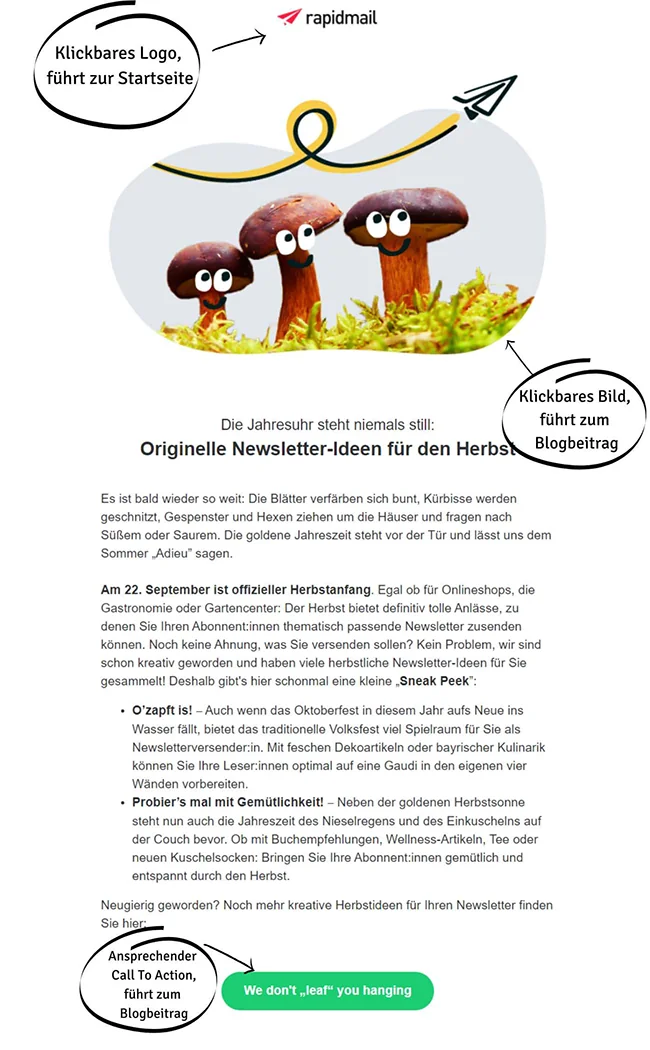
💡 The right newsletter strategy makes all the difference
Draw up a rough sending plan in advance, covering both the frequency and the content of your newsletters. Perhaps you have ideas for newsletter series whose themes complement or build on one another? The calendar year and public holidays also provide useful inspiration: they contain numerous occasions for sending a special newsletter.
Sending newsletters with rapidmail
Achieve successful newsletter delivery with rapidmail. In our email editor, you can save various elements, such as your company logo or legal notice, and reuse them whenever you need them. You can also edit images directly in the tool using our practical image editor, choose from ready-made templates for all kinds of occasions, or even automatically create newsletters in your corporate design with 1-click design. You also receive instant feedback on your subject line and can review all the important details before sending: have you selected the correct recipient list? Does all the formatting look the way you intended?
Once the newsletter has been sent, you can also analyze the data. This allows you to optimize your newsletter over time.
4. Blog vs newsletter: A comparison
Now that you have an initial overview of newsletters and blogs, you may be wondering which medium is best suited to keeping in touch with prospective customers. That is why we have created a comparison covering all the important aspects:
| Blog | Newsletter | |
|---|---|---|
| Scope of content | In principle, a blog post can be as extensive as the topic allows. There is no character limit. | A newsletter tends to be kept short and contains only the most important and essential information for a quick overview. Links direct interested readers to detailed information on the website. |
| Time required | Depending on the topic and scope, writing a good blog post can take anywhere from several hours to a few days. After the research comes the writing. You should also include a few images or graphics to illustrate the content so that readers are not confronted with an enormous block of text. | Brevity is the soul of wit, and this also applies to newsletters. Creating one is therefore not too time-consuming. Newsletter software saves you even more time by letting you use pre-designed templates and check various details directly in the tool. |
| Writing style | You have complete freedom here! Our tip is to keep your language relaxed and create a sense of connection by communicating with readers as equals. | A newsletter should be engagingly written and have a personal touch. This sense of connection can be created both through informal copy and by addressing recipients personally. |
| Visual design | Because blog posts are long, presenting them clearly is important. Emphasize headings and use paragraphs so that blocks of text do not become too long and confusing. Graphics help readers understand the written content more easily. | Design your newsletter intuitively so that readers can easily find their way around and click through it. The ideal text-to-image ratio and an appealing newsletter design are especially important. Headings, the subject line and the sender also immediately catch readers’ attention. |
| Customer loyalty | Your blog readers do not automatically belong to your regular readership. They have probably reached your blog through a social media link or a search engine. Ideally, readers should subscribe to your newsletter or follow you on social media so they become aware of new blog posts. | Newsletters make it easy to build customer loyalty. Because your subscribers have agreed to receive regular content from you, there is nothing else to do on that front. Now you simply need to deliver good content and keep readers engaged with your newsletter over the long term! |
| Content | You can research and explore a wide variety of topics relevant to your industry in depth. There is probably far more potential here than you initially imagine. | A newsletter touches on topics more briefly. It is more about informing readers and using concise facts to persuade them to visit your website or blog. News tickers, articles for further reading, discount campaigns and new product features can all fit in a single newsletter. |
| Visibility | A blog is visible to everyone because it is published on a website. Readers do not need to register in advance to access the content. | A newsletter lands directly in subscribers’ inboxes. The content is therefore guaranteed to reach only the people who actively chose to receive the newsletter. |
| Shareability | Both you as a blog author and your readers can share blog posts on social media, for example. Links to the posts can also be sent privately from one person to another. | Your readers can forward the newsletter to other people by email. Newsletters are less likely to be shared on social media, but you can promote them there. To gain new subscribers sustainably, these people must also sign up for your newsletter. |
5. How blogs and newsletters support each other
As the saying goes, teamwork makes the dream work. This also applies to combining blog posts and newsletters. Each has its own strengths, but the coordinated and thoughtful use of both marketing activities can help you achieve great things. We have developed an example process showing how blogs and newsletters can support one another:
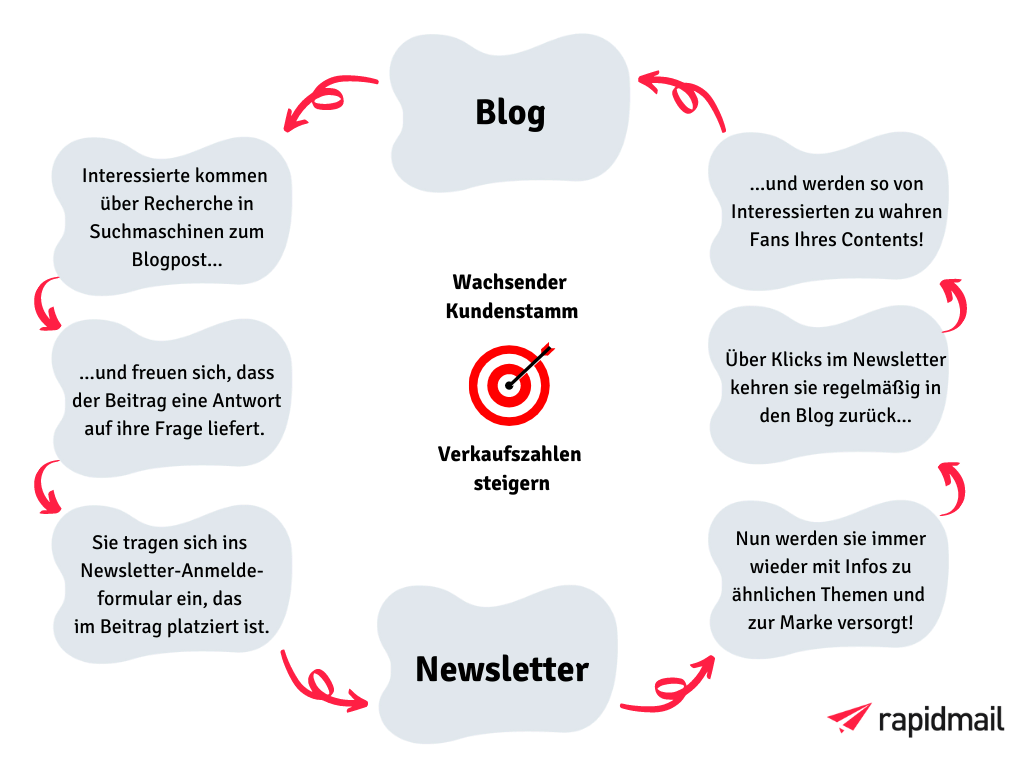
As you can see, using a blog and newsletter together creates a win-win situation. The process shown above begins with writing the blog post. This is not essential, of course, but the resulting post provides an excellent opportunity to align the newsletter with the same topic and include it in the campaign.
What you gain: Ideally, these marketing activities can even increase your revenue and help you welcome new customers. Your reach also grows.
💡 rapidtip
We recommend that you do not take on too much at once. Start small, for example by sending newsletters first. Once you feel confident and can accurately estimate the time required, the next step is to begin collecting blog ideas and gradually build a blog.
6. Conclusion: Working hand in hand for the best results
We have learned a great deal in this post, including that there is no clear answer to the question “Blog vs newsletter: Which is more effective?” A blog provides the foundation for building trust with readers and creating a relationship with your company, while a newsletter promotes the blog and ensures that interested readers become regular readers. A blog communicates industry-specific knowledge and expertise that can set your company apart from the competition, while acquiring customers and selling products, for example, is easier with a newsletter.
The circle of marketing
Think of it as a cycle that repeatedly connects different levels. You include the newsletter sign-up form in the blog post so that your recipient list grows and readers hear about future blog posts. At the same time, you link to blog posts in your newsletters, which is how some subscribers first discover your blog.
Whichever route they take, linking a blog and newsletter is incredibly efficient in marketing. If you have the time and resources for both formats, and you also enjoy writing a blog, our recommendation is simple: get started!
If you are completely new to the field, we suggest first planning content for a handful of newsletters and starting with those. This allows you to build a recipient list and consolidate your reach before adding the blog. Over time, you will certainly be able to judge whether your subscribers would like a blog where they can learn more about the topics you have introduced.
Try it for yourself!