50 years of email marketing history: Happy birthday, email!

Wow, email turns 50 this year. Happy birthday! To celebrate, we are looking back at the most important moments in the history of email marketing, which began in 1971. And we are just a little proud that rapidmail is playing a part in continuing the story of email.
1. Written communication before email, before 1971
When did you last send a handwritten letter? It was probably quite a while ago, wasn’t it? Yet from the beginning of the 19th century, the letter was the communication medium par excellence. Letters did not just carry important messages and news of public interest to other towns. They were also the medium for private exchanges between family members and friends living far apart, for example. Today, it is hard to imagine having to allow several weeks for delivery.
Alongside letters, the newspaper also played an important role as a medium in the 19th century. Daily newspapers brought the latest news and opinions on matters of public interest to the public in particular. But at the time, newspapers were far from a mass medium: because print runs were usually only a few thousand copies, daily newspapers generally reached a small readership.
The invention of the printing telegraph in 1837 allowed Samuel Morse to set a milestone in the history of modern wired telecommunications. The Morse code he developed for it made it possible to send telegrams using electrical sound signals. From then on, this innovation meant messages could not only be sent incredibly quickly, but could also reach far more recipients in distant regions. From 1866, an undersea cable made it possible for the first time to send a message from Europe to the USA in just a few minutes.
Before email achieved its breakthrough, messages were sent in the middle of the 20th century using the first two electronic processes for transmitting messages: teleprinting, also known as Telex, and its more advanced successor, Teletex. Both methods are scarcely known today. Alongside the arrival of far more modern fax technology, one technical innovation in particular drove these first two electronic transmission methods out of the market: email!
2. Ray Tomlinson and his first email revolutionize communication, 1971
“Sie haben Post!” (“You’ve got mail!”) This legendary announcement when new email arrived was not only memorable to AOL users. The well-known romantic comedy “e-m@il für Dich” (“You’ve Got Mail”) also helped the phrase evoke an almost nostalgic feeling by the end of the 1990s.
Those were the beginnings of good old email… weren’t they? In fact, the history of email goes back much further. Ray Tomlinson was the US computer genius who made history with his invention in 1971. The 30-year-old computer engineer, who worked for the research company BNN, had been tasked with building Arpanet, effectively the forerunner of the internet. In the process, he developed a protocol that made it possible to transfer files between different computer systems.
This project laid the foundations for the history of email. Tomlinson had the brilliant idea of using it to “build” a communication service that would also make it possible to send messages between two computers. He later said he simply thought it was a “neat idea”. A modest assessment when you consider how different today’s world would probably be without email communication.

So there was Tomlinson in 1971, sitting in his small office with several computers, machines as tall as our wardrobes are today. And he assigned the very first email address to himself: tomlinson@bbntenexa. Since no other email addresses existed yet, endings such as “.de” or “.com” were not necessary.
What happened next revolutionized the history of communication: he sent the very first email ever. He sent it from the computer in front of him to the computer right beside it. Unfortunately, Tomlinson was later unable to remember the content of the email. At the time, he never imagined he was making world history. Quite the opposite: because he was supposed to be working on a different project, he even tried to cover up his ingenious invention. He showed it to his colleague and asked him not to tell anyone under any circumstances, because he was afraid his boss might be angry.
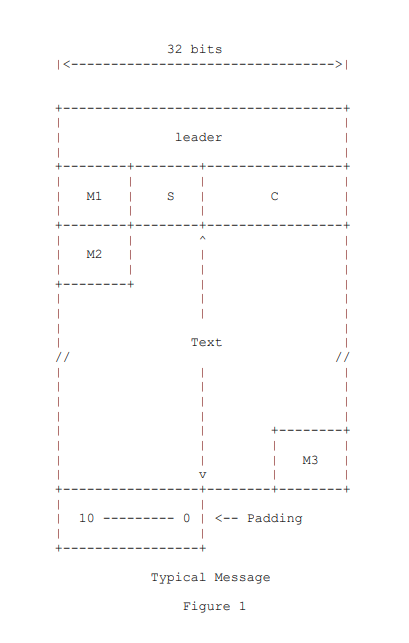
Tomlinson’s first email address, tomlinson@bbntenexa, shows that the invention of email also marked the birth of the @ symbol, or “at sign”, in our email addresses. Tomlinson placed the recipient’s name before the at sign and the host name of the computer to which the email was delivered after the symbol. But why did he choose @?
He needed a symbol to separate the recipient name from the host name. Logically, it had to be present on the computer keyboard, but could not appear in personal or company names. That automatically ruled out letters and numbers.
Unlike other symbols on the keyboard, “@” had an additional advantage. Its established name in finance, “at”, could also be understood as assigning recipients to a location in email addresses. Email addressing still follows this logic today: an email to “support@rapidmail.de” is a message to the rapidmail support team in Germany. Tomlinson’s decision to use @ made the symbol famous around the world!
👀 Did you know?
The @ sign only became famous in Germany in the 1990s, where it was known as “Klammeraffe” (“spider monkey”). Other countries certainly did not lack creativity or a fondness for animals when naming the new trending symbol either, for example:
- Denmark: @ is called “snabel-a”, literally meaning “elephant’s-trunk a”.
- Italy: It is also called “chiocciola”, meaning “snail”.
- Czechia: The chosen name was “zavináč”, meaning “rollmop herring”.
- Hungary: @ is called “kukac”, meaning “worm”.
- Kazakhstan: It is called “aikulak”, which means “the moon’s ear”.
- Greece: The at sign is called “παπάκι”, pronounced “papaki”, which means “duckling”.
- Russia: @ is called “собака”, pronounced “sobachka”, meaning “dog”.
3. The first marketing email is sent, 1978
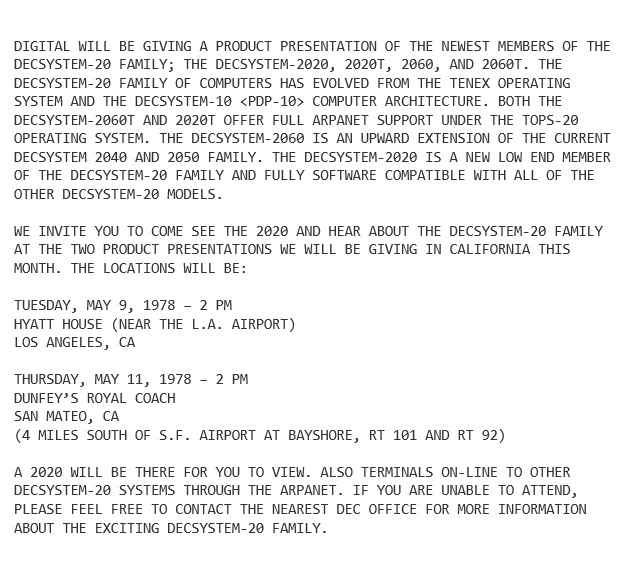
Seven years after email was invented, Gary Thuerk, who worked in marketing for Digital Equipment Corporation, sent the very first marketing email to around 400 recipients. Although it was only a very simple text message, the email generated 13 million in US currency in revenue and made companies around the world sit up and take notice.
From today’s perspective, the marketing email was actually also the first spam email ever sent. Gary Thuerk had not obtained permission from the 400 people he contacted before sending them the email. But at the time, nobody was thinking about legal requirements for sending emails or processes such as double opt-in. Together with a colleague from IT, Thuerk simply compiled a list of recipients from Los Angeles and California and invited them to a product presentation by his company.
However, the send ran into what we might now call deliverability problems: a buffer overflow meant the newsletter only reached 320 recipients.
4. The first email reaches Germany, 1984
It took a few more years for email to cross the Atlantic and reach Germany. Then, in 1984, it finally happened: one day after it was sent, the first email in Germany arrived in the inbox of Karlsruhe professor Michael Rotert. The message was a greeting to “rotert@germany”, with project manager “zorn@germany” copied in.
The sender of the email was Laura Breeden from the American computer network CSNET, and the subject line was “Wilkommen in CSNET!” (“Welcome to CSNET!”). She had even taken the trouble to write the subject line in German. The missing second “l” in the German word “Willkommen” probably did not bother Michael Rotert much. After all, at that moment he went down in history as Germany’s first email recipient!
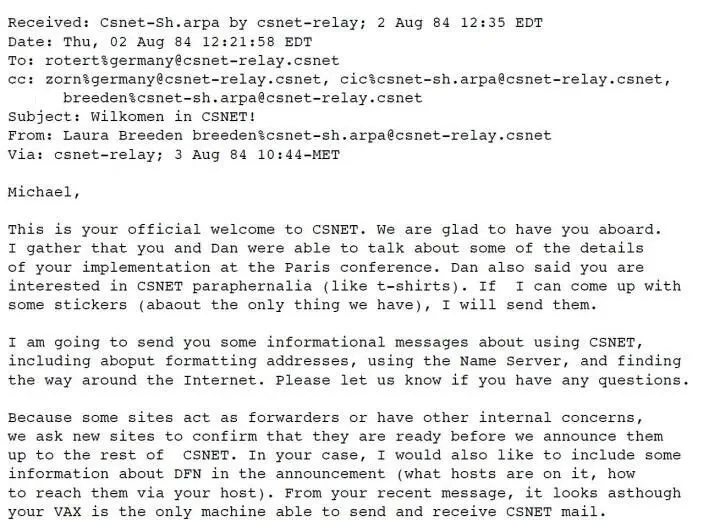
The email structure, with a header area and the main section below, was already similar to the format we know today. However, the message contained no colors or design elements. What is more, sending and receiving private emails both cost money at the time: around 20 cents per message!
5. Email spreads with the invention of the internet, 1989
At the beginning of email’s history, only universities and other research institutions could send emails via a mail server. After the first email from the USA reached the university in Karlsruhe, other institutions connected to its mail server. Email communication therefore spread quickly throughout the research sector.
By the end of the 1980s, more and more PCs were being purchased in Germany and were increasingly used for word processing at home and at work. With the emergence of the internet from 1989, electronic communication opened up entirely new possibilities for individuals and companies. From then on, email increasingly made its way into our daily lives and our inboxes.
Companies quickly recognized the enormous opportunity offered by email communication with customers and prospective customers. However, widespread email marketing was not yet an option in the early 1990s because there were no free email providers at the time. Emails were therefore used mainly by company employees in a professional context.
👀 Did you know?
Even before we sent emails to friends and acquaintances from our free email addresses, email had already traveled much further. The first email from space was sent in 1991. Astronauts Shannon Lucid and James Adamson sent the following message to their colleague Marcia Ivins at NASA’s Johnson Space Center:

Email and its features developed rapidly throughout the 1990s. From 1992, for example, it became possible to send emails with attachments. At first, however, this presented developers with a new problem: attachments were often so large that the limited storage space in the recipient’s inbox quickly filled up. So the 1990s were certainly not dull on the internet and email front.
6. The first free email provider, 1996
In 1996, the time had finally come: Hotmail, now Outlook, became the first free email provider available to the general public! Other providers quickly followed. In no time at all, using and managing a personal email inbox became so simple that there have been no major changes to inbox structure since then.
Now that anyone could create an email inbox free of charge and send messages to friends and family, usage figures rose rapidly. In the private sphere, email was initially often used for everyday communication and personal exchanges, much like we use messaging services such as WhatsApp or Facebook today.
7. Email goes mobile, 2007
In the age of flip phones, the Internet Explorer icon was the enemy on your mobile screen. Whatever you did, you had to avoid tapping it! If your finger slipped and you opened it anyway, you were immediately punished with an extremely high mobile phone bill. Over time, using the internet on a mobile phone became easier and cheaper, until it was eventually included in most monthly mobile plans.
Apple then had the idea of bringing email from the PC to the mobile phone. In 2007, the company launched its first smartphone, the iPhone, complete with a mobile email app. iPhone users could now read their emails from anywhere, including on their way to work or during their lunch break. Mobile email apps for Android smartphones and other email providers followed shortly afterwards.
The rapidmail newsletter
Tips, ideas and news about email marketing, straight to your inbox.
8. rapidmail launches its newsletter tool, 2008
Email became increasingly popular, both for private use and among companies. Many businesses had already recognized the opportunity and regularly sent promotional newsletters to their customers through their internal systems. However, a common problem was that many of these newsletters ended up in customers’ spam folders. Naturally, this severely limited the success of their email campaigns.
As a result, several professional external newsletter providers emerged to make it easier for companies to create and send successful newsletters. This was also how the rapidmail newsletter tool came into being in 2008. With its extensive, modern newsletter features, the practical software not only saved companies and marketing agencies work in many different ways. It also increased the revenue companies generated from sending newsletters. In-house deliverability experts ensured an ideal sending infrastructure, meaning company newsletters no longer ended up in customers’ spam folders and instead arrived reliably in their inboxes.
Before founding rapidmail, we worked in software development for other companies. We noticed that hardly any company used professional email marketing software. Promotional newsletters were sent through internal systems, but with only limited success. What was missing was a proper sending infrastructure. That is what we delivered with rapidmail. Our newsletter tool was well received immediately!
– Sven Kummer, Managing Director of rapidmail and involved from the very beginning
With ready-made, modern newsletter templates, rapidmail also enabled companies to position products intelligently in customer campaigns with just a few clicks and direct prospective customers straight from the email to their website or shop.
In 2022, rapidmail went one step further with 1-click design: 1-click design lets you create individual newsletter templates in your corporate design, complete with your company colors and fonts, logo and even social links. All you have to do is enter your website URL and click the “Continue” button. See for yourself!
9. The GDPR turns email marketing upside down, 2018
In 2018, the EU enacted a common General Data Protection Regulation (GDPR) governing the protection of personal data. It applies to anyone who processes personal data such as the names or email addresses of EU citizens.
Email marketing was also shaken up by the changes introduced by the GDPR. Greater attention was paid to protecting the data of customers contacted by newsletter. From then on, unlawful mass emails and spam were to be prevented. Newsletters could no longer be sent across the EU without the recipients’ express consent. Specially developed procedures such as double opt-in therefore became increasingly important for companies sending newsletters.
The new regulations also increased sending companies’ general interest in the legal requirements for email marketing. Companies wanted to ensure that they did not face unnecessary data protection lawsuits from customers. Businesses were therefore also forced to stop sending newsletters to purchased email addresses and rebuild their newsletter lists from scratch.

10. Happy birthday, email: email marketing 50 years later, 2021
Fifty years after Ray Tomlinson worked on the very first email in his office, email can look back proudly at its own development! The success of email and email marketing remains unbroken, as the following figures show:
- Around 3,000,600 emails are sent worldwide every second (Internet Live Stats, as at 25/02/2021)
- 98% of all companies use email marketing to communicate actively with customers, compared with 95% in the previous year. (Study by DDV & absolit Dr. Schwarz Consulting, 2021)
- 91% of all companies offer a regular email newsletter, 6% more than in the previous year. (Study by DDV & absolit Dr. Schwarz Consulting, 2021)
The following overview from Google Trends also shows that general interest in email and newsletters has continued to increase in recent years:
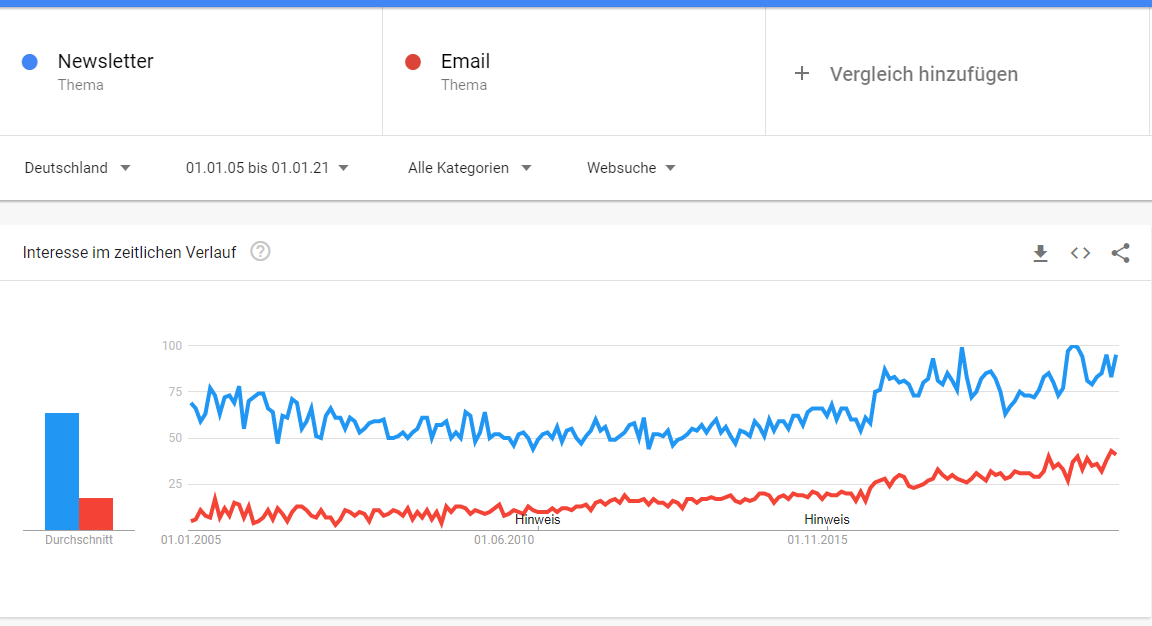
Although email use is declining slightly in the private sphere, the trend in the business sector continues to rise steadily. The year 2020 gave email and newsletter sending another boost. During the coronavirus pandemic, numerous companies moved their activities online and increasingly relied on communication by email newsletter.

A great deal has also changed technically over 50 years of email marketing history. Newsletters and emails have long contained far more than just text. Professional email marketing tools now offer numerous features that allow newsletter content to be tailored even more closely to its communication objective, such as:
- 🖼️ Adding images to emails
- 👆 Adding linked call-to-action buttons
- 🎯 Segmenting the customer list into different recipient groups
- 💌 Personalized campaigns, such as personalized customer greetings
- 📱 Extensive options for optimizing newsletters for mobile devices
- 👀 A preview function before sending
- 🆚 A/B tests for comparing different subject lines
- 🔄 Transactional emails
- ⚙️ Marketing automation
It seems that email has grown up at some point over the past 50 years. Even so, we are certain that it will continue to grow and explore new, uncharted territory in the future. We are thrilled that, as email marketing software, we can play a part in shaping the future of email, just as Ray Tomlinson did with a generous helping of creativity, passion and motivation. As the rapidmail team, we occasionally feel like proud parents pulling a dusty photo album from the cupboard to remember email’s first steps. Then we look up and proudly see what the child has become: a big, beautiful email marketing tool brimming with potential. See for yourself: