Marketing expert Irene Theiß reveals her most important tips
 Lea·

Irene Theiß is a self-employed marketing consultant who helps other freelancers and small businesses establish customer relationships through email marketing and maintain them over the long term. In an interview, she shared her most important newsletter tips with us and explained what effective newsletter marketing requires.
1. Career path: becoming a self-employed marketing consultant
What led you to support companies with their newsletter marketing as a self-employed marketing consultant?
I have always liked newsletters because they are so targeted, because you can prepare them and test them yourself before sending them.
I first worked with newsletters during internships, before I even had my first permanent job. I also set up newsletters at the publishing companies where I worked afterwards. So newsletters have been part of my life for quite some time.
But becoming a self-employed email marketing consultant took a little longer: I was still in permanent employment until last year. I had thought about it from time to time, but I was still missing that spark of inspiration. First, I had to ask myself: “What am I actually best at?” Before that, I had worked as a project manager and marketing expert, which covered a very broad range of tasks. It was only later that I could say: “Okay, my focus and the field I really know well is newsletter marketing.”
Sending newsletters in three words: targeted, plannable and personal.
Over the course of last year, I noticed that many people were exploring sending newsletters and that many new newsletters were being launched. I also saw a genuine need to support this development and guide people right from the start: from building a list to their first emails and everything that follows.
2. Marketing formats and what they can offer
To win new customers and keep existing customers and other interested people up to date, you use your own newsletter, your blog and Pinterest. Did you start “on a smaller scale”?
I started by publishing blog posts. Once I had published the first four or five, it became worthwhile to promote them on Pinterest. You can work with keywords very effectively there, helping interested people find my blog. That is also my general strategy: I create content for my blog that people can find through Pinterest and Google. Once users have arrived on my blog, I want them to subscribe to my newsletter next. This lets me actively keep them informed and notify them directly when there is news on the blog, such as important newsletter tips.
3. Expert tips for sending newsletters
If you had to be brief, which three adjectives would you use to describe newsletters as a marketing activity? And what sets them apart from other marketing activities?
Targeted, plannable and personal. Other marketing activities often have just one of these qualities, but the combination of all three really only exists when sending newsletters. That is what makes them special in my view.
Do you follow a routine when creating your newsletters? What does it look like?
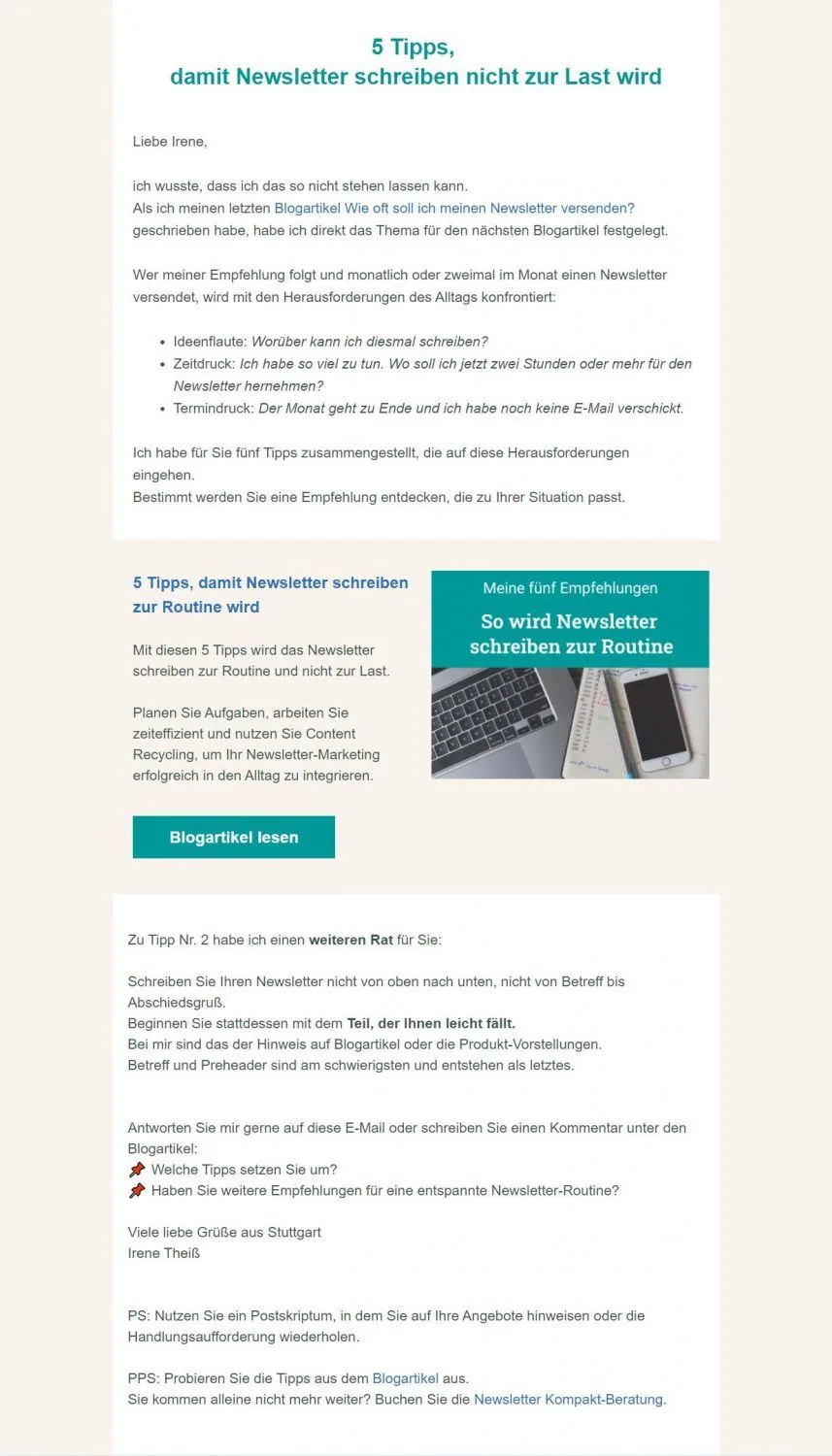
I have a structure that I follow when I design and assemble a newsletter online. Of course, I first consider what it should be about. But then I begin neither with the subject line nor the introduction; I start in the middle.
I actually write the subject line last. For me, it is the most creative part of the process, because the subject line has to hit the mark.
For product newsletters, the middle is where I compile the product information being promoted. If the newsletter is informative and links to a blog post, I start with a summary of that post.
Once the middle section is in place, I gradually work through the rest: next I write the introduction, followed by the closing section and sign-off, and then add a call to action.
I actually write the subject line last. For me, it is the most creative part of the process, because the subject line has to hit the mark. Once I have reviewed all the content and engaged with it closely, I find it easier to get an idea for a successful subject line.
Would you say newsletter senders need to create a concept or some kind of sending plan? Is there a “golden rule of thumb”?
For me, having a routine for sending newsletters is important, if only to remind myself that I want to send something regularly. A sending plan helps many people. With a plan, you can specify exactly when you want to send a newsletter, for example every other Tuesday or on the first Wednesday of the month. This gives you something to work toward. You know the newsletter has to be ready by then. Sending the newsletter becomes a scheduled task instead of slipping onto the “someday” to-do list.
Despite all the planning, another great thing about newsletters is that the planning process remains flexible. If something worth mentioning happens in the meantime, you can simply send an additional newsletter that may not have been scheduled beforehand.
What is the best way to start newsletter marketing once you have gained your first subscribers?
There is no beginning or end in newsletter marketing. […] More and more readers gradually join, and for each of them it is a “new first newsletter”.
At first, I drew on the blog posts I had published up to that point. Online shops, for example, tend to focus on seasonal occasions or current products that they can promote in their newsletter.
I think you have to let go of the idea that newsletter marketing has a beginning and an end. Instead, the newsletter has to suit the current situation for both the sender and the contacts, and then you simply have to get started. More and more readers gradually join, and for each of them it is a “new first newsletter”. Once you have gathered some content that feels like a suitable introduction, I would recommend setting up a welcome sequence. This is a set of fixed content that you send out first. It is a good way to welcome newcomers. After the first four or five emails, they then move on to the regular newsletter schedule.
Let us hear some insider tips: what are your top three secrets for a successful newsletter?
- The first thing I would mention is the content: you should not confront readers with too much information or abrupt changes of topic, and the calls to action in the newsletter should also fit the content. The design can communicate this effectively: the most important piece of information gets the largest and most prominent call-to-action button so that it immediately catches the eye.
- This also involves the newsletter structure: the most important information belongs at the top. Newsletters are not necessarily read in full; they are often only skimmed. Important information should be clearly recognizable as such.
- My third tip concerns the newsletter subject line: you should definitely take the time to get it right. The subject line should be creative and unambiguous.
What does a successful newsletter subject line look like to you?
It should be short enough to display in full in different email clients, without the most important part disappearing behind an ellipsis. It should spark curiosity and entice me to open the email to learn more.
Another approach, in contrast to “sparking curiosity”, is to make the subject line completely clear and directly express what the email is about. This can also prevent subscribers from becoming annoyed by the newsletter if the content does not interest them this time. If you are promoting a campaign, you can state that directly in the subject line so that those who are interested open the newsletter immediately.
You send your newsletter every other Tuesday. How do you determine the best time to send it?
That is a good point and one that seems to concern many people: I am asked this question quite often. There is no single correct answer, and I personally do not think the sending time is all that important. The factors you can use as a guide differ from one sender to another.
If I use anything as a guide, it is my website statistics: when are most visitors on my site? That is a time when my newsletter readers are also online and engaging with the topic. To me, that is far more meaningful than making a blanket statement that newsletters should be sent on Fridays or Wednesdays, never on weekends or always in the morning.
It is more of a learning-by-doing process that you can adapt and change over time. You look at the makeup of your own target audience. When did subscribers open the email? When did they click the links? This gives you a useful guide for determining the sending time.
Once the newsletter has been sent, how do you measure whether it was successful? Can you learn anything for future newsletters along the way?
I think it is important to find the right balance between evaluating qualitative and quantitative feedback.
With product newsletters, you can look at how much was actually sold as a result. When promoting blog posts, you can use customer reactions as a guide, for example. I receive feedback from readers by email, which helps me see whether people were genuinely interested in the topic. Then I know it is a topic for which I can publish more content.
I think it is important to find the right balance between evaluating qualitative and quantitative feedback. I repeatedly catch myself becoming fixated on the numbers, but feedback on the content is ultimately just as important: the numbers do not tell me whether my content is relevant and engaging. For that, I need specific opinions from readers.
Depending on the size of your contact list, A/B tests can of course be helpful. But they are not yet particularly meaningful for a small contact list. The differences are too small to provide much useful information for my analysis. That is why a combination of personal feedback and statistical analysis works very well.
In one of your blog posts, you write that you do not want to “annoy” people with your newsletter. What makes readers feel annoyed? How do you avoid that?
The idea that newsletters can be annoying came mainly from the fact that I am sometimes annoyed by them myself: if the content does not interest me or my inbox is overflowing with newsletters, it can certainly become bothersome.
I have also heard concerns from my customers that they might annoy people with their newsletter, for example if they send it too frequently. I have also heard from people who are generally critical of newsletters and put them all in the same category: “It is all just spam.” That is why it is personally important to me to offer relevant content and deliver it to readers who are genuinely interested. If people tell me that the content of the last newsletter was not at all to their taste, I want to prevent them from receiving more newsletters on that topic in the future.
This is where segmentation comes into play to some extent: do you divide your contact lists into groups?
So far, I have created three segments that give me an initial indication of what interests my readers. At the end of my newsletters, I also tell readers that they can contact me if a particular topic was not relevant to them so that I can make a note of it. I would much rather someone stop receiving newsletters about every topic than become annoyed at some point and unsubscribe from my newsletter altogether. You cannot engage every contact equally with every topic, so receiving this kind of feedback from readers is extremely important.
Do you personalize your newsletters? If so, why? How can you successfully use personalization in newsletters?
I personalize them to some extent. At the start, it is important not to make everything too complex or detailed. In my opinion, one thing you should do from the beginning is address recipients personally, and then use their name again later in the newsletter rather than only in the greeting.
If my target audience is quite diverse, it definitely makes sense to personalize text blocks and product offers or adapt them for the different target groups. If I try to appeal equally to everyone in my mixed audience, the content can quickly become completely vague and meaningless. I would rather adapt or replace individual blocks, or even send two newsletters.
Does that not take much more time? Is personalization in this form also feasible for small businesses with less time available?
Once the technical aspects are clear and you have established a routine for sending newsletters, you can get started with it. At the very beginning, there are more important factors that you need to become familiar with first. Once you know what to look out for and are no longer making mistakes, you can begin experimenting with personalized text blocks. It is really not that much extra work:
I can duplicate my newsletter draft and adapt only parts of it; I do not have to recreate the entire layout. Two completely separate versions of the content would probably require too much effort. You have to find the right balance for yourself, depending on your own priorities and circumstances.
How do you find relevant content for a newsletter?
In my view, there are always two considerations that need to be balanced. First, you ask yourself: what is relevant to me? What do I want to achieve? And not only in relation to this particular newsletter, but with regard to the bigger picture and your quarterly or annual goal.
Second, I try to find out what interests readers. This also includes questions asked by people who are not yet newsletter subscribers. Which topics bring people to my blog most often? What do people frequently search for on Google? This shows me which content is relevant to a broad audience and what may be relevant for my newsletter.
What should senders consider when designing their newsletter? Is the design just as important as the content?
I think the design plays a very important role initially. First, the subject line entices us to open the newsletter at all. Then the first impression when opening the newsletter either wins readers over or does not. Nevertheless, the same principle applies to both design and content:
Less is more. It should not be too garish or inconsistent, just as the copy should not be as long as a novel.
How important is the overall structure? Does it make a difference where images and links are placed, for example?
How you structure your newsletter is linked to how you want to present yourself through it. Should the newsletter feel personal, like an ordinary email, for example? In that case, the layout will tend to be simple and the design more pared back. This gives the whole newsletter a personal touch.
But there is also the opposite approach: a newsletter designed more like a magazine, with lots of images and colorful accents. As the saying goes, a picture is worth 1,000 words. Of course, this depends heavily on the image and its subject, but in some cases it also applies to newsletters. Rather than describing something in too much detail or in overly technical terms, a suitable image can support my copy.
Would you say that depends on the target audience? Can you say, for example, that older readers prefer traditional campaigns, while a younger audience would rather read brightly colored newsletters with lots of images?
I think it depends more on the topic than on age. We all belong to different target groups: we are drivers, parents and chocolate buyers. Different things apply to us in our personal and professional lives, so an individual can also be drawn to different newsletter designs.
Let us talk about newsletter signups: you can provide signup forms both online and offline. Are offline forms still worthwhile in our digital age?
I know examples where they work very well. This certainly does not apply to everyone and again depends more on what you offer. Events and courses that take place in a particular location, for example, are ideal opportunities to gain new newsletter subscribers through an offline signup form. If you interact with people in person, you should also provide an opportunity for them to sign up there.
Generally speaking, whether online or offline, very few people are inherently enthusiastic about subscribing to a newsletter. They need a specific reason that convinces them they will benefit from receiving it. You can, of course, attract them with freebies or other incentives, or simply persuade them that they will “always stay up to date”. In any case, most people need a reason that convinces them to sign up in the first place.
What information should a newsletter signup form on a website contain?
Above all, it is important to tell people what to expect when they sign up for the newsletter. This provides transparency, but also helps persuade them. You should immediately show subscribers the benefits of receiving the newsletter and give them a rough idea of what to expect in terms of frequency and content.
For legal reasons, only the email address can be a mandatory field. Nevertheless, I think it is perfectly legitimate to ask for a name as well, which customers can provide voluntarily. I am also a big fan of offering a choice of topics so that people can immediately select the content that is relevant to them.
But a signup form should not request too much optional information either. People are generally more willing to sign up if they do not immediately have to complete a questionnaire with dozens of fields. It becomes particularly problematic when customers cannot understand why the requested data is relevant or why they are being asked to provide their address, telephone number and so on straight away.
4. Her own services and working with rapidmail
 |
How did you become a rapidmail service partner? And what does that actually mean?
A rapidmail employee approached me. At that point, I already knew the tool, but I did not yet have any customers who also used it. When the service partner program was introduced to me, I realized: I would really love to get involved!
rapidmail’s entire style fits my own style very well, both in terms of the target audience and its external communication. When I browse the rapidmail blog, I very often think the same content could appear on my blog. These are recommendations I would make as well and things I also put into practice myself.
What I offer my customers is a service for rapidmail users who are looking for support beyond the standard support service. For me, the service partnership is naturally a great opportunity for people who do not know me yet to find me through rapidmail. And because they come from rapidmail, I already know the platform and understand how the processes work, so I can quickly help them take their first steps toward effective newsletter marketing.
Do you have a motto or piece of advice that you share with all your customers? What is it?
My recommendation once the newsletter has been fully set up is this:
Choose a sending frequency that is manageable. Once a month or twice a month, but I would not do more than that at the beginning, especially if resources for newsletter marketing are limited. You should then remain consistent.
Building the list is also important. At first, you may not have many readers yet and might wonder whether you should really send anything already.
💡 My tip:
Absolutely! Users deliberately signed up for the newsletter and are waiting for something to arrive. If they then hear nothing for two or three months, they will have forgotten about the newsletter again. This will have a negative impact on the number of newsletter opens.
So, start early, do not be needlessly hesitant because of the size of your contact list, and develop a newsletter routine and schedule that you can maintain.
5. Looking ahead: the industry in 10 years
Speaking as an expert, how do you think email marketing will develop in the future? Where will the industry be in 10 years?
I believe there will be further developments in personalization and in tailoring content. You can already see this to some extent: you click a link in an email and arrive on a landing page personalized for you, offering exactly the content that interests you.
I do not think email will disappear. We do not need to worry about that. People have been predicting the death of email for a long time. And I come from the publishing industry, where people have also been predicting the demise of newspapers, books and so on for quite some time. These are all media and formats that change, adapt and remain flexible. But they will not disappear.