Food manufacturer Hengstenberg: Newsletters connect us directly with customers

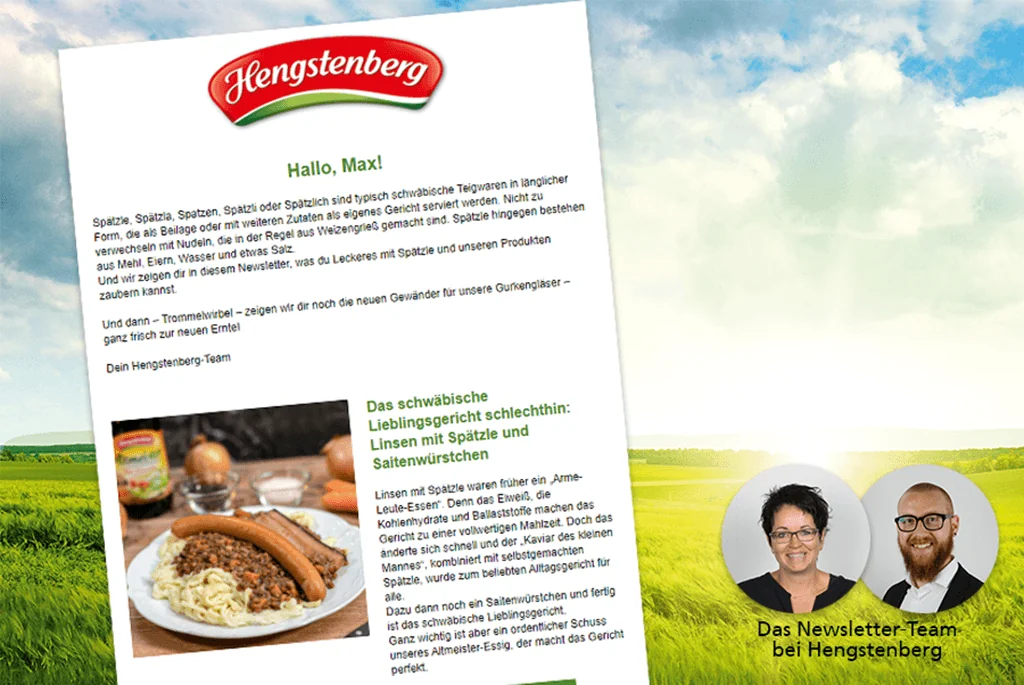
“Making the best from good things. Since 1876.” This is the motto of well-known food manufacturer Hengstenberg. You probably have a few Hengstenberg products at home just waiting to be used in your kitchen, whether it is mild Mildessa sauerkraut, crunchy KNAX gherkins, traditional red cabbage or tangy Altmeister vinegar. The monthly newsletter, packed with delicious recipes, gives the company an important, direct point of contact with end consumers, as it primarily sells its products through retailers. Hengstenberg Online Marketing Manager Tobias Schmidt explains how sending newsletters with rapidmail fits into the family business’s communication strategy and how a recipe idea becomes a finished newsletter.
1. Hengstenberg: We are a family business with a long tradition
Our company, Hengstenberg, began with a stake in a small vinegar factory and was founded by Richard Alfried Hengstenberg in 1876. Even then, the factory stood at the site in Esslingen am Neckar where our head office is still located today.
More than 140 years ago, Hengstenberg products already stood for genuine enjoyment and the highest quality. That is a long time in which our company has made history, and naturally, we want to continue writing it today. Our approximately 450 employees make this possible, filling the next chapters of the Hengstenberg story at our various sites in Germany!
Our ambition has always been, and will remain, to make the best food from nature’s goodness while respecting people and nature at all times. This means that, in everything we do, we remain true to the Hengstenberg principle: no compromises on quality! After all, not only for us but also for our customers, Hengstenberg represents sustainable production “Made in Germany”. Throughout Germany, we are particularly well known and loved for our wide range of specialities, including Mildessa sauerkraut and red cabbage, Altmeister vinegar and KNAX pickled gherkins. Our products also delight people beyond Germany’s borders. Our “Bavarian Style Sauerkraut”, for example, is also a hit in the US and Japan.
As we sell our products through retailers, our marketing activities primarily involve the B2B marketing of Hengstenberg specialities to supermarkets and other food retailers. We maintain direct contact and communication with our retail partners, so our digital advertising activities are aimed exclusively at our end customers, in other words B2C customers. Ultimately, consumers’ decisions for or against our brand while shopping help to determine how many products retailers purchase from us.
Our website is the hub of our communication with end consumers. It provides all the information about our products and inspires visitors with delicious recipe ideas. Nevertheless, newsletters are incredibly important to us because they enable us to reach our end customers directly and personally. Thanks to our newsletter, customers and prospects do not have to take the initiative and make their way to our website first. Instead, we take a step toward them and deliver our promotional content directly to their email inboxes. For us, email marketing therefore provides valuable contact with customers and prospects. In 2019, we looked for an alternative to the Mailchimp newsletter tool and chose rapidmail for several reasons. Among other things, we were immediately impressed by the simple subscriber management and the extensive newsletter editor features during our trial.
2. How do we gain new newsletter subscribers?
We do not have our own online store and sell our products exclusively through retailers. Our newsletter list therefore consists mainly of the email addresses of visitors who use the sign-up form on our website to subscribe to the Hengstenberg newsletter. These are probably primarily end consumers. Of course, some B2B customers or producers may also be among the subscribers.
We also regularly run contests on our website where participants can opt in to receive our newsletters. We then add these contacts to our recipient list in our rapidmail account as well.
Our newsletter contact list currently includes around 2,000 recipients, whom we contact regularly. Since every subscriber has actively signed up for our newsletter of their own accord, our recipients are high-quality contacts who are interested in our content and happy to hear from us. Artificially increasing our subscriber numbers, for example by buying email addresses, is therefore out of the question for us.
3. How do we plan and create our newsletters?
At Hengstenberg, I plan our newsletters together with a colleague from the marketing team. We distinguish between our monthly newsletters featuring seasonal recipe ideas and occasional special newsletters, which inform readers, for example, that they have won one of our contests. Whichever of the two types of newsletter we are planning, we naturally always keep in mind that we want to build readers’ loyalty to our brand and products through the content we offer. Our newsletters effectively act as the link between our website, our most important communication channel, and our social media channels, such as our Facebook page. All the news and information from these two communication platforms come together in the newsletter.
We plan our monthly recipe newsletter relatively spontaneously. Our aim is to send the newsletter in the first week of each month. Beforehand, we look at which content we can include in the newsletter depending on the season. Simply presenting our products in every newsletter would become too repetitive over time and give readers less incentive to put Hengstenberg specialities in their shopping baskets. Instead, we focus on imaginative and original recipe ideas that make people want to try our products and cook with them. At Easter, for example, we send delicious recipe ideas for Easter menus; in the fall, stew and soup recipes; and shortly before Christmas, suggestions and ideas for Christmas roasts. Each newsletter contains two or three delicious recipes using fresh, seasonal ingredients, and every recipe includes at least one Hengstenberg product.
The frequency of our special newsletters depends on the number of contests we run throughout the year. For example, we give away product packages, draw winners from all the receipts submitted for Hengstenberg products or organize a contest via our social media channels. We can then easily notify the winners by newsletter!
As well as notifying winners, we occasionally send other special newsletters, for example for important marketing promotions. These newsletter campaigns are planned further in advance. We use our general annual content plan for this. Alongside important seasonal themes, it naturally also includes special dates relating to our product range and the associated marketing activities.
When we started email marketing, we used the rapidmail newsletter editor to create our own newsletter template in our corporate design. We now use the template for every newsletter we send, simply replacing the content. When building the newsletter template, we based it on our website and used the same colors, among other things. We send a white newsletter with a beige background and use green headings and call-to-action buttons.
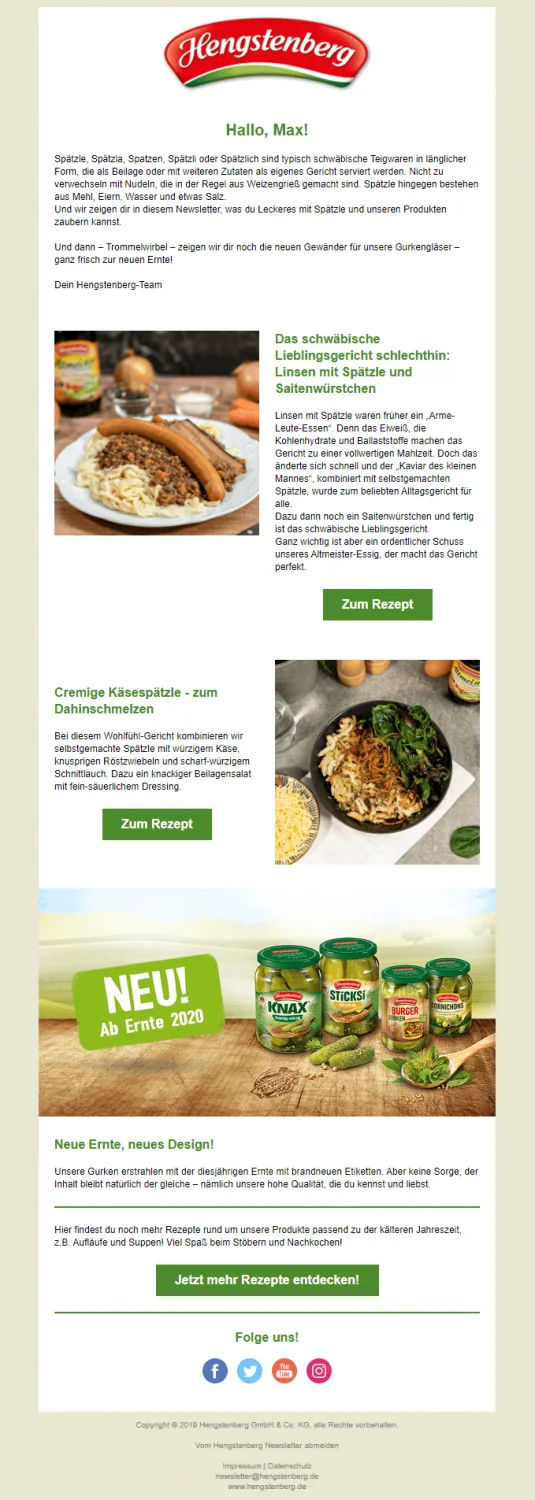
Our newsletter template also includes a personalization field, which allows us to address and greet subscribers personally by their first name in the newsletter. The field can be easily selected from the drop-down menu in the rapidmail newsletter editor with a single click. Of course, this only works if we have the relevant recipient data, for example if a first name was provided as part of a contest. Since we send our newsletters in compliance with the law, we only ask for the email address in the sign-up form on our website. For these subscribers, rapidmail’s personalization field automatically ensures that recipients are greeted simply with “Hello”.
💡 rapidtip: Automatic newsletter templates in your brand design
To save you time and effort when creating a newsletter template in your corporate design, we developed the smart rapidmail 1-click design for you. Once you enter your company URL, the feature puts together a modern design that already contains your company logo, corporate colors and fonts, and even your social media links. You can use the finished newsletter templates for future campaigns time and time again in different variations and layouts.
Once the newsletter has been completed with the latest content and looks ready to send, we still send ourselves and, where applicable, other colleagues a test email for proofreading. This also allows us to check whether the newsletter appears as planned in email clients. After that, it is time for the final newsletter send!
4. How do we send our newsletters?
As a rule, we send our seasonal recipe newsletter once a month, at the beginning of the month. For special marketing promotions, we may occasionally send a second special newsletter around the middle of the month.
The send time of our newsletter varies depending on how much time we need to create the campaign. However, we try to send on a Thursday or Friday because we assume our subscribers are particularly interested in new recipe ideas just before the weekend. As we also assume that our subscribers primarily read the newsletter on their smartphones during their lunch break, we usually send our campaigns during the morning. However, we have not yet carried out a detailed analysis of the send time. Since we are more than satisfied with the open rate, our assumptions seem to be fairly accurate!
At the moment, we send the Hengstenberg newsletter in German only. Our analysis of recipient addresses and the recipient world map in the rapidmail newsletter statistics has shown that the subscribers also include a small number of contacts from France, England, Spain and Japan. For these few recipients abroad, it is not yet worthwhile for us to offer the newsletter in other languages.
Segmenting our recipient list, for example using tags, is still on our to-do list and is definitely planned for the near future. Currently, all recipients on the main list receive our emails. However, we are well aware that subscribers are interested in different recipes. For example, vegetarians currently still receive our newsletters containing meat recipes. This is naturally less useful, so we intend to tackle the segmentation of the main list soon.
For the newsletter subject line, we frequently use an A/B test to test two different subject line variations on a small proportion of subscribers. At the end of the test phase, everyone else receives the newsletter with the subject line that performed better among the test recipients and led to more email opens. As this method and our newsletter content already achieve a very good open rate of around 42%, we do not currently send follow-up campaigns.
5. How do we measure the success of our newsletters?
We are delighted that our newsletter is so well received by readers! This is confirmed not only by consumer feedback but also by the newsletter metrics displayed in the rapidmail statistics after sending. We are naturally particularly pleased with the high open rate, which averages more than 40%, and are more than satisfied with it. Alongside opens, the click rate is also important to us because it shows which topics are of particular interest to our subscribers. In our content overview, we add a corresponding marker that reminds us in the following year whether each piece of content was received particularly well or less favorably. Topics that were less successful may be slightly adapted and sent again the following year. If we still cannot detect any interest from our readers, however, we remove that content from our plan for the next year.
The click map, which is displayed for each newsletter after it is sent, also helps us find out which links included in the newsletter perform better. For example, it showed us that only a minimal proportion of our subscribers click linked images. Since then, we have only used linked call-to-action buttons. The click map also showed us that our newsletters receive far more clicks since we began using green CTAs, probably because they simply stand out more to readers.
rapidmail’s automatic newsletter reporting therefore helps us enormously to keep improving our campaigns, reach even more end consumers with our content and make Hengstenberg products even more appetizing to prospective customers, in the truest sense of the word.
Would you like to raise awareness of your brand too?
Write your success story with rapidmail and plan your first newsletter today: