The rapidmail DNA: an interview with Jasmin from the product team

In our “The rapidmail DNA” blog series, colleagues talk about their day-to-day work, introduce themselves and explain what makes working at rapidmail special to them. Today, Jasmin from our product team gives us an inside look and explains how the initial idea for a new feature in the rapidmail newsletter tool becomes a finished product.
Jasmin, what do you do at rapidmail and how long have you been with the company?
I’ve been part of the product team at rapidmail for five years now. In addition to product management itself, which Nico, Anna-Lena and I are responsible for, Andrea, our UX designer, and Arne, who works in quality assurance, complete the product team. Together, we make sure that our newsletter tool keeps getting better for customers and work on useful new features.
Does everyone on the product team have their own area of responsibility? How do you divide up the work?
At first, when we were establishing and expanding the product team, we product managers worked together on every project and divided up the tasks. Anna-Lena was mainly responsible for documenting the user interface and worked closely with Andrea from the design team. I looked after the background processes, which means everything you don’t see directly in the tool. As head of our team, Nico manages the overall coordination and prioritization of tasks, but no longer creates concepts himself.
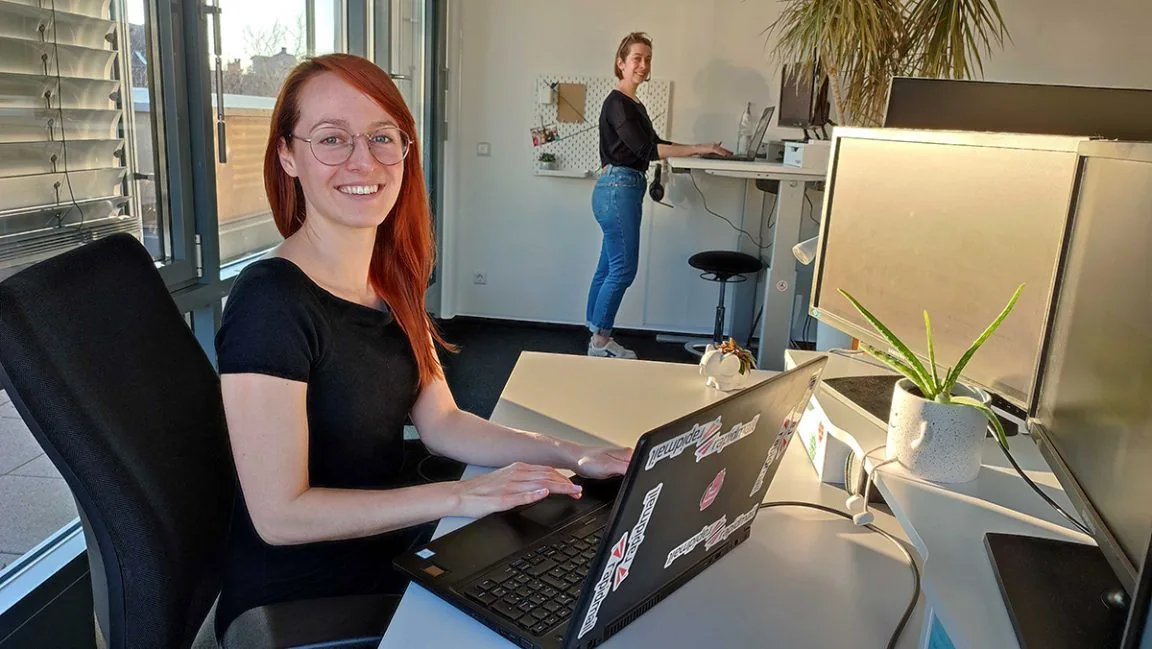
These days, Anna-Lena and I work more in parallel, and each of us has our own projects, which also helps us make faster progress. But we sit next to each other in the Freiburg office, so it’s easy for us to coordinate. And if someone has a question, we simply call out across our screens and solve the problem together. 🤝🏻
And how do you come up with ideas for new features?
On the one hand, we monitor market developments and consider which features our tool needs to stay up to date. But we primarily take our lead from customer inquiries. The support team keeps a customer wish list that records how often each feature is requested. Of course, we want to fulfill these wishes, but we must also keep an eye on developments in the online marketing world and what our competitors are doing.
That sounds like a long list full of feature ideas for rapidmail. How do you set priorities?
We have three criteria that help us decide which feature is currently the most important. For each feature, support assigns a “priority score”, which indicates how often our customers have requested the feature.
The second assessment relates to our personas. Here, we in the PM team assess how relevant the feature is to our customer groups. To do this, we have created various personas that represent the different needs of our target audience, such as flexibility, simplicity or reliability. When we assess the persona priority for a new feature, we look at precisely these needs and check which ones the feature fulfills.
Thirdly, there is the market value. Here, we look at whether all competitors already offer the feature or whether we can gain a competitive advantage by releasing it ahead of them. These three scores are then used to calculate an overall priority score. The feature with the highest score is implemented next.
What is your main motivation when you develop new features for our customers?
We want to help customers as much as possible when creating newsletters, for example by saving them time and effort. At the same time, the software should remain simple and intuitive to use. To prevent the tool from feeling overloaded, unfortunately we can’t offer every single feature that one person may have requested at some point. Our goal is to provide exactly what makes our customers’ work easier, without overwhelming them with too many individual features.
What stages are involved in project work? Do you start with a finished idea that is then implemented? Or does the idea continue to evolve during implementation?
Normally, the plan is to finalize the idea first and then implement it. In practice, however, that often isn’t possible, and the idea frequently continues to evolve during implementation. It also always depends on whether we simply want to improve a feature or develop something completely new.
Before we can start creating the concept, however, we begin with the research phase, in which we carefully consider our customers’ needs, whether and how other marketing tools have implemented the feature, and what we should and want to do differently.
In the concept phase, we list our ideas and record which features we need and everything we want to make possible. It is then Andrea’s job to design the “user path”. She considers the steps users should take in the tool and creates a concept for the “user interface”.
After that, we take care of all the project documentation. We document the visible user interface as well as background processes, such as:
- What does the finished feature look like to the user?
- What happens when someone clicks a particular button?
- What is saved and what isn’t?
- Where are confirmation prompts required?
- What happens when the page is reloaded?
- Which inputs must be checked for completeness and correct formatting when they are saved?
- How long can individual page elements take to load?
Only then does it move on to IT for implementation.
Once the feature has been fully implemented, it undergoes extensive quality control on our test system. We only release the new feature once it has successfully passed these checks.
The release is followed by another testing phase, or quality control. After a certain amount of time, there is one final evaluation phase. At that point, we look at how the feature has been received and whether there are any problems using it, so that we can improve it further if necessary.
And how long does this process take, from the initial idea to the finished feature?
The basic rule is: it always takes longer than you think. 😄
How long it takes really depends on the project and its scope. If we’re simply improving an existing feature, it is of course much faster than creating something completely new.
There are features that don’t change very much from the customer’s perspective, but are nevertheless extremely extensive and time-consuming because many details have to be considered in the background.
Which feature has caused you the most headaches so far?
Hmm, I’ll have to think about that. Every feature has its peculiarities. My first feature when I started at rapidmail was user management. The project included a function that was so complex it would have affected the entire software. Although a great deal of work had already gone into the concept, its complexity led us to decide not to implement the function for the time being and to add it later if necessary. So I would say that user management is the project that has caused me the most headaches so far, perhaps also because it was my very first feature.
And which feature are you particularly proud of?
The sign-up forms! This project involved the most intensive teamwork we’ve had in the product team so far, and it was the first feature for which I was officially the project manager. That meant I had overall responsibility and had to make sure everything went according to plan. I’m still the main point of contact when it comes to forms. So it really was a very cool project for me.
Has there ever been a feature that couldn’t be implemented? If so, why?
Yes, that happens more often than you might think because more important matters frequently have to be fitted in. With the last project that Andrea and I had been working on for a while, the feature we’re currently working on took priority. 🤫
Of course, it’s disappointing at first when a project has to be put on hold. But postponed projects are generally picked up again as soon as time allows.
Can you give us a preview of what our customers can expect next?
This much I can reveal: we’re currently working on a major project that will make creating newsletters, and especially designing them, significantly easier. I’m very excited to see how the feature is received!
The rapidmail newsletter
Tips, ideas and news about email marketing, straight to your inbox.
You’ve been working at rapidmail for a while now. How has email marketing changed over time?
On the one hand, I see email marketing tools becoming increasingly detailed and including more and more features, some of which users actively request. Nowadays, you can configure even the smallest details and tailor newsletters precisely to each customer. On the other hand, I also notice that many users are overwhelmed by too many features.
I think the gap is growing wider: there are beginners who need an intuitive newsletter tool with as many settings as possible already configured, so they can get to grips with the subject more easily. At the same time, there are customers who want to pursue email marketing in an increasingly professional and comprehensive way, and they need more and more configuration options. Through our work, we try to accommodate both groups.
What does your working day as a product manager actually look like?
When a project is in the implementation phase, as it is now, I regularly review its progress and planning: are we still on schedule? Is everything progressing as planned? How are the developers getting on? So every morning, I go through my current to-dos and create a task plan for the day and the week.
I’m also responsible for coordinating translations within our team. Because our software is also available in English, French, Italian and Spanish, we regularly need translations for new features. I commission them, manage communication with the translators and answer minor queries for the other projects in our team.
That makes your job sound very varied. How would you describe your work?
Although my tasks don’t repeat daily or weekly, all the projects we work on follow the same process. So my tasks tend to repeat at longer intervals.
When we’re in the concept phases, for example, I write a lot of technical documentation and work out the processes. Our latest project is already in implementation. At that point, I’m essentially only there to answer queries. So you could say that the process is always the same for each project, but not on a daily basis.
What do you enjoy most about your job? What do you focus on?
Of course, I really enjoy my tasks. I simply like working on projects and making sure everything gets implemented. The best part is seeing the result of our work online at the end and receiving positive feedback from our customers. That’s why my focus is on helping customers.
Design, for example, isn’t my greatest strength, so I’m happy to leave that to the others. My main strength within the team is connecting all the different areas. Because I’ve been here for five years, I’m familiar with many features and know what we need to consider when we change something in one part of the system.
What do you like about rapidmail as an employer? How would you describe the team culture?
What I like most is the team and the working atmosphere! Because we rapidmailers are a relatively small team, everyone takes on all the more responsibility and is given the necessary trust in return. The company makes sure that employees are doing well, and everyone helps create a welcoming atmosphere within the rapidmail family. You can raise any issue and resolve it quickly and easily, without worrying about how to bring something up or phrase a question. And that makes work simple and enjoyable!
How did you become a product manager?
I studied industrial engineering. The degree program also focused on product management, but mainly for the manufacturing sector. However, I also took some IT subjects during my studies and enjoyed programming much more than the more engineering-oriented subjects.
Ultimately, though, it was simply luck that I ended up here. I knew I wanted to work in product management and then found an advert at rapidmail for a junior product management position. Positions like that are relatively rare, so I was very happy to find mine here and get the job.
What does a product manager need to be able to do? What special skills are required?
You need to be able to put yourself in the shoes of all kinds of people and departments.
In product management, we are the link between support, management and IT, and they all have different requirements for us. Support is an important point of contact because they know our customers’ requirements and wishes best. Each customer has their own, usually very specific, use cases that they want to cover with our tool. We prepare these requirements so that individual cases aren’t all passed on to IT, but instead become a sustainable feature that helps many customers and, ideally, only requires IT resources once.
At the same time, management naturally wants our company to grow and be profitable. We product managers need to find a good middle ground, understand everyone’s requirements and be able to respond to them.
And now, a little about you: what do you do in your free time?
Oh dear. 😅 Some colleagues here at rapidmail affectionately call me the “crazy plant lady”. I wouldn’t necessarily describe myself that way, but plants are definitely my hobby, and I also find them very calming. When I’m working from home and find myself in a stressful situation, I walk around my flat, look at the plants and immediately feel calm again.
For example, I really, really enjoy growing avocados, so nobody around me is allowed to throw away avocado stones. 🙈 I think I now have more than 20 avocado plants in my flat, and the number keeps growing. Apart from that, I like lying outside in the sun in summer with an ice cream in my hand.
In our last interview, Fabi from the support team gave us a few tips for Freiburg. What do you think everyone should do when visiting Freiburg?
I think the forests here are excellent for walking. For a while, I lived very close to the forest, where there are some beautiful little trails. So anyone visiting Freiburg shouldn’t just stroll through the beautiful old town, but should also take the opportunity to explore the Black Forest.
Last but not least: if you could toast the success of a new feature with a drink of your choice, what would it be?
Definitely iced tea! 🍹
Would you like to become part of our fantastic team? Take a look here!